
Imatinib Accord 100 & 400 100 mg/400 mg FC tablets.
PDF Leaflet Revision Date: 26 August 2022
Clinical Summary
Quick overview from the medicine insert
Indication
Treatment of various cancers including CML and GIST.
Dosage (summary)
400 mg daily for chronic phase CML; 600 mg for accelerated phase; 800 mg for DFSP.
Special Populations
- Children
- Hepatic impairment
- Renal impairment
Pregnancy & Breastfeeding
Contraindicated in pregnancy and breastfeeding; use effective contraception.
Key Drug Interactions
- CYP3A4 inhibitors
- CYP3A4 inducers
- Warfarin
Contraindications
- Hypersensitivity to imatinib
- Pregnancy
- Lactation
Common side effects
- Nausea
- Diarrhea
- Fatigue
- Fluid retention
- Neutropenia
Counselling Points
- Take with food and water
- Monitor for signs of bleeding
- Regular blood tests required
Serious warnings
- Hepatotoxicity
- Cardiac issues
- Tumor lysis syndrome
- Hypothyroidism
Important Disclaimer
The Imatinib Accord 100 & 400 100 mg/400 mg FC tablets. professional information leaflet below is the property of Accord Healthcare and is provided on Medinsert exactly as issued, with no.. alterations or editorial changes. We make every effort to keep content current by updating documents as soon as new versions become available. Medinsert serves as a trusted access point for healthcare professionals, but does not replace official sources or clinical judgement. For more details, please read our full disclaimer. read more>>
 Healthcare Professionals Only
This content is for registered healthcare professionals
Sign in or create a free account to read the full package insert.
Free for HPCSA-registered professionals. Powered by Medinsert.
Clinical Particulars
Section 4 of the official insert — extracted exactly as issued, no alterations
4.1 THERAPEUTIC INDICATIONS
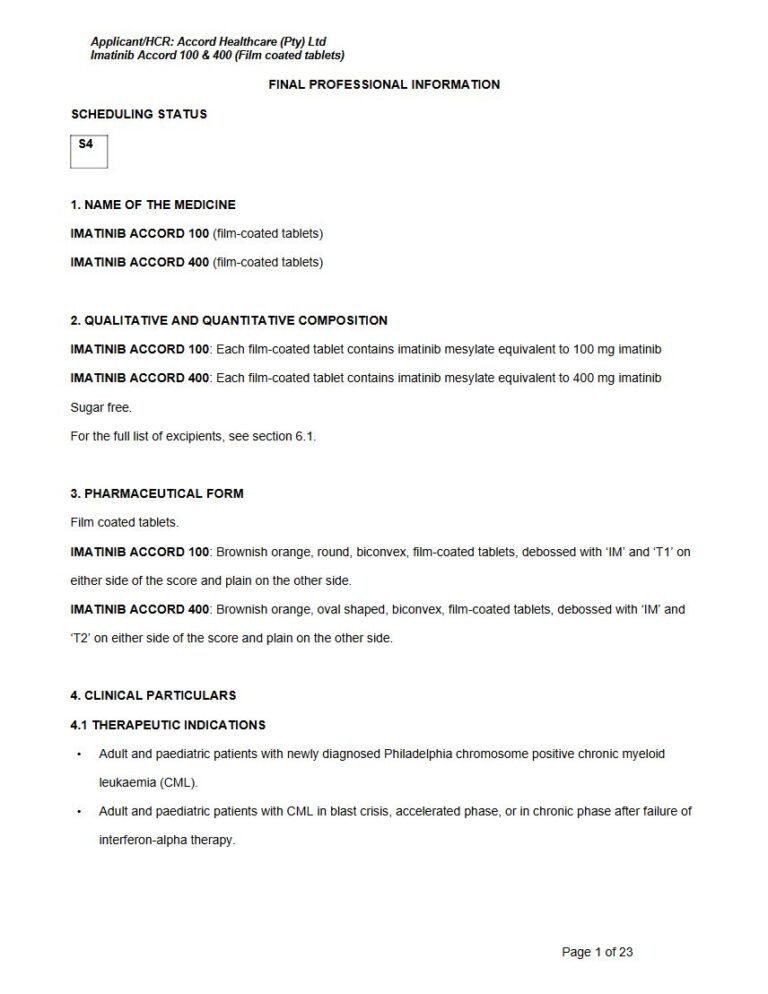
- Adult and paediatric patients with newly diagnosed Philadelphia chromosome positive chronic myeloid leukaemia (CML).
- Adult and paediatric patients with CML in blast crisis, accelerated phase, or in chronic phase after failure of interferon-alpha therapy.
- Adult patients with newly diagnosed Philadelphia chromosome positive acute lymphoblastic leukaemia (Ph+ ALL) integrated with chemotherapy.
- Adult patients with relapsed or refractory Ph+ ALL as monotherapy.
- Adult patients with myelodysplastic/myeloproliferative diseases (MDS/MPD) associated with platelet-derived growth factor receptor (PDGFR) gene rearrangements.
- Adult patients with systemic mastocytosis (SM) without the D816V c-Kit mutation and eosinophilia.
- Adult patients with hypereosinophilic syndrome (HES) and/or chronic eosinophilic leukaemia (CEL) with FIP1L1-PDGFRu03b1 rearrangement.
- Adult patients with unresectable and/or metastatic malignant gastrointestinal stromal tumours (GIST).
- Adult patients with unresectable, recurrent and/or metastatic dermatofibrosarcoma protuberans (DFSP).
4.2 POSOLOGY AND METHOD OF ADMINISTRATION
Therapy should be initiated by a medical practitioner experienced in the treatment of patients with chronic myeloid leukaemia or GIST respectively.
Adult Dosage in CML
The recommended dosage of IMATINIB ACCORD is 400 mg daily for patients in chronic phase CML and 600 mg daily for patients in accelerated phase or blast crisis. Treatment should be continued as long as the patient continues to benefit.
...
Dosage in DFSP
The recommended dose of IMATINIB ACCORD is 800 mg daily for patients with DFSP.
Method of administration
The prescribed dose should be administered orally, once daily with a meal and a large glass of water, to minimize the risk of gastrointestinal disturbances.
4.3 CONTRAINDICATIONS
Hypersensitivity to imatinib, the metabolite N-demethylated piperazine derivative, or to any of the inactive ingredients of IMATINIB ACCORD listed in section 6.1. Pregnancy and lactation (see section 4.6).
4.4 SPECIAL WARNINGS AND PRECAUTIONS FOR USE
When IMATINIB ACCORD is co-administered with other medications, there is a potential for drug interactions (see section 4.5).
Caution should be exercised when taking IMATINIB ACCORD with protease inhibitors, azole antifungals, certain macrolides (see section 4.5), CYP3A4 substrates with a narrow therapeutic window (e.g. cyclosporine, pimozide, tacrolimus, sirolimus, ergotamine, diergotamine, fentanyl, alfentanil, terfenadine, bortezomib, docetaxel, quinidine) or warfarin and other coumarin derivatives (see section 4.5).
...
4.5 INTERACTIONS WITH OTHER MEDICINES
Medicines that may increase IMATINIB ACCORD plasma concentrations include substances that inhibit the cytochrome P-450 isoenzyme CYP3A4 activity (e.g. protease inhibitors such as indinavir, lopinavir/ritonavir, ritonavir, saquinavir, telaprevir, nelfinavir, boceprevir; azole antifungals including ketoconazole, itraconazole, posaconazole, voriconazole; certain macrolides such as erythromycin, clarithromycin and telithromycin).
Medicines that may decrease IMATINIB ACCORD plasma concentrations include substances that are inducers of CYP3A4 activity (e.g. dexamethasone, phenytoin, carbamazepine, rifampicin, phenobarbital, fosphenytoin, primidone or Hypericum perforatum).
4.6 FERTILITY, PREGNANCY AND LACTATION
IMATINIB ACCORD should not be taken during pregnancy or lactation (see section 4.3). Women of childbearing potential must be advised to use highly effective contraception during treatment and for 15 days after stopping treatment to avoid pregnancy. Use in pregnancy may lead to foetal abortion or malformation. Patients should not breastfeed during treatment.
4.7 EFFECTS ON ABILITY TO DRIVE AND USE MACHINES
Patients should be advised that they may experience undesirable effects such as dizziness, somnolence or blurred vision during treatment with IMATINIB ACCORD. Therefore, caution should be recommended when driving a car or operating machinery.
4.8 UNDESIRABLE EFFECTS
Tabulated summary of adverse reactions:
SYSTEM ORGAN CLASS FREQUENCY ADVERSE REACTION
Infections and infestations: Less frequent - Sepsis, pneumonia, herpes simplex, herpes zoster, upper respiratory tract infection, gastroenteritis, sinusitis, cellulitis, influenza, urinary tract infections, nasopharyngitis, fungal infection.
...
4.9 OVERDOSE
Symptoms: Severe muscle cramps, elevations of serum creatinine, ascites and elevated liver transaminase levels, and elevations of bilirubin. A general exacerbation of symptoms listed as side effects may be seen in the event of overdosage (see section 4.8).
Treatment: Patients should be observed and appropriate symptomatic and supportive treatment given.
