
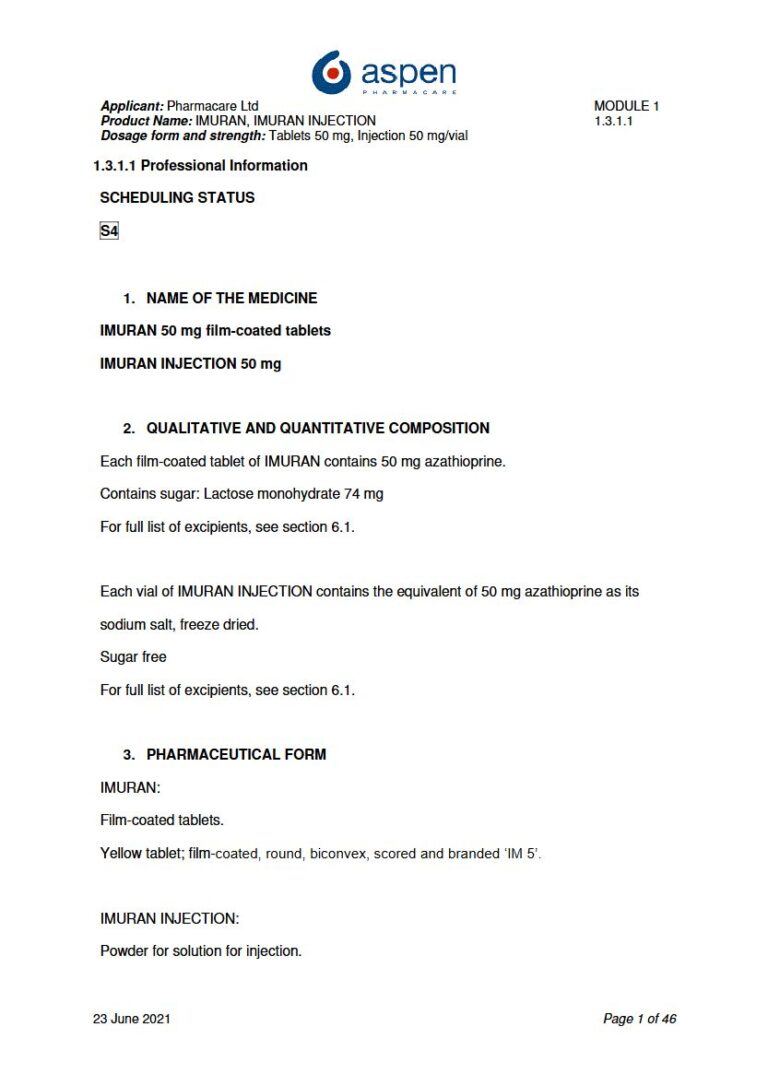
Imuran 50 Mg Solution
PDF Leaflet Revision Date: 23 June 2021
Clinical Summary
Quick overview from the medicine insert
Indication
Immunosuppressant for organ transplantation and autoimmune diseases.
Dosage (summary)
Loading: up to 5 mg/kg/day; Maintenance: 1-4 mg/kg/day.
Onset of Action / Duration
Onset: weeks, Duration: long-term therapy.
Special Populations
- Elderly
- Renal impairment
- Hepatic impairment
Pregnancy & Breastfeeding
Contraindicated in pregnancy and breastfeeding; potential fetal harm.
Key Drug Interactions
- Allopurinol (reduce IMURAN dose to 25%)
- Ribavirin (not advised)
- Neuromuscular blockers (monitor effects)
Contraindications
- Hypersensitivity to azathioprine
- Pregnancy and lactation
- Previous treatment with alkylating agents
Common side effects
- Leukopenia
- Nausea
- Vomiting
- Alopecia
- Infections
Counselling Points
- Avoid live vaccines during and post-treatment.
- Monitor for signs of infection.
- Report any unusual bruising or bleeding.
Serious warnings
- Risk of malignancies
- Bone marrow suppression
- Hepatotoxicity
Important Disclaimer
The Imuran 50 Mg Solution professional information leaflet below is the property of Pharmacare Limited and is provided on Medinsert exactly as issued, with no.. alterations or editorial changes. We make every effort to keep content current by updating documents as soon as new versions become available. Medinsert serves as a trusted access point for healthcare professionals, but does not replace official sources or clinical judgement. For more details, please read our full disclaimer. read more>>
 Healthcare Professionals Only
This content is for registered healthcare professionals
Sign in or create a free account to read the full package insert.
Free for HPCSA-registered professionals. Powered by Medinsert.
Clinical Particulars
Section 4 of the official insert — extracted exactly as issued, no alterations
4.1. Therapeutic indications
IMURAN is used as an immunosuppressant antimetabolite either alone or, more commonly, in combination with other medicines (usually corticosteroids) and procedures which influence the immune response. Therapeutic effect may be evident only after weeks or months and can include a steroid-sparing effect, thereby reducing the toxicity associated with high dosage and prolonged usage of corticosteroids.
IMURAN is indicated for:
- Transplantation
IMURAN, in combination with corticosteroids and/or other immunosuppressive medicines and procedures, is indicated to enhance the survival of organ transplants, such as renal transplants, cardiac transplants and hepatic transplants. It also reduces the corticosteroid requirement of renal transplant recipients. IMURAN INJECTION is used for the suppression of the immune response in organ transplantation, in patients who are unable to take oral medicine. - Inflammatory bowel disease
IMURAN is indicated for the treatment of moderate to severe inflammatory bowel disease (IBD) (Crohnu2019s disease or ulcerative colitis) in patients in whom corticosteroid therapy is required, in patients who cannot tolerate corticosteroid therapy, or in patients whose disease is refractory to other standard first line therapy. - Auto-immune diseases
IMURAN, either alone or more usually in combination with corticosteroids and/or other medicines and procedures, has been used with clinical benefit (which may include reduction of dosage or discontinuation of corticosteroids) in a proportion of patients suffering from the following:- severe rheumatoid arthritis,
- systemic lupus erythematosus,
- dermatomyositis and polymyositis,
- auto-immune active chronic hepatitis,
- pemphigus vulgaris,
- polyarteritis nodosa,
- auto-immune haemolytic anaemia,
- chronic refractory idiopathic thrombocytopenic purpura,
- relapsing remittent multiple sclerosis.
4.2. Posology and method of administration
Specialist medical literature should be consulted for guidance as to clinical experience in particular conditions.
Powder for injection: IMURAN INJECTION should be used ONLY when the oral route is impractical and should be discontinued as soon as oral therapy is tolerated. It must be administered only by the IV route.
IMURAN tablets should be administered at least one hour before or three hours after food or milk.
Posology
Adults
Transplants
Depending on the immunosuppressive regimen employed, a loading dosage of up to 5,0 mg/kg bodyweight/day may be given orally or intravenously on the first day of therapy. Maintenance dosage should range from 1,0 to 4,0 mg/kg bodyweight/day orally (or intravenously ONLY if oral therapy is not tolerated) and must be adjusted according to clinical requirements and haematological tolerance. Evidence indicates that IMURAN therapy should be maintained indefinitely, even if only low doses are necessary, because of the risk of graft rejection.
Multiple sclerosis
The dose recommended for the treatment of relapsing remittent multiple sclerosis is 2 to 3 mg/kg bodyweight/day. Treatment duration in excess of one year may be required to establish efficacy. Control of disease progression may not be apparent until after two years of therapy.
Other indications
In general, starting dosage is from 1 to 3 mg/kg bodyweight/day, and should be adjusted, within these limits, depending on the clinical response (which may not be evident for weeks or months) and haematological tolerance. The dosage of IMURAN and the duration of treatment may vary according to the condition, its severity and the clinical response obtained. A therapeutic response in auto-immune disease may not be evident for a few days or even weeks after initiation of IMURAN therapy. When therapeutic response is evident, consideration should be given to reducing the maintenance dosage to the lowest level compatible with the maintenance of that response. If no improvement occurs in the patient's condition within three months, consideration should be given to withdrawing IMURAN. Treatment is otherwise undertaken on a long-term basis unless the patient exhibits evidence of intolerance to IMURAN. However, for patients with IBD, a treatment duration of at least twelve months should be considered and a response to treatment may not be clinically apparent until after three to four months of treatment. The maintenance dosage required may range from less than 1 mg/kg bodyweight/day to 3 mg/kg bodyweight/day, depending on the clinical condition being treated and the individual patient response, including haematological tolerance.
Special populations
Elderly population
There is limited experience of the administration of IMURAN to elderly patients. The dosage of IMURAN in the elderly has not been established. Although the available data do not provide evidence that the incidence of side effects among elderly patients is higher than that among other patients treated with IMURAN, it is advisable to monitor renal and hepatic function, and to consider dosage reduction if there is impairment. It is recommended that the dosages used are at the lower end of the range given.
Renal impairment
IMURAN pharmacokinetics has not been formally studied in patients with renal insufficiency. No specific dose recommendations can be given. Since impaired renal function may result in slower elimination of azathioprine and its metabolites, IMURAN should be given at the lowest normal dose (see section 4.4).
Hepatic impairment
IMURAN pharmacokinetics has not been formally studied in patients with hepatic impairment. Since impaired hepatic function may result in reduced elimination of azathioprine and its metabolites, no specific dose recommendations can be given. In patients with hepatic insufficiency, IMURAN should be given at the lowest normal dose (see section 4.4). Patients should be monitored for dose related adverse effects.
Interaction
When xanthine oxidase inhibitors, such as allopurinol, and azathioprine, as in IMURAN are administered concomitantly it is essential that only 25 % of the usual dose of IMURAN is given since allopurinol decreases the rate of catabolism of IMURAN (see section 4.5).
TPMT-deficient patients
Patients with inherited little or no thiopurine S-methyltransferase (TPMT) activity are at increased risk for severe toxicity from conventional doses of azathioprine, as in IMURAN, and generally require substantial dose reduction. The optimal starting dose for homozygous deficient patients has not been established (see section 4.4). Most patients with heterozygous TPMT deficiency can tolerate recommended IMURAN doses, but some may require dose reduction. Genotypic and phenotypic tests of TPMT are available (see section 4.4).
Fatal cases of myelosuppression in patients with low or absent TPMT activity treated with thiopurines have been reported. This problem could be exacerbated by coadministration with medicines that inhibit TPMT, such as olsalazine, mesalazine or sulfasalazine.
Patients with NUDT15 variant
Patients with inherited mutated NUDT15 gene are at increased risk for severe thiopurine toxicity, such as early leukopenia and alopecia, from conventional doses of thiopurine therapy and generally require substantial dose reduction. Patients of Asian ethnicity are particularly at risk, due to the increased frequency of the mutation in this population. The optimal starting dose for heterozygous or homozygous deficient patients has not been established. Genotypic and phenotypic testing of NUDT15 variants should be considered before initiating thiopurine therapy in all patients (including paediatric patients) to reduce the risk of thiopurine-related severe leukocytopenia and alopecia, especially in Asian populations (see section 5.2).
Paediatric population
The use of IMURAN is not recommended in children with multiple sclerosis. For transplants and other indications, the posology is as in adults. Overweight paediatric population: Children considered to be overweight may require doses at the higher end of the dose range and therefore close monitoring of response to treatment is recommended (see section 5.2).
Method of administration
Precaution to be taken before manipulating or administering IMURAN INJECTION (see section 6.6). IMURAN tablets are given by mouth, but patients unable to take oral medicine may be given IMURAN INJECTION for a short period. It is seldom necessary to continue with the injection for more than a day or two and IMURAN tablets should be substituted as soon as possible.
IMURAN INJECTION: For instructions on reconstitution and dilution of IMURAN INJECTION before administration, see section 6.6. When IMURAN INJECTION is reconstituted as directed, it is a very irritant solution with a pH of 10 to 12. When the reconstituted solution is diluted as directed (see section 6.6), the pH of the resulting solution may be expected to be within the range pH 8.0 to 9.5 (the greater the dilution, the lower the pH). Where dilution of IMURAN INJECTION is not practicable, the reconstituted solution should be injected slowly over a period of not less than one minute and followed immediately by not less than 50 ml of one of the recommended infusion solutions (see section 6.6). IMURAN INJECTION is given intravenously. Care must be taken to avoid perivenous injection, which may produce tissue damage. Should this occur accidentally, the injection/infusion should be stopped immediately, and appropriate local therapy instituted. Should any visible turbidity or crystallisation appear in the reconstituted or diluted solution the preparation must be discarded.
4.3. Contraindications
IMURAN is contraindicated in:
- Patients with hypersensitivity to azathioprine or to any of the excipients in IMURAN (see section 6.1). Hypersensitivity to 6-mercaptopurine (6-MP) should alert the prescriber to probable hypersensitivity to IMURAN.
- Pregnancy and lactation.
- Patients with rheumatoid arthritis previously treated with alkylating agents (cyclophosphamide, chlorambucil, melphalan or others) may have a prohibitive risk of neoplasia if treated with IMURAN.
- Patients who may be pregnant, who are likely to become pregnant in the near future, or who are known to be pregnant.
4.4. Special warnings and precautions for use
Hypersensitivity
Patients suspected to have previously presented a hypersensitivity reaction to 6- mercaptopurine (6-MP) should not be treated with its pro-drug azathioprine, after allergological tests have confirmed the medicine the patient is allergic to. In many cases, re-challenge has confirmed an association with IMURAN. It has been suggested that the imidazole side-chain gives rise to sensitivity, whereas the 6-MP molecule gives rise to cholestasis.
Immunisation
Immunisation using a live organism vaccine has the potential to cause infection in immunocompromised hosts. Therefore, it is recommended that patients do not receive live organism vaccines until at least three months after the end of their treatment with azathioprine (see section 4.5).
Ribavirin
Co-administration of ribavirin and IMURAN is not advised. Ribavirin may reduce efficacy and increase toxicity of IMURAN (see section 4.5).
Monitoring
THE RISKS ASSOCIATED WITH IMURAN THERAPY SHOULD BE CONSIDERED AGAINST THE SEVERITY OF THE PATIENT'S CONDITION AND THE EXPECTED BENEFICIAL CLINICAL EFFECT. There are potential hazards in the use of IMURAN. IMURAN should be prescribed only if the patient can be adequately monitored for toxic effects throughout the duration of the therapy. Particular care should be taken to monitor haematological response and to reduce the maintenance dosage to the minimum required for clinical response. It is suggested that during the first 8 weeks of therapy, complete blood counts, including platelets, should be performed weekly or more frequently if high dosage is used or if severe renal and/or hepatic disorder is present. The blood count frequency may be reduced later in therapy, but it is suggested that complete blood counts are repeated monthly, or at least at intervals of no longer than three months. At the first signs of an abnormal fall in blood counts, treatment should be interrupted immediately as leucocytes and platelets may continue to fall after treatment is stopped. Patients receiving IMURAN should be instructed to report immediately any evidence of infection, unexpected bruising or bleeding or other manifestations of bone-marrow depression. Bone marrow suppression is reversible if IMURAN is withdrawn early enough. IMURAN is hepatotoxic and liver function tests should be routinely monitored during treatment. More frequent monitoring may be advisable in those with pre-existing liver disease or receiving other potentially hepatotoxic therapy. The patient should be instructed to discontinue IMURAN immediately if jaundice becomes apparent.
If IMURAN is used in conjunction with, or soon after, withdrawal of another medicine known to have a depressive effect on the bone marrow, it is particularly important that frequent blood counts be taken. Since IMURAN may have a delayed action, it is important to reduce dosage or withdraw the medicine temporarily at the first sign of an abnormally large fall in leucocyte count and/or other evidence of persistent depression of the bone marrow. Such bone marrow depression is usually reversible at the doses recommended for auto-immune disease. The effect on white cell count is not closely correlated with the immunosuppressive effect of IMURAN; a good immunosuppressive effect can often be obtained without change in the white cell count, but sometimes the count may be greatly reduced without any apparent immunosuppression.
Thiopurine methyltransferase
There are individuals with an inherited deficiency of the enzyme thiopurine methyltransferase (TPMT) who may be unusually sensitive to the myelosuppressive effect of azathioprine, as in IMURAN and prone to developing rapid bone marrow depression following the initiation of treatment with IMURAN. This problem could be exacerbated by coadministration with medicines that inhibit TPMT, such as olsalazine, mesalazine or sulphasalazine. Also, a possible association between decreased TPMT activity and secondary leukaemias and myelodysplasia has been reported in individuals receiving 6-MP (the active metabolite of azathioprine) in combination with other cytotoxics (see section 4.8). Some laboratories offer testing for TPMT deficiency, although these tests have not been shown to identify all patients at risk of severe toxicity. Therefore, close monitoring of blood counts is still necessary. The dosage of IMURAN may need to be reduced when IMURAN is combined with other medicines whose primary or secondary toxicity is myelosuppression (see section 4.5).
NUDT15 mutation
Patients with inherited mutated NUDT15 gene are at increased risk for severe thiopurine toxicity, such as early leukopenia and alopecia, from conventional doses of thiopurine therapy and generally require substantial dose reduction. Patients of Asian ethnicity are particularly at risk, due to the increased frequency of the mutation in this population. The optimal starting dose for heterozygous or homozygous deficient patients has not been established. Genotypic analysis determining NUDT15 genotype should be determined for all patients, including paediatric patients, prior to initiating thiopurine treatment (see section 4.2). The prescribing physician is advised to establish whether dose reduction is required based on patient response to treatment as well as their genetic profile. Patients with variants in both the NUDT15 and TPMT enzymes are significantly less tolerant of thiopurines than those with risk alleles in only one of these two genes. The precise mechanism of NUDT15-associated thiopurine-related toxicity is not understood.
Elimination
After oral administration of 100 mg 35S-azathioprine, 50 % of the radioactivity was excreted in the urine over 24 hours and 12 % in the faeces after 48 hours. In the urine, the major compound was the inactive oxidised metabolite thiouric acid. Less than 2 % was excreted in the urine as azathioprine or 6-MP. Azathioprine has a high extraction ratio with a total clearance greater than 3 L/min in normal volunteers. There are no data on the renal clearance or half-life of azathioprine. The renal clearance of 6-MP and the half-life of 6-MP are 191 mL/min/m2 and 0,9 hour respectively. Mercaptopurine, a metabolite of azathioprine, has been identified in the colostrum and breast-milk of women receiving azathioprine treatment.
4.5. Interactions with other medicines
Vaccines
The immunosuppressive activity of azathioprine, as in IMURAN, could result in an atypical and potentially deleterious response to live vaccines. It is therefore recommended that patients do not receive live vaccines until at least three months after the end of their treatment with IMURAN (see section 4.4). A diminished response to killed vaccines is likely and such a response to hepatitis B vaccine has been observed among patients treated with a combination of azathioprine, as in IMURAN, and corticosteroids. Contributing causes to a suboptimal response to the hepatitis B vaccine include genetic predisposition, immunosuppression, certain chronic illnesses (for example, HIV and AIDS, chronic kidney disease) and age. A small clinical study has indicated that standard therapeutic doses of azathioprine, as in IMURAN, do not deleteriously affect the response to polyvalent pneumococcal vaccine, as assessed on the basis of mean anti-capsular specific antibody concentration.
Ribavirin
Ribavirin inhibits the enzyme, inosine monophosphate dehydrogenase (IMPDH), leading to a lower production of the active 6-thioguanine nucleotides. Severe myelosuppression has been reported following concomitant administration of azathioprine, as in IMURAN, and ribavirin; therefore, co-administration is not advised (see section 4.4).
Allopurinol/oxipurinol/thiopurinol and other xanthine oxidase inhibitors
Xanthine oxidase activity is inhibited by allopurinol, oxipurinol and thiopurinol which results in reduced conversion of biologically active 6-thioinosinic acid to biologically inactive 6-thiouric acid. When allopurinol, oxipurinol and/or thiopurinol are given concomitantly with 6-MP or azathioprine, as in IMURAN, the dose of 6-MP and IMURAN should be reduced to 25 % of the original dose.
Other xanthine oxidase inhibitors, such as febuxostat may decrease the metabolism of azathioprine, as in IMURAN. Concomitant administration is not recommended as data are insufficient to determine an adequate dose reduction.
Neuromuscular blocking medicines
Azathioprine inhibits phosphodiesterase activity in motor nerve terminals increasing the release of acetylcholine. There is clinical evidence that azathioprine antagonises the effect of non-depolarising muscle relaxants such as curare, d-tubocurarine and pancuronium. Experimental data confirm that IMURAN reverses the neuromuscular blockade produced by d-tubocurarine and show that IMURAN potentiates the neuromuscular blockade produced by succinylcholine (see section 4.4).
Cytostatic/myelosuppressive medicines
Where possible, concomitant administration of cytostatic medicines, or medicines which may have a myelosuppressive effect, such as penicillamine, should be avoided. There are conflicting clinical reports of interactions, resulting in serious haematological abnormalities, between azathioprine, as in IMURAN, and trimethoprim/sulfamethoxazole also known as co-trimoxazole. Medicines which may affect leukocyte production, including co-trimoxazole, may lead to exaggerated leukopenia, especially in renal transplant recipients. There have been case reports suggesting that haematological abnormalities may develop due to the concomitant administration of IMURAN and angiotensin converting enzyme (ACE) inhibitors (e.g. captopril). The use of ACE inhibitors to control hypertension in patients on azathioprine, as in IMURAN, has been reported to induce severe leukopenia. It has been suggested that cimetidine and indomethacin may have myelosuppressive effects, which may be enhanced by concomitant administration of IMURAN.
Diuretics
Furosemide has been shown to impair the metabolism of azathioprine by human hepatic tissue in vitro. The clinical significance is unknown.
Aminosalicylates
There is in vitro and in vivo evidence that aminosalicylate derivatives (e.g. olsalazine, mesalazine or sulphasalazine) inhibit the TPMT enzyme. Therefore, lower doses of IMURAN may need to be considered when administered concomitantly with aminosalicylate derivatives (see section 4.4).
Methotrexate
Methotrexate (20 mg/m2 orally) increased 6-MP AUC by approximately 31 % and methotrexate (2 or 5 g/m2 intravenously) increased 6-MP AUC by 69 % and 93 %, respectively. Therefore, when IMURAN is administered concomitantly with high dose methotrexate, the dose should be adjusted to maintain a suitable white blood cell count.
Infliximab
An interaction has been observed between azathioprine, as in IMURAN, and infliximab. Patients receiving ongoing azathioprine experienced transient increases in 6-TGN (6-thioguanine nucleotide, an active metabolite of azathioprine) levels and a decrease in the mean leukocyte count in the initial weeks following infliximab infusion, which returned to previous levels after three months.
Anticoagulants
Inhibition of the anticoagulant effect of warfarin and acenocoumarol has been reported when co-administered with azathioprine, as in IMURAN; therefore, higher doses of the anticoagulant may be needed. It is recommended that coagulation tests (INR and/or PT) are closely monitored when oral anticoagulants (warfarin) are concurrently administered with IMURAN.
4.6. Fertility, pregnancy and lactation
The safety of IMURAN in pregnancy and lactation has not been established.
Pregnancy
IMURAN can cause foetal harm when administered to pregnant women. IMURAN should not be given to patients who are pregnant or likely to become pregnant in the near future. Substantial transplacental and trans-amniotic transmission of azathioprine, as in IMURAN, and its metabolites from the mother to the foetus have been shown to occur. IMURAN should not be given to patients who are pregnant or likely to become pregnant in the near future without careful assessment of risk versus benefit. Evidence of the teratogenicity of IMURAN in man is equivocal. As with all cytotoxic chemotherapy, adequate contraceptive precautions should be advised when either partner is receiving IMURAN. There have been a few reports of congenital deformity when the father was receiving IMURAN at the time of conception.
Mutagenicity
Chromosomal abnormalities, which disappear with time, have been demonstrated in lymphocytes from the off-spring of patients treated with IMURAN. Except in extremely rare cases, no overt physical evidence of abnormality has been observed in the offspring of patients treated with IMURAN. Azathioprine, as in IMURAN, and long-wave ultraviolet light have been shown to have a synergistic clastogenic effect in patients treated with azathioprine, as in IMURAN, for a range of disorders (see section 4.4). There have been reports of intra-uterine growth retardation, premature birth and low birth weight following maternal exposure to azathioprine, as in IMURAN, particularly in combination with corticosteroids. There have also been reports of spontaneous abortion following either maternal or paternal exposure. Leukopenia and/or thrombocytopenia have been reported in a proportion of neonates whose mothers took azathioprine, as in IMURAN, throughout their pregnancies. Extra care in haematological monitoring is advised during pregnancy.
Breastfeeding
IMURAN and/or its metabolites, such as 6-MP, have been identified in the colostrum and breastmilk of women receiving treatment with azathioprine, as in IMURAN. It is recommended that mothers receiving IMURAN should not breastfeed.
Fertility
The specific effect of azathioprine, as in IMURAN, therapy on human fertility is unknown but there are reports of successful fatherhood/motherhood after receiving treatment. Several studies report that azathioprine, as in IMURAN, at standard doses does not appear to affect male fertility. Relief of chronic renal insufficiency by renal transplantation involving the administration of IMURAN has been accompanied by increased fertility in both male and female transplant recipients.
4.7. Effects on ability to drive and use machines
IMURAN has a moderate influence on the ability to drive and use machines. Since adverse reactions such as dizziness and retinopathy have been reported in patients receiving IMURAN, patients should not drive, use machinery or perform any tasks that require concentration, until they are certain that IMURAN does not adversely affect their ability to do so (see section 4.8).
4.8 Undesirable effects
a) Tabulated list of adverse reactions
System organ class
- Frequent
- Less frequent
- Frequency unknown
Infections and infestations
Viral, fungal and bacterial infections in transplant patients receiving IMURAN in combination with immunosuppressants. Viral, fungal and bacterial infections in other patient populations, cases of JC virus associated PML have been reported following the use of IMURAN in combination with other immunosuppressants. Protozoal and uncommon bacterial infections.
Neoplasm benign, malignant and unspecified (including cysts and polyps)
Neoplasms including lymphoproliferative disorders, skin cancers (melanoma and non-melanoma), sarcomas (Kaposiu2019s and non-Kaposiu2019s) and uterine cervical cancer in situ, acute myeloid leukaemia and myelodysplastic syndrome. Hepatosplenic T-cell lymphoma.
Blood and the lymphatic system disorders
Leukopenia, depression of bone marrow, thrombocytopenia. Anaemia, agranulocytosis, pancytopenia, aplastic anaemia, megaloblastic anaemia, bone marrow failure, erythroid hypoplasia.
Immune system disorders
Hypersensitivity (including skin rashes, pruritus and erythema, often of an area previously irradiated), erythema nodosum, Stevens-Johnson syndrome, toxic epidermal necrolysis (TEN). Anaphylaxis.
Metabolism and nutrition disorders
Hyperphosphataemia, anorexia.
Nervous system disorders
Headache, dizziness.
Eye disorders
Retinopathy.
Cardiac disorders
Cardiac dysrhythmia.
Vascular disorders
Hypotension, Raynaudu2019s phenomenon.
Respiratory, thoracic and mediastinal disorders
Reversible pneumonitis, pulmonary oedema.
Gastrointestinal disorders
Nausea. Pancreatitis, colitis, diverticulitis and bowel perforation reported in transplant population, severe diarrhoea in inflammatory bowel disease population. Vomiting, stomatitis, mouth ulceration, oesophagitis, abdominal pain, intestinal haemorrhage, ulceration, peritoneal haemorrhage.
Hepato-biliary disorders
Cholestasis (biliary stasis), liver function tests abnormal (elevated serum bilirubin levels), life-threatening liver injury. Disturbed liver functions, cholestatic jaundice, toxic hepatitis.
Skin and subcutaneous tissue disorders
Alopecia. Vesicant or irritant effects on the skin and mucous membranes, pigmentation of the skin and nails, acute febrile neutrophilic dermatosis (Sweetu2019s syndrome), photosensitivity.
Musculoskeletal and connective tissue disorders
Muscular pains, arthralgia.
Renal and urinary disorders
Hyperuricaemia and acute renal failure due to uric acid nephropathy.
Reproductive system and breast disorders
Suppression of ovarian and testicular function with amenorrhoea and inhibition of spermatogenesis.
Congenital and familial/genetic disorders
Chromosomal abnormalities.
General disorders and administrative site conditions
Medicine fever, serum sickness, malaise, fever, rigors, weakness.
Investigations
Persistent negative nitrogen balance.
b. Description of selected adverse reactions
Infections and infestations
Patients receiving azathioprine, as in IMURAN alone or in combination with other immunosuppressants, particularly corticosteroids, have shown increased susceptibility to viral, fungal and bacterial infections, including severe or atypical infection, and reactivation with VZV, hepatitis B and other infectious agents (see section 4.4).
Neoplasms benign, malignant and unspecified (including cysts and polyps)
Patients receiving immunosuppressive therapy, including IMURAN, are at an increased risk of developing lymphoproliferative disorders and other malignancies, notably skin cancers (melanoma and nonmelanoma), sarcomas, (Kaposi's and non-Kaposi's) and uterine cervical cancer in situ. The increased risk appears to be related to the degree and duration of immunosuppression. It has been reported that discontinuation of immunosuppression may provide partial regression of the lymphoproliferative disorder. There have been reports of acute myeloid leukaemia and myelodysplasia (some in association with chromosomal abnormalities).
Blood and lymphatic system disorders
Azathioprine, as in IMURAN, may be associated with a dose-related, generally reversible, depression of bone marrow function, most frequently expressed as leukopenia, but also sometimes as anaemia and thrombocytopenia and rarely as agranulocytosis, pancytopenia and aplastic anaemia. These occur particularly in patients predisposed to myelotoxicity, such as those with TPMT deficiency and renal or hepatic insufficiency and in patients failing to reduce the dose of IMURAN when receiving concurrent allopurinol therapy. Reversible, dose-related increases in mean corpuscular volume and red cell haemoglobin content have occurred in association with IMURAN therapy. Megaloblastic bone marrow changes have also been observed but severe megaloblastic anaemia and erythroid hypoplasia are rare (see section 4.4).
Immune system disorders
Several different clinical syndromes, which appear to be idiosyncratic manifestations of hypersensitivity, have been described occasionally following administration of azathioprine, as in IMURAN. Clinical features include general malaise, dizziness, nausea, vomiting, diarrhoea, fever, rigors, exanthema, rash, vasculitis, myalgia, arthralgia, hypotension, renal dysfunction, hepatic dysfunction and cholestasis. In many cases, rechallenge has confirmed an association with azathioprine, as in IMURAN. Immediate withdrawal of IMURAN and institution of circulatory support where appropriate have led to recovery in the majority of cases. Other marked underlying pathology has contributed to the very rare deaths reported. Following a hypersensitivity reaction to IMURAN, the necessity for continued administration should be carefully considered on an individual basis.
Gastrointestinal disorders
Some patients experience nausea when first given IMURAN. With oral administration, nausea appears to be relieved by administering the tablets after meals. However, administration of IMURAN tablets after meals may reduce oral absorption, therefore monitoring for therapeutic efficacy should be considered after administration in this way (see section 4.2 and section 5.2).
Serious complications, including colitis, diverticulitis and bowel perforation, have been described in transplant recipients receiving immunosuppressive therapy. However, the aetiology is not clearly established and high-dose corticosteroids may be implicated. Severe diarrhoea, recurring on rechallenge, has been reported in patients treated with IMURAN for IBD. The possibility that exacerbation of symptoms might be medicine-related should be borne in mind when treating such patients. Pancreatitis has been reported in a small percentage of patients on azathioprine, as in IMURAN therapy, particularly in renal transplant patients and those diagnosed as having IBD. There are difficulties in relating the pancreatitis to the administration of one particular medicine, although re-challenge has confirmed an association with IMURAN on occasions.
Hepatobiliary disorders
Cholestasis and deterioration of liver function have occasionally been reported in association with azathioprine, as in IMURAN, therapy and are usually reversible on withdrawal of therapy. This may be associated with symptoms of a hypersensitivity reaction (see section 4.4). Life-threatening hepatic damage associated with chronic administration of azathioprine, as in IMURAN, has been described primarily in transplant patients. Histological findings include sinusoidal dilatation, peliosis hepatis, veno-occlusive disease and nodular regenerative hyperplasia. In some cases, withdrawal of azathioprine, as in IMURAN, has resulted in either a temporary or permanent improvement in liver histology and symptoms.
Skin and subcutaneous tissue disorders
Hair loss has been described on a number of occasions in patients receiving azathioprine, as in IMURAN, and other immunosuppressive medicines. In many instances the condition resolved spontaneously despite continuing therapy. The relationship between alopecia and IMURAN treatment is uncertain.
4.9 Overdose
Symptoms
Unexplained infection, ulceration of the throat, bruising and bleeding are the main signs of overdose with IMURAN and result from bone marrow depression which may be maximal after 9 to 14 days. These signs are more likely to manifest following chronic overdosage, rather than after a single acute overdose. There has been a report of a patient who ingested a single overdose of 7,5 g of azathioprine, as in IMURAN. The immediate toxic effects of this overdose were nausea, vomiting and diarrhoea, followed by mild leukopenia and mild abnormalities in liver function. Recovery was uneventful.
Treatment
Treatment is symptomatic and supportive. As there is no specific antidote, blood counts should be closely monitored and general supportive measures, together with appropriate blood transfusion, instituted if necessary. Active measures (such as the use of activated charcoal) may not be effective in the event of azathioprine overdose unless the procedure can be undertaken within 60 minutes of ingestion. Further management should be as clinically indicated or as recommended by the national poisons centre, where available. The value of dialysis in patients who have taken an overdose of IMURAN is not known, though azathioprine is partially dialysable.
