
Proventil 100 aµg Pressurised metered-dose inhaler.
PDF Leaflet Revision Date: 26 March 2021
Clinical Summary
Quick overview from the medicine insert
Indication
Relief of bronchospasm in bronchial asthma, chronic bronchitis, and emphysema.
Dosage (summary)
1-2 inhalations every 4 hours as needed.
Onset of Action / Duration
Onset: 5 mins, Duration: 4-6 hours
Special Populations
- Thyrotoxicosis
- Cardiovascular disorders
Pregnancy & Breastfeeding
Safety not established; potential reproductive toxicity in animals.
Key Drug Interactions
- Non-selective beta-blockers
- Cardiac glycosides
- Tricyclic antidepressants
Contraindications
- Hypersensitivity to salbutamol
- Premature labour
- Threatened abortion
Common side effects
- Tremor
- Tachycardia
- Headache
- Hypokalaemia
Counselling Points
- Check inhaler technique
- Seek medical advice if symptoms worsen
- Monitor for hypokalaemia
Serious warnings
- Paradoxical bronchospasm
- Risk of cardiac dysrhythmias
- Caution in severe asthma
Important Disclaimer
The Proventil 100 aµg Pressurised metered-dose inhaler. professional information leaflet below is the property of Ipharma and is provided on Medinsert exactly as issued, with no.. alterations or editorial changes. We make every effort to keep content current by updating documents as soon as new versions become available. Medinsert serves as a trusted access point for healthcare professionals, but does not replace official sources or clinical judgement. For more details, please read our full disclaimer. read more>>
 Healthcare Professionals Only
This content is for registered healthcare professionals
Sign in or create a free account to read the full package insert.
Free for HPCSA-registered professionals. Powered by Medinsert.
Clinical Particulars
Section 4 of the official insert — extracted exactly as issued, no alterations
4.1 Therapeutic indications
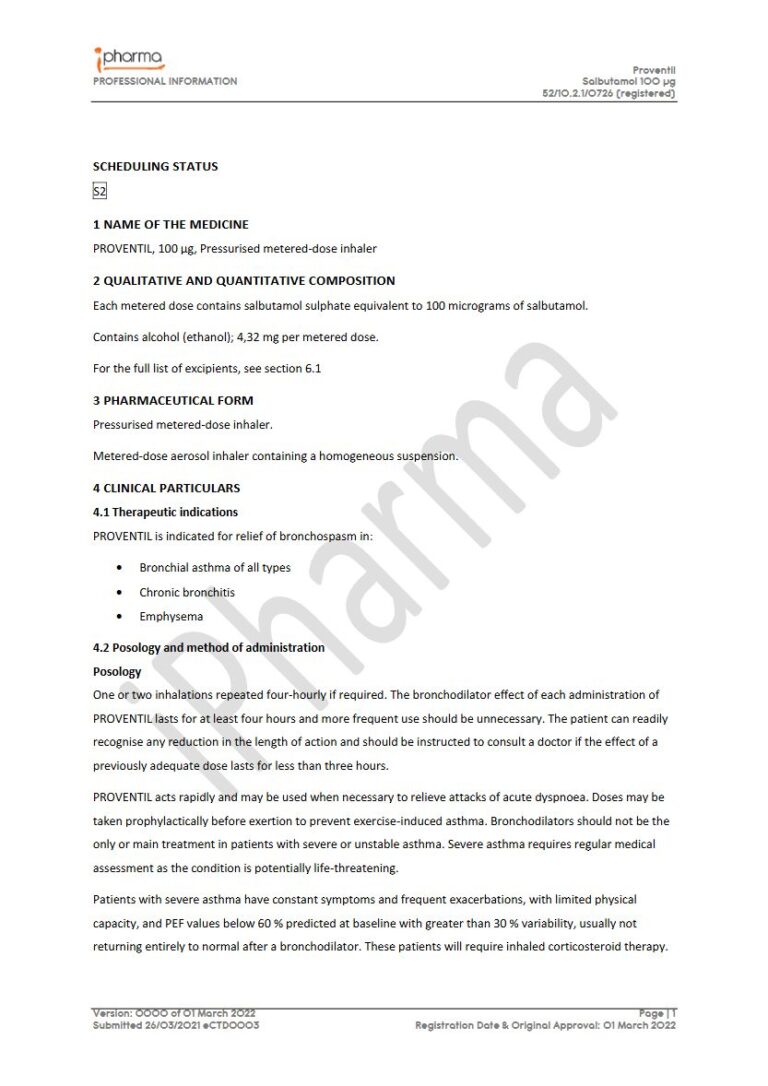
PROVENTIL is indicated for relief of bronchospasm in:
- Bronchial asthma of all types
- Chronic bronchitis
- Emphysema
4.2 Posology and method of administration
Posology
One or two inhalations repeated four-hourly if required. The bronchodilator effect of each administration of PROVENTIL lasts for at least four hours and more frequent use should be unnecessary. The patient can readily recognise any reduction in the length of action and should be instructed to consult a doctor if the effect of a previously adequate dose lasts for less than three hours.
PROVENTIL acts rapidly and may be used when necessary to relieve attacks of acute dyspnoea. Doses may be taken prophylactically before exertion to prevent exercise-induced asthma. Bronchodilators should not be the only or main treatment in patients with severe or unstable asthma. Severe asthma requires regular medical assessment as the condition is potentially life-threatening. Patients with severe asthma have constant symptoms and frequent exacerbations, with limited physical capacity, and PEF values below 60 % predicted at baseline with greater than 30 % variability, usually not returning entirely to normal after a bronchodilator. These patients will require inhaled corticosteroid therapy.
Failure to respond promptly or fully to such rescue medication signals a need for urgent medical advice and treatment.
Method of administration
PROVENTIL is administered by the inhaled route only, to be breathed in through the mouth. Patients' inhaler technique should be checked to make sure that aerosol actuation is synchronised with inspiration of breath for optimum delivery of the medicine to the lungs.
4.3 Contraindications
- Hypersensitivity to salbutamol sulphate or to any of the excipients listed in section 6.1.
- PROVENTIL is not appropriate for managing premature labour.
- PROVENTIL should not be used for threatened abortion.
4.4 Special warnings and precautions for use
PROVENTIL should be administered cautiously to patients suffering from thyrotoxicosis.
PROVENTIL should be used with caution in patients with cardiovascular disorders especially ischaemic heart disease, angina, tachycardia, dysrhythmias and hypertension. Patients with underlying severe heart disease (e.g. ischaemic heart disease, dysrhythmia or severe heart failure) who are using PROVENTIL should be warned to seek medical advice if they experience chest pain or other symptoms of worsening heart disease. Attention should be paid to assessment of symptoms such as dyspnoea and chest pain, as they may be of either respiratory or cardiac origin.
PROVENTIL should be used with caution in patients known to have received other sympathomimetic medicine.
PROVENTIL and beta-blocking medicines, such as propranolol, should not be prescribed together.
Increasing use of PROVENTIL may be a sign of worsening asthma. Under these conditions, a reassessment of the patient's therapy plan may be required. Sudden and progressive deterioration in asthma control is potentially life threatening and concomitant glucocorticosteroid therapy should be considered.
As there may be adverse effects associated with excessive dosing, the dosage or frequency of administration should only be increased on medical advice. The management of asthma should normally follow a stepwise programme, and patient response should be monitored clinically and by lung function tests.
In patients considered at risk, daily peak flow monitoring may be instituted.
In the event of a previously effective dose of PROVENTIL failing to give relief for at least three hours, the patient should be advised to seek medical advice in order that any necessary additional steps may be taken.
Particular caution is advised in acute severe asthma as hypokalaemia may be potentiated by concomitant treatment with xanthine derivatives, corticosteroids, diuretics and by hypoxia. It is recommended that serum potassium levels are monitored in such situations.
High dosages may increase the risk of serious side effects, including cardiac dysrhythmias. The risk is further aggravated if administered concomitantly with other medicines that cause hypokalaemia and cardiac dysrhythmias or in the presence of hypoxia and acidosis. The maximum dose should not be exceeded.
Paradoxical bronchospasm may occur with an immediate increase in wheezing after dosing. This should be treated immediately with an alternative presentation or a different fast-acting inhaled bronchodilator. PROVENTIL should be discontinued immediately, the patient assessed, and if necessary, a different fast acting bronchodilator instituted for on-going use.
PROVENTIL contains a small amount of alcohol (ethanol). Each actuation (puff) from this inhaler contains about 4,32 mg of ethanol.
The use of salbutamol as contained in PROVENTIL may lead to a positive test for a prohibited substance in competitive sport activities.
4.5 Interaction with other medicines and other forms of interaction
PROVENTIL and non-selective beta-blocking medicines such as propranolol, should not usually be prescribed together.
Sympathomimetics should be used with caution in patients undergoing anaesthesia with cyclopropane, halothane or other halogenated anaesthetics as ventricular fibrillation may be induced.
An increased risk of dysrhythmias may also occur if administered concomitantly with cardiac glycosides, quinidine or tricyclic antidepressants.
Sympathomimetic amines should not be given to patients receiving mono-amine oxidase inhibitors or within 14 days of termination of mono-amine oxidase inhibitor therapy.
4.6 Fertility, pregnancy and lactation
Pregnancy
Safety in pregnant women has not been established. Studies in animals have shown reproductive toxicity (see section 5.3).
No controlled clinical trials with salbutamol have been conducted in pregnant women. Reports of various congenital anomalies following intrauterine exposure to salbutamol (including cleft palate, limb defects and cardiac disorders) have been received. Some of the mothers were taking multiple medications during their pregnancies.
Breastfeeding
Safety during breastfeeding has not been established. As salbutamol is probably secreted in breast milk, its use in nursing mothers requires careful consideration.
Fertility
There is no information on the effects of salbutamol on human fertility. There were no adverse effects on fertility in animals (see section 5.3).
4.7 Effects on ability to drive and use machines
None reported.
4.8 Undesirable effects
Tabulated summary of adverse reactions
System Organ Class Frequency Description
- Immune system disorders Less frequent Hypersensitivity reactions including angioedema, urticaria, bronchospasm, hypotension and collapse.
- Metabolism and nutrition disorders Less frequent Hypokalaemia, potentially serious hypokalaemia may result from beta 2 agonist therapy.
- Nervous system disorders Frequent Tremor, headache. Less frequent Hyperactivity. Frequency unknown Agitation, nervousness, fatigue, fear, restlessness, dizziness, confusion, insomnia*
- Cardiac disorders Frequent Tachycardia. Less frequent Palpitations, cardiac dysrhythmias (including atrial fibrillation, supraventricular tachycardia and extrasystoles). Frequency unknown Myocardial ischaemia* (see section 4.4).
- Vascular disorders Less frequent Peripheral vasodilatation.
- Respiratory, thoracic and mediastinal disorders Less frequent Paradoxical bronchospasm.
- Gastrointestinal disorders Less frequent Mouth and throat irritation. Frequency unknown Loss of appetite, nausea, vomiting.*
- Musculoskeletal and connective tissue disorders Less frequent Muscle cramps.
*reported spontaneously in post-marketing data therefore frequency regarded as unknown
Other effects that may occur with sympathomimetic medicines include difficulty in micturition, urinary retention, dyspnoea, altered metabolism, sweating and hypersalivation.
Reporting of suspected adverse reactions
Reporting suspected adverse reactions after authorisation of the medicine is important. It allows continued monitoring of the benefit/risk balance of the medicine. Healthcare providers are asked to report any suspected adverse reactions to SAHPRA via the u201c6.04 Adverse Drug Reactions Reporting Formu201d, found online under SAHPRAu2019s publications: https://www.sahpra.org.za/Publications/Index/8.
4.9 Overdose
Signs and Symptoms
The most common signs and symptoms of overdose with PROVENTIL are beta agonist pharmacologically mediated events, including tachycardia, tremor, hyperactivity and metabolic effects including hypokalaemia (see sections 4.4 and 4.8). Agitation, hallucinations and irritability have been reported.
Hypokalaemia may occur following overdose with PROVENTIL. Serum potassium levels should be monitored. Lactic acidosis has been reported in association with high therapeutic doses as well as overdoses of short-acting beta-agonist therapy, therefore monitoring for elevated serum lactate and consequent metabolic acidosis (particularly if there is persistence or worsening of tachypnoea despite resolution of other signs of bronchospasm such as wheezing) may be indicated in the setting of overdose.
Treatment: Consideration should be given to discontinuation of treatment and appropriate symptomatic therapy.
