
Ventolin 1 mg/ml Solution for Infusion.
PDF Leaflet Revision Date: 16 September 2025
Clinical Summary
Quick overview from the medicine insert
Indication
Relief of severe bronchospasm in asthma and to inhibit premature labour.
Dosage (summary)
Asthma: 5-20 u03bcg/min; Premature labour: 10-45 u03bcg/min.
Special Populations
- Diabetic patients
- Patients with heart disease
Pregnancy & Breastfeeding
Safety in pregnancy and lactation not established.
Key Drug Interactions
- Beta-blockers
- Corticosteroids
Contraindications
- Hypersensitivity to salbutamol
- Threatened abortion
- Gestational age < 22 weeks
Common side effects
- Tremor
- Tachycardia
- Headache
- Nausea
- Muscle cramps
Counselling Points
- Monitor heart rate during treatment
- Dilute before administration
- Report any side effects
Serious warnings
- Potentially serious hypokalaemia
- Risk of myocardial ischaemia
- Monitor for pulmonary oedema
Important Disclaimer
The Ventolin 1 mg/ml Solution for Infusion. professional information leaflet below is the property of Glaxosmithkline South Africa and is provided on Medinsert exactly as issued, with no.. alterations or editorial changes. We make every effort to keep content current by updating documents as soon as new versions become available. Medinsert serves as a trusted access point for healthcare professionals, but does not replace official sources or clinical judgement. For more details, please read our full disclaimer. read more>>
 Healthcare Professionals Only
This content is for registered healthcare professionals
Sign in or create a free account to read the full package insert.
Free for HPCSA-registered professionals. Powered by Medinsert.
Clinical Particulars
Section 4 of the official insert — extracted exactly as issued, no alterations
4.1 Therapeutic indications
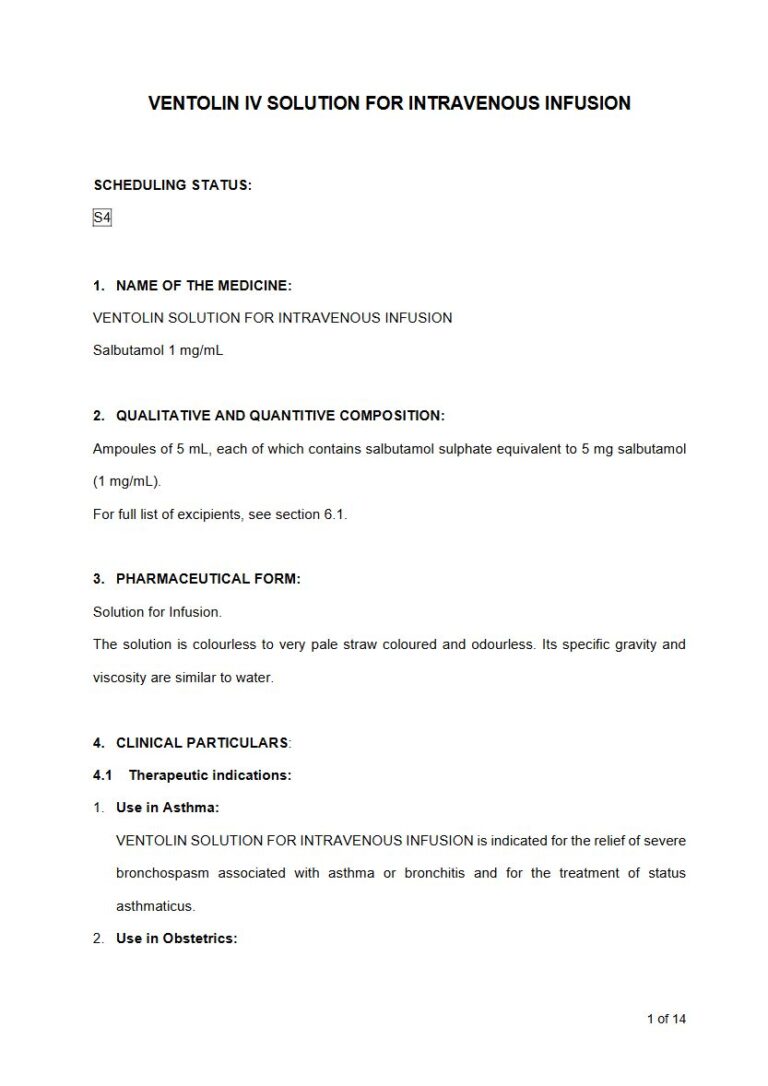
1. Use in Asthma: VENTOLIN SOLUTION FOR INTRAVENOUS INFUSION is indicated for the relief of severe bronchospasm associated with asthma or bronchitis and for the treatment of status asthmaticus.
2. Use in Obstetrics: VENTOLIN SOLUTION FOR INTRAVENOUS INFUSION is indicated to inhibit uncomplicated premature labour between 22 and 37 weeks of gestation in patients with no medical or obstetric contraindication to tocolytic therapy.
4.2 Posology and method of administration
VENTOLIN SOLUTION FOR INTRAVENOUS INFUSION is to be used only under medical direction. VENTOLIN SOLUTION FOR INTRAVENOUS INFUSION should not be administered in the same syringe or infusion as any other medication.
1. Use in Asthma: In status asthmaticus infusion rates of 3 to 20 u03bcg/minute are generally adequate, but in patients with respiratory failure higher dosage has been used with success. A starting dose of 5 u03bcg/minute is recommended with appropriate adjustments in dosage according to patient response. NOTE: If VENTOLIN SOLUTION FOR INTRAVENOUS INFUSION must be given to an asthmatic patient in labour, it will inhibit uterine contractions. This effect can be counteracted by administration of natural or synthetic oxytocic drugs.
2. Use in Obstetrics: Treatment with VENTOLIN SOLUTION FOR INTRAVENOUS INFUSION should only be initiated by medical practitioners experienced in the use of tocolytic agents. Ideally, it should be carried out in facilities adequately equipped to perform continuous monitoring of maternal and foetal health status. Duration of treatment should not exceed 48 hours as data show that the main effect of tocolytic therapy is a delay in delivery of up to 48 hours. No statistically significant effect on perinatal mortality or morbidity has been observed in randomised, controlled trials. This delay may be used to administer glucocorticoids or to implement other measures known to improve perinatal health. VENTOLIN SOLUTION FOR INTRAVENOUS INFUSION should be administered as early as possible after the diagnosis of premature labour and after evaluation of the patient to eliminate any contraindications to the use of VENTOLIN SOLUTION FOR INTRAVENOUS INFUSION (see section 4.3). This should include an adequate assessment of the patient's cardiovascular status with continuous ECG monitoring throughout treatment (see section 4.4). In premature labour infusion rates of 10 to 45 u03bcg/minute are generally adequate to control uterine contractions. The infusion rate required varies according to the strength and frequency of contractions. A starting dose of 10 u03bcg per minute is recommended, increasing the rate at 10-minute intervals until there is evidence of patient response shown by a diminution in strength, frequency or duration of contractions. Thereafter the infusion rate may be increased slowly until contractions cease. Careful attention should be given to cardio-respiratory function, including increases in pulse rate and changes in blood pressure, electrolytes, glucose and lactate levels and fluid balance monitoring. A maximum sustained maternal heart rate of 120 beats/min should not be exceeded. Use of an infusion pump will facilitate accurate adjustments and control of salbutamol infusion. Once uterine contractions have ceased the infusion rate should be maintained at the same level for one hour and then reduced by 50 % decrements at 6-hourly intervals. Treatment should be discontinued, should signs and symptoms of pulmonary oedema or myocardial ischaemia develop (see section 4.4).
4.3 Contraindications
VENTOLIN SOLUTION FOR INTRAVENOUS INFUSION is contraindicated in patients with a history of hypersensitivity to salbutamol sulphate or to any of the components of VENTOLIN SOLUTION FOR INTRAVENOUS INFUSION (see section 6.1). VENTOLIN SOLUTION FOR INTRAVENOUS INFUSION should not be used for threatened abortion. VENTOLIN SOLUTION FOR INTRAVENOUS INFUSION, when used in the management of premature labour, is contraindicated in the following conditions:
- at a gestational age < 22 weeks
- intra-uterine foetal death, known lethal congenital or lethal chromosomal malformation
- any condition of the mother or foetus in which prolongation of the pregnancy is hazardous (including placenta praevia, antepartum haemorrhage, toxaemia of pregnancy)
- in patients with pulmonary hypertension, valvular heart disease, pre-existing ischaemic heart disease or those patients with significant risk factors for ischaemic heart disease.
4.4 Special warnings and precautions
VENTOLIN SOLUTION FOR INTRAVENOUS INFUSION should be administered with caution in patients with thyrotoxicosis. Increasing use of VENTOLIN SOLUTION FOR INTRAVENOUS INFUSION to control symptoms of asthma, indicates deterioration of asthma control. Under these conditions, the patient's therapy plan should be reassessed. Sudden and progressive deterioration in asthma control is potentially life threatening and consideration should be given to starting or increasing corticosteroid therapy. In patients considered at risk, daily peak flow monitoring may be instituted. Potentially serious hypokalaemia may occur from VENTOLIN SOLUTION FOR INTRAVENOUS INFUSION therapy. VENTOLIN SOLUTION FOR INTRAVENOUS INFUSION and beta-blocking medicines should not be prescribed together. Diabetic patients and those concurrently receiving corticosteroids should be monitored frequently during IV infusion of VENTOLIN. VENTOLIN SOLUTION FOR INTRAVENOUS INFUSION can induce increased blood glucose levels. A diabetic patient may be unable to compensate for this and the development of keto-acidosis has been reported. Concurrent administration of corticosteroids can exaggerate this effect. Diabetic patients and those concurrently receiving corticosteroids should be monitored frequently during IV infusion of VENTOLIN so that remedial steps (e.g. an increase in insulin dosage) can be taken to counter any metabolic change occurring. For these patients VENTOLIN SOLUTION FOR INTRAVENOUS INFUSION should be diluted with Sodium Chloride Injection B.P., rather than Sodium Chloride and Dextrose Injection B.P. The contents of the ampoule of VENTOLIN SOLUTION FOR INTRAVENOUS INFUSION 5 mg in 5mL must not be injected in the undiluted form. VENTOLIN SOLUTION FOR INTRAVENOUS INFUSION should be administered with caution to patients with co-existing heart disease. The use of VENTOLIN SOLUTION FOR INTRAVENOUS INFUSION in the treatment of severe bronchospasm or status asthmaticus does not obviate the requirement for glucocorticoid steroid therapy as appropriate. When practicable, administration of oxygen concurrently with VENTOLIN SOLUTION FOR INTRAVENOUS INFUSION is recommended, particularly when it is given by IV infusion to hypoxic patients. Particular caution is advised in acute severe asthma, as hypokalaemia may be potentiated by concomitant treatment with xanthine derivatives, corticosteroids, diuretics and by hypoxia. It is recommended that serum potassium levels are monitored in such situations. Lactic acidosis has been reported in association with high doses of VENTOLIN SOLUTION FOR INTRAVENOUS INFUSION mainly in patients being treated for an acute asthma exacerbation. Increase in lactate levels may lead to dyspnoea and compensatory hyperventilation, which could be misinterpreted as a sign of asthma treatment failure and lead to inappropriate intensification of VENTOLIN SOLUTION FOR INTRAVENOUS INFUSION treatment. It is therefore recommended that patients are monitored for the development of elevated serum lactate and consequent metabolic acidosis in this setting. In addition, in obstetric use: In the treatment of premature labour, before VENTOLIN SOLUTION FOR INTRAVENOUS INFUSION is given to any patient with known or suspected heart disease, an adequate assessment of the patient's cardiovascular status should be made by a medical practitioner experienced in heart diseases (see section 4.3). Tocolysis with VENTOLIN SOLUTION FOR INTRAVENOUS INFUSION is not recommended when membranes have ruptured or the cervix has dilated beyond 4 cm. Increases in maternal heart rate of the order 20 to 50 beats per minute usually accompany infusion. The maternal pulse rate should be monitored and not normally allowed to exceed a sustained rate of 120 beats per minute. The effect of infusion on foetal rate is less marked but increases of up to 20 beats per minute may occur. Maternal blood pressure may fall slightly during the infusion; the effect being greater on diastolic than on systolic pressure. Falls in diastolic pressure are usually within the range of 10 to 20 mmHg. As maternal pulmonary oedema and myocardial ischaemia have been reported during or following treatment of premature labour with VENTOLIN SOLUTION FOR INTRAVENOUS INFUSION, careful attention should be given to fluid balance and cardio-respiratory function, including ECG, should be monitored continuously. If signs of pulmonary oedema or myocardial ischaemia develop, VENTOLIN SOLUTION FOR INTRAVENOUS INFUSION should be discontinued.
4.5 Interaction with other medicines and other forms of interaction
VENTOLIN SOLUTION FOR INTRAVENOUS INFUSION and beta-blocking medicines should not be prescribed together.
4.6 Fertility, pregnancy and lactation
The safety of VENTOLIN SOLUTION FOR INTRAVENOUS INFUSION in pregnancy and lactation has not been established.
4.8 Undesirable effects
Adverse events are listed below by system organ class and frequency. Frequencies are defined as: very common ( u2265 1/10), common ( u2265 1/100 to < 1/10), uncommon ( u2265 1/1 000 to < 1/100), rare ( u2265 1/10 000 to < 1/1 000) and very rare (< 1/10 000), including isolated reports.
Clinical trials data:
- Nervous system disorders: Very common: tremor; Common: headache
- Cardiac disorders: Very common: tachycardia, palpitations; Uncommon: myocardial ischaemia*
- Respiratory, thoracic and mediastinal disorders: Uncommon: pulmonary oedema
- Musculoskeletal and connective tissue disorders: Common: muscle cramps.
Post marketing data:
- Immune system disorders: anaphylactic reactions (hypersensitivity reactions including angioedema, urticaria, bronchospasm, hypotension and collapse)
- Metabolism and nutrition disorders: potentially serious hypokalaemia may occur, lactic acidosis
- Nervous system disorders: hyperactivity, agitation
- Cardiac disorders: cardiac dysrhythmias including atrial fibrillation, superventricular tachycardia and extrasystoles
- Vascular disorders: peripheral vasodilatation
- Gastrointestinal disorders: nausea, vomiting. In the management of premature labour, VENTOLIN SOLUTION FOR INTRAVENOUS INFUSION has been associated with nausea and vomiting
- Injury, poisoning and procedural complications: slight pain or stinging on i.m. use of undiluted injection.
Reporting of side effects: If you get side effects, talk to your doctor or pharmacist or nurse. You can also report side effects to SAHPRA via the u201c6.04 Adverse Drug Reaction Reporting Formu201d, found online under SAHPRAu2019s publications: https://www.sahpra.org.za/Publications/Index/8. By reporting side effects, you can help provide more information on the safety of VENTOLIN SOLUTION FOR INTRAVENOUS INFUSION.
4.9 Overdose
The most common signs and symptoms of overdose with VENTOLIN SOLUTION FOR INTRAVENOUS INFUSION are beta agonist pharmacologically mediated events (refer to section 4.8). Agitation, hallucination and irritability have been reported. Hypokalaemia may occur following overdose with VENTOLIN SOLUTION FOR INTRAVENOUS INFUSION. Serum potassium levels should be monitored. Nausea, vomiting and hyperglycaemia have been reported, predominantly in children and when salbutamol overdose has been taken via the oral route. Consideration should be given to discontinuation of treatment and appropriate symptomatic therapy.
