
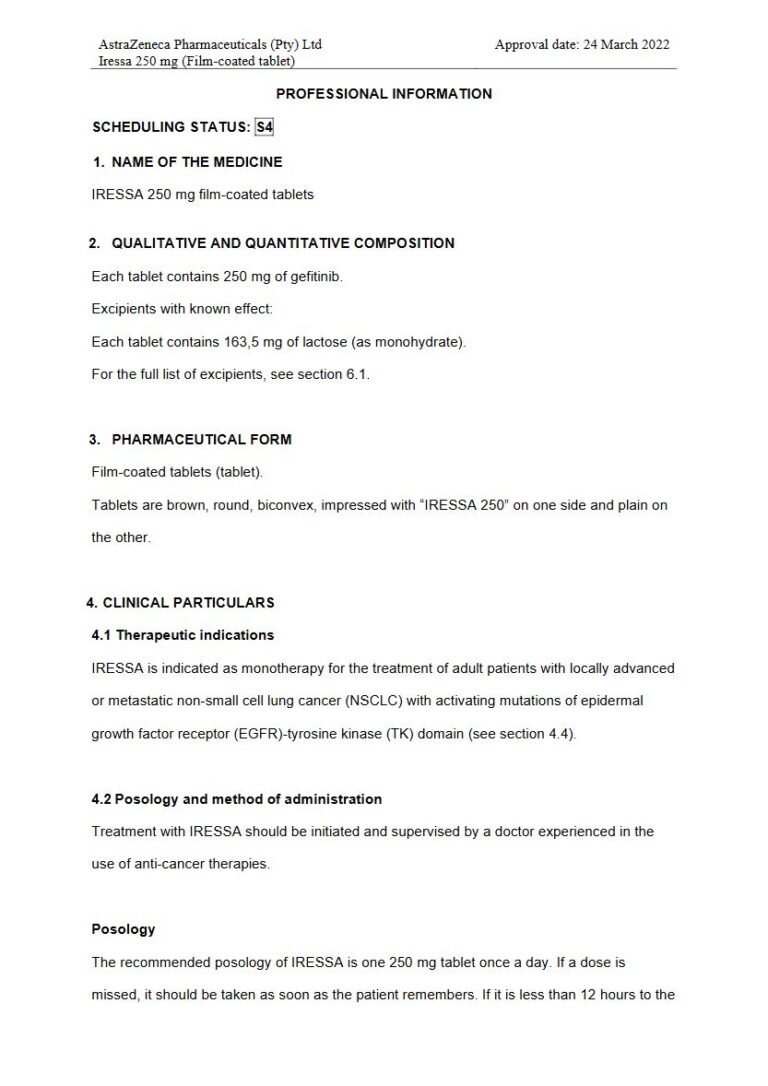
Iressa 250 Mg Film-Coated Tablets
PDF Leaflet Revision Date: 24 March 2022
Clinical Summary
Quick overview from the medicine insert
Indication
Monotherapy for advanced or metastatic NSCLC with EGFR mutations.
Dosage (summary)
250 mg once daily.
Special Populations
- Hepatic impairment
- Renal impairment
- Elderly
Pregnancy & Breastfeeding
Contraindicated in pregnancy and breastfeeding.
Key Drug Interactions
- CYP3A4 inducers decrease efficacy
- CYP3A4 inhibitors increase plasma levels
- Warfarin may increase INR
Contraindications
- Hypersensitivity to gefitinib or excipients
- Pregnancy
- Breastfeeding
Common side effects
- Diarrhoea
- Skin reactions
- Interstitial lung disease
Counselling Points
- Take at the same time daily
- Do not double doses
- Report severe diarrhoea or respiratory symptoms
Serious warnings
- Risk of interstitial lung disease
- Hepatotoxicity
- Monitor liver function
Important Disclaimer
The Iressa 250 Mg Film-Coated Tablets professional information leaflet below is the property of Astrazeneca Pharmaceuticals and is provided on Medinsert exactly as issued, with no.. alterations or editorial changes. We make every effort to keep content current by updating documents as soon as new versions become available. Medinsert serves as a trusted access point for healthcare professionals, but does not replace official sources or clinical judgement. For more details, please read our full disclaimer. read more>>
 Healthcare Professionals Only
This content is for registered healthcare professionals
Sign in or create a free account to read the full package insert.
Free for HPCSA-registered professionals. Powered by Medinsert.
Clinical Particulars
Section 4 of the official insert — extracted exactly as issued, no alterations
4.1 Therapeutic indications
IRESSA is indicated as monotherapy for the treatment of adult patients with locally advanced or metastatic non-small cell lung cancer (NSCLC) with activating mutations of epidermal growth factor receptor (EGFR) - tyrosine kinase (TK) domain (see section 4.4).
4.2 Posology and method of administration
Treatment with IRESSA should be initiated and supervised by a doctor experienced in the use of anti-cancer therapies.
Posology
The recommended posology of IRESSA is one 250 mg tablet once a day. If a dose is missed, it should be taken as soon as the patient remembers. If it is less than 12 hours to the next dose, the patient should not take the missed dose. Patients should not take a double dose (two doses at the same time) to make up for a forgotten dose.
Paediatric population
The safety and efficacy of IRESSA in children and adolescents aged less than 18 years have not been established. There is no relevant use of gefitinib in the paediatric population in the indication of NSCLC.
Hepatic impairment
Patients with moderate to severe hepatic impairment (Child-Pugh Class B or Class C) due to cirrhosis have increased plasma concentrations of gefitinib. These patients should be closely monitored for adverse events. Plasma concentrations were not increased in patients with elevated serum aspartate transaminase (AST), serum alkaline phosphatase or serum bilirubin due to liver metastases (see section 5.2).
Renal impairment
No dose adjustment is required in patients with impaired renal function at creatinine clearance > 20 ml/min. Only limited data are available in patients with creatinine clearance u2264 20 ml/min and caution is advised in these patients (see section 5.2).
Elderly
No dose adjustment is required on the basis of patient age (see section 5.2).
CYP2D6 poor metabolisers
No specific dose adjustment is recommended in patients with known CYP2D6 poor metaboliser genotype, but these patients should be closely monitored for adverse events (see section 5.2).
Dose adjustment due to toxicity
Patients with poorly tolerated diarrhoea or skin adverse reactions may be successfully managed by providing a brief (up to 14 days) therapy interruption followed by reinstatement of the 250 mg dose (see section 4.8). For patients unable to tolerate treatment after a therapy interruption, gefitinib should be discontinued and an alternative treatment should be considered.
Method of administration
The tablet may be taken orally with or without food, at about the same time each day. The tablet can be swallowed whole with some water or if dosing of whole tablets is not possible, tablets may be administered as a dispersion in water (non-carbonated). No other liquids should be used. Without crushing it, the tablet should be dropped in half a glass of drinking water. The glass should be swirled occasionally, until the tablet is dispersed (this may take up to 20 minutes). The dispersion should be drunk immediately after dispersion is complete (i.e. within 60 minutes). The glass should be rinsed with half a glass of water, which should also be drunk. The dispersion can also be administered through a naso-gastric or gastrostomy tube.
4.3 Contraindications
Hypersensitivity to the active substance or to any of the excipients listed in section 6.1. Pregnancy and breastfeeding (see section 4.6).
4.4 Special warnings and precautions for use
When considering the use of IRESSA as a treatment for locally advanced or metastatic NSCLC, it is important that EGFR mutation assessment of the tumour tissue is attempted for all patients. If a tumour sample is not evaluable, then circulating tumour DNA (ctDNA) obtained from a blood (plasma) sample may be used. Only robust, reliable and sensitive test(s) with demonstrated utility for the determination of EGFR mutation status of tumours or ctDNA should be used to avoid false negative or false positive determinations (see section 5.1).
Interstitial lung disease
Interstitial lung disease (ILD) which may be acute in onset, has been observed in 1.3% of patients receiving gefitinib, and some cases have been fatal (see section 4.8). If patients experience worsening of respiratory symptoms such as dyspnoea, cough and fever, IRESSA should be interrupted and the patient should be promptly investigated. If ILD is confirmed, IRESSA should be discontinued and the patient treated appropriately. In a Japanese pharmacoepidemiological case control study in 3,159 patients with NSCLC receiving gefitinib or chemotherapy who were followed up for 12 weeks, the following risk factors for developing ILD (irrespective of whether the patient received IRESSA or chemotherapy) were identified: smoking, poor performance status (PS u2265 2), CT scan evidence of reduced normal lung coverage (u2264 50%), recent diagnosis of NSCLC (< 6 months), pre-existing ILD, older age (u2265 55 years old) and concurrent cardiac disease. An increased risk of ILD on gefitinib relative to chemotherapy was seen predominantly during the first 4 weeks of treatment (adjusted OR 3.8; 95% CI 1.9 to 7.7); thereafter the relative risk was lower (adjusted OR 2.5; 95% CI 1.1 to 5.8). Risk of mortality among patients who developed ILD on IRESSA or chemotherapy was higher in patients with the following risk factors: smoking, CT scan evidence of reduced normal lung coverage (u2264 50%), pre-existing ILD, older age (u2265 65 years old), and extensive areas adherent to pleura (u2265 50%).
Hepatotoxicity and liver impairment
Liver function test abnormalities (including increases in alanine aminotransferase, aspartate aminotransferase, bilirubin) have been observed, uncommonly presenting as hepatitis (see section 4.8). There have been isolated reports of hepatic failure which in some cases led to fatal outcomes. Therefore, periodic liver function testing is recommended. Gefitinib should be used cautiously in the presence of mild to moderate changes in liver function. Discontinuation should be considered if changes are severe.
Impaired liver function due to cirrhosis has been shown to lead to increased plasma concentrations of gefitinib (see section 5.2).
4.5 Interactions with other medicines
CYP3A4 inducers may increase metabolism of gefitinib and decrease gefitinib plasma concentrations. Therefore, concomitant administration of CYP3A4 inducers (e.g. phenytoin, carbamazepine, rifampicin, barbiturates or herbal preparations containing St Johnu2019s wort/Hypericum perforatum) may reduce efficacy of the treatment and should be avoided (see section 4.5). In individual patients with CYP2D6 poor metaboliser genotype, treatment with a potent CYP3A4 inhibitor might lead to increased plasma levels of gefitinib. At initiation of treatment with a CYP3A4 inhibitor, patients should be closely monitored for gefitinib adverse reactions (see section 4.5). International normalised ratio (INR) elevations and/or bleeding events have been reported in some patients taking warfarin together with gefitinib (see section 4.5). Patients taking warfarin and gefitinib concomitantly should be monitored regularly for changes in prothrombin time (PT) or INR. Medicinal products that cause significant sustained elevation in gastric pH, such as proton-pump inhibitors and H2-antagonists may reduce bioavailability and plasma concentrations of gefitinib and, therefore, may reduce efficacy. Antacids if taken regularly close in time to administration of gefitinib may have a similar effect (see sections 4.5 and 5.2). Data from phase II clinical trials, where gefitinib and vinorelbine have been used concomitantly, indicate that gefitinib may exacerbate the neutropenic effect of vinorelbine.
IRESSA contains lactose. Patients with hereditary problems of galactose intolerance e.g. galactosaemia, total lactase deficiency or glucose-galactose malabsorption should not take this medicinal product.
Further precautions for use
Patients should be advised to seek medical advice immediately if they experience severe or persistent diarrhoea, nausea, vomiting or anorexia as these may indirectly lead to dehydration. These symptoms should be managed as clinically indicated (see section 4.8). Patients presenting with signs and symptoms suggestive of keratitis such as acute or worsening: eye inflammation, lacrimation, light sensitivity, blurred vision, eye pain and/or red eye should be referred promptly to an ophthalmology specialist. If a diagnosis of ulcerative keratitis is confirmed, treatment with gefitinib should be interrupted, and if symptoms do not resolve, or if symptoms recur on reintroduction of gefitinib, Iressa should be stopped. In a phase I/II trial studying the use of gefitinib and radiation in paediatric patients, with newly diagnosed brain stem glioma or incompletely resected supratentorial malignant glioma, 4 cases (1 fatal) of Central Nervous System (CNS) haemorrhages were reported from 45 patients enrolled. A further case of CNS haemorrhage has been reported in a child with an ependymoma from a trial with gefitinib alone. An increased risk of cerebral haemorrhage in adult patients with NSCLC receiving gefitinib has not been established. Gastrointestinal perforation has been reported in patients taking gefitinib. In most cases this was associated with other known risk factors, including concomitant medications such as steroids or NSAIDS, underlying history of GI ulceration, age, smoking or bowel metastases at sites of perforation.
4.6 Fertility, pregnancy and lactation
Women of childbearing potential must be advised not to get pregnant during therapy. There are no data from the use of gefitinib in pregnant women. Studies in animals have shown reproductive toxicity (see section 5.3). The potential risk for humans is unknown. IRESSA should not be used during pregnancy.
Breastfeeding
It is not known whether gefitinib is secreted in human milk. Gefitinib and metabolites of gefitinib accumulated in milk of lactating rats (see section 5.3). Gefitinib is contraindicated during breast-feeding and therefore breast-feeding must be discontinued while receiving gefitinib therapy (see section 4.3).
4.7 Effects on ability to drive and use machines
During treatment with gefitinib, asthenia has been reported. Therefore, patients who experience this symptom should be cautious when driving or using machines.
4.8 Undesirable effects
Summary of the safety profile
In the pooled dataset from the ISEL, INTEREST and IPASS phase III clinical trials (2462 IRESSA-treated patients), the most frequently reported adverse drug reactions (ADRs), occurring in more than 20% of the patients, were diarrhoea and skin reactions (including rash, acne, dry skin and pruritus). ADRs usually occur within the first month of therapy and were generally reversible. Approximately 8% of patients had a severe ADR (common toxicity criteria (CTC) grade 3 or 4). Approximately 3% of patients stopped therapy due to an ADR. Interstitial lung disease (ILD) has occurred in 1.3% of patients, often severe (CTC grade 3 - 4). Cases with fatal outcomes have been reported.
Tabulated list of adverse reactions
The safety profile presented in Table 1 is based on the gefitinib clinical development programme and postmarketed experience. Adverse reactions have been assigned to the frequency categories in Table 1 where possible based on the incidence of comparable adverse event reports in a pooled dataset from the ISEL, INTEREST and IPASS phase III clinical trials (2462 IRESSA-treated patients). Frequencies of occurrence of undesirable effects are defined as: very common (u2265 1/10); common (u2265 1/100 to < 1/10); uncommon (u2265 1/1,000 to < 1/100); rare (u2265 1/10,000 to < 1/1,000); very rare (< 1/10,000), not known (cannot be estimated from the available data).
Table 1 Adverse reactions
Adverse reactions by system organ class and frequency
Metabolism and nutrition disorders
Very common: Anorexia mild or moderate (CTC grade 1 or 2)
Eye disorders
Common: Conjunctivitis, blepharitis, and dry eye*, mainly mild (CTC grade 1)
Uncommon: Corneal erosion, reversible and sometimes in association with aberrant eyelash growth, Keratitis (0.12%)
Vascular disorders
Common: Haemorrhage, such as epistaxis and haematuria
Respiratory, thoracic and mediastinal disorders
Common: Interstitial lung disease (1.3%), often severe (CTC grade 3 - 4). Cases with fatal outcomes have been reported
Gastrointestinal disorders
Very common: Diarrhoea, mainly mild or moderate (CTC grade 1 or 2), Vomiting, mainly mild or moderate (CTC grade 1 or 2), Nausea, mainly mild (CTC grade 1), Stomatitis, predominantly mild in nature (CTC grade 1)
Common: Dehydration, secondary to diarrhoea, nausea, vomiting or anorexia, Dry mouth*, predominantly mild (CTC grade 1)
Uncommon: Pancreatitis, Gastrointestinal perforation
Hepatobiliary disorders
Very common: Elevations in alanine aminotransferase, mainly mild to moderate
Common: Elevations in aspartate aminotransferase, mainly mild to moderate, Elevations in total bilirubin, mainly mild to moderate
Uncommon: Hepatitis**
Skin and subcutaneous tissue disorders
Very common: Skin reactions, mainly a mild or moderate (CTC grade 1 or 2) pustular rash, sometimes itchy with dry skin, including skin fissures, on an erythematous base
Common: Nail disorder, Alopecia, Allergic reactions (1.1%), including angioedema and urticaria
Uncommon: Palmar-plantar erythrodysaesthesia syndrome
Rare: Bullous conditions including toxic epidermal necrolysis, Stevens Johnson syndrome and erythema multiforme, Cutaneous vasculitis
Renal and urinary disorders
Common: Asymptomatic laboratory elevations in blood creatinine, Proteinuria, Cystitis
Rare: Haemorrhagic cystitis
General disorders and administration site conditions
Very common: Asthenia, predominantly mild (CTC grade 1)
Common: Pyrexia
The frequency of adverse drug reactions relating to abnormal laboratory values is based on patients with a change from baseline of 2 or more CTC grades in the relevant laboratory parameters.
*This adverse reaction can occur in association with other dry conditions (mainly skin reactions) seen with gefitinib.
** This includes isolated reports of hepatic failure which in some cases led to fatal outcomes. Interstitial lung disease (ILD) In the INTEREST trial, the incidence of ILD type events was 1.4% (10) patients in the gefitinib group versus 1.1% (8) patients in the docetaxel group. One ILD-type event was fatal, and this occurred in a patient receiving gefitinib. In the ISEL trial, the incidence of ILD-type events in the overall population was approximately 1% in both treatment arms. The majority of ILD-type events reported was from patients of Asian ethnicity and the ILD incidence among patients of Asian ethnicity receiving gefitinib therapy and placebo was approximately 3% and 4% respectively. One ILD-type event was fatal, and this occurred in a patient receiving placebo. In a post-marketing surveillance study in Japan (3350 patients) the reported rate of ILD-type events in patients receiving gefitinib was 5.8%. The proportion of ILD-type events with a fatal outcome was 38.6%.
4.9 Overdose
There is no specific treatment in the event of overdose of gefitinib. However, in phase I clinical trials, a limited number of patients were treated with daily doses of up to 1000 mg. An increase of frequency and severity of some adverse reactions was observed, mainly diarrhoea and skin rash. Adverse reactions associated with overdose should be treated symptomatically; in particular severe diarrhoea should be managed as clinically indicated. In one study a limited number of patients were treated weekly with doses from 1500 mg to 3500 mg. In this study IRESSA exposure did not increase with increasing dose, adverse events were mostly mild to moderate in severity, and were consistent with the known safety profile of IRESSA.
