
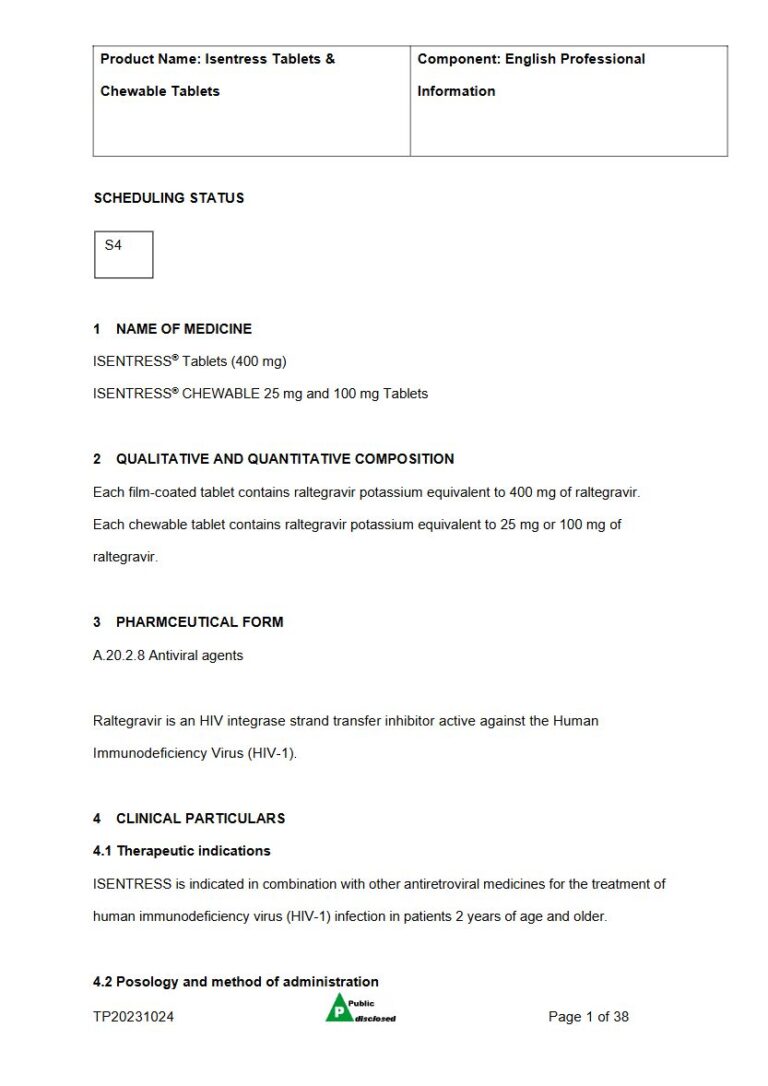
Isentress 400 mg, 25 mg and 100 mg FC tablet, chewable tablet
PDF Leaflet Revision Date: 21 November 2023
Clinical Summary
Quick overview from the medicine insert
Indication
Treatment of HIV-1 infection in patients 2 years and older.
Dosage (summary)
Adults: 400 mg twice daily; Children: weight-based dosing for chewable tablets.
Special Populations
- Elderly
- Renal impairment
- Hepatic impairment
Pregnancy & Breastfeeding
Use in pregnancy considered safe; breastfeeding not recommended.
Key Drug Interactions
- Aluminium and magnesium antacids
- Rifampicin
- Atazanavir
Contraindications
- Hypersensitivity to components
- Breastfeeding
Common side effects
- Diarrhoea
- Nausea
- Headache
- Fatigue
- Rash
Counselling Points
- Take with or without food
- Monitor for severe rash
- Avoid antacids close to dosing
Serious warnings
- Severe skin reactions
- Immune reconstitution syndrome
Important Disclaimer
The Isentress 400 mg, 25 mg and 100 mg FC tablet, chewable tablet professional information leaflet below is the property of Msd and is provided on Medinsert exactly as issued, with no.. alterations or editorial changes. We make every effort to keep content current by updating documents as soon as new versions become available. Medinsert serves as a trusted access point for healthcare professionals, but does not replace official sources or clinical judgement. For more details, please read our full disclaimer. read more>>
 Healthcare Professionals Only
This content is for registered healthcare professionals
Sign in or create a free account to read the full package insert.
Free for HPCSA-registered professionals. Powered by Medinsert.
Clinical Particulars
Section 4 of the official insert — extracted exactly as issued, no alterations
4.1 Therapeutic indications
ISENTRESS is indicated in combination with other antiretroviral medicines for the treatment of human immunodeficiency virus (HIV-1) infection in patients 2 years of age and older.
4.2 Posology and method of administration
ISENTRESS is available as a 400 mg tablet formulation and as a chewable tablet formulation in 100 mg (scored) and 25 mg strengths. Because the formulations are not bioequivalent, do not substitute chewable tablets for the 400 mg tablet. The maximum dose of the chewable tablet is 300 mg twice daily. ISENTRESS can be administered with or without food. ISENTRESS is to be given in a combination regimen with other antiretroviral medicines. For the treatment of patients with HIV-1 infection, the dosage of ISENTRESS is as follows:
Adults: One 400 mg tablet twice daily, orally.
Children and adolescents:
- At least 25 kg: One 400 mg tablet twice daily, orally
- 2 to less than 6 years of age: Chewable tablets: Weight based to maximum dose 300 mg, twice daily, as specified in Table 1.
Table 1: Recommended Dose * for ISENTRESS CHEWABLE Tablets in Paediatric Patients
Body Weight (kg) Dose Number of Chewable Tablets
- 7 to < 10 50 mg twice daily 0,5 x 100 mg u2020 twice daily
- 10 to < 14 75 mg twice daily 3 x 25 mg twice daily
- 14 to < 20 100 mg twice daily 1 x 100 mg twice daily
- 20 to < 28 150 mg twice daily 1,5 x 100 mg u2020 twice daily
- 28 to < 40 200 mg twice daily 2 x 100 mg twice daily
- At least 40 300 mg twice daily 3 x 100 mg twice daily
* The weight-based dosing recommendation for the chewable tablet is based on approximately 6 mg/kg/dose twice daily. u2020 The 100 mg chewable tablet can be divided into equal halves.
Paediatric Use
The safety, tolerability, pharmacokinetic profile, and efficacy of ISENTRESS were evaluated in HIV-1 infected children and adolescents 2 through 18 years of age in an open-label, multi-centre clinical trial, IMPAACT P1066 (see 5.2 Pharmacokinetic properties, Characteristics in Patients). The safety profile was comparable to that observed in adults (see 4.8). See 4.2 for dosing recommendations for children 2 years of age and older. Safety and effectiveness of ISENTRESS in children below 2 years of age have not been established.
Use in the Elderly
Clinical studies of ISENTRESS did not include sufficient numbers of patients aged 65 years and over to determine whether they respond differently from younger patients. Dose selection for an elderly patient should be cautious, reflecting the greater frequency of decreased hepatic, renal or cardiac function, and of concomitant disease or other medicine therapy.
4.3 Contraindications
ISENTRESS is contraindicated in patients who are hypersensitive to any component of ISENTRESS.
ISENTRESS is contraindicated in mothers breastfeeding their babies (see 4.6).
4.4 Special warnings and precautions for use
Severe Skin and Hypersensitivity Reactions
Severe, potentially life-threatening and fatal skin reactions have been reported in patients taking ISENTRESS. These include cases of Stevens-Johnson syndrome and toxic epidermal necrolysis. Hypersensitivity reactions have also been reported and were characterised by rash, constitutional findings, and sometimes organ dysfunction, including hepatic failure. Discontinue ISENTRESS immediately if signs or symptoms of severe skin reactions or hypersensitivity reactions develop (including but not limited to, severe rash or rash accompanied by fever, general malaise, fatigue, muscle or joint aches, blisters, oral lesions, conjunctivitis, facial oedema, hepatitis, eosinophilia, angioedema). Clinical status including liver aminotransferases should be monitored and appropriate therapy initiated. Delay in stopping ISENTRESS treatment or other suspect medicines after the onset of severe rash may result in a life-threatening reaction.
Interactions
Co-administration of ISENTRESS with aluminium and magnesium antacids resulted in reduced raltegravir plasma levels. Co-administration of ISENTRESS with aluminium and/or magnesium antacids is not recommended (see 4.5). Caution should be used when co-administering ISENTRESS with strong inducers of uridine diphosphate glucuronosyltransferase (UGT) 1A1 (e.g. rifampicin) due to reduced plasma concentrations of raltegravir (see 4.5).
Immune and Reconstitution Syndrome
During the initial phase of treatment, patients responding to antiretroviral therapy such as ISENTRESS may develop an inflammatory response to indolent or residual opportunistic infections (such as Mycobacterium avium complex, cytomegalovirus, Pneumocystis jirovecii pneumonia, and tuberculosis or reactivation of varicella zoster virus), which may necessitate further evaluation and treatment. Autoimmune disorders (such as Gravesu2019 disease, Guillain-Barru00e9 syndrome and polymyositis) have also been reported to occur in the setting of immune reconstitution, however reported time to onset is more variable and these events can occur many months after initiation of treatment.
ISENTRESS contains lactose; ISENTRESS CHEWABLE Tablets contain fructose. Patients with the rare hereditary conditions of galactose intolerance e.g. galactosaemia, the Lapp lactase deficiency, glucose-galactose malabsorption or fructose intolerance should not take ISENTRESS/ISENTRESS CHEWABLE Tablets. Lactose and fructose may have an effect on the glycaemic control of patients with diabetes mellitus. ISENTRESS CHEWABLE Tablets also contain the following: Aspartame, a component of which is phenylalanine. Phenylalanine can be harmful to patients with phenylketonuria. Sorbitol and mannitol: Patients with the rare hereditary condition of sorbitol/mannitol intolerance should not take ISENTRESS CHEWABLE Tablets, and saccharin sodium and sucralose.
4.5 Interaction with other medicines and other forms of interaction
Co-administration of ISENTRESS with medicines that are potent inducers of UGT1A1, such as rifampicin (an inducer of numerous medicine metabolising enzymes), reduces plasma concentrations of ISENTRESS. Caution should be used when co-administering ISENTRESS with rifampicin or other strong inducers of UGT1A1 (see 4.4). The impact of other potent inducers of medicine metabolising enzymes, such as phenytoin and phenobarbital, on UGT1A1 is unknown.
Co-administration of ISENTRESS with antacids containing divalent metal cations may reduce raltegravir absorption by chelation, resulting in a decrease of raltegravir plasma levels. Taking an aluminium and magnesium antacid within 6 hours of ISENTRESS administration significantly decreased raltegravir plasma levels. Therefore, co-administration of ISENTRESS with aluminium and/or magnesium containing antacids is not recommended. Co-administration of ISENTRESS with a calcium carbonate antacid decreased raltegravir plasma levels however, this interaction is not considered clinically meaningful. Therefore, when ISENTRESS is co-administered with calcium carbonate containing antacids, no dose adjustment is recommended.
Raltegravir is not a substrate of cytochrome P450 (CYP) enzymes and does not inhibit (IC 50 > 100 u03bcM) CYP1A2, CYP2B6, CYP2C8, CYP2C9, CYP2C19, CYP2D6 or CYP3A in vitro. Moreover, in vitro, raltegravir did not induce CYP3A4. An interaction study with midazolam confirmed the low propensity of raltegravir to alter the pharmacokinetics of medicines metabolised by CYP3A4 in vivo, by demonstrating a lack of meaningful effect of raltegravir on the pharmacokinetics of midazolam, a sensitive CYP3A4 substrate. Similarly, raltegravir is not an inhibitor (IC 50 > 50 u03bcM) of the UDP-glucuronosyltransferases (UGTs) tested (UGT1A1, UGT2B7), and raltegravir does not inhibit P-glycoprotein-mediated transport. Based on these data, ISENTRESS is not expected to affect the pharmacokinetics of medicines that are substrates of these enzymes or P-glycoprotein. Based on in vivo and in vitro studies, raltegravir is eliminated mainly by metabolism via a UGT1A1-mediated glucuronidation pathway.
Co-administration of ISENTRESS with medicines that are known to be potent UGT1A1 inhibitors (e.g. atazanavir) increases plasma levels of ISENTRESS. However, the degree of increase is modest and combination therapy with these inhibitors was well tolerated in the clinical studies such that no dose adjustment is required. Co-administration of ISENTRESS with medicines that are known to increase gastric pH (e.g. omeprazole), may increase ISENTRESS plasma levels based on increased solubility of ISENTRESS at higher pH. In subjects who received ISENTRESS in combination with proton pump inhibitors or H2 blockers in Protocols 018 and 019, comparable safety profiles were observed in this subgroup relative to subjects not receiving proton pump inhibitors or H2 blockers. Based on these data, proton pump inhibitors and H2 blockers may be co-administered with ISENTRESS without dose adjustment.
4.6 Fertility, pregnancy and lactation
Pregnancy
Limited data on the use of raltegravir at recommended doses, covering the periconception period, first trimester and other trimesters of pregnancy did not result in an increase of neural tube defects or other congenital malformations. After due consideration of treatment options in pregnancy, the use of raltegravir can be considered if an integrase strand transfer inhibitor is deemed indicated to be a component of antiretroviral therapy in pregnancy. Mother and embryo/foetal wellbeing should be frequently monitored/assessed by appropriate methods. Animal studies suggested minor congenital abnormalities (supernumerary ribs in rats). Toxicokinetic studies demonstrated placental transfer of raltegravir medicine in both animal species evaluated. In vivo human studies confirmed that raltegravir readily crosses the human placenta.
Lactation
Safety of breastfeeding of babies born to women on treatment with ISENTRESS has not been established. Women on treatment with ISENTRESS should not breastfeed their babies (see 4.3). It is not known whether raltegravir is secreted in human milk. However, ISENTRESS is secreted in the milk of lactating rats. In rats at a maternal dose of 600 mg/kg/day, mean medicine concentrations in milk were approximately 3-fold greater than in maternal plasma. In addition, HIV-infected mothers should not breastfeed their infants, to avoid risking post-natal transmission of HIV.
4.7 Effects on ability to drive and use machines
Fatigue and drowsiness have been reported with ISENTRESS and may affect some patientu2019s ability to drive or operate machinery. Individual responses to ISENTRESS may vary (see 4.8).
4.8 Undesirable effects
Adults
The safety assessment of ISENTRESS is based on the pooled safety data from randomised clinical studies, using the recommended dose of ISENTRESS 400 mg twice daily in combination with optimised background therapy (OBT) in 462 patients. During double-blind treatment, the total follow-up was 1 051 patient-years in the group receiving ISENTRESS 400 mg twice daily. For patients receiving ISENTRESS 400 mg twice daily + OBT in the pooled analysis for studies P018 and P019, the most commonly reported clinical adverse experiences (> 10 % in either group) of all intensities and regardless of causality were:
- diarrhoea in 26,6 % and 24,9 %
- nausea in 13,6 % and 16,0 %
- headache in 12,1 % and 13,5 %
- nasopharyngitis in 14,3 % and 8,9 %
- fatigue in 12,1 % and 5,9 %
- upper respiratory tract infection in 15,8 % and 10,1 %
- bronchitis in 12,1 % and 6,8 %
- pyrexia in 9,7 % and 13,9 %
- vomiting in 8,9 % and 11,0 % of patients, respectively.
The rates of discontinuation of therapy due to adverse experiences (clinical and laboratory) were 4,5 % in patients receiving ISENTRESS + OBT.
Serious Events
Medicine-Related
The following serious medicine-related clinical adverse experiences were reported in the clinical studies: gastritis, hepatitis, renal failure, genital herpes, accidental overdose. Adverse reactions considered by investigators to be causally related to ISENTRESS (alone or in combination with other ART) are listed below by System Organ Class. Frequencies are defined as Common (u2265 1/100 to < 1/10), Uncommon (u2265 1/1 000 to < 1/100), and Not known (cannot be estimated from the available data).
4.9 Overdose
In overdose, side effects may be exacerbated and exaggerated (see 4.8). In the event of overdose, standard supportive measures should be employed, e.g. removing unabsorbed material from the gastrointestinal tract by administering activated charcoal, clinical monitoring (including obtaining an electrocardiogram) and institute supportive therapy if required. The extent to which ISENTRESS may be dialysable is unknown.
