
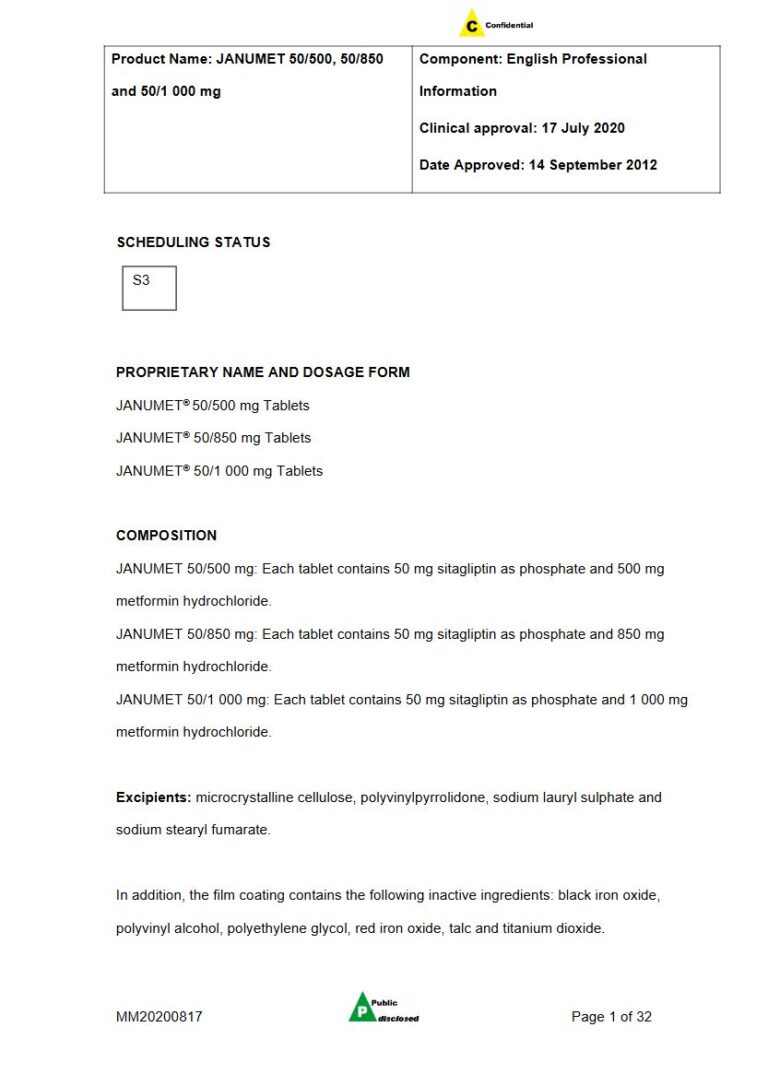
Janumet 500mg/850mg/1000mg. 50mg Tablet
PDF Leaflet Revision Date: 17 July 2020
Clinical Summary
Quick overview from the medicine insert
Indication
Adjunct to diet and exercise in type 2 diabetes mellitus.
Dosage (summary)
Starting dose based on current regimen; usually twice daily with meals.
Special Populations
- Renal insufficiency
- Hepatic insufficiency
- Elderly
Pregnancy & Breastfeeding
Contraindicated in pregnancy and lactation.
Key Drug Interactions
- Digoxin
- Cationic medicines
- Thiazides
Contraindications
- Hypersensitivity
- Renal disease
- Diabetic ketoacidosis
- Type 1 diabetes
Common side effects
- Nausea
- Hypoglycaemia
- Somnolence
Counselling Points
- Monitor renal function regularly
- Avoid excessive alcohol intake
- Report severe abdominal pain immediately
Serious warnings
- Lactic acidosis
- Pancreatitis
- Hypersensitivity reactions
Important Disclaimer
The Janumet 500mg/850mg/1000mg. 50mg Tablet professional information leaflet below is the property of Msd and is provided on Medinsert exactly as issued, with no.. alterations or editorial changes. We make every effort to keep content current by updating documents as soon as new versions become available. Medinsert serves as a trusted access point for healthcare professionals, but does not replace official sources or clinical judgement. For more details, please read our full disclaimer. read more>>
 Healthcare Professionals Only
This content is for registered healthcare professionals
Sign in or create a free account to read the full package insert.
Free for HPCSA-registered professionals. Powered by Medinsert.
Clinical Particulars
Section 4 of the official insert — extracted exactly as issued, no alterations
4.1 Therapeutic indications
JANUMET is indicated in combination with a sulphonylurea (i.e. triple combination therapy) as an adjunct to diet and exercise in patients with type 2 diabetes mellitus inadequately controlled with any two of the three agents: metformin, sitagliptin or a sulphonylurea.
JANUMET is also indicated in combination with pioglitazone or with insulin.
JANUMET is indicated as an adjunct to diet and exercise to improve glycaemic control in patients with type 2 diabetes mellitus already being treated with sitagliptin and metformin given separately.
4.2 Posology and method of administration
The dosage of antihyperglycaemic therapy with JANUMET should be individualised on the basis of the patientu2019s current regimen, effectiveness and tolerability while not exceeding the maximum recommended daily dose of 100 mg sitagliptin.
JANUMET should generally be given twice daily with meals, with gradual dose escalation, to reduce the gastro-intestinal (GI) side effects associated with metformin.
The starting dose of JANUMET should be based on the patientu2019s current regimen. JANUMET should be given twice daily with meals. The following doses are available:
- 50 mg sitagliptin/500 mg metformin hydrochloride
- 50 mg sitagliptin/850 mg metformin hydrochloride
- 50 mg sitagliptin/1 000 mg metformin hydrochloride.
For patients switching from co-administration of sitagliptin and metformin, JANUMET may be initiated at the dose of sitagliptin and metformin already being taken.
For patients inadequately controlled on dual combination therapy with any two of the following three antihyperglycaemic agents: sitagliptin, metformin or a sulphonylurea, the usual starting dose of JANUMET should provide 100 mg total daily dose of sitagliptin. In determining the starting dose of the metformin component, the patientu2019s level of glycaemic control and current dose (if any) of metformin should be considered. Gradual dose escalation to reduce the gastro-intestinal (GI) side effects associated with metformin should be considered. Patients currently on or initiating a sulphonylurea may require lower sulphonylurea doses to reduce the risk of sulphonylurea-induced hypoglycaemia.
For patients inadequately controlled on dual combination therapy with any two of the following three antihyperglycaemic agents: sitagliptin, metformin or insulin, the usual starting dose of JANUMET should provide 100 mg total daily dose of sitagliptin. In determining the starting dose of the metformin component, the patientu2019s level of glycaemic control and current dose (if any) of metformin should be considered. Gradual dose escalation to reduce the gastrointestinal (GI) side effects associated with metformin should be considered. Patients currently on or initiating insulin therapy may require lower doses of insulin to reduce the risk of hypoglycaemia.
4.3 Contraindications
JANUMET (sitagliptin phosphate/metformin HCl) is contraindicated in patients with:
- known hypersensitivity, including anaphylaxis or angioedema, to sitagliptin phosphate or to other gliptins (DPP-4s inhibitors), metformin hydrochloride or to any other component of JANUMET (see WARNINGS AND SPECIAL PRECAUTIONS, Sitagliptin phosphate, Hypersensitivity reactions and SIDE EFFECTS, Post-Marketing Experience).
- renal disease or moderate to severe renal dysfunction, e.g. as suggested by serum creatinine levels u2265 133 u03bcmol/L [males], u2265 124 u03bcmol/L [females] or creatinine clearance < 50 mL/min.
- acute or chronic metabolic acidosis, including diabetic ketoacidosis, with or without coma.
- type 1 diabetes mellitus.
- pregnancy and lactation (see HUMAN REPRODUCTION).
JANUMET should be temporarily discontinued in patients undergoing radiologic studies involving intravascular administration of iodinated contrast materials, because the use of such products may result in acute alteration of renal function (see WARNINGS AND SPECIAL PRECAUTIONS, Metformin hydrochloride).
4.4 Special warnings and precautions for use
JANUMET should not be used in patients with type 1 diabetes or for the treatment of diabetic ketoacidosis (see CONTRAINDICATIONS).
Pancreatitis: In post marketing experience there have been reports of acute pancreatitis, including fatal and non-fatal haemorrhagic or necrotising pancreatitis (see SIDE EFFECTS, Post-Marketing Experience), in patients taking sitagliptin. Patients should be informed of the characteristic symptom of acute pancreatitis: persistent, severe abdominal pain. Resolution of pancreatitis has been observed after discontinuation of sitagliptin. If pancreatitis is suspected, JANUMET and other potentially suspect medicines should be discontinued immediately.
Hypersensitivity reactions: There have been post-marketing reports of serious hypersensitivity reactions in patients treated with sitagliptin, one of the components of JANUMET. These reactions include anaphylaxis, angioedema and exfoliative skin conditions including Stevens-Johnson syndrome. Onset of these reactions usually occurred within the first 3 months after initiation of treatment with sitagliptin, with some reports occurring after the first dose. If a hypersensitivity reaction is suspected, discontinue JANUMET immediately, assess for other potential causes for the event and institute an alternative treatment for diabetes (see CONTRAINDICATIONS and SIDE EFFECTS, Post-Marketing Experience).
Monitoring of renal function: Metformin and sitagliptin are mainly excreted by the kidney. The risk of metformin accumulation and lactic acidosis increases with the degree of impairment of renal function. Thus, patients with serum creatinine levels above the upper limit of normal for their age should not receive JANUMET (see CONTRAINDICATIONS). In patients of advanced age, JANUMET should be carefully titrated to establish the minimum dose for adequate blood glucose lowering effect, as aging can be associated with reduced renal function. In elderly patientu2019s renal function should be monitored regularly.
Before initiation of therapy with JANUMET and at least annually thereafter, renal function should be assessed and verified as normal. In patients in whom development of renal dysfunction is anticipated, renal function should be assessed more frequently and JANUMET discontinued if evidence of renal impairment is present.
Hypoglycaemia in combination with a sulphonylurea or with insulin: When sitagliptin, a component of JANUMET was used in combination with metformin and a sulphonylurea or insulin, medicines known to cause hypoglycaemia, the incidence of hypoglycaemia was increased over that of placebo in combination with metformin, sulphonylurea or insulin (see SIDE EFFECTS). Therefore, to reduce the risk of sulphonylurea- or insulin-induced hypoglycaemia, a lower dose of sulphonylurea or insulin may be considered (see DOSAGE AND DIRECTIONS FOR USE).
Lactic acidosis: Lactic acidosis is a rare, but serious, metabolic complication that can occur due to metformin accumulation during treatment with JANUMET; when it occurs, it is fatal in approximately 50 % of cases. Lactic acidosis may also occur in association with a number of other pathophysiologic conditions, including when there is significant tissue hypoperfusion and hypoxaemia. Lactic acidosis is characterised by elevated blood lactate levels ( u02c3 5 mmol/litre), decreased blood pH, electrolyte disturbances with an increased anion gap and an increased lactate/pyruvate ratio. When metformin is implicated as the cause of lactic acidosis, metformin plasma levels u02c3 5 u03bcg/mL are generally found.
Reported cases of lactic acidosis have occurred primarily in diabetic patients with significant renal insufficiency, including both intrinsic renal disease and renal hypoperfusion, often in the setting of multiple concomitant medical/surgical problems and multiple concomitant medicines. Patients with congestive heart failure requiring pharmacologic management, in particular those with unstable or acute congestive heart failure who are at risk of hypoperfusion and hypoxemia, are at increased risk of lactic acidosis. The risk of lactic acidosis increases with the degree of renal dysfunction and the patient's age. The risk of lactic acidosis may, therefore, be reduced by regular monitoring of renal function in patients taking metformin and by use of the minimum effective dose of metformin. In particular, treatment of the elderly should be accompanied by careful monitoring of renal function.
JANUMET should be promptly withheld in the presence of any condition associated with hypoxaemia, dehydration or sepsis. Because impaired hepatic function may significantly limit the ability to clear lactate, JANUMET should generally be avoided in patients with clinical or laboratory evidence of hepatic disease. Patients should be cautioned against excessive alcohol intake, either acute or chronic, when taking JANUMET, since alcohol potentiates the effects of metformin hydrochloride on lactate metabolism. In addition, JANUMET should be temporarily discontinued prior to any intravascular radio-contrast study and for any surgical procedure.
4.5 Interactions with other medicines
Concomitant medicines that may affect renal function or result in significant haemodynamic change or may interfere with the disposition of metformin, such as cationic medicines that are eliminated by renal tubular secretion (see INTERACTIONS, Metformin hydrochloride), should be used with caution.
Radiologic studies involving the use of intravascular iodinated contrast materials can lead to acute alteration of renal function and have been associated with lactic acidosis in patients receiving metformin such as in JANUMET (see CONTRAINDICATIONS). Therefore, in patients in whom any such study is planned, JANUMET should be temporarily discontinued at the time of or prior to the procedure and withheld for 48 hours subsequent to the procedure and re-instituted only after renal function has been re-evaluated and found to be normal.
Hypoxic states: Cardiovascular collapse (shock) from whatever cause, acute congestive heart failure, acute myocardial infarction and other conditions characterised by hypoxaemia have been associated with lactic acidosis and may also cause prerenal uraemia. When such events occur in patients on JANUMET therapy, the medicine should be promptly discontinued.
Surgical procedures: Use of JANUMET should be temporarily suspended for any surgical procedure (except minor procedures not associated with restricted intake of food and fluids) and should not be restarted until the patient's oral intake has resumed and renal function has been evaluated as normal.
Alcohol intake: Alcohol is known to potentiate the effect of metformin on lactate metabolism. Patients should, therefore, be warned against excessive alcohol intake, acute or chronic, while receiving JANUMET.
Impaired hepatic function: Since impaired hepatic function has been associated with lactic acidosis, JANUMET should be avoided in patients with clinical or laboratory evidence of hepatic disease.
4.6 Fertility, pregnancy and lactation
JANUMET is contraindicated in pregnancy and lactation.
JANUMET should not be used by a woman who is breastfeeding an infant.
4.7 Effects on ability to drive and use machines
No studies of the effects of JANUMET on the ability to drive and use machines have been performed.
4.8 Undesirable effects
Adverse reactions considered as medicine related reported in excess (> 0,2 % and difference > 1 patient) of placebo and in patients receiving JANUMET in double-blind studies are listed below as MedDRA preferred term by system organ class and absolute frequency. Frequencies are defined as: very common (u2265 1/10); common (u2265 1/100 to < 1/10); uncommon (u22651/1 000 to < 1/100); rare (u2265 1/10 000 to < 1/1 000); very rare (< 1/10 000).
Sitagliptin with Metformin:
- Nervous system disorders: Common: somnolence
- Gastrointestinal disorders: Common: nausea; Uncommon: diarrhoea; Uncommon: upper abdominal pain
- Investigations: Uncommon: blood glucose decreased.
Sitagliptin with Metformin and a Sulphonylurea:
- Metabolism and nutrition disorders: Common: hypoglycaemia
- Respiratory, thoracic and mediastinal: Uncommon: rhinorrhoea
- Gastrointestinal disorders: Common: constipation; Uncommon: nausea.
Sitagliptin with Metformin and a PPARu03b3 Agonist:
- Metabolism and nutrition disorders: Common: hypoglycaemia
- General disorders and administration site conditions: Common: peripheral oedema.
Sitagliptin with Metformin and Insulin:
- Metabolism and nutrition disorders: Very common: hypoglycaemia
- Nervous system disorders: Uncommon: headache
- Gastrointestinal disorders: Uncommon: dry mouth.
Additional information on the individual active substances of the fixed dose combination:
Sitagliptin: In addition, in monotherapy studies of up to 24 weeks in duration of sitagliptin 100 mg once daily alone compared to placebo, adverse reactions considered as medicine-related reported in patients treated with sitagliptin in excess (> 0,2 % and difference > 1 patient) of that in patients receiving placebo are headache, hypoglycaemia, constipation and dizziness. In addition to the medicine-related adverse reactions described above, adverse events (reported regardless of causal relationship to medicinal product) occurring in at least 5 % and more commonly in patients treated with sitagliptin included upper respiratory tract infection and nasopharyngitis. Additional adverse events that occurred more frequently in patients treated with sitagliptin (not reaching the 5 % level but occurring with an incidence of u02c3 0,5 % higher with sitagliptin than that in the control group) included osteoarthritis and pain in extremity.
Post-Marketing Experience: During post-marketing experience of JANUMET or sitagliptin, one of the active substances of JANUMET, the following additional adverse reactions were reported (frequency not known): hypersensitivity reactions including anaphylaxis, angioedema, rash, urticaria, cutaneous vasculitis and exfoliative skin conditions including Stevens-Johnson syndrome (see WARNINGS AND SPECIAL PRECAUTIONS): acute pancreatitis, including fatal and non-fatal haemorrhagic and necrotising pancreatitis (see WARNINGS AND SPECIAL PRECAUTIONS, Pancreatitis); worsening renal function, including acute renal failure (sometimes requiring dialysis); upper respiratory tract infection; nasopharyngitis; constipation, vomiting; headache, severe and disabling arthralgia (see WARNINGS AND SPECIAL PRECAUTIONS); myalgia; pain in extremity; back pain.
Metformin: Established adverse reactions with metformin: The following side effects may occur with metformin:
- Metabolism and nutrition disorders: Very rare: decrease of vitamin B12 and folic acid absorption with decrease of serum levels during long-term use of metformin
- Very rare: lactic acidosis (see WARNINGS AND SPECIAL PRECAUTIONS)
- Nervous system disorders: Common: metallic taste
- Gastrointestinal disorders: Very common: gastrointestinal disorders such as nausea, vomiting, diarrhoea, abdominal pain and loss of appetite. These side effects occur most frequently during initiation of therapy and resolve spontaneously in most cases
- Skin and subcutaneous tissue disorders: Very rare: mild erythema in some hypersensitive individuals.
4.9 Overdose
In the event of an overdose, it is reasonable to employ the usual supportive measures, e.g. remove unabsorbed material from the gastro-intestinal tract, employ clinical monitoring (including obtaining an electrocardiogram) and institute supportive therapy if required.
Sitagliptin is modestly dialysable. In clinical studies, approximately 13,5 % of the dose was removed over a 3- to 4-hour haemodialysis session. Prolonged haemodialysis may be considered if clinically appropriate. It is not known if sitagliptin is dialysable by peritoneal dialysis.
Metformin hydrochloride: Overdose of metformin hydrochloride has occurred, including ingestion of amounts u02c3 50 grams. Hypoglycaemia was reported in approximately 10 % of cases, but no causal association with metformin hydrochloride has been established. Lactic acidosis has been reported in approximately 32 % of metformin overdose cases (see SIDE EFFECTS, Metformin hydrochloride). Metformin is dialysable with a clearance of up to 170 mL/min under good haemodynamic conditions. Therefore, haemodialysis may be useful for removal of accumulated medicine from patients in whom metformin overdosage is suspected.
