
Klarithran 125 Mg/5 Ml/250 Mg/500 mg Tablets
PDF Leaflet Revision Date: 14 July 2025
Clinical Summary
Quick overview from the medicine insert
Indication
Prevention and treatment of nausea and vomiting induced by cytostatic therapy and postoperative nausea and vomiting.
Dosage (summary)
Adults: 3 mg IV for cytostatic therapy; 1 mg IV for postoperative nausea.
Special Populations
- Elderly
- Renal impairment
- Hepatic impairment
Pregnancy & Breastfeeding
Not recommended during pregnancy and lactation due to safety concerns.
Key Drug Interactions
- QT prolonging agents
- Serotonergic medications
Contraindications
- Hypersensitivity to granisetron
- Children under 2 years
- Congenital long QT syndrome
Common side effects
- Headache
- Constipation
- Dizziness
Counselling Points
- Administer prior to cytostatic therapy
- Monitor for signs of myocardial ischaemia
- Report any adverse reactions
Serious warnings
- May cause dysrhythmias
- Monitor for serotonin syndrome
- Risk of myocardial ischaemia
Important Disclaimer
The Klarithran 125 Mg/5 Ml/250 Mg/500 mg Tablets professional information leaflet below is the property of Ranbaxy Pharmaceuticals and is provided on Medinsert exactly as issued, with no.. alterations or editorial changes. We make every effort to keep content current by updating documents as soon as new versions become available. Medinsert serves as a trusted access point for healthcare professionals, but does not replace official sources or clinical judgement. For more details, please read our full disclaimer. read more>>
 Healthcare Professionals Only
This content is for registered healthcare professionals
Sign in or create a free account to read the full package insert.
Free for HPCSA-registered professionals. Powered by Medinsert.
Clinical Particulars
Section 4 of the official insert — extracted exactly as issued, no alterations
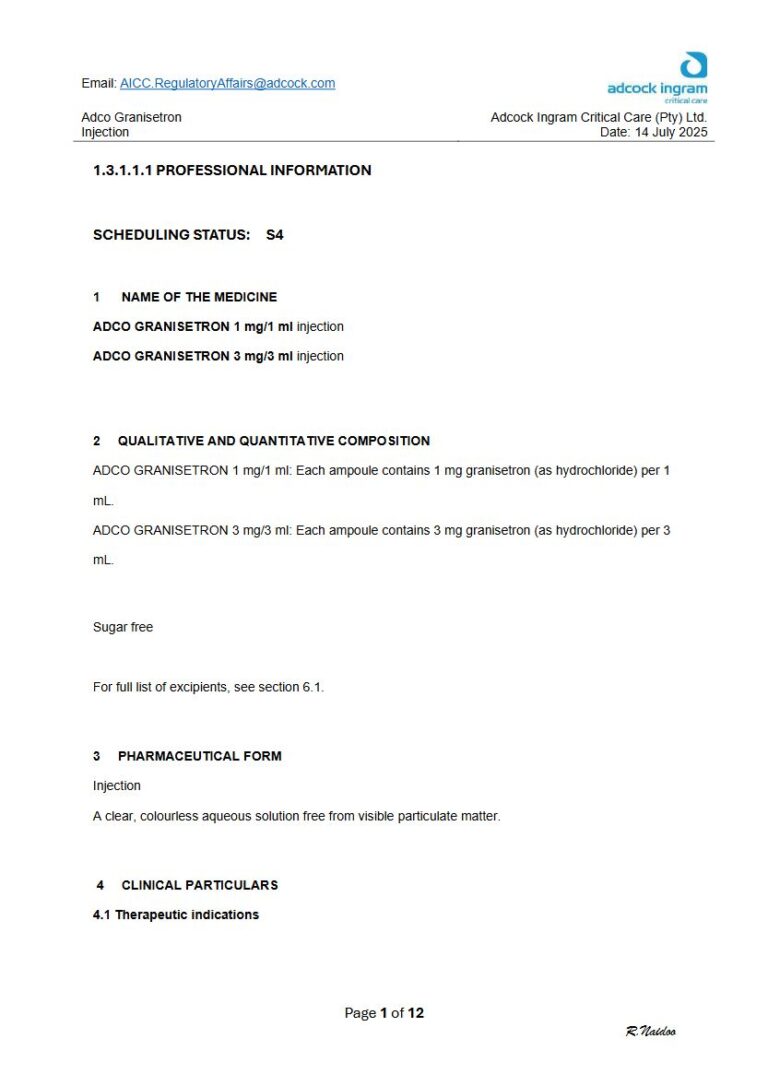
4.1 Therapeutic indications
ADCO GRANISETRON ampoules are indicated for the prevention or treatment of nausea and vomiting induced by cytostatic therapy and for the prevention and treatment of postoperative nausea and vomiting.
4.2 Posology and method of administration
Posology
Cytostatic therapy:
Adults: Intravenous: The dose of ADCO GRANISETRON is 3 mg (corresponding to a dose of approximately 40 u03bcg/kg) which should be administered either as a slow intravenous injection (over 30 seconds) or diluted as directed in 20 to 50 ml infusion fluid and administered over 5 minutes.
Maximum daily dose: Up to two additional doses of 3 mg ADCO GRANISETRON may be administered either as intravenous injection (over 30 seconds) or as a 5 minute infusion. Additional administration should be administered at least 10 minutes apart. The maximum dose of ADCO GRANISETRON infusion to be administered over 24 hours should not exceed 9 mg (120 u03bcg/kg). The experience of the use of granisetron beyond 7 cycles of chemotherapy is limited.
Special populations: Although present experience indicates that no dosage adjustment is required, care should be exercised when administering ADCO GRANISETRON to elderly patients and patients with renal or hepatic impairment.
Paediatric population: Children: Intravenous Prevention: A single dose of 10 to 40 u03bcg/kg body weight (up to 3 mg) should be administered as an intravenous infusion, diluted in 10 to 30 ml infusion fluid and administered over 5 minutes. Administration should be completed prior to the start of cytostatic therapy.
Treatment: The same as for prevention. One additional dose of 10 to 40 u03bcg/kg body weight (up to 3 mg) may be administered within a 24 hour period. This additional dose should be administered at least 10 minutes apart from the initial infusion.
Postoperative nausea and vomiting:
Adults: Intravenous: For prevention in adults prior to induction of anaesthesia, a single dose of 1 mg of ADCO GRANISETRON should be administered as a slow intravenous injection (over 30 seconds). For the treatment of established postoperative nausea and vomiting in adults, a single dose of 1 mg ADCO GRANISETRON should be administered by slow intravenous injection (30 seconds).
Maximum dose and duration of treatment: A total dose of 3 mg of ADCO GRANISETRON given intravenously per day should not be exceeded in patients undergoing anaesthesia for elective surgery.
Special populations: Care should be exercised when administering ADCO GRANISETRON to the elderly and patients with renal or hepatic impairment.
Paediatric population: Children: No data are available for prevention and treatment of postoperative nausea and vomiting in children.
Method of administration: Slow intravenous injection or slow intravenous infusion. Prophylactic administration of ADCO GRANISETRON should be completed prior to the start of cytostatic therapy or induction of anaesthesia. For instructions on preparing the injection and for compatibility of ADCO GRANISETRON with infusion fluids, see section 6.6.
4.3 Contraindications
- Hypersensitivity to granisetron or to any of the ingredients contained in ADCO GRANISETRON
- Children under the age of 2 years.
- Congenital long QT syndrome
- Pregnancy and lactation (see section 4.6).
4.4 Special warnings and precautions for use
As ADCO GRANISETRON may reduce lower bowel motility, patients with signs of sub-acute intestinal obstruction should be monitored following administration of ADCO GRANISETRON. The maximum dose of ADCO GRANISETRON to be administered over 24 hours should not exceed 9 mg (120 u03bcg/kg). 5-HT3 antagonists, such as ADCO GRANISETRON, may be associated with dysrhythmias or ECG abnormalities including QT interval prolongation. This potentially may have clinical significance in patients with pre-existing dysrhythmias or cardiac conduction disorders or patients who are being treated with anti-dysrhythmic medicines or beta-blockers. Caution should be exercised in patients with cardiac co-morbidities, patients on cardiotoxic chemotherapy and/or with concomitant electrolyte abnormalities (see section 4.5). Cases of myocardial ischaemia have been reported in patients treated with serotonin receptor antagonists. In some patients, especially in the case of intravenous administration, symptoms appeared immediately after administration of a serotonin receptor antagonist (e.g. ADCO GRANISETRON). Patients should be alerted to the signs and symptoms of myocardial ischaemia. Cross-sensitivity between 5-HT3 antagonists (e.g. dolasetron, ondansetron) has been reported. There have been reports of serotonin syndrome with the use of 5-HT3 antagonists either alone, but mostly in combination with other serotonergic medicines (including selective serotonin reuptake inhibitors (SSRIs) and serotonin noradrenaline reuptake inhibitors (SNRIs)). Appropriate observation of patients for serotonin syndrome-like symptoms is advised. No special precautions are required for the elderly or renally and/or hepatically impaired patients. Owing to kinetics a degree of caution should be exercised in using ADCO GRANISETRON with this category. Sodium content ADCO GRANISETRON contains 4,01 mg sodium per ml, equivalent to 0,2 % of the WHO recommended maximum daily intake of 2 g sodium for an adult.
4.5 Interaction with other medicines and other forms of interaction
As for other 5-HT3 antagonists, cases of ECG modifications including QT prolongation have been reported with ADCO GRANISETRON. In patients concurrently treated with medicines known to prolong the QT interval and/or which are dysrhythmogenic, this may lead to clinical consequences (see section 4.4). This may also have clinical significance in patients who are being treated with anti-dysrhythmic medicines or beta-blockers (see section 4.4). Hepatic enzyme induction with phenobarbital resulted in an increase in total plasma clearance of intravenous ADCO GRANISETRON of approximately one-quarter. ADCO GRANISETRON may be co-administered with benzodiazepines, neuroleptics and anti-ulcer medications commonly prescribed with anti-emetic treatments. Additionally, ADCO GRANISETRON has shown no apparent interaction with emetogenic cancer chemotherapies. No specific interaction studies have been conducted in anaesthetised patients, but ADCO GRANISETRON has been safely administered with commonly used anaesthetic and analgesic agents. In vitro, it could be shown that metabolism of ADCO GRANISETRON is inhibited by ketoconazole, a potent CYP3A inhibitor. Co-administration of ADCO GRANISETRON with systemic ketoconazole may, therefore, increase the elimination half-life of ADCO GRANISETRON. There have been reports of serotonin syndrome following concomitant use of 5-HT3 antagonists and other serotonergic medicines (including SSRIs and SNRIs) (see section 4.4).
4.6 Fertility, pregnancy and lactation
The use of ADCO GRANISETRON during pregnancy and lactation is not recommended as safety and efficacy have not been established (see section 4.3).
4.7 Effects on ability to drive and use machines
There have been reports of somnolence with the use of ADCO GRANISETRON, and this should be taken into account.
4.8 Undesirable effects
a. Summary of the safety profile
The most frequently reported adverse reactions for ADCO GRANISETRON are headache and constipation which may be transient. ECG changes including QT prolongation have been reported with ADCO GRANISETRON (see sections 4.4 and 4.5).
b. Tabulated summary of adverse reactions
Side effects are ranked according to the frequency within each MeDRA System Organ Class (SOC).
The following side effects may occur with use of ADCO GRANISETRON:
System Organ Class Frequency Adverse Event
Immune system disorders Less frequent Allergic reactions, including anaphylaxis*, shortness of breath*, hypotension*, urticaria*, oedema, facial oedema
Nervous system disorder Frequent Headache, somnolence, agitation, anxiety, insomnia, taste disorder Less frequent Extrapyramidal reactions, dystonia, dyskinesia, serotonin syndrome
Eye disorders Less frequent Abnormal vision
Ear and labyrinth disorders Frequent Dizziness
Cardiac disorders Less frequent Dysrhythmias and chest pain, sinus bradycardia, atrial fibrillation, AV-block, ventricular ectopy, non-sustained tachycardia, ECG abnormalities, QT interval prolonged Frequency not known Myocardial ischaemia (see section 4.4)
Vascular disorders Frequent Hypertension Less frequent Hypotension
Gastrointestinal disorders Frequent Constipation, diarrhoea, anorexia
Hepatobiliary disorders Frequent Raised transaminase levels Less frequent Abnormal hepatic function
Skin and subcutaneous tissue disorders Less frequent Allergic reactions, including minor skin rashes, local irritation at administration site**
General disorders and administrative site conditions Frequent Fever, asthenia
*Hypersensitivity reactions
**After repeated intravenous administration
c. Description of selected adverse events
As for other 5-HT3 antagonists, ECG changes including QT prolongation have been reported with ADCO GRANISETRON (see sections 4.4 and 4.5).
Reporting of suspected adverse reactions
Reporting suspected adverse reactions after authorisation of the medicine is important. It allows continued monitoring of the benefit/risk balance of the medicine. Healthcare providers are requested to report any suspected adverse drug reactions to SAHPRA via the Med Safety APP (Medsafety X SAHPRA) and eReporting platform (who-umc.org) found on SAHPRA website. For reporting of side effects directly to the Holder of the Certificate of Registration, contact +27 11 635 0134 or email [email protected]
4.9 Overdose
Headache may occur. There is no specific antidote for ADCO GRANISETRON. In the case of overdosage, symptomatic treatment should be given.
