
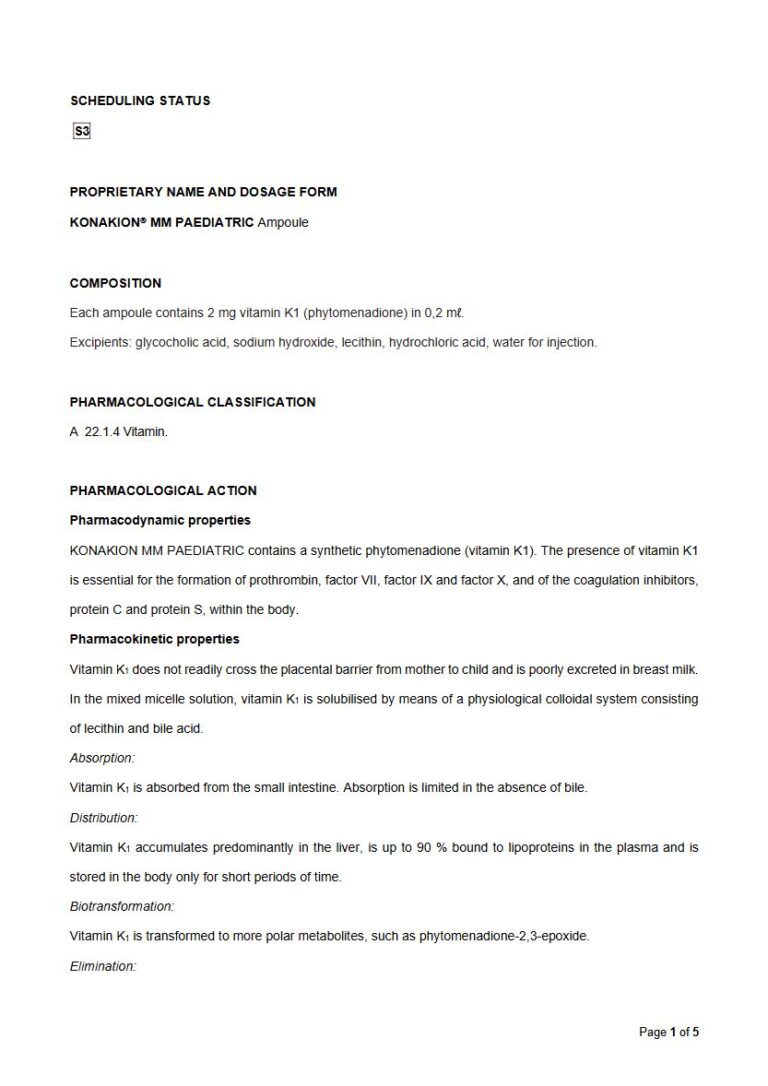
Konakion Mm Paediatric 2 mg Ampoule
PDF Leaflet Revision Date: 20 July 2018
Clinical Summary
Quick overview from the medicine insert
Indication
Prophylaxis and treatment of haemorrhagic disease of the newborn.
Dosage (summary)
2 mg orally at birth; 1 mg IM/IV for at-risk neonates.
Special Populations
- Premature infants
- Hepatobiliary disease
- Inability to swallow
Pregnancy & Breastfeeding
Safety and efficacy in pregnancy and lactation not demonstrated.
Key Drug Interactions
- Antagonises warfarin
Contraindications
- Hypersensitivity to constituents
Common side effects
- Tissue necrosis
- Anaphylactoid reactions
- Local irritation
Counselling Points
- Administer as directed
- Monitor for adverse reactions
- Store below 25 u00b0C
Serious warnings
- Increased risk of kernicterus in premature infants <2.5 kg
Important Disclaimer
The Konakion Mm Paediatric 2 mg Ampoule professional information leaflet below is the property of Pharmaco Distribution and is provided on Medinsert exactly as issued, with no.. alterations or editorial changes. We make every effort to keep content current by updating documents as soon as new versions become available. Medinsert serves as a trusted access point for healthcare professionals, but does not replace official sources or clinical judgement. For more details, please read our full disclaimer. read more>>
 Healthcare Professionals Only
This content is for registered healthcare professionals
Sign in or create a free account to read the full package insert.
Free for HPCSA-registered professionals. Powered by Medinsert.
Clinical Particulars
Section 4 of the official insert — extracted exactly as issued, no alterations
4.1 Indications
Prophylaxis and treatment of haemorrhagic disease of the newborn.
4.2 Contraindications
Known hypersensitivity to any of the constituents.
4.3 Warnings and special precautions
Parenteral administration may be associated with an increased risk of kernicterus in premature infants weighing less than 2,5 kg. At the time of use, the ampoule solution should be clear. Following incorrect storage, the solution may become turbid or present a phase-separation. In this case the ampoule must not be used.
4.4 Interactions
Vitamin K 1 antagonises the effect of warfarin.
4.6 Pregnancy and lactation
Safety and efficacy in pregnancy and lactation have not been demonstrated.
4.2 Dosage and directions for use
Prophylaxis
For all healthy neonates: 2 mg orally at birth, or soon after birth, followed by 2 mg between 4 - 7 days later. Exclusively breast-fed babies: In addition to the recommendations for all neonates, 2 mg orally should be given after four to six weeks. A single 1 mg (0,1 mu2113) dose IM is recommended in babies who are not assured of receiving a second oral dose or, in the case of breast-fed babies, who are not assured of receiving a third oral dose.
Neonates at special risk (e.g. premature, hepatobilliary disease, inability to swallow, birth asphyxia, maternal use of anticoagulants or antiepileptics): 1 mg IM or IV at birth or soon after birth if the oral route is not suitable. Intramuscular and intravenous doses should not exceed 0,4 mg/kg (equivalent to 0,04 mu2113/kg) in premature infants weighing less than 2,5 kg, see WARNINGS. Size and frequency of further doses depend on coagulation status. Therapy: Initially, 1 mg IV and further doses as required, depending on clinical picture and coagulation status. KONAKION MM PAEDIATRIC therapy may need to be accompanied by a more immediately effective treatment such as transfusion of whole blood or blood clotting factors to compensate for severe blood loss and the delayed response to vitamin K 1.
4.8 Undesirable effects
Skin disorders: Tissue necrosis and acute ischaemia at the injection site. General disorders: Anaphylactoid reactions. Local irritation at the injection site.
4.9 Overdose
The following adverse events have been reported concerning overdose with use of KONAKION in neonates and infants: jaundice, hyperbilirubinaemia, increased Aspartate transaminase (AST) and Gamma-glutamyltransferase (GGT), abdominal pain, constipation, soft stools, malaise, agitation and cutaneous eruption. The causality of those events cannot be established. Treatment of suspected overdose is palliative and supportive.
