
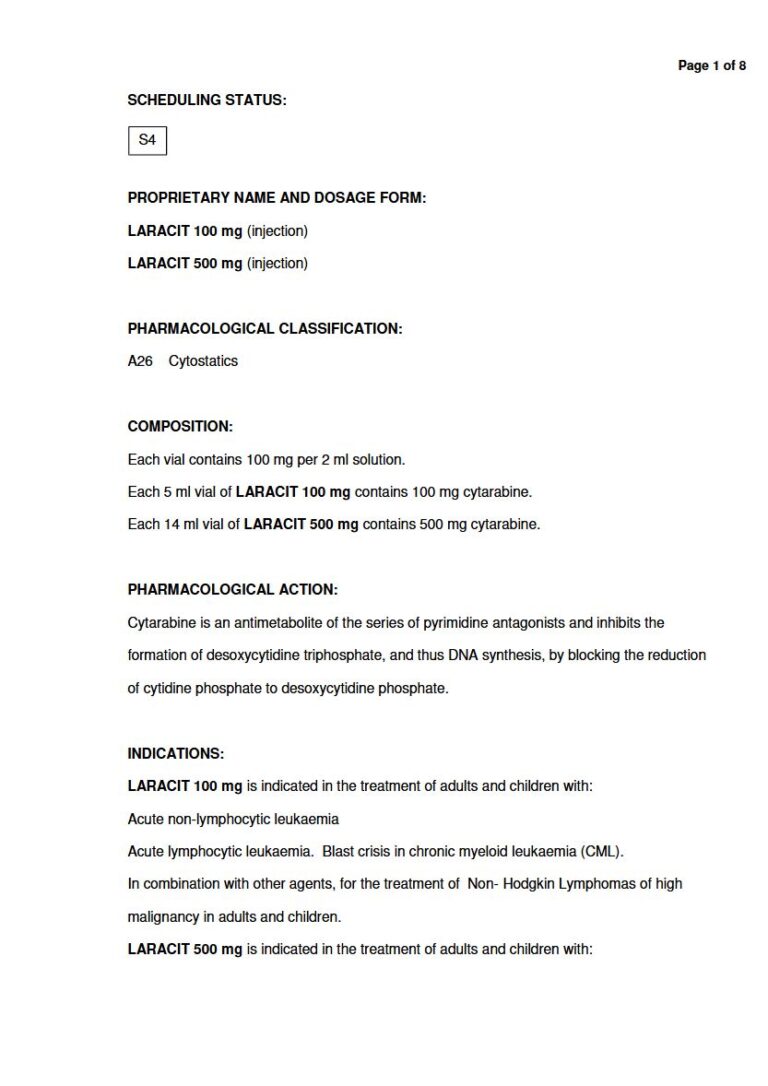
Laracit 100mg / 5ml. 500mg / 14ml Injection
PDF Leaflet Revision Date: 8 October 2004
Clinical Summary
Quick overview from the medicine insert
Indication
Treatment of acute leukaemias and high-risk non-Hodgkin lymphomas.
Dosage (summary)
3-6 mg/kg/day or 100-200 mg/mu00b2/day; administered IV or intrathecally.
Special Populations
- Renal impairment
- Hepatic impairment
Pregnancy & Breastfeeding
Contraindicated; teratogenic in animals.
Contraindications
- Hypersensitivity to cytarabine
- Drug-induced bone marrow suppression
Common side effects
- Anaemia
- Leucopenia
- Thrombocytopenia
- Nausea
- Vomiting
Counselling Points
- Monitor blood counts regularly
- Report signs of infection
- Avoid pregnancy during treatment
Serious warnings
- Bone marrow suppression
- Anaphylaxis risk
- Neurotoxicity after intrathecal use
Important Disclaimer
The Laracit 100mg / 5ml. 500mg / 14ml Injection professional information leaflet below is the property of Teva and is provided on Medinsert exactly as issued, with no.. alterations or editorial changes. We make every effort to keep content current by updating documents as soon as new versions become available. Medinsert serves as a trusted access point for healthcare professionals, but does not replace official sources or clinical judgement. For more details, please read our full disclaimer. read more>>
 Healthcare Professionals Only
This content is for registered healthcare professionals
Sign in or create a free account to read the full package insert.
Free for HPCSA-registered professionals. Powered by Medinsert.
Clinical Particulars
Section 4 of the official insert — extracted exactly as issued, no alterations
4.1 Therapeutic indications
LARACIT 100 mg is indicated in the treatment of adults and children with:
- Acute non-lymphocytic leukaemia
- Acute lymphocytic leukaemia. Blast crisis in chronic myeloid leukaemia (CML).
- In combination with other agents, for the treatment of Non-Hodgkin Lymphomas of high malignancy in adults and children.
LARACIT 500 mg is indicated in the treatment of adults and children with:
- Refractory acute non-lymphocytic leukaemias
- Refractory acute lymphocytic leukaemias
- Blast crisis of chronic myeloid leukaemia (CML)
- High risk leukaemias such as acute leukaemias as second malignancies after preceding chemotherapy and/or radiation.
- Transformation of preleukaemias.
- Refractory Non-Hodgkin's lymphomas.
4.2 Posology and method of administration
In cytostatic therapy: If not otherwise defined in specific combinations: 3 - 6 mg/kg/day or 100 - 200 mg/mu00b2/day. For induction, LARACIT is administered as a rapid intravenous injection, short infusion or 8 u2013 24 hours continuous infusion. The duration of therapy is dependent on the haematological tolerance (bone marrow) and the clinical findings. With intravenous injection or short infusion, the daily dosage should be uniformly divided into several, at least two, administrations given at appropriate levels. See WARNINGS AND SPECIAL PRECAUTIONS. For maintenance of remission, LARACIT may also be administered intra muscularly or sub-cutaneously. Intracutaneous injection must be avoided. LARACIT can also be administered directly intrathecally. The solution for infusion may be prepared with a suitable diluent, such as physiological saline solution, 5 % glucose solution or sodium chloride-lactate for intrathecal use.
4.3 Contraindications
LARACIT is contraindicated in:
- Patients with hypersensitivity to cytarabine.
- Patients with drug-induced bone marrow suppression.
4.4 Special warnings and precautions for use
LARACIT should be administered only under the supervision of medical specialists in oncology and the use of antineoplastic chemotherapeutic agents. For induction therapy, patients should be treated in a facility with laboratory and supportive resources sufficient to monitor medicine tolerance and protect and maintain a patient compromised by medicine toxicity. Anaphylaxis that resulted in acute cardiopulmonary arrest and required resuscitation, has been reported. The main toxic effect of LARACIT is bone marrow suppression, possibly fatal, manifesting as leucopenia, particularly infection resulting from granulocytopenia, other impaired body defences, haemorrhage secondary to thrombocytopenia and anaemia, sometimes with striking megaloblastic changes. Myelosuppression is more evident after high doses and continuous infusions. Patients receiving this medicine must be under close medical supervision and during induction therapy, should have leucocyte and platelet counts performed daily. Bone marrow examinations should be performed frequently after blasts have disappeared from the peripheral blood. Consider suspending or modifying therapy when drug-induced marrow depression has resulted in a platelet count below 50 000 or a polymorphonuclear granulocyte count below 1 000/mm3. Counts of formed elements in the peripheral blood may continue to fall after the medicine is stopped and reach lowest values after medicine-free intervals of 12 to 24 days. When indicated, restart therapy when definite signs of marrow recovery appear (on successive bone marrow studies). Patients whose medicine is withheld until 'normal' peripheral blood values are attained may escape from control. Seizures and other manifestations of neurotoxicity may occur after intrathecal administration. The human liver apparently detoxifies a substantial fraction of an administration dose. Use the medicine with caution and at reduced dose in patients whose liver function is poor. Regular checks of liver and kidney functions should also be performed in patients receiving LARACIT. LARACIT may induce hyperuricaemia secondary to rapid lysis of neoplastic cells. The clinician should monitor the patientu2019s blood uric acid level and be prepared to use such supportive and pharmacologic measures as might be necessary to control this problem. Focal leukaemic involvement of the central nervous system may not respond to intrathecal LARACIT and may better be treated with radiotherapy. LARACIT given intrathecally may cause systemic toxicity and careful monitoring of the haemopoietic system is indicated. Modification of the anti-leukaemia therapy may be necessary.
4.6 Fertility, pregnancy and lactation
Contrandicated as Cytarabine is teratogenic in animals.
4.8 Undesirable effects
Adverse reactions reported as more than an isolated case is listed below, by system organ class and by frequency. Frequencies are defined as: very common (> 1/10), common (>1/100, 1/1000, < 1/100), rare (< 1/1000).
Infections and infestations:
- Uncommon: Sepsis, pneumonia
Blood and lymphatic system disorders:
- Common: Anaemia, leucopenia, thrombocytopenia, megaloblastosis and reduced reticulocytes
Nervous system disorders:
- Uncommon: Headache, dizziness, neural toxicity, neuritis, peripheral sensitivity
- Rare: Severe and fatal central nervous system toxicity following high dose dosage schedules. These reactions include cerebral and cerebellar dysfunction.
Eye disorders:
- Uncommon: Conjunctivitis may occur with rash.
- Rare: Corneal toxicity.
Vascular disorders:
- Common: Bleeding (all sites)
Respiratory, thoracic and mediastinal disorders:
- Uncommon: Shortness of breath, chest pain
- Rare: Severe and fatal pulmonary toxicity following high dose dosage schedules. These reactions include pulmonary oedema. Reactions after intrathecal administration are nausea, vomiting and fever. Paraplegia has been reported as well as necrotizing leuco-encephalopathy. Neurotoxicity has been reported and blindness occurred in patients in remission whose treatment had consisted of combination systemic chemotherapy, prophylactic central nervous system radiation and intrathecal LARACIT.
Gastrointestinal disorders:
- Common: Nausea, vomiting, diarrhoea, anorexia
- Uncommon: Abdominal pain, oesophageal ulceration, oesophagitis
- Rare: Severe and fatal gastrointestinal toxicity following high dose dosage schedules. These reactions include severe gastrointestinal ulceration, including pneumatosis cystoides intestinalis leading to peritonitis, sepsis and liver abscess.
Hepato-biliary disorders:
- Common: Hepatic dysfunction
- Uncommon: Jaundice
Skin and subcutaneous tissue disorders:
- Common: Oral and anal inflammation or ulceration, rash.
- Uncommon: Skin ulceration, pruritus, urticaria, alopecia, freckling.
Renal and urinary disorders:
- Uncommon: Urinary retention, renal dysfunction
General disorders and administration site conditions:
- Common: Thrombophlebitis, fever.
- Uncommon: Cellulitis at injection site, sore throat, allergic oedema, anaphylaxis
4.9 Overdose
There is no antidote for LARACIT overdosage. Refer to 'Side Effects'. Delayed or long-term adverse effects may result from the action on rapidly dividing normal cells in the bone marrow, lymphoreticular tissue, gastrointestinal mucosa, skin, gonad, and foetus. Treatment: Control of nausea and vomiting may be attempted by giving phenothiazines such as perphenazine, prochlorperazine, promethazine, or thiethylperazine, before antineoplastic agents are administered. In bone marrow depression, transfusions of blood or platelets are given to diminish the risk of life-threatening haemorrhage. Granulocyte transfusions and injections of antibiotics may be necessary to combat infection in the neutropenic patient. Hyperuricaemia is avoided by the addition of allopurinol to treatment schedules and measures such as alkalinisation of the urine and hydration may also be adopted.
