
Letraz 2.5 mg FC tablet.
PDF Leaflet Revision Date: 06 May 2022
Clinical Summary
Quick overview from the medicine insert
Indication
Adjuvant treatment of hormone receptor-positive early breast cancer in postmenopausal women.
Dosage (summary)
2.5 mg once daily; treatment duration is 5 years or until tumor relapse.
Special Populations
- Elderly patients
- Hepatic impairment
- Renal impairment
Pregnancy & Breastfeeding
Contraindicated in pregnancy and breastfeeding.
Key Drug Interactions
- CYP2A6 and CYP2C19 inhibitors
- Tamoxifen may reduce LETRAZ levels
Contraindications
- Hypersensitivity to letrozole
- Premenopausal women
- Severe hepatic impairment
- Severe renal impairment
Common side effects
- Hot flushes
- Nausea
- Fatigue
Counselling Points
- Monitor bone density
- Caution advised when driving or operating machinery
Serious warnings
- Risk of bone fractures
- Increased cardiovascular events in patients with ischaemic heart disease
Important Disclaimer
The Letraz 2.5 mg FC tablet. professional information leaflet below is the property of Equity Pharmaceuticals and is provided on Medinsert exactly as issued, with no.. alterations or editorial changes. We make every effort to keep content current by updating documents as soon as new versions become available. Medinsert serves as a trusted access point for healthcare professionals, but does not replace official sources or clinical judgement. For more details, please read our full disclaimer. read more>>
 Healthcare Professionals Only
This content is for registered healthcare professionals
Sign in or create a free account to read the full package insert.
Free for HPCSA-registered professionals. Powered by Medinsert.
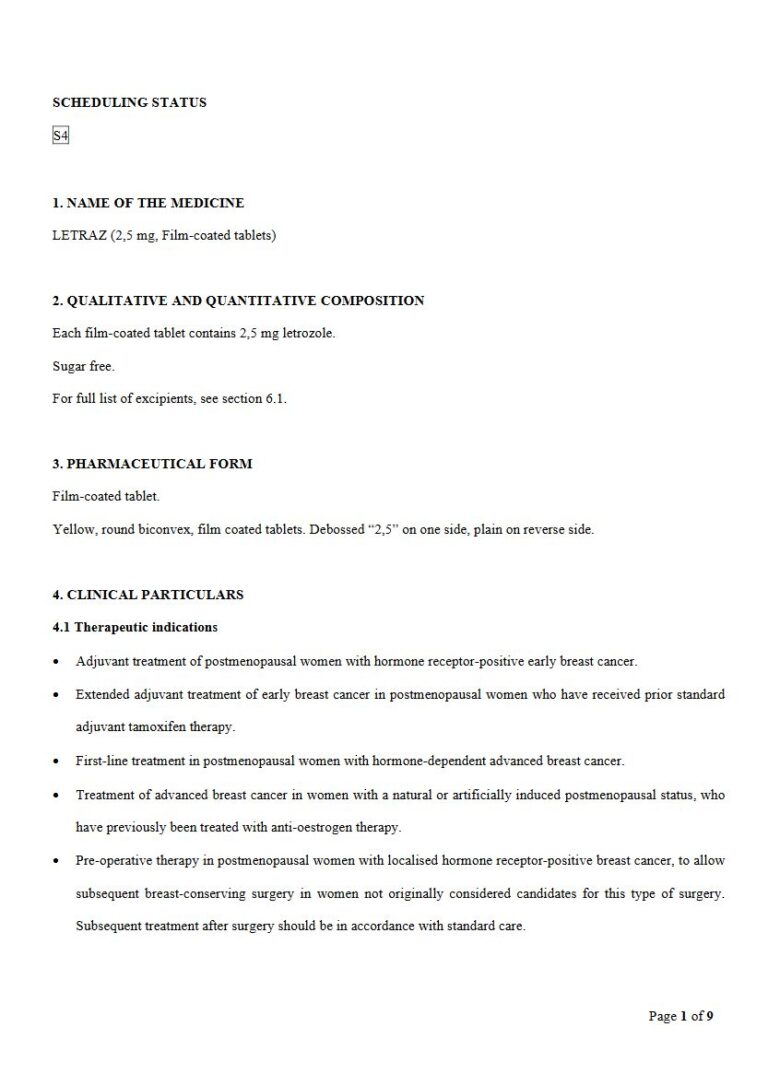
Clinical Particulars
Section 4 of the official insert — extracted exactly as issued, no alterations
4.1 Therapeutic indications
u2022 Adjuvant treatment of postmenopausal women with hormone receptor-positive early breast cancer.
u2022 Extended adjuvant treatment of early breast cancer in postmenopausal women who have received prior standard adjuvant tamoxifen therapy.
u2022 First-line treatment in postmenopausal women with hormone-dependent advanced breast cancer.
u2022 Treatment of advanced breast cancer in women with a natural or artificially induced postmenopausal status, who have previously been treated with anti-oestrogen therapy.
u2022 Pre-operative therapy in postmenopausal women with localised hormone receptor-positive breast cancer, to allow subsequent breast-conserving surgery in women not originally considered candidates for this type of surgery. Subsequent treatment after surgery should be in accordance with standard care.
4.2 Posology and method of administration
Posology
Adults and elderly patients: The recommended dose of LETRAZ is 2,5 mg once daily by mouth. In the adjuvant and extended adjuvant setting, treatment with LETRAZ is given for 5 years or until tumour relapse occurs, whichever comes first. Where metastatic disease occurs, treatment with LETRAZ should continue until tumour progression is evident.
Method of administration
Oral.
Elderly patients : No dose adjustment is required for geriatric patients.
Paediatric patients : Not suitable for use in children.
Patients with hepatic and/or renal impairment : No dosage adjustment is recommended for patients with mild to moderate hepatic function impairment (Child Pugh grade A and B) or renal function impairment (creatinine clearance u2265 10 ml/min). Insufficient data are available to establish dosage recommendations for patients with a creatinine clearance of < 10 ml/min (see section 4.3). LETRAZ should not be used in patients with severe hepatic impairment (Child-Pugh score C) (see section 4.3).
4.3 Contraindications
u2022 Hypersensitivity to the active substance, letrozole, or to any of the excipients, see section 6.1.
u2022 Premenopausal women.
u2022 Pregnancy and lactation.
u2022 Severe hepatic function impairment (Child-Pugh grade C).
u2022 Severe renal function impairment (creatinine clearance < 10 ml/min).
4.4 Special warnings and precautions for use
Reductions in bone mineral density can occur during treatment with LETRAZ. This effect may increase the risk of bone fractures, especially in patients with osteoporosis. Patients with or at risk of osteoporosis should have their bone density assessed at the start of therapy and at regular intervals thereafter. Treatment or prophylaxis for osteoporosis should be started as appropriate and carefully monitored.
No data are available in patients with a creatinine clearance of < 10 ml/min (see section 4.3).
An increased incidence of cardiovascular adverse effects has been seen in woman with pre-existing ischaemic heart disease and caution is advised in these patients.
In patient with severe hepatic impairment (Child-Pugh score C), systemic exposure and terminal half-life were approximately doubled compared to healthy volunteers (see section 4.3).
4.5 Interaction with other medicines and other forms of interaction
LETRAZ inhibits in vitro the cytochrome P450-isozymes 2A6, and moderately 2C19. CYP2A6 does not play a major role in the metabolism of LETRAZ. However, caution should be used in the concomitant administration of medicines whose disposition is mainly dependent on these isoenzymes and whose therapeutic index is narrow.
The co-administration of LETRAZ with the following commonly prescribed medicines does not result in clinically significant interactions: cimetidine, warfarin, benzodiazepines; barbiturates; NSAIDs such as diclofenac sodium, ibuprofen; paracetamol; furosemide; omeprazole.
Concomitant administration of tamoxifen may reduce plasma concentrations of LETRAZ.
4.6 Fertility, pregnancy and lactation
Pregnancy
The use of LETRAZ is contraindicated during pregnancy (see section 4.3).
Breastfeeding
The use of LETRAZ is contraindicated during breastfeeding (see section 4.3).
Fertility
No data is available.
4.7 Effects on ability to drive and use machines
Since fatigue, dizziness and somnolence may occur when using LETRAZ, caution is advised when driving or using machines.
4.8 Undesirable effects
a) Summary of the safety profile
The most frequent side effects with LETRAZ are hot flushes, nausea and fatigue.
b) Tabulated summary of adverse reactions
System Organ Class Frequency Undesirable effect
Infections and infestations Less frequent Urinary tract infections
Neoplasms benign and malignant (including cysts and polyps) Less frequent Tumour pain in metastatic/neoadjuvant setting only
Blood and lymphatic system disorders Less frequent Leukopenia
Immune system disorders Less frequent Anaphylaxis, angioedema
Metabolism and nutrition disorders Frequent Anorexia, appetite increase, hypercholesterolaemia, hypercalcaemia
Less frequent General oedema
Psychiatric disorders Frequent Depression
Less frequent Anxiety, including nervousness and irritability
Nervous system disorders Frequent Headache, dizziness
Less frequent Somnolence, insomnia, memory impairment, dysaesthesia including paraesthesia and hypoaesthesia, taste disturbance, cerebrovascular accident
Eye disorders Less frequent Cataract, eye irritation, blurred vision
Cardiac disorders* Less frequent Palpitations, tachycardia, cardiac failure, angina pectoris, ischaemic cardiac events
Vascular disorders Less frequent Superficial and deep thrombophlebitis including superficial and deep thrombophlebitis, hypertension, pulmonary embolism, arterial thrombosis, cerebrovascular infarction
Respiratory, thoracic and mediastinal disorders Less frequent Dyspnoea, cough
Gastrointestinal disorders Frequent Nausea, vomiting, dyspepsia, constipation, diarrhoea
Less frequent Abdominal pain, stomatitis, dry mouth
Hepato-biliary disorders Less frequent Increased hepatic enzymes, hepatitis
Skin and subcutaneous tissue disorders Frequent Alopecia, increased sweating, rash including erythematous, macupapular, psoriaform and vesicular rash.
Less frequent Pruritus, dry skin, urticaria, toxic epidermal necrolysis, Stevens-Johnson syndrome, erythema multiforme
Musculoskeletal, connective tissue and bone disorders Frequent Arthralgia, myalgia, bone pain, osteoporosis, bone fractures
Less frequent Arthritis, decreased bone mineral density
Renal and urinary disorders Less frequent Increased urinary frequency
Reproductive system and breast disorders Less frequent Vaginal bleeding, vaginal discharge, vaginal dryness, breast pain
General disorders and administrative site conditions Frequent Hot flushes, fatigue, including asthenia and malaise, peripheral oedema
Less frequent Pyrexia, mucosal dryness, thirst
Investigations Frequent Weight increase
Less frequent Weight loss
c) Description of selected adverse reactions
* In the adjuvant setting, irrespective of causality, the following adverse events occurred in the LETRAZ and tamoxifen groups respectively: thromboembolic events, angina pectoris, myocardial infarction and cardiac failure.
4.9 Overdose
Treatment is symptomatic and supportive. There is no specific treatment for overdosage.
