
Lidocaine Hcl 2 %/5 Ml Solution
PDF Leaflet Revision Date: 13 December 2022
Clinical Summary
Quick overview from the medicine insert
Indication
Treatment of ventricular dysrhythmias and as a local anaesthetic.
Dosage (summary)
Up to 300 mg IM for myocardial infarction; 100 mg IV for dysrhythmias, repeat as needed.
Onset of Action / Duration
Onset: 30 mins, Duration: 30-45 mins
Special Populations
- Elderly
- Children
- Hepatic impairment
- Renal impairment
Pregnancy & Breastfeeding
Not recommended in early pregnancy; use caution in breastfeeding.
Key Drug Interactions
- Caution with other local anaesthetics
- Increased risk with muscle relaxants
- Reduced clearance with beta-blockers
Contraindications
- Hypersensitivity to lidocaine
- Heart block
- Severe myocardial depression
- Porphyria
Common side effects
- Drowsiness
- Hypotension
- Bradycardia
- Nausea
- Tinnitus
Counselling Points
- Avoid driving if affected
- Report any allergic reactions
- Monitor for signs of toxicity
Serious warnings
- Serious CNS and cardiovascular toxicity
- Monitor during spinal anaesthesia
- Risk of hypotension
Important Disclaimer
The Lidocaine Hcl 2 %/5 Ml Solution professional information leaflet below is the property of Fresenius Kabi Manufacturing Sa and is provided on Medinsert exactly as issued, with no.. alterations or editorial changes. We make every effort to keep content current by updating documents as soon as new versions become available. Medinsert serves as a trusted access point for healthcare professionals, but does not replace official sources or clinical judgement. For more details, please read our full disclaimer. read more>>
 Healthcare Professionals Only
This content is for registered healthcare professionals
Sign in or create a free account to read the full package insert.
Free for HPCSA-registered professionals. Powered by Medinsert.
Clinical Particulars
Section 4 of the official insert — extracted exactly as issued, no alterations
4.1 Therapeutic indications
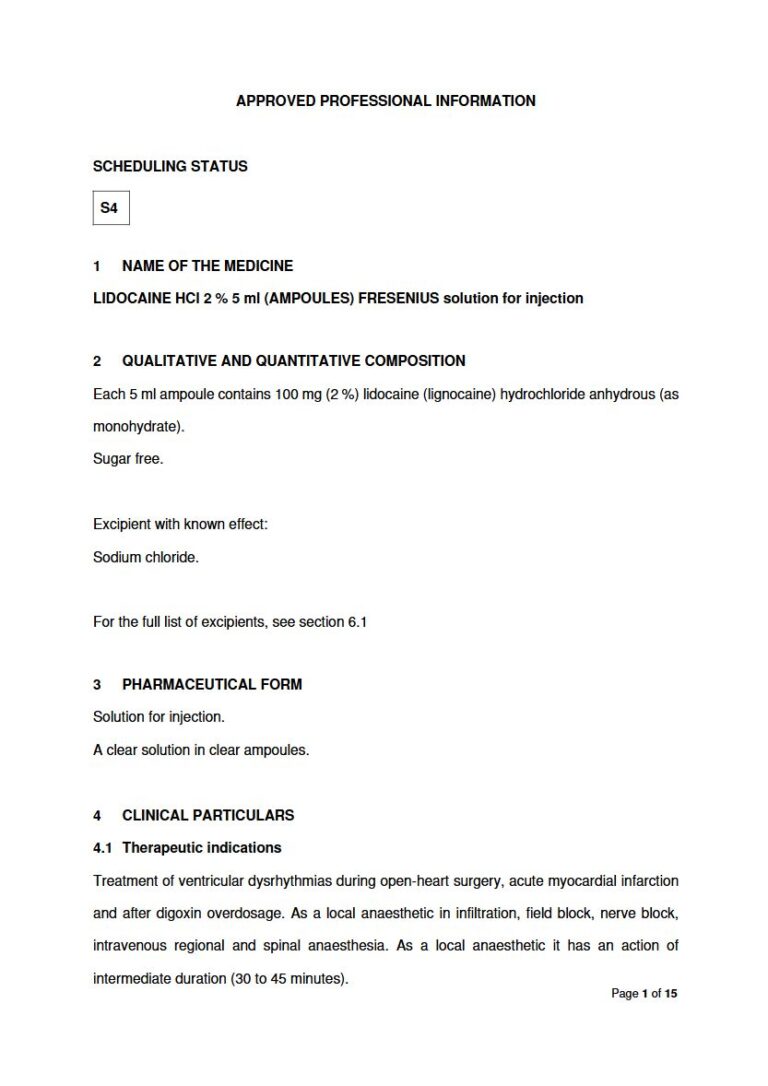
Treatment of ventricular dysrhythmias during open-heart surgery, acute myocardial infarction and after digoxin overdosage. As a local anaesthetic in infiltration, field block, nerve block, intravenous regional and spinal anaesthesia. As a local anaesthetic it has an action of intermediate duration (30 to 45 minutes).
4.2 Posology and method of administration
Posology
For the emergency treatment of acute myocardial infarction doses of up to 300 mg may be given by intramuscular injection into the deltoid muscle, followed by a 0,1 % to 0,2 % intravenous infusion (in Dextrose 5 % in water for injections) at a rate of 1 to 4 mg per minute in accordance with the needs of the patient.
For the treatment of ventricular dysrhythmias, LIDOCAINE HCl FRESENIUS is given intravenously, it may be used in advanced cardiac life support for cardiac arrest due to ventricular fibrillation and pulseless ventricular tachycardia when direct current shocks (together with adrenaline (epinephrine)) have failed to restore a normal rhythm. For adults, a dose of 100 mg (1,5 mg per kg if based on body weight) can be given and repeated after 3 to 5 minutes to a total dose of 3 mg per kg if necessary. LIDOCAINE HCl FRESENIUS is also used in other ventricular dysrhythmias in which the patient is in a more stable condition, and it is usually given as a loading dose followed by an infusion. Usual doses are 50 to 100 mg or 1,0 to 1,5 mg per kg body weight as a direct intravenous injection at a rate of 25 to 50 mg per minute. If no effect is seen within 5 to 10 minutes, it may be repeated to a maximum dose of 200 to 300 mg in 1 hour. A continuous intravenous infusion is usually commenced after loading, at a dose of 1 to 4 mg per minute. Dosage may need to be reduced in patients with heart failure or liver disorders.
As local anaesthetic:
1. Infiltration anaesthesia u2013 0,5 to 1,0 % is used.
2. Field block anaesthesia u2013 as for infiltration anaesthesia.
3. Nerve block anaesthesia u2013 depending upon which nerves or plexuses, the types of fibres to be blocked, and the duration of anaesthesia required u2013 a 1 to 1,5 % solution is used for blocks of 2 to 4 hours.
4. Intravenous regional anaesthesia of upper extremities u2013 1,5 mg/kg body mass of 0,5 % solution.
5. Spinal anaesthesia u2013 the injected concentration should not exceed 5 %. When high thoracic anaesthesia is sought, 100 mg of lignocaine (lidocaine) may be used.
6. Epidural anaesthesia u2013 determined by the segmental level of anaesthesia required. The volumes of local anaesthetic injected during epidural anaesthesia are determined principally by the type of nerve fibres to be blocked, what level of anaesthesia is required, and the technique employed. The duration of anaesthesia is frequently prolonged by addition of adrenaline (epinephrine) 1:200 000. Doses of LIDOCAINE HCl FRESENIUS should be reduced in children, the elderly, and in debilitated patients.
4.3 Contraindications
LIDOCAINE HCl FRESENIUS is contraindicated in:
u2022 Patients that are hypersensitive to lidocaine (lignocaine), local anaesthetics or any of the excipients of LIDOCAINE HCl FRESENIUS, listed in section 6.1.
u2022 Patients with hypovolaemia, heart block or other conduction disturbances, bradycardia, cardiac decompensation, or hypotension.
u2022 Sino-atrial disorders.
u2022 All grades of atrioventricular block.
u2022 Severe myocardial depression.
u2022 Patients with porphyria.
4.4 Special warnings and precautions for use
Intravenous injections should be given slowly over 2 minutes and infusion at a rate of 1 to 4 mg per minute. LIDOCAINE HCl FRESENIUS should not be given to patients with hypovolaemia, heart block or other conduction disturbances, and should be used with caution in patients with congestive heart failure, bradycardia, or respiratory depression. LIDOCAINE HCl FRESENIUS is metabolised in the liver and must be given with caution to patients with hepatic insufficiency. The plasma half-life of LIDOCAINE HCl FRESENIUS may be prolonged in conditions which reduce hepatic blood flow such as cardiac and circulatory failure. Metabolites of LIDOCAINE HCl FRESENIUS may accumulate in patients with renal impairment. LIDOCAINE HCl FRESENIUS should be used with caution in patients with impaired renal function. LIDOCAINE HCl FRESENIUS should also be given cautiously to patients with epilepsy, shock, and myasthenia gravis. Hypokalaemia, hypoxia, and disorders of acid-base balance should be corrected before treatment with intravenous LIDOCAINE HCl FRESENIUS begins. Facilities for resuscitation should be available when administering local anaesthetics. The effect of local anaesthetics may be reduced if the injection is made into an inflamed or infected area. Certain local anaesthetic procedures may be associated with serious adverse reactions, regardless of the local anaesthetic medicine used:
u2022 Central nerve blocks may cause cardiovascular depression, especially in the presence of hypovolaemia, and therefore epidural anaesthesia should be used with caution in patients with impaired cardiovascular function.
u2022 Blood pressure should be monitored during spinal anaesthesia. Epidural anaesthesia may lead to hypotension and bradycardia. This risk can be reduced by preloading the circulation with crystalloidal or colloidal solutions. Hypotension should be treated promptly.
u2022 Injections in the head and neck regions may be made inadvertently into an artery, causing cerebral symptoms even at low doses. The severity of tissue reactions is related to the degree of trauma, the concentration of the local anaesthetic and the duration of exposure of the tissue to the local anaesthetic. For this reason, the lowest effective concentration and dose of LIDOCAINE HCl FRESENIUS should be used. LIDOCAINE HCl FRESENIUS given intramuscularly, may increase creatinine phosphokinase concentrations which can interfere with the diagnosis of acute myocardial infarction. LIDOCAINE HCl FRESENIUS contains less than 1 mmol sodium (23 mg) per ampoule, that is to say essentially sodium-free.
4.5 Interaction with other medicines and other forms of interaction
Effects of LIDOCAINE HCl FRESENIUS on other medicines:
LIDOCAINE HCl FRESENIUS should be used with caution in patients receiving other local anaesthetics or medicines structurally related to amide-type local anaesthetics (e.g., antidysrhythmics, such as mexiletine), since the systemic toxic effects are additive. Specific interaction studies with lidocaine and class III antidysrhythmic medicines (e.g., amiodarone) have not been performed, but caution is advised. There may be an increased risk of enhanced and prolonged neuromuscular blockade in patients treated concurrently with muscle relaxants (e.g., suxamethonium).
Effects of other medicinal products on LIDOCAINE HCl FRESENIUS:
The clearance of LIDOCAINE HCl FRESENIUS may be reduced by beta-adrenoceptor blocking medicines (e.g., propranolol) and by cimetidine, requiring a reduction in the dosage of lidocaine. Increase in serum levels of lidocaine may also occur with antiviral medicines (e.g., amprenavir, atazanavir, darunavir, lopinavir). There may be an increased risk of ventricular dysrhythmia in patients treated concurrently with antipsychotics which prolong or may prolong the QT interval (e.g., pimozide, sertindole, olanzapine, quetiapine, zotepine), or 5-HT 3 antagonists (e.g., tropisetron, dolasetron). While adrenaline (epinephrine) when used in conjunction with LIDOCAINE HCl FRESENIUS might decrease vascular absorption, it greatly increases the danger of ventricular tachycardia and fibrillation if accidentally injected intravenously. Cardiovascular collapse has been reported following the use of bupivacaine in patients on treatment with verapamil and timolol; lidocaine (lignocaine) is closely related to bupivacaine. Concomitant use of quinupristin/dalfopristin should be avoided.
Hypokalaemia produced by acetazolamide, loop diuretics and thiazides may antagonise the effect of LIDOCAINE HCl FRESENIUS if administered concomitantly (see section 4.4). Inhibition of CYP1A2 by fluvoxamine considerably reduces elimination of lidocaine (lignocaine) and increases the risk of LIDOCAINE HCl FRESENIUS toxicity. Concomitant use of both fluvoxamine and a CYP3A4 inhibitor such as erythromycin can further increase lidocaine concentrations. Because lidocaine possesses a narrow therapeutic window, doses of LIDOCAINE HCl FRESENIUS may need to be adjusted accordingly. Conversely, reduced serum lidocaine (lignocaine) concentrations may result from medicines that may stimulate the hepatic metabolism of lidocaine (lignocaine) (e.g., phenytoin, oral hormone replacement therapy [HRT]). Narcotics are probably proconvulsants and this would support the evidence that LIDOCAINE HCl FRESENIUS reduces the seizure threshold to fentanyl in man. Opioid-antiemetic combination sometimes used for sedation in children could reduce the convulsant threshold to LIDOCAINE HCl FRESENIUS and increase the CNS depressant effect. LIDOCAINE HCl FRESENIUS is markedly bound to u03b1-l-acid glycoprotein (AAG). AAG concentrations may be reduced by oestrogens leading to a higher free fraction of lidocaine (lignocaine) in women than in men and the free fraction is further increased during pregnancy and in women taking oral contraceptives or HRT.
4.6 Fertility, pregnancy and lactation
Pregnancy
Lidocaine (lignocaine) crosses the placenta, therefore LIDOCAINE HCl FRESENIUS should not be administered during early pregnancy. LIDOCAINE HCl FRESENIUS given as epidural anaesthesia prior to delivery especially in large doses, crosses rapidly into the foetal circulation. Elevated lidocaine (lignocaine) levels may persist in the new-born for at least 48 hours after delivery. Foetal bradycardia or neonatal bradycardia, hypotonia or respiratory depression may occur. Foetal intoxication has occurred following the use of LIDOCAINE HCl FRESENIUS in labour.
Breastfeeding:
LIDOCAINE HCl FRESENIUS is excreted into breast milk and should be used with caution in nursing women.
4.7 Effects on ability to drive and use machines
LIDOCAINE HCl FRESENIUS may cause side effects such as blurred or double vision, light-headedness, drowsiness or dizziness. Patients should be advised not to drive or operate machines until it is established that their ability to perform such activities is not affected.
4.8 Undesirable effects
a. Summary of the safety profile
Adverse reactions to LIDOCAINE HCl FRESENIUS are usually the result of raised plasma concentrations due to accidental intravascular injection, excessive dosage or rapid absorption from highly vascular areas, or may result from a hypersensitivity, idiosyncrasy or diminished tolerance on the part of the patient. The systemic toxicity mainly involves the central nervous system and the cardiovascular system.
Excitation of the CNS may be manifested by restlessness, excitement, nervousness, paraesthesias, dizziness, tinnitus, blurred vision, nausea and vomiting, muscle twitching and tremors, and convulsions. Numbness of the tongue and perioral region and light-headedness followed by sedation may appear as early signs of systemic toxicity. Excitation of the central nervous system may be transient, and followed by depression, with drowsiness, respiratory failure, and coma. There is simultaneous depression of the cardiovascular system, with pallor, sweating and hypotension. Dysrhythmias, bradycardia, and cardiac arrest may be precipitated. Allergic reactions of an anaphylactic nature may occur. Drowsiness, lassitude, and amnesia have been reported with therapeutic doses of LIDOCAINE HCl FRESENIUS. Foetal intoxication has occurred following the use of LIDOCAINE HCl FRESENIUS in labour.
b. Tabulated summary of adverse reactions
MedDRA system organ class Frequency Adverse reactions
Blood and lymphatic system disorders Frequency unknown Methaemoglobinaemia.
Immune system disorders Frequency unknown Hypersensitivity reactions (allergic or anaphylactoid reactions, anaphylactic shock).
Nervous system disorders Frequency unknown Neurological signs of systemic toxicity include restlessness, excitement, dizziness or light-headedness, nervousness, tremor, circumoral paraesthesia, numbness of the tongue and perioral region, drowsiness, convulsions, coma
Eye disorders Frequency unknown Blurred vision, diplopia and transient amaurosis may be signs of lidocaine toxicity. Bilateral amaurosis may also be a consequence of accidental injection of the optic nerve sheath during ocular procedures.
Ear and labyrinth disorders Frequency unknown Tinnitus, hyperacusis.
Cardiac disorders Frequency unknown Cardiovascular reactions are depressant and may manifest as hypotension, bradycardia, myocardial depression, cardiac dysrhythmias and possibly cardiac arrest or circulatory collapse. Isolated cases of bradycardia and cardiac arrest have also been reported.
Vascular disorders Frequency unknown Hypotension often accompanies spinal and epidural anaesthesia.
Respiratory, thoracic, and mediastinal disorders Frequency unknown Dyspnoea, bronchospasm, respiratory depression, respiratory arrest.
Gastrointestinal disorders Frequency unknown Nausea, vomiting.
Skin and subcutaneous tissue disorders Frequency unknown Rash, urticaria, oedema (including angioedema, face oedema).
4.9 Overdose
See symptoms mentioned under section 4.8. Treatment is symptomatic and supportive.
Symptoms of acute systemic toxicity: Central nervous system toxicity presents with symptoms of increasing severity. Patients may present initially with circumoral paraesthesia, numbness of the tongue, light-headedness, hyperacusis and tinnitus. Visual disturbance and muscular tremors or muscle twitching are more serious and precede the onset of generalised convulsions. These signs must not be mistaken for neurotic behaviour. Unconsciousness and grand mal convulsions may follow, which may last from a few seconds to several minutes. Hypoxia and hypercapnia occur rapidly following convulsions due to increased muscular activity, together with the interference with normal respiration and loss of the airway. In severe cases, apnoea may occur. Acidosis increases the toxic effects of local anaesthetics. Effects on the cardiovascular system may be seen in severe cases. Hypotension, bradycardia, dysrhythmia, and cardiac arrest may occur because of high systemic concentrations, with potentially fatal outcome. Recovery occurs because of redistribution of the local anaesthetic medicine from the central nervous system, and of metabolism and may be rapid unless large amounts of lignocaine (lidocaine) have been injected.
Treatment of acute toxicity: If signs of acute systemic toxicity appear, injection of LIDOCAINE HCL FRESENIUS should be stopped immediately. Treatment will be required if convulsions and CNS depression occurs. The objectives of treatment are to maintain oxygenation, stop the convulsions and support the circulation. A patent airway should be established, and oxygen should be administered, together with assisted ventilation (mask and bag) if necessary. The circulation should be maintained with infusions of plasma or intravenous fluids. Where further supportive treatment of circulatory depression is required, use of a vasopressor type of medicine may be considered although this involves a risk of central nervous system excitation. If the convulsions do not stop spontaneously in 15 u2013 20 seconds, they may be controlled by the intravenous administration of diazepam or thiopentone sodium, bearing in mind that anticonvulsant medicines may also depress respiration and the circulation. Prolonged convulsions may jeopardise the patient's ventilation and oxygenation and early endotracheal intubation should be considered. If cardiac arrest should occur, standard cardiopulmonary resuscitation procedures should be instituted. Continual optimal oxygenation and ventilation and circulatory support as well as treatment of acidosis are of vital importance. Dialysis is of negligible value in the treatment of acute overdosage with LIDOCAINE HCL FRESENIUS.
