
Lotemax Co 5 mg Eye drops, suspension
PDF Leaflet Revision Date: 10 August 2022
Clinical Summary
Quick overview from the medicine insert
Indication
Treatment of bacterial ocular infections and inflammatory conditions.
Dosage (summary)
1-2 drops every 4-6 hours; may increase to 1-2 hours initially.
Special Populations
- Elderly
- Paediatric population
Pregnancy & Breastfeeding
Not established; contraindicated in pregnancy and breastfeeding.
Key Drug Interactions
- CYP3A inhibitors
- Neuromuscular blocking agents
Contraindications
- Hypersensitivity to components
- Viral infections of the eye
Common side effects
- Burning/stinging
- Increased intraocular pressure
- Headache
Counselling Points
- Do not touch the applicator tip
- Avoid contact lenses during use
- Monitor for increased intraocular pressure
Serious warnings
- Prolonged use may cause glaucoma
- Risk of secondary infections
Important Disclaimer
The Lotemax Co 5 mg Eye drops, suspension professional information leaflet below is the property of Soflens and is provided on Medinsert exactly as issued, with no.. alterations or editorial changes. We make every effort to keep content current by updating documents as soon as new versions become available. Medinsert serves as a trusted access point for healthcare professionals, but does not replace official sources or clinical judgement. For more details, please read our full disclaimer. read more>>
 Healthcare Professionals Only
This content is for registered healthcare professionals
Sign in or create a free account to read the full package insert.
Free for HPCSA-registered professionals. Powered by Medinsert.
Clinical Particulars
Section 4 of the official insert — extracted exactly as issued, no alterations
4.1 Therapeutic indications
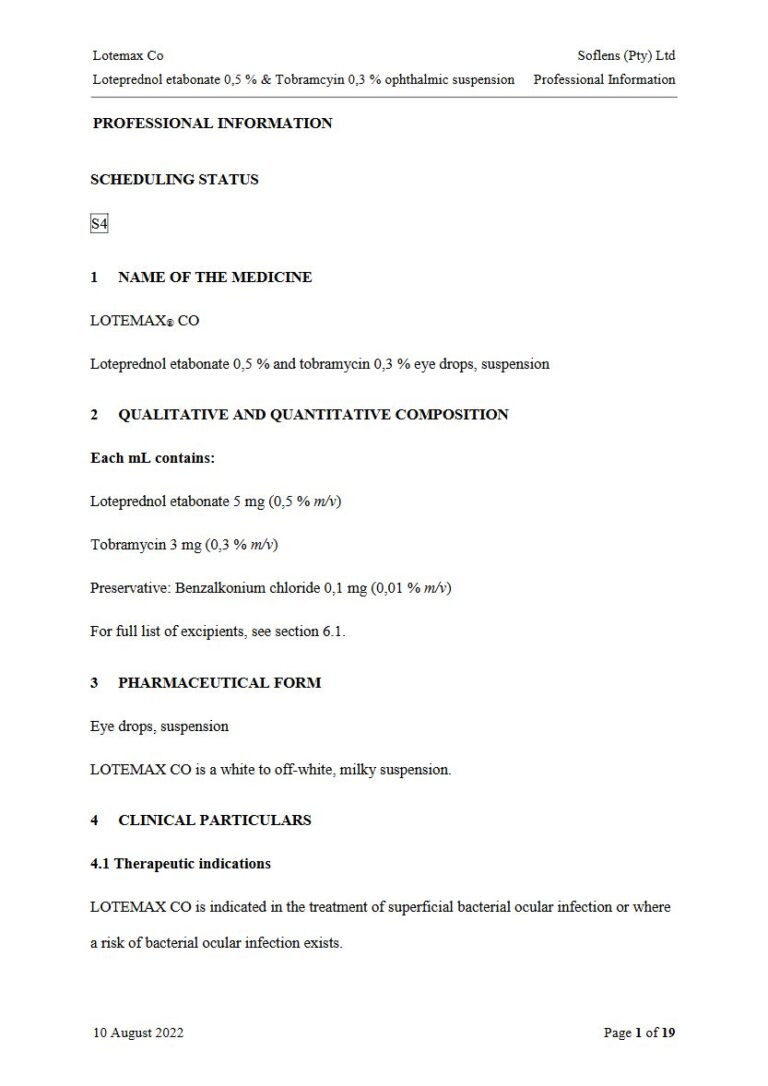
LOTEMAX CO is indicated in the treatment of superficial bacterial ocular infection or where a risk of bacterial ocular infection exists.
LOTEMAX CO is indicated in the treatment of inflammatory conditions of the palpebral and bulbar conjunctiva, cornea and anterior segment of the globe such as allergic conjunctivitis, acne rosacea, superficial punctate keratitis, herpes zoster keratitis, iritis, and cyclitis.
LOTEMAX CO is also indicated in chronic anterior uveitis and corneal injury from chemical, radiation or thermal burns, or penetration of foreign bodies.
The particular anti-infective medicine in this product (tobramycin) is active against the following common bacterial eye pathogens: Staphylococci, including S. aureus and S. epidermidis (coagulase-positive and coagulase-negative), including penicillin-resistant strains. Streptococci, including some of the Group A-beta-haemolytic species, some nonhemolytic species, and some Streptococcus pneumoniae, Pseudomonas aeruginosa, Escherichia coli, Klebsiella pneumoniae, Enterobacter aerogenes, Proteus mirabilis, Morganella morganii, most Proteus vulgaris strains, Haemophilus influenzae, and H. aegyptius, Moraxella lacunata, Acinetobacter calcoaceticus and some Neisseria species.
4.2 Posology and method of administration
SHAKE VIGOROUSLY BEFORE USING.
Recommended dosing: Apply one or two drops of LOTEMAX CO into the conjunctival sac of the affected eye(s) every four to six hours. During the initial 24 to 48 hours, the dosing may be increased, to every one to two hours. Frequency should be decreased gradually as warranted by improvement in clinical signs. Care should be taken not to discontinue therapy prematurely.
Prescription guideline: Not more than 20 ml should be prescribed initially, and the prescription should not be repeated without further evaluation (see section 4.4)
Handling the container: To avoid contamination, patients should be advised not to let the applicator tip touch the surface of the eye, fingers, or any other surface.
Paediatric population: Currently available data are described in section 5.1 but no recommendation on a posology can be made.
Elderly populations: No clinical differences in safety have been observed between elderly and younger patients.
4.3 Contraindications
Hypersensitivity to tobramycin, loteprednol etabonate, other corticosteroids or any other ingredients listed in section 6.1.
LOTEMAX CO is contraindicated in most viral diseases of the cornea and conjunctiva including epithelial herpes simplex keratitis (dendritic keratitis), vaccinia, and varicella, and also in mycobacterial infection of the eye and fungal diseases of ocular structures.
4.4 Special warnings and precautions for use
Prescribers must adhere to the principles of antibiotic stewardship.
For ophthalmic use only, not for injection into the eye or other tissue.
If pain develops, redness, itching or inflammation become aggravated, the patient should be advised to consult a medical doctor.
Avoidance of contact lenses: LOTEMAX CO contains benzalkonium chloride, patients should be advised not to wear soft contact lenses when using LOTEMAX CO.
Benzalkonium chloride has been reported to cause eye irritation, symptoms of dry eyes and may affect the tear film and corneal surface. LOTEMAX CO should be used with caution in dry eye patients and in patients where the cornea may be compromised. Patients should be monitored in case of prolonged use.
As the possibility of adverse effects on the corneal permeability, and the danger of disruption of the corneal epithelium with prolonged or repeated usage of benzalkonium chloride preserved ophthalmological preparations, cannot be excluded, regular ophthalmological examination is required. Caution should be exercised in the use of benzalkonium chloride preserved topical medication over an extended period in patients with extensive ocular surface disease.
Paediatric population: From the limited data available, there is no difference in the adverse event profile in children compared to adults. Generally, however, eyes in children show a stronger reaction for a given stimulus than the adult eye. Irritation may have an effect on treatment adherence in children.
Intraocular Pressure (IOP) Increase: Prolonged use of corticosteroids may result in glaucoma with damage to the optic nerve, defects in visual acuity and fields of vision. Steroids should be used with caution in the presence of glaucoma. If this product is used for 10 days or longer, intraocular pressure should be monitored.
Cataracts: Use of corticosteroids may result in posterior subcapsular cataract formation.
Delayed Healing: The use of steroids after cataract surgery may delay healing and increase the incidence of bleb formation. In those diseases causing thinning of the cornea or sclera, perforations have been known to occur with the use of topical steroids. The initial prescription and repeats of the prescription should be made by a medical practitioner only after examination of the patient with the aid of magnification such as a slit lamp biomicroscopy and, where appropriate, fluorescein staining.
Bacterial Infections: Prolonged use of corticosteroids may suppress the host response and thus increase the hazard of secondary ocular infections. In acute purulent conditions of the eye, steroids may mask infection or enhance existing infection. If signs and symptoms fail to improve after 2 days, the patient should be re-evaluated.
Viral Infections: Employment of a corticosteroid medication in the treatment of patients with a history of herpes simplex requires great caution. Use of ocular steroids may prolong the course and may exacerbate the severity of many viral infections of the eye (including herpes simplex).
Fungal Infections: Fungal infections of the cornea are particularly prone to develop coincidentally with long-term local steroid application. Fungus invasion must be considered in any persistent corneal ulceration where a steroid has been used or is in use.
Aminoglycoside Hypersensitivity: Sensitivity to topically applied aminoglycosides may occur in some patients. Cross-sensitivity to other aminoglycoside antibiotics may also occur, and the possibility that patients who become sensitized to topical ocular tobramycin may also be sensitive to other topical and/or systemic aminoglycosides should be considered. If hypersensitivity develops with this product, discontinue use and institute appropriate therapy.
Serum Concentration: Serious adverse reactions including neurotoxicity, ototoxicity and nephrotoxicity have occurred in patients receiving systemic aminoglycoside therapy. If topical ocular tobramycin is administered concomitantly with systemic aminoglycoside antibiotics, care should be taken to monitor the total serum concentration.
Caution should be exercised when prescribing LOTEMAX CO to patients with known or suspected neuromuscular disorders such as myasthenia gravis or Parkinsonu2019s disease. Aminoglycosides may aggravate muscle weakness because of their potential effect on neuromuscular function. Prolonged use may lead to skin sensitisation or result in overgrowth of non-susceptible organisms, including fungi. If superinfection occurs, appropriate therapy should be initiated.
4.5 Interaction with other medicines and other forms of interaction
No interaction studies have been performed.
Since loteprednol etabonate is not detected in significant amounts in plasma following the topical administration, it is not expected to affect the pharmacokinetics of systemically administered medicinal products. However, the low potential of ocular loteprednol etabonate to increase the intraocular pressure may be adversely affected by systemically administered medicinal products with anticholinergic activity.
In patients receiving concomitant ocular hypotensive therapy, the addition of loteprednol etabonate may increase intraocular pressure and decrease the apparent ocular hypotensive effect of these medicinal products.
Co-treatment with CYP3A inhibitors, including cobicistat-containing products, is expected to increase the risk of systemic side-effects. The combination should be avoided unless the benefit outweighs the increased risk of systemic corticosteroid side-effects, in which case patients should be monitored for systemic corticosteroid side-effects.
No clinically relevant interactions for tobramycin have been described with topical ocular dosing. Care should be exercised when tobramycin is given to patients receiving other medicines with neuromuscular blocking activity or which are ototoxic. Tobramycin and carbenicillin have been reported to have an enhanced effect. However, since an in vitro incompatibility with carbenicillin sodium has been demonstrated, the two antibiotics should be administered separately when both are required.
4.6 Fertility, pregnancy and lactation
Pregnancy: Safety of LOTEMAX CO in pregnancy has not been established. There are no adequate and well controlled studies of tobramycin in pregnant women.
Teratogenic effects: Loteprednol etabonate has been shown to be embryotoxic and teratogenic when administered to animals. The potential risk for humans is unknown and LOTEMAX CO should not be used in pregnancy.
Breastfeeding: Systemic steroids appear in human milk and could suppress growth, interfere with endogenous corticosteroid production or cause other untoward effects. Mothers on treatment with LOTEMAX CO should not breastfeed their babies.
4.7 Effects on ability to drive and use machines
LOTEMAX CO may cause blurred vision or other visual disturbances which may affect the ability to drive or use machines. If abnormal or blurred vision occurs at instillation, patients should wait until their vision clears before driving or using machinery.
4.8 Undesirable effects
a. Summary of the safety profile: Adverse reactions have occurred with steroid/anti-infective combination medicines which can be attributed to the steroid component, the anti-infective component, or the combination. LOTEMAX CO: In a 42-day safety study of LOTEMAX CO, ocular adverse reactions included injection (21 %) and superficial punctate keratitis (13 %). Increased intraocular pressure was reported in 10 % of LOTEMAX CO subjects. Nine percent (9 %) of LOTEMAX CO subjects reported burning and stinging upon instillation. Ocular reactions reported with an incidence less than 4 % include vision disorders, discharge, itching, lacrimation disorder, photophobia, corneal deposits, ocular discomfort, eyelid disorder, and other unspecified eye disorders. The incidence of non-ocular reactions reported in approximately 14 % of subjects was headache; all other non-ocular reactions had an incidence of less than 5 %.
Loteprednol etabonate: Reactions associated with ophthalmic steroids include elevated intraocular pressure, which may be associated with infrequent optic nerve damage, visual acuity and field defects, posterior subcapsular cataract formation, delayed wound healing and secondary ocular infection from pathogens including herpes simplex, and perforation of the globe where there is thinning of the cornea or sclera. In randomized studies of individuals treated for 28 days or longer with loteprednol etabonate, the incidence of significant elevation of intraocular pressure (u2265 10 mm Hg) was 2 % (15/901) among patients receiving loteprednol etabonate.
Tobramycin: The most frequent adverse reactions to topical tobramycin are hypersensitivity and localized ocular toxicity, including lid itching and swelling and conjunctival erythema. These reactions occur in less than 4 % of patients. Similar reactions may occur with the topical use of other aminoglycoside antibiotics.
Secondary Infection: The development of secondary infection has occurred after use of combinations containing steroids and antimicrobials. Fungal infections of the cornea are particularly prone to develop coincidentally with long-term applications of steroids. The possibility of fungal invasion must be considered in any persistent corneal ulceration where steroid treatment has been used. Secondary bacterial ocular infection following suppression of host responses also occurs.
b. Tabulated list of adverse reactions: Adverse reactions are categorized by frequency as follows: very common (u22651/10), common (u22651/100 to < 1/10), uncommon (u22651/1 000 to < 1/100), rare (u22651/10 000 to < 1/1 000), very rare (<1/10 000).
Adverse events from LOTEMAX CO clinical trials: System Organ Class Frequency Undesirable effects Nervous system disorders Common Headache Eye disorders Common Burning/stinging upon instillation, blurred vision, conjunctivitis, increased lacrimation, eye pain, meibomianitis, corneal staining, eyelid erythema, eyelid oedema Uncommon Increased intraocular pressure, foreign body sensation, asthenopia, keratitis Gastrointestinal disorders Uncommon Nausea
Skin and subcutaneous tissue disorders Common Rash Adverse reactions from clinical trials with Loteprednol etabonate eye drops: System Organ Class Frequency Undesirable effects Eye disorders Very common Abnormal vision / blurring, burning on instillation, chemosis, discharge, dry eye, epiphora, foreign body sensation, itching, infection, photophobia Common Conjunctivitis, corneal abnormalities, eyelid erythema, keratoconjunctivitis, ocular irritation / pain / discomfort, papillae, uveitis Vascular disorders Very common Headache Respiratory, thoracic and mediastinal disorders Very common Rhinitis and pharyngitis Adverse reactions from clinical trials with Tobramycin eye drops: System Organ Class Frequency Undesirable effects Immune system disorders Uncommon Hypersensitivity Nervous system disorders Uncommon Headache Eye disorders Common Ocular discomfort, ocular hyperaemia Uncommon Keratitis, corneal abrasion, visual impairment, vision blurred, erythema of eyelid, conjunctival oedema, eyelid oedema, eye pain, dry eye, eye discharge, eye pruritis, lacrimation increased Skin and subcutaneous tissue disorders Uncommon Urticaria, dermatitis, madarosis, leukoderma, pruritis, dry skin Adverse reactions observed from post-marketing surveillance include the following. Frequencies cannot be estimated from the available data. Loteprednol etabonate eye drops: System Organ Class Undesirable effects Eye disorders Elevated intraocular pressure with damage to the optic nerve, visual acuity and field defects, posterior subcapsular cataract formation, secondary ocular infection, perforation of the globe Tobramycin eye drops: System Organ Class Undesirable effects Infections and infestations Eye infection (secondary) Immune system disorders Anaphylactic reaction, hypersensitivity (local) Eye disorders Eye allergy, eye irritation, ocular hyperaemia, blurred vision, eyelid oedema, eyelids pruritis, eye pain (periorbital) Skin and subcutaneous tissue disorders Erythema (periorbital), rash
d. Paediatric population: In paediatric studies with LOTEMAX CO, rates of incidence of adverse events were not higher than those of the adult studies.
e. Other special populations: Elderly use: No overall differences in safety have been observed between elderly and younger patients.
Reporting of suspected adverse reactions: Reporting suspected adverse reactions after authorisation of the medicine is important. It allows continued monitoring of the benefit-risk of the medicine. Health care providers are asked to report any suspected adverse reactions to SAHPRA via the u201cAdverse Drug Reactions Reporting Formu201d, found online under SAHPRAu2019s publications: https://www.sahpra.org.za/Publications/Index/8 Suspected adverse reactions may also be reported directly to the Holder of the Certificate of registration at the following e-mail address: [email protected]
4.9 Overdose
Overdosage of this medicine is unlikely to occur via the ophthalmic route. In overdose, side effects can be precipitated and/or be of increased severity (see section 4.8). Treatment is supportive and symptomatic.
