
Lymecycline Activo 300 mg Hard capsules.
PDF Leaflet Revision Date: 24 June 2025
Clinical Summary
Quick overview from the medicine insert
Indication
Treatment of infections caused by susceptible pathogens.
Dosage (summary)
300 mg/day for acne; 300 mg every 12 hours for other indications.
Onset of Action / Duration
Onset: 2-4 hours, Duration: 12 hours
Special Populations
- Elderly
- Children under 12
Pregnancy & Breastfeeding
Contraindicated in pregnancy and breastfeeding due to risks of liver damage and dental issues in infants.
Key Drug Interactions
- Antacids
- Oral retinoids
- Anticoagulants
- Lithium
Contraindications
- Hypersensitivity
- Impaired renal function
- Children under 12
- Systemic lupus erythematosus
Common side effects
- Nausea
- Abdominal pain
- Diarrhoea
- Headache
Counselling Points
- Take with adequate fluids
- Avoid sun exposure
- Report severe side effects immediately
Serious warnings
- Photosensitivity
- Hepatotoxicity
- Increased intracranial pressure
Important Disclaimer
The Lymecycline Activo 300 mg Hard capsules. professional information leaflet below is the property of Activo Health and is provided on Medinsert exactly as issued, with no.. alterations or editorial changes. We make every effort to keep content current by updating documents as soon as new versions become available. Medinsert serves as a trusted access point for healthcare professionals, but does not replace official sources or clinical judgement. For more details, please read our full disclaimer. read more>>
 Healthcare Professionals Only
This content is for registered healthcare professionals
Sign in or create a free account to read the full package insert.
Free for HPCSA-registered professionals. Powered by Medinsert.
Clinical Particulars
Section 4 of the official insert — extracted exactly as issued, no alterations
4.1 Therapeutic indications
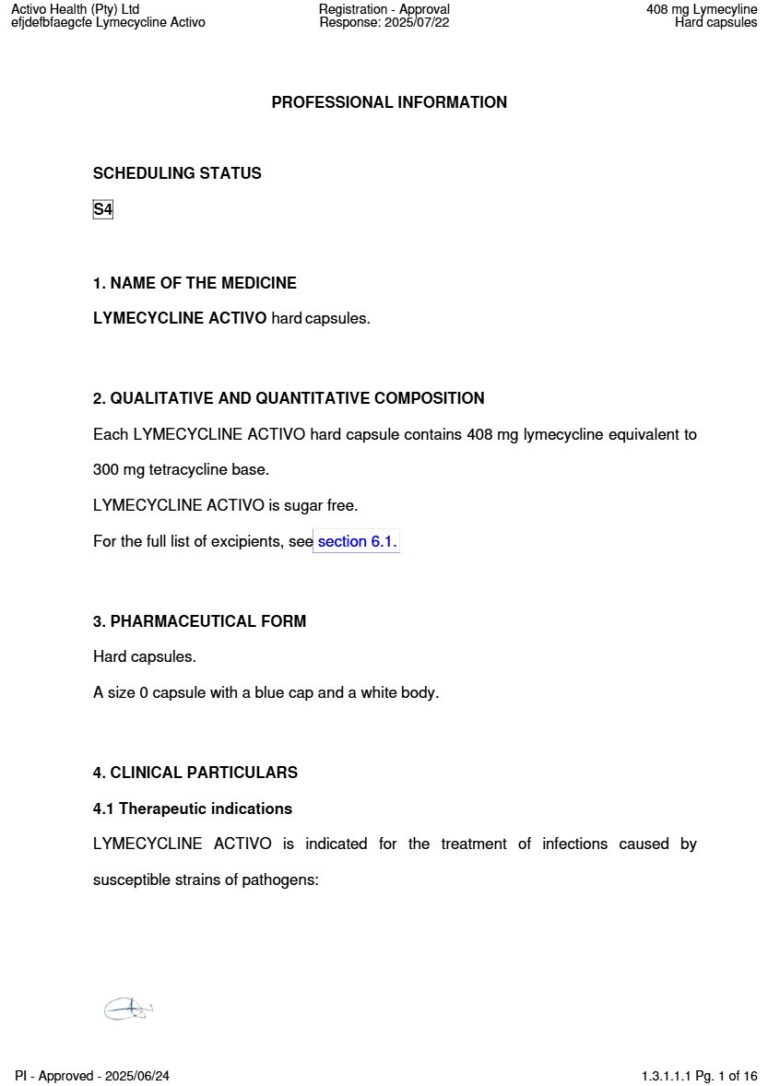
LYMECYCLINE ACTIVO is indicated for the treatment of infections caused by susceptible strains of pathogens:
- Upper and lower respiratory tract infections: Sinusitis, pharyngitis, Mycoplasma pneumoniae, psittacosis and chronic bronchitis.
- Genito-urinary tract infections: Non-specific urethritis (only if the strain is sensitive), lymphogranuloma venereum, chancroid and granuloma inguinale, gonococcal salpingitis, epididymitis, acute epididymo-orchitis, endocervical infections, syphilis and gonorrhoea (in cases of penicillin allergy).
- Soft tissue infections: Acne.
- Ophthalmic infections: Trachoma and inclusion conjunctivitis.
- Intestinal infections: Cholera, Whippleu2019s disease and tropical sprue.
- Miscellaneous infections: Rickettsial infections, brucellosis, tularemia, actinomycosis, Lyme disease, yaws, relapsing fever, leptospirosis during the early infective phase.
It is effective in-vitro against gram-positive and gram-negative organisms (in-vitro activity does not necessarily imply in-vivo efficacy), including: Vibrio cholerae, Ureaplasma urealyticum, Mycoplasma pneumoniae, Chlamydia trachomatis, Chlamydia psittaci, Borrelia recurrentis, Calyminatobacterium granulomatis, Borrelia burgdorferi, penicillin sensitive Neisseria gonorrhoea and Rickettsiae. Lymecycline is also effective against the following organisms in-vitro: Haemophilus ducreyi, Actinomyces israelii, Francisella tularensis and Treponema pertenue.
4.2 Posology and method of administration
Posology
Adults: The recommended dose for acne is 300 mg/day with a usual treatment duration of 12 weeks. The usual dose for indications other than acne is 300 mg every 12 hours (depending on the severity of infection). The maximum dose of LYMECYCLINE ACTIVO should not exceed 3 g daily for adults and 50 mg/kg body mass per day for children.
Special populations
Elderly: No specific dose adjustment is required.
Paediatric population: The safety and efficacy in children younger than 12 years of age have not been established.
Method of administration: Capsules should be taken either one hour before meals or two hours after meals with adequate liquid to avoid lodging of capsules in the distal oesophagus resulting in local corrosive irritation and ulceration.
4.3 Contraindications
LYMECYCLINE ACTIVO is contraindicated in:
- patients with hypersensitivity to lymecycline, any other tetracyclines or any of the other excipients listed is section 6.1.
- patients with impaired renal function.
- children under the age of 12 years due to the risk of permanent discolouration of teeth and enamel hypoplasia.
- patients with systemic lupus erythematosus.
- patients on concurrent treatment with oral retinoids (see sections 4.5).
- pregnancy and lactation (see section 4.6).
4.4 Special warnings and precautions for use
Prescribers must abide by the principles of antibiotic stewardship.
Impaired renal or liver function: LYMECYCLINE ACTIVO is contraindicated for use in patients with impaired renal function (see section 4.3). Increased severity of uraemia and hepatotoxicity have been found in patients with renal disease given high doses. Caution should be exercised if LYMECYCLINE ACTIVO is administered to patients with liver-function impairment.
Oesophageal irritation and ulceration: Solid dosage forms of tetracyclines, as contained in LYMECYCLINE ACTIVO, may cause oesophageal irritation and ulceration. To avoid oesophageal irritation and ulceration, LYMECYCLINE ACTIVO should be taken with adequate fluids (water) (see section 4.2).
Hepatotoxicity: Overdosage could result in hepatotoxicity. Frail or elderly patients are susceptible to hepatotoxic medicines and the anti-anabolic effects of tetracyclines. Do not use LYMECYCLINE ACTIVO in combination with hepatotoxic medicines.
Antibiotic resistance: Prescribers must adhere to the principles of antibiotic stewardship. Prolonged use of broad spectrum antibiotics may result in the appearance of resistant organisms and superinfection (see section 4.8).
Phototoxicity: Photosensitivity of the skin and nails may occur (see section 4.8). Due to the risks of photosensitivity, it is recommended to avoid exposure to direct sunlight and ultraviolet light for the duration of treatment. Treatment should be discontinued if erythematous cutaneous manifestations occur.
Expired medication: The use of expired tetracyclines, like LYMECYCLINE ACTIVO, may lead to a Fanconi-type syndrome renal tubular acidosis (Pseudo-Fanconi syndrome) which is characterised by polyuria and polydipsia with nausea, vomiting, proteinuria, glucosuria, acidosis, aminoaciduria, hypophosphatemia and hypocalcaemia. This is readily reversible upon treatment discontinuation.
Systemic lupus erythematosus: Treatment with LYMECYCLINE ACTIVO may cause exacerbations of systemic lupus erythematosus (see section 4.3).
Myasthenia Gravis: LYMECYCLINE ACTIVO should be used with caution in Myasthenia Gravis, as it can cause weak neuromuscular blockade, which may aggravate the symptoms associated with this condition.
Jarisch-Herxheimer-like reaction: A Jarisch-Herxheimer-like reaction has been reported in patients with relapsing fever treated with tetracyclines.
Vitamin deficiencies: Vitamin deficiencies may occur with prolonged use of LYMECYCLINE ACTIVO.
Special Population
Elderly: A negative nitrogen balance may be induced with lymecycline, as contained in LYMECYCLINE ACTIVO, in elderly patients.
Paediatric population: Use in children under the age of 12 years is not recommended due to the risk of permanent dental staining and enamel hypoplasia (see section 4.3). Raised intracranial pressure may occur, particularly in infants, and especially if LYMECYCLINE ACTIVO is used concurrently with Vitamin A or other retinoids (see sections 4.3 and 4.5).
4.5 Interaction with other medicines and other forms of interaction
The risk of benign intracranial hypertension may be increased by the concurrent use of LYMECYCLINE ACTIVO with oral retinoids and Vitamin A (above 10 000 IU/day). This combination must be avoided (see section 4.3).
Simultaneous administration of iron preparations or preparations containing magnesium, aluminium and calcium hydroxides, sodium bicarbonate, oxides, salts, cholestyramine, bismuth chelates, sucralfate and quinapril may decrease the absorption of lymecycline, as contained in LYMECYCLINE ACTIVO. Patients should therefore not receive antacid therapy or milk concomitantly.
Enzyme inducers such as barbiturates, carbamazepine and phenytoin may accelerate the decomposition of tetracycline due to enzyme induction in the liver thereby decreasing its half-life. These products should not be taken within two hours before or two hours after taking LYMECYCLINE ACTIVO.
An increase in the effects of anticoagulants may occur with concurrent tetracycline use, resulting in an increased risk of haemorrhage. Doses of anticoagulants may need to be reduced if used simultaneously.
Concurrent use with diuretics should be avoided. Medicines containing penicillin and beta-lactams should not be used concurrently with tetracyclines, as contained in LYMECYCLINE ACTIVO, as an antagonistic effect may occur. The interaction between lithium and the tetracycline class is a recognised one and adverse effects have been reported with tetracycline therapy in general when used simultaneously with lithium. The concurrent use of lymecycline, as contained in LYMECYCLINE ACTIVO, with lithium may cause an increase in serum lithium levels.
LYMECYCLINE ACTIVO may decrease the effectiveness of oral contraceptives. Serious nephrotoxicity may occur with concurrent use of LYMECYCLINE ACTIVO with methoxyflurane.
Paediatric population: There are no data available from interaction studies in this population group.
4.6 Fertility, pregnancy and lactation
Pregnancy: Lymecycline crosses the placental barrier and is deposited in foetal bones and teeth. Pregnant women are at an increased risk of developing severe tetracycline-induced liver damage. LYMECYCLINE ACTIVO should not be used by pregnant women (see section 4.3).
Breastfeeding: Lymecycline is readily excreted into breast milk. LYMECYCLINE ACTIVO should not be administered to breastfeeding women (due to the risk of enamel hypoplasia or dental dyschromia in the infant) (see section 4.3).
Fertility: No data on the effect on fertility are available.
4.7 Effects on ability to drive and use machines
The effect of lymecycline, as contained in LYMECYCLINE ACTIVO, on the ability to drive and use machines is determined by the adverse effects such as visual disturbances and dizziness (see section 4.8). Patients should establish the effect of adverse effects before they drive or use machines.
4.8 Undesirable effects
Summary of safety profile: The most frequently reported adverse events are gastrointestinal disorders of nausea, abdominal pain, diarrhoea and nervous system disorder of headache. The most serious adverse events reported are Stevens-Johnson syndrome, anaphylactic reaction, angioedema and intracranial hypertension.
List of adverse reactions:
- Blood and lymphatic system disorders: Frequency unknown: haemolytic anaemia, eosinophilia, neutropenia and thrombocytopenia.
- Immune system disorders: Frequency unknown: anaphylactic reaction, hypersensitivity, urticaria and angioedema.
- Psychiatric disorders: Frequency unknown: depression and nightmare.
- Nervous system disorders: Frequent: headache.* Frequency unknown: dizziness and intracranial hypertension.
- Eye disorders: Frequency unknown: visual disturbance.*
- Gastrointestinal disorders: Frequent: nausea, abdominal pain and diarrhoea. Frequency unknown: epigastralgia (gastrointestinal pain upper), glossitis, vomiting and enterocolitis.
- Hepato-biliary disorders: Frequency unknown: jaundice and hepatitis.
- Skin and subcutaneous tissues disorders: Frequency unknown: erythematous rash, photosensitivity of the skin and nails, pruritus, Stevens-Johnson syndrome, nail discolouration and oncholysis.
- General disorders and administration site conditions: Frequency unknown: pyrexia.
- Investigations: Frequency unknown: transaminases increased, blood alkaline phosphatase increased and blood bilirubin increased.
Description of selected adverse reactions: * Increased intracranial pressure: The manifestation of clinical symptoms, including vision disorders, or headache, may be indicative of the possibility of a cranial hypertension diagnosis. If increased intracranial pressure is suspected during treatment with LYMECYCLINE ACTIVO, treatment should be discontinued.
Benign intracranial hypertension and bulging fontanelles in infants have been reported with tetracyclines, as contained in LYMECYCLINE ACTIVO, with possible symptoms of headaches, vomiting, visual disturbances including blurring of vision, scotomata, diplopia or permanent visual loss.
Symptoms resulting from the overgrowth of non-susceptible organisms: Overgrowth of non-susceptible organisms may cause candidiasis, pseudomembranous colitis (Clostridium difficile overgrowth), glossitis, stomatitis, vaginitis or staphylococcal enterocolitis. Overgrowth of Candida albicans in the mouth causes soreness, redness and thrush, which may extend into the bronchi and trachea; overgrowth of C. albicans in the bowel results in pruritis ani and vulvovaginitis and there may be overgrowth of resistant coliform organisms, such as Pseudomonas species and Proteus species, causing diarrhoea. Colitis due to Clostridium difficile may occur. Super-infection due to resistant staphylococci may cause fulminating enteritis.
Allergic (hypersensitivity) reactions: Allergic reactions to lymecycline, as contained in LYMECYCLINE ACTIVO, and its analogues have been reported. Cross-sensitisation is common. Symptoms include maculopapular rashes, exfoliative dermatitis, exacerbation of systemic lupus erythematosus, pericarditis and Henoch-Schu00f6nlein purpura (anaphylactoid purpura).
Tetracyclines class adverse effects: The following adverse effects were reported with tetracyclines in general and may occur with LYMECYCLINE ACTIVO: dysphagia, oesophagitis, oesophageal ulceration, systemic lupus erythematosus, pancreatitis, teeth discolouration, hepatitis and hepatic failure. Dental dyschromia and/or enamel hypoplasia may occur if administered to children younger than 12 years of age.
Reporting of suspected adverse reactions: Reporting suspected adverse reactions after authorisation of the medicine is important. It allows continued monitoring of the benefit/risk balance of the medicine. Health care providers are asked to report any suspected adverse reactions to SAHPRA via the Med Safety APP (Medsafety X SAHPRA) and eReporting platform (who-umc.org) found on the SAHPRA website.
4.9 Overdose
In overdose, side effects can be precipitated and/or be of increased severity (see section 4.8). If idiosyncrasy or adverse reactions occur, discontinue the use of LYMECYCLINE ACTIVO. There is no specific treatment for overdosage. Treatment should be supportive and symptomatic.
