
Actasvo 0,5 mg Capsules
PDF Leaflet Revision Date: 18 June 2025
Clinical Summary
Quick overview from the medicine insert
Indication
Treatment of Benign Prostatic Hyperplasia (BPH).
Dosage (summary)
1 capsule (0.5 mg) orally once daily.
Onset of Action / Duration
Onset: 1-2 weeks, Duration: 6-8 hours
Special Populations
- Renal impairment
- Hepatic impairment
Pregnancy & Breastfeeding
Contraindicated in pregnancy; potential risk to male fetus. Unknown if excreted in breast milk.
Key Drug Interactions
- CYP3A4 inhibitors
- Tamsulosin
- Terazosin
Contraindications
- Hypersensitivity to dutasteride
- Women and children
- Severe hepatic impairment
Common side effects
- Impotence
- Altered libido
- Ejaculation disorders
- Breast disorders
Counselling Points
- Avoid contact with leaking capsules
- Report breast changes
- Use condoms if partner is pregnant
Serious warnings
- Risk of high-grade prostate cancer
- Breast neoplasia
- Cardiovascular adverse events
Important Disclaimer
The Actasvo 0,5 mg Capsules professional information leaflet below is the property of Activo Health and is provided on Medinsert exactly as issued, with no.. alterations or editorial changes. We make every effort to keep content current by updating documents as soon as new versions become available. Medinsert serves as a trusted access point for healthcare professionals, but does not replace official sources or clinical judgement. For more details, please read our full disclaimer. read more>>
 Healthcare Professionals Only
This content is for registered healthcare professionals
Sign in or create a free account to read the full package insert.
Free for HPCSA-registered professionals. Powered by Medinsert.
Clinical Particulars
Section 4 of the official insert — extracted exactly as issued, no alterations
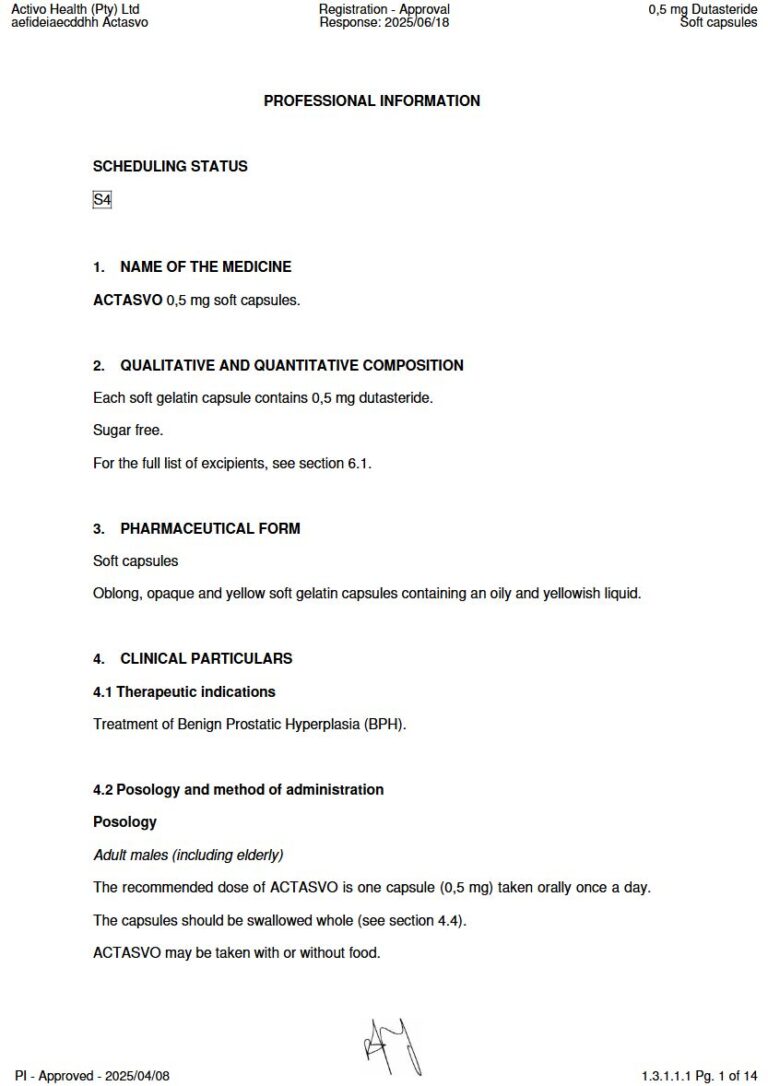
4.1 Therapeutic indications
Treatment of Benign Prostatic Hyperplasia (BPH).
4.2 Posology and method of administration
Posology
Adult males (including elderly)
The recommended dose of ACTASVO is one capsule (0,5 mg) taken orally once a day. The capsules should be swallowed whole (see section 4.4). ACTASVO may be taken with or without food.
Although an improvement may be observed at an early stage, treatment for at least 6 months may be necessary in order to assess objectively whether a satisfactory response to the treatment can be achieved.
Special populations
Renal impairment
The effect of renal impairment on dutasteride pharmacokinetics has not been studied. However, no adjustment in dosage is anticipated for patients with renal impairment (see section 5.2).
Hepatic impairment
The effect of hepatic impairment on dutasteride pharmacokinetics has not been studied (see section 4.3; section 4.4 and section 5.2). In patients with severe hepatic impairment, the use of dutasteride is contraindicated (see section 4.3).
Paediatric population
The use of ACTASVO in children is contraindicated (see section 4.3).
Method of administration
Capsules for oral use.
4.3 Contraindications
The use of ACTASVO is contraindicated in:
- Hypersensitivity to dutasteride, other 5-alpha reductase inhibitors, soya or any of the excipients (see section 6.1).
- women and children.
- patients with severe hepatic impairment.
4.4 Special warnings and precautions for use
Leaking capsules
Dutasteride is absorbed through the skin, therefore, women and children must avoid contact with leaking capsules (see section 4.3). If contact is made with leaking capsules, the contact area should be washed immediately with soap and water.
Hepatic impairment
The effect of hepatic impairment on dutasteride pharmacokinetics has not been studied. ACTASVO should be administered with caution in patients with mild to moderate hepatic impairment because dutasteride is extensively metabolised and has a half-life of 3 to 5 weeks (see section 5.2).
Prostate specific antigen (PSA) and prostate cancer detection
Digital rectal examination, as well as other evaluations for prostate cancer, should be performed on patients with BPH prior to initiating therapy with ACTASVO and periodically thereafter. Serum prostate-specific antigen (PSA) concentration is an important component of the screening process to detect prostate cancer. Generally, a serum PSA concentration > 4 ng/ml (Hybritech) requires further evaluation and consideration of prostate biopsy. Medical practitioners should be aware that a baseline PSA < 4 ng/ml in patients taking ACTASVO does not exclude a diagnosis of prostate cancer.
ACTASVO causes a decrease in serum PSA levels by approximately 50 %, after 6 months of treatment, in patients with BPH, even in the presence of prostate cancer. Although there may be individual variation, the reduction in PSA by approximately 50 % is predictable as it is observed over the entire range of baseline PSA value (1,5 to 10 ng/ml). Therefore, to interpret and isolated PSA value in a man treated with ACTASVO for 6 months or longer, PSA values should be doubled for comparison with normal ranges in untreated men. The adjustment preserves the sensitivity and specificity of the PSA assay and maintains its ability to detect prostate cancer. Any sustained increases in PSA levels while on ACTASVO should be carefully evaluated, including consideration of non-compliance to therapy with ACTASVO. Total serum PSA levels return to baseline within 6 months of discontinuing treatment. The ratio of free to total PSA remains constant even under the influence of ACTASVO. If clinicians elect to use percent-free PSA as an aid in the detection of prostate cancer in men undergoing dutasteride therapy, no adjustment to its value is necessary.
Prostate cancer and high grade tumours
The results of a study to investigate the effect of dutasteride 0,5 mg daily on patients with a high risk for prostate cancer revealed a higher incidence of Gleason 8 u2013 10 prostate cancers in dutasteride treated men. The relationship between dutasteride and Gleason 8 u2013 10 prostate cancers is not clear. Thus, men taking ACTASVO should be regularly evaluated for prostate cancer.
Breast neoplasia
Male breast cancer has been reported in men taking dutasteride. Patients should therefore be instructed to promptly report any changes in their breast tissue such as lumps or nipple discharge.
Cardiovascular adverse events
It is documented that in two 4-year clinical studies, the incidence of cardiac failure (a composite term of reported events, primarily cardiac failure and congestive cardiac failure) was marginally higher among subjects taking the combination of ACTASVO and an alpha blocker, primarily tamsulosin, than it was among subjects not taking the combination. However, the incidence of cardiac failure in these trials was lower in all actively treated groups compared to the placebo group, and other data available for dutasteride or alpha- blockers do not support a conclusion on increased cardiovascular risks.
4.5 Interaction with other medicines and other forms of interaction
Effects of other medicines on the pharmacokinetics of dutasteride
Dutasteride is mainly eliminated via metabolism. Dutasteride is metabolised by human cytochrome P450 isoenzyme CYP3A4. Therefore, blood concentrations of dutasteride may increase in the presence of inhibitors of CYP3A4. Concomitant use of ACTASVO with the CYP3A4 inhibitors verapamil and diltiazem have shown a decrease in the clearance of dutasteride. In contrast, no decrease in clearance has been reported when amlodipine, another calcium channel antagonist, was co-administered with ACTASVO. A decrease in clearance and subsequent increase in exposure to dutasteride, in the presence of CYP3A4 inhibitors, is unlikely to be clinically significant due to the wide margin of safety, therefore no dose adjustment is necessary. Long-term combination of ACTASVO with medicines that are potent inhibitors of the enzyme CYP3A4 (e.g. ritonavir, indinavir, nefazodone, itraconazole, ketoconazole administered orally) may increase serum concentrations of dutasteride. A reduction of the dutasteride dosing frequency can be considered if side effects are noted. It should be noted that in the case of enzyme inhibition, the long half-life may be further prolonged, and it can take more than 6 months of concurrent therapy before a new steady state is reached.
Effects of dutasteride on the pharmacokinetics of other medicines
Dutasteride is not metabolised by human cytochrome P450 isoenzymes CYP1A2, CYP2C9, CYP2C19, and CYP2D6. Dutasteride neither inhibits human cytochrome P450 medicine-metabolising enzymes nor induces cytochrome P450 isoenzymes CYP1A, CYP2B and CYP3A.
Dutasteride does not displace warfarin, diazepam, or phenytoin from plasma protein, nor do these medicines displace dutasteride. Medicines that have been tested for interactions with dutasteride include tamsulosin, terazosin, warfarin, digoxin, and cholestyramine, but no clinically significant interactions have been observed. No clinically significant adverse interactions have been reported when dutasteride was co-administered with anti-hyperlipidaemics, angiotensin-converting enzyme (ACE) inhibitors, beta-adrenergic blocking agents, calcium channel blockers, corticosteroids, diuretics, nonsteroidal anti-inflammatory drugs (NSAIDs), phosphodiesterase Type V inhibitors, and quinolone antibiotics. No evidence of pharmacokinetic or pharmacodynamic interactions were reported when tamsulosin or terazosin have been administered in combination with dutasteride. The co-administration of dutasteride with tamsulosin showed that the combination with an alpha blocker is well tolerated.
4.6 Fertility, pregnancy and lactation
Women of childbearing potential / Contraception in males and females
The use of ACTASVO is contraindicated in women (see section 4.3).
Pregnancy
As with other 5 alpha reductase inhibitors, dutasteride inhibits the conversion of testosterone to dihydrotestosterone and may, if administered to a woman carrying a male foetus, inhibit the development of the external genitalia of the foetus (see section 4.4). Small amounts of dutasteride have been recovered from the semen in subjects receiving dutasteride 0,5 mg daily. It is not known whether a male foetus may be adversely affected if his mother is exposed to the semen of a patient being treated with dutasteride (the risk of which is greatest during the first 16 weeks of pregnancy).
As with all 5 alpha reductase inhibitors, when the patient's partner is or may potentially be pregnant it is recommended that the patient avoids exposure of his partner to semen by use of a condom.
Breastfeeding
It is not known whether dutasteride is excreted in human milk.
Fertility
Dutasteride has been reported to affect semen characteristics (reduction in sperm count, semen volume, and sperm motility) in healthy men. The possibility of reduced male fertility cannot be excluded.
4.7 Effects on ability to drive and use machines
Based on the pharmacodynamic properties of dutasteride, treatment with ACTASVO would not be expected to interfere with the ability to drive or operate machinery.
4.8 Undesirable effects
a. Summary of the safety profile
Most side effects experienced are mild to moderate and occur in the reproductive system.
b. Tabulated list of adverse reactions
System Organ Class Frequency Adverse reactions
Immune system disorders Frequency unknown Allergic reactions including rash, pruritus, urticaria, localised oedema, and angioedema
Psychiatric disorders Frequency unknown Depression
Skin and subcutaneous tissue disorders Less frequent Alopecia (primarily body hair loss), hypertrichosis
Reproductive system and breast disorders Frequent Impotence *, altered (decreased) libido*, ejaculation disorders*^ breast disorders + (4)
Frequency unknown Testicular pain and swelling
* These sexual adverse events are associated with dutasteride treatment (including monotherapy and combination with tamsulosin). These adverse events may persist after treatment discontinuation. The role of dutasteride in this persistence is unknown.
^ includes semen volume decreased.
+ includes breast tenderness and breast enlargement.
Reporting of suspected adverse reactions
Reporting suspected adverse reactions after authorisation of the medicine is important. It allows continued monitoring of the benefit/risk balance of the medicine. Healthcare professionals are asked to report any suspected adverse reactions to SAHPRA via the u201c6.04 Adverse Drug Reaction Reporting Formu201d, found online under SAHPRAu2019s publications: https://www.sahpra.org.za/Publications/Index/8.
4.9 Overdose
Results from volunteer studies report that single doses of dutasteride up to 40 mg/day (80 times the therapeutic dose) for seven days have been administered without significant safety concerns. In clinical studies, doses of 5 mg daily have been administered to patients for 6 months with no additional adverse effects to those seen at therapeutic doses of 0,5 mg.
There is no specific antidote for dutasteride therefore, in cases of suspected overdosage symptomatic and supportive treatment should be given as appropriate.
