
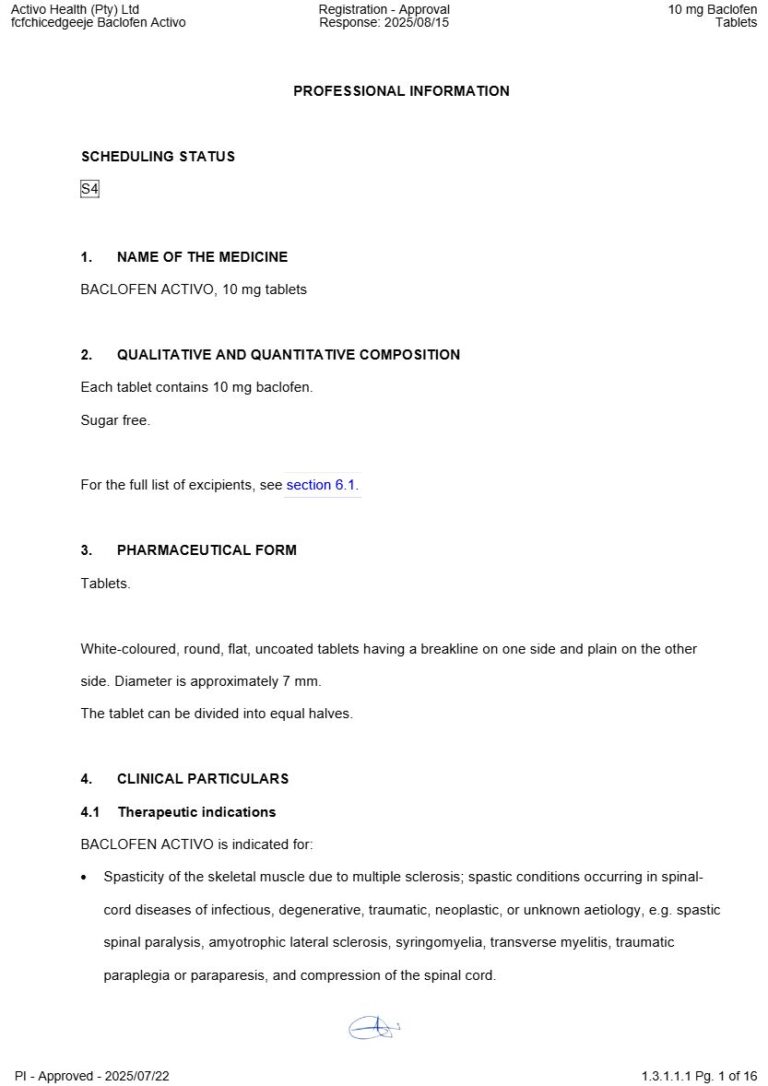
Baclofen Activo 10 mg Tablet
PDF Leaflet Revision Date: 22 July 2025
Clinical Summary
Quick overview from the medicine insert
Indication
Management of spasticity due to neurological conditions.
Dosage (summary)
Adults: Start with 5 mg three times daily, titrate to 30-80 mg daily. Children: Start with 0.3 mg/kg/day.
Special Populations
- Renal impairment
- Hepatic impairment
- Elderly patients
Pregnancy & Breastfeeding
Not recommended in pregnancy; minimal transfer to breast milk.
Key Drug Interactions
- CNS depressants
- Levodopa
- Antidepressants
- Lithium
- Antihypertensives
Contraindications
- Hypersensitivity to baclofen
- Porphyria
Common side effects
- Sedation
- Somnolence
- Dizziness
- Nausea
- Fatigue
Counselling Points
- Avoid alcohol
- Monitor for mood changes
- Do not drive if affected
Serious warnings
- Risk of dependence
- Suicidal thoughts
- Abrupt withdrawal may cause severe reactions
Important Disclaimer
The Baclofen Activo 10 mg Tablet professional information leaflet below is the property of Activo Health and is provided on Medinsert exactly as issued, with no.. alterations or editorial changes. We make every effort to keep content current by updating documents as soon as new versions become available. Medinsert serves as a trusted access point for healthcare professionals, but does not replace official sources or clinical judgement. For more details, please read our full disclaimer. read more>>
 Healthcare Professionals Only
This content is for registered healthcare professionals
Sign in or create a free account to read the full package insert.
Free for HPCSA-registered professionals. Powered by Medinsert.
Clinical Particulars
Section 4 of the official insert — extracted exactly as issued, no alterations
4.1 Therapeutic indications
BACLOFEN ACTIVO is indicated for:
- Spasticity of the skeletal muscle due to multiple sclerosis; spastic conditions occurring in spinal-cord diseases of infectious, degenerative, traumatic, neoplastic, or unknown aetiology, e.g. spastic spinal paralysis, amyotrophic lateral sclerosis, syringomyelia, transverse myelitis, traumatic paraplegia or paraparesis, and compression of the spinal cord.
- Spasticity of cerebral origin, e.g. following cerebrovascular accidents or in the presence of neoplastic or degenerative brain disease.
4.2 Posology and method of administration
Treatment should always be initiated with small, gradually increasing doses of BACLOFEN ACTIVO. The optimum daily dosage should be individually adapted to the patient's requirements in such a way that clonus, flexor and extensor spasms, and spasticity are reduced, but that a sufficient degree of muscle tone is maintained to permit active movements and adverse effects are avoided as far as possible.
In order to prevent excessive weakness and falling, BACLOFEN ACTIVO should be used with caution when spasticity is needed to sustain upright posture and balance in locomotion or whenever spasticity is used to maintain function. It may be important to maintain some degree of muscle tone and allow occasional spasms to help support circulatory function.
The daily dosage should be given in at least 3 divided doses in adults, and 3 to 4 in children. If no benefit is apparent within 6 to 8 weeks of achieving the maximum dosage, a decision should be taken whether to continue with BACLOFEN ACTIVO. Discontinuation of the treatment should always be gradual, by successively reducing the dosage over a period of approximately 1 to 2 weeks, except in overdose-related emergencies, or where serious adverse effects have occurred. Abrupt discontinuation of the treatment should be avoided (see section 4.4.).
Adults: Treatment should, as a rule, be started with a dosage of 5 mg three times daily, which for the purpose of cautious dose titration, should subsequently be increased at three-day intervals by 5 mg three times daily until the requisite daily dosage has been attained, i.e.:
- 5 mg three times daily for 3 days
- 10 mg three times daily for 3 days
- 15 mg three times daily for 3 days
- 20 mg three times daily for 3 days.
In certain patients reacting sensitively to medicines, it may be advisable to begin with a lower daily dosage (5 mg or 10 mg) and to raise this dosage more gradually. The optimum dosage generally ranges from 30 mg to 80 mg daily. Doses of more than 80 mg to 100 mg daily are not generally recommended although higher doses have been given to carefully supervised patients in hospital.
Children: Treatment should usually be started with a very low dose, e.g. 0,3 mg/kg a day, in divided doses. The dosage should be raised cautiously, at about 1 to 2 week intervals, until it becomes sufficient for the child's individual requirements. The usual daily dosage for maintenance therapy ranges between 0,75 and 2 mg/kg body mass. In children over 10 years of age, however, a maximum daily dosage of 2,5 mg/kg body mass may be given.
Special populations: In patients with impaired renal function BACLOFEN ACTIVO should be given with caution and at lower doses. These patients should be closely monitored for prompt diagnosis of early signs and/or symptoms of toxicity (e.g. somnolence, lethargy). Patients undergoing chronic haemodialysis, baclofen concentrations in plasma are elevated and therefore a particularly low dosage of LIORESAL should be selected, i.e. approximately 5 mg daily.
Since unwanted effects are more likely to occur in elderly patients or in patients with spastic states of cerebral origin, in such cases it is recommended that a very cautious dosage schedule be adopted and that the patient be kept under appropriate surveillance. No studies have been performed in patients with hepatic impairment. The liver does not play significant role in the metabolism of baclofen after oral administration of BACLOFEN ACTIVO. However, baclofen has the potential of elevating liver enzymes. BACLOFEN ACTIVO should be prescribed with caution in patients with hepatic impairment.
Method of administration: For oral use. BACLOFEN ACTIVO should be taken during meals with a little liquid.
4.3 Contraindications
- Hypersensitivity to baclofen or to any of the excipients of BACLOFEN ACTIVO (see section 6.1).
- Porphyria.
4.4 Special warnings and precautions for use
Effects on ability to drive and use machines: BACLOFEN ACTIVO may be associated with dizziness, sedation, somnolence, visual disturbances and impaired concentration. This may impair the patientu2019s reaction and may be aggravated by the simultaneous intake of alcohol or central nervous system depressant medicines. Patients experiencing these adverse reactions should be advised to refrain from driving or using machines (see section 4.7).
Psychiatric and nervous system disorders: Patients suffering from psychotic disorders, schizophrenia, depressive or manic disorders, confusional states or Parkinson's disease should be treated cautiously with BACLOFEN ACTIVO and kept under careful surveillance, because exacerbations of these conditions may occur. Suicide and suicide-related events have been reported in patients treated with baclofen. Close supervision of patients with additional risk factors for suicide (e.g. alcohol use disorder, depression and/or a history of previous suicide attempts) should accompany therapy with BACLOFEN ACTIVO. Patients (and caregivers of patients) should be alerted about the need to monitor for clinical worsening, suicidal behaviour or thoughts or unusual changes in behaviour and to seek medical advice immediately if these signs are present.
Cases of misuse, abuse and dependence have been reported with baclofen, as contained in BACLOFEN ACTIVO. Caution should be exercised in patients with a history of substance abuse and the patient should be monitored for symptoms of baclofen misuse, abuse or dependence e.g. dose escalation, drug-seeking behaviour, development of tolerance.
Epilepsy: Special attention should be given to patients known to suffer from epilepsy since lowering of the convulsion threshold may occur and seizures have occasionally been reported in connection with the discontinuation of BACLOFEN ACTIVO or with over-dosage. Adequate anticonvulsive therapy should be continued, and the patient carefully monitored.
Others: BACLOFEN ACTIVO should be used with caution in patients with, or with a history of, peptic ulcers, as well as in those suffering from cerebrovascular diseases or from respiratory, hepatic, or renal failure. Patients with stroke tolerate BACLOFEN ACTIVO poorly.
Urinary retention: BACLOFEN ACTIVO should be used with caution in patients with pre-existing sphincter hypertonia as acute retention of urine may occur.
Laboratory tests: In instances, elevated aspartate aminotransferase (AST), alkaline phosphatase (ALP), and glucose levels in the serum have been recorded. Appropriate laboratory tests should therefore be performed periodically in patients with liver disease or diabetes mellitus in order to ensure that no medicine-induced changes in these underlying diseases have occurred.
Renal impairment: BACLOFEN ACTIVO should be used with caution in patients with renal impairment (see section 4.2). Neurological signs and symptoms of overdose including clinical manifestations of toxic encephalopathy (e.g. confusion, somnolence, hallucination) have been observed in patients with renal impairment taking BACLOFEN ACTIVO at doses of more than 5 mg per day. Patients with renal impairment should be closely monitored for prompt diagnosis of early signs and symptoms of toxicity (see section 4.9). Particular caution is required when combining BACLOFEN ACTIVO with medicines which may significantly impact renal function. Renal function should be closely monitored and BACLOFEN ACTIVO daily dosage adjusted accordingly to prevent baclofen toxicity. Besides discontinuing treatment, unscheduled haemodialysis might be considered as a treatment alternative in patients with severe baclofen toxicity. Haemodialysis effectively removes baclofen from the body, alleviates clinical symptoms of overdose and shortens the recovery time in these patients.
Abrupt discontinuation: Anxiety and confusional states, hallucinations, psychotic, manic or paranoid states, convulsions (status epilepticus), dyskinesia, tachycardia, hyperthermia, rhabdomyolysis and (as a rebound phenomenon), temporary aggravation of spasticity have been reported upon the abrupt withdrawal of BACLOFEN ACTIVO, especially after long-term medication. Medicine withdrawal reactions including postnatal convulsions in neonates have been reported after intrauterine exposure to oral baclofen. As a precautionary measure, BACLOFEN ACTIVO administration to neonates with gradual tapering can help in controlling and preventing the withdrawal reactions (see section 4.6). Except in overdose-related emergencies or where serious adverse effects have occurred, treatment should therefore always be gradually discontinued by successively reducing the dosage (over a period of approximately one to two weeks).
4.5 Interactions with other medicines and other forms of interaction
Levodopa/dopa decarboxylase (DDC) inhibitor (carbidopa): In patients with Parkinson's disease receiving treatment with baclofen, as contained in BACLOFEN ACTIVO, and levodopa (alone or in combination with DDC inhibitor, carbidopa), there have been reports of mental confusion, hallucinations, nausea and agitation. Worsening of the symptoms of Parkinsonism has also been reported. Hence, caution should be exercised during concomitant administration of BACLOFEN ACTIVO and levodopa/carbidopa.
Medicines causing central nervous system (CNS) depression: Increased sedation may occur when BACLOFEN ACTIVO is taken concomitantly with other medicines causing CNS depression including other muscle relaxants (such as tizanidine), with synthetic opiates or with alcohol (see section 4.7). The risk of respiratory depression is also increased. In addition, hypotension has been reported with concomitant use of morphine and intrathecal baclofen. Careful monitoring of respiratory and cardiovascular functions is essential especially in patients with cardiopulmonary disease and respiratory muscle weakness.
Antidepressants: During concomitant treatment with tricyclic antidepressants, the effect of BACLOFEN ACTIVO may be potentiated, resulting in pronounced muscular hypotonia.
Lithium: Concomitant use of baclofen and lithium resulted in aggravated hyperkinetic symptoms. Thus, caution should be exercised when BACLOFEN ACTIVO is used concomitantly with lithium.
Antihypertensives: Since concomitant treatment with baclofen and anti-hypertensives is likely to increase the fall in blood pressure, the dosage of antihypertensive medication should be adjusted accordingly.
Medicines reducing renal function: Medicines that can significantly affect renal function may reduce baclofen excretion leading to toxic effects (see section 4.4).
4.6 Fertility, pregnancy and lactation
Pregnancy: There are no adequate and well-controlled studies in pregnant women. Baclofen crosses the placental barrier and should not be used during pregnancy. Withdrawal reactions including postnatal convulsions in neonates have been reported after intrauterine exposure to oral baclofen (see section 4.4).
Breastfeeding: In mothers taking BACLOFEN ACTIVO in therapeutic doses, the active substance passes into the breast milk, but in quantities so small that no undesirable effects on the infant are to be expected.
Fertility: There are no data available on the effect of baclofen on fertility in humans.
4.7 Effects on ability to drive and use machines
BACLOFEN ACTIVO may cause dizziness, sedation, somnolence and visual impairment (see section 4.8) which may impair the patientu2019s reaction. These effects may be aggravated by the simultaneous intake of alcohol or other central nervous system depressant medicines. Patients experiencing these adverse reactions should be advised to refrain from driving or using machines. BACLOFEN ACTIVO can have a major influence on the ability to drive and use machines.
4.8 Undesirable effects
Summary of the safety profile: Unwanted effects occur mainly at the start of treatment (e.g. sedation, somnolence, drowsiness, fatigue and nausea), if the dose is raised too rapidly, if large doses are employed, or if the patient is an elderly person. In patients with a case history of psychiatric illness or with cerebrovascular disorders (e.g. stroke), as well as in elderly patients, adverse reactions may assume a more serious form. Lowering of the convulsion threshold and attacks of convulsions may possibly occur, particularly in epileptic patients. Certain patients have shown increased muscle spasticity as a paradoxical reaction to BACLOFEN ACTIVO. Many of the adverse CNS and genitourinary effects reported are known to occur in association with the underlying conditions being treated. An undesirable degree of muscular hypotonia, making it more difficult for patients to walk or fend for themselves, may occur and may be relieved by re-adjusting the dosage (i.e. by reducing the doses given during the day and possibly increasing the evening dose).
Tabulated summary of adverse reactions:
Nervous system disorders
- Frequent: Sedation, somnolence, drowsiness, fatigue, dryness of the mouth, respiratory depression, exhaustion, mental confusion, dizziness, headache, insomnia, euphoria, depressive states, myalgia, muscular weakness, ataxia, tremor, nystagmus, hallucinations, nightmares.
- Less frequent: Paraesthesia, dysarthria, dysgeusia.
- Frequency unknown: Sleep apnoea syndrome.
Eye disorders
- Frequent: Accommodation disorders, visual impairment.
Ear and labyrinth disorders
- Less frequent: Tinnitus.
Cardiac disorders
- Frequent: Cardiac output decreased.
- Frequency unknown: Bradycardia.
Vascular disorders
- Frequent: Hypotension.
Gastrointestinal disorders
- Frequent: Nausea, gastrointestinal disorders, retching, vomiting, constipation, diarrhoea.
- Less frequent: Abdominal pain.
Hepatobiliary disorders
- Less frequent: Hepatic function abnormal.
Skin and subcutaneous tissue disorders
- Frequent: Hyperhidrosis, rash.
- Frequency unknown: Urticaria.
Renal and urinary disorders
- Frequent: Pollakiuria, enuresis, dysuria.
- Less frequent: Urinary retention.
Reproductive system and breast disorders
- Less frequent: Erectile dysfunction.
General disorders and administration site conditions
- Less frequent: Hypothermia.
Frequency unknown: Medicine withdrawal syndrome (see section 4.4).
Investigations
- Frequency unknown: Blood glucose increased.
Description of selected adverse reactions: Central sleep apnoea syndrome: Cases of central sleep apnoea syndrome have been observed with baclofen at high doses (u2265 100 mg) in patients who are alcohol dependent.
Reporting of suspected adverse reactions: Reporting suspected adverse reactions after authorisation of BACLOFEN ACTIVO is important. It allows continued monitoring of the benefit/risk balance of BACLOFEN ACTIVO. Health care providers are asked to report any suspected adverse reactions to SAHPRA via the Med Safety APP (Medsafety X SAHPRA) and eReporting platform (who-umc.org) found on the SAHPRA website.
4.9 Overdose
Symptoms: Prominent features are signs of central nervous depression: drowsiness, impairment of consciousness, respiratory depression, coma. Also liable to occur are: confusion, hallucinations, agitation, accommodation disorders, absent pupillary reflex; generalised muscular hypotonia, myoclonia, hyporeflexia or areflexia; convulsions; peripheral vasodilatation, hypotension or hypertension, bradycardia or tachycardia; hypothermia; nausea, vomiting, diarrhoea, hypersalivation; elevated LDH, AST, and AP values, sleep apnoea, rhabdomyolysis. A deterioration in the condition may occur if various substances or medicines acting on the central nervous system (e.g. alcohol, diazepam, tricyclic antidepressants) have been taken at the same time.
Treatment: No specific antidote is known. Supportive measures and symptomatic treatment should be given for complications such as hypotension, hypertension, convulsions, gastrointestinal disturbances, and respiratory or cardiovascular depression.
