
Mabthera Iv Range 100 mg. 500 mg Infusion
PDF Leaflet Revision Date: 12 October 2022
Clinical Summary
Quick overview from the medicine insert
Indication
Treatment of CD20-positive B-cell malignancies.
Dosage (summary)
375 mg/mu00b2 IV infusion weekly for 4 doses for NHL; 1000 mg IV infusion twice for RA.
Onset of Action / Duration
Onset: 30 mins, Duration: variable
Special Populations
- Elderly
- Renal impairment
- Hepatic impairment
Pregnancy & Breastfeeding
Not recommended in pregnancy; unknown if excreted in breast milk.
Key Drug Interactions
- Methotrexate
- Fludarabine
- Cyclophosphamide
Contraindications
- Hypersensitivity
- Active severe infections
- Severe heart failure
Common side effects
- Infusion-related reactions
- Infections
- Neutropenia
Counselling Points
- Monitor for infusion reactions
- Avoid live vaccines
- Use contraception during treatment
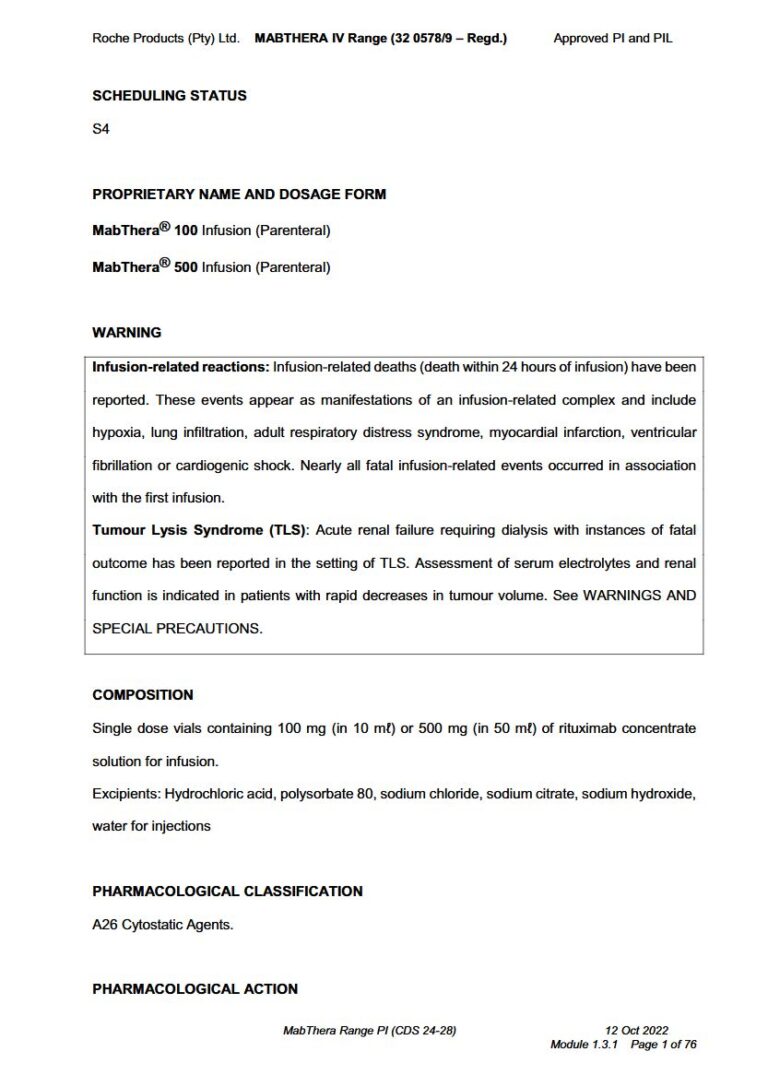
Serious warnings
- Severe infusion-related reactions
- Tumour lysis syndrome
- Progressive multifocal leukoencephalopathy
Important Disclaimer
The Mabthera Iv Range 100 mg. 500 mg Infusion professional information leaflet below is the property of Roche Products and is provided on Medinsert exactly as issued, with no.. alterations or editorial changes. We make every effort to keep content current by updating documents as soon as new versions become available. Medinsert serves as a trusted access point for healthcare professionals, but does not replace official sources or clinical judgement. For more details, please read our full disclaimer. read more>>
 Healthcare Professionals Only
This content is for registered healthcare professionals
Sign in or create a free account to read the full package insert.
Free for HPCSA-registered professionals. Powered by Medinsert.
Clinical Particulars
Section 4 of the official insert — extracted exactly as issued, no alterations
4.1 Therapeutic indications
Non-Hodgkinu2019s Lymphoma
- MabThera is indicated for the treatment of:
- patients with relapsed or chemo-resistant low-grade or follicular, CD20-positive, B-cell non-Hodgkinu2019s lymphoma
- previously untreated patients with stage III-IV follicular lymphoma in combination with chemotherapy
- patients with follicular lymphoma as maintenance treatment, after response to induction therapy;
- patients with high grade CD20-positive diffuse large B-cell non-Hodgkinu2019s lymphoma in combination with CHOP (Cyclophosphamide - C, Doxorubicin - H, Vincristine - O, Prednisone - P) chemotherapy
Chronic Lymphocytic Leukaemia
MabThera in combination with fludarabine and cyclophosphamide is indicated for the treatment of patients with previously untreated and relapsed/refractory chronic lymphocytic leukaemia (CLL).
Rheumatoid Arthritis
MabThera in combination with methotrexate is indicated for the treatment of adult patients with active rheumatoid arthritis who have had an inadequate response or intolerance to other disease-modifying anti-rheumatic drugs (DMARDs) including one or more tumour necrosis factor (TNF) inhibitor therapies.
Granulomatosis with polyangiitis (Wegeneru2019s) (GPA) and Microscopic polyangiitis (MPA):
MabThera IV in combination with glucocorticoids is indicated for the treatment of patients with severely active Granulomatosis with polyangiitis (GPA, also known as Wegener's granulomatosis) and Microscopic polyangiitis (MPA).
4.2 Posology and method of administration
The prepared MabThera solution should be administered as an IV infusion through a dedicated line. The prepared infusion solution must not be administered as an IV injection or bolus infusion. MabThera infusions should be administered in an environment where full resuscitation facilities are immediately available, and under the close supervision of an experienced healthcare professional.
MabThera is compatible with 0,9 % sodium chloride (normal saline) or 5 % dextrose (D5W) solutions for infusion. Premedication consisting of an anti-pyretic and an antihistaminic, e.g. paracetamol and diphenhydramine, should always be administered 30 to 60 minutes prior to each infusion of MabThera. Premedication with glucocorticoids should be considered, particularly if MabThera is not given in combination with steroid-containing chemotherapy. Patients should be closely monitored for the onset of cytokine release syndrome. In patients who develop evidence of severe reactions, especially severe dyspnoea, bronchospasm or hypoxia the infusion should immediately be interrupted. The patient should then be evaluated for evidence of tumour lysis syndrome including appropriate laboratory tests and, for pulmonary infiltration, with a chest X-ray. The infusion should not be restarted until complete resolution of all symptoms, and normalisation of laboratory values and chest X-ray findings. At this time, the infusion can be initially resumed at not more than one-half the previous rate. If the same severe adverse reactions occur for a second time the decision to stop the treatment should be seriously considered on a case by case basis. See WARNINGS AND SPECIAL PRECAUTIONS.
4.3 Contraindications
Hypersensitivity to the active substance or to any of the excipients or to murine proteins. Active, severe infections. Patients in a severely immunocompromised state. Severe heart failure (New York Heart Association Class IV) or severe, uncontrolled cardiac disease.
4.4 Special warnings and precautions for use
In order to improve the traceability of biological medicinal products, the trade name and batch number of the administered product should be clearly recorded (or stated) in the patient file.
Infusion-related adverse events:
MabThera is associated with infusion-related reactions (IRRs), which may be related to release of cytokines and/or other chemical mediators. Premedication consisting of an analgesic/anti-pyretic and an anti-histaminic, should always be administered before each infusion of MabThera. For RA patients, pre-medication with glucocorticoids should also be administered before each infusion of MabThera, in order to reduce the frequency and severity of infusion-related reactions. See DOSAGE AND DIRECTIONS FOR USE, and SIDE EFFECTS.
Patients with a high number (> 25 x 10 9 /u2113) of circulating malignant cells or high tumour burden such as patients with CLL and mantle cell lymphoma may be at higher risk of especially severe infusion-related reactions. These patients should be treated with extreme caution and only when other therapeutic alternatives have been exhausted. These patients should be very closely monitored throughout the first infusion. Consideration should be given to the use of a reduced infusion rate for the first infusion in these patients or a split dosing over two days during the first cycle and any subsequent cycles if the lymphocyte count is still > 25 x 10 9 /u2113. (See SIDE EFFECTS).
4.5 Interactions with other medicines
Currently, limited data are available on possible medicine interactions with MabThera. In CLL patients, co-administration with MabThera did not appear to have an effect on the pharmacokinetics of fludarabine or cyclophosphamide. In addition, there was no apparent effect of fludarabine and cyclophosphamide on the pharmacokinetics of rituximab. Co-administration with methotrexate had no effect on the pharmacokinetics of MabThera in rheumatoid arthritis patients. Patients with human anti-mouse antibody or human anti-chimeric antibody (HAMA/HACA) titres may have allergic or hypersensitivity reactions when treated with other diagnostic or therapeutic monoclonal antibodies.
4.6 Fertility, pregnancy and lactation
Safety in pregnancy and lactation has not been established.
Pregnancy: IgG immunoglobulins are known to cross the placental barrier. Developmental toxicity studies performed in 12 pregnant cynomolgus monkeys revealed no evidence of embryotoxicity in utero. Newborn offspring of maternal animals exposed to MabThera were noted to have depleted B cell populations during the post natal phase. Abortion occurred in 3 and foetal death in 2 dams. It is not known whether MabThera can cause foetal harm when administered to a pregnant woman or whether it can affect reproductive capacity. B-cell levels in human neonates following maternal exposure to MabThera have not been studied in clinical trials. There are no adequate and well-controlled data from studies in pregnant women, however transient B-cell depletion and lymphocytopenia have been reported in some infants born to mothers exposed to rituximab during pregnancy. For these reasons MabThera should not be given to a pregnant woman.
Contraception in males and females; Due to the long retention time of rituximab in B-cell depleted patients, women of childbearing potential should use effective contraceptive methods during treatment and up to 12 months following MabThera therapy.
Lactation: Whether rituximab is excreted in human milk is not known. However, because maternal IgG is excreted in human milk, MabThera should not be given to women who are breastfeeding.
4.7 Effects on ability to drive and use machines
It is not known whether MabThera has an effect on the ability to drive and operate machines.
4.8 Undesirable effects
The overall safety profile of MabThera in non-Hodgkinu2019s lymphoma and chronic lymphocytic leukaemia is based on data from patients from clinical trials and from post-marketing surveillance. These patients were treated either with MabThera monotherapy (as induction treatment or maintenance treatment following induction treatment) or in combination with chemotherapy. The most frequently observed adverse drug reactions (ADRs) in patients receiving MabThera were infusion-related reactions which occurred in the majority of patients during the first infusion. The incidence of infusion-related symptoms decreases substantially with subsequent infusions and is less than 1 % after eight doses of MabThera. Infectious events (predominantly bacterial and viral) occurred in approximately 30 - 55 % of patients during clinical trials in patients with NHL and in 30 - 50 % of patients during clinical trials in patients with CLL. The most frequent reported or observed serious adverse drug reactions were infusion-related reactions (including cytokine-release syndrome, tumour-lysis syndrome), infections and cardiovascular events. Other serious ADRs reported include hepatitis B reactivation and PML (See WARNINGS AND SPECIAL PRECAUTONS).
4.9 Overdose
Patients who experience overdose should have immediate interruption of their infusion and be closely monitored. Consideration should be given to the need for regular monitoring of blood cell count and for increased risk of infections while patients are B cell-depleted.
