
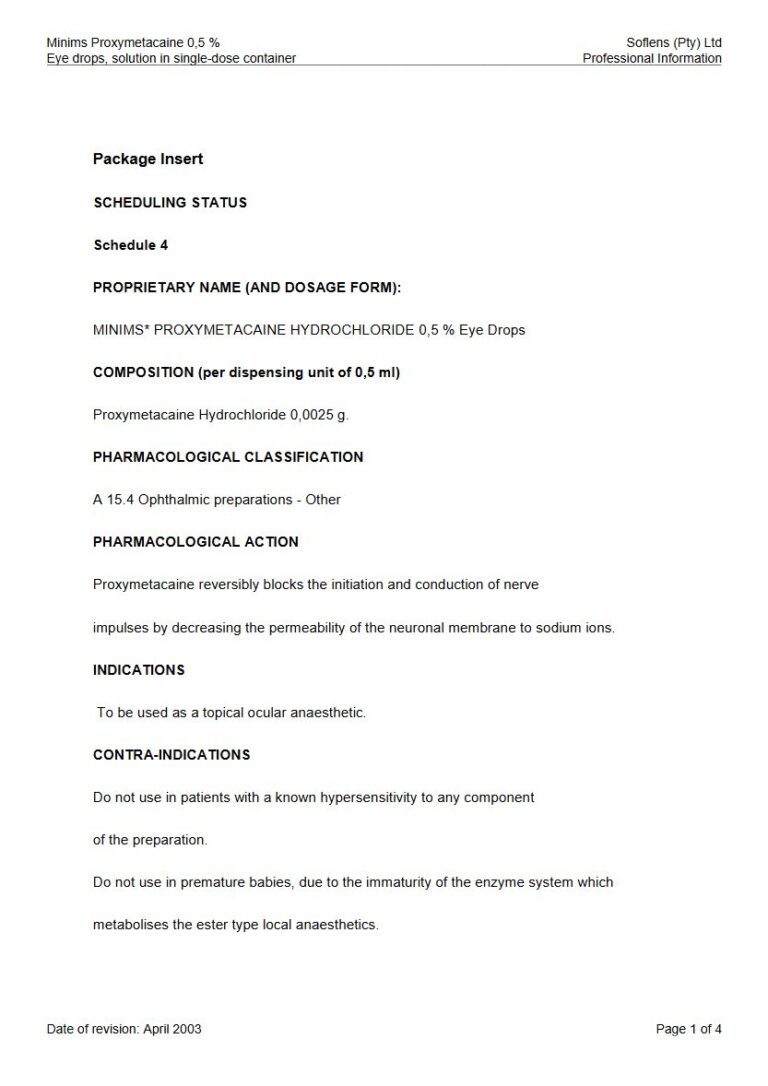
Minims* Proxymetacaine Hydrochloride 0,5 % Eye Drop
PDF Leaflet Revision Date: April 2003
Clinical Summary
Quick overview from the medicine insert
Indication
Topical ocular anaesthetic.
Dosage (summary)
Adults/children: 1 drop every 5-10 mins for deep anaesthesia; 1-2 drops before suture removal/tonometry.
Special Populations
- Premature babies
- Patients with known allergies
- Cardiac disease
- Hyperthyroidism
Contraindications
- Hypersensitivity to components
- Ocular inflammation/infection
Common side effects
- Pupillary dilatation
- Conjunctival irritation
- Hyperallergic corneal reaction
Counselling Points
- Do not rub or touch the eye while anaesthesia persists
- Protect the anaesthetised eye from dust and contamination
Serious warnings
- Use with caution in patients with allergies, cardiac disease, or hyperthyroidism
Important Disclaimer
The Minims* Proxymetacaine Hydrochloride 0,5 % Eye Drop professional information leaflet below is the property of Soflens and is provided on Medinsert exactly as issued, with no.. alterations or editorial changes. We make every effort to keep content current by updating documents as soon as new versions become available. Medinsert serves as a trusted access point for healthcare professionals, but does not replace official sources or clinical judgement. For more details, please read our full disclaimer. read more>>
 Healthcare Professionals Only
This content is for registered healthcare professionals
Sign in or create a free account to read the full package insert.
Free for HPCSA-registered professionals. Powered by Medinsert.
Clinical Particulars
Section 4 of the official insert — extracted exactly as issued, no alterations
4.1 Therapeutic indications
To be used as a topical ocular anaesthetic.
4.3 Contraindications
Do not use in patients with a known hypersensitivity to any component of the preparation. Do not use in premature babies, due to the immaturity of the enzyme system which metabolises the ester type local anaesthetics. Do not use in the presence of ocular inflammation and / or infection.
4.4 Special warnings and precautions for use
Use with caution in patients with known allergies, cardiac disease or hyperthyroidism because of the increased risk of sensitivity reactions.
4.2 Posology and method of administration
Adults and children: To be used as a single dose treatment. Deep anaesthesia: Instil 1 drop every 5 u2013 10 minutes for 5 u2013 7 applications. Removal of sutures: Instil 1 or 2 drops 2 to 3 minutes before removal of stitches. Removal of foreign bodies: Instil 1 or 2 drops prior to operating. Tonometry: Instil 1 or 2 drops immediately before measurement.
4.8 Undesirable effects
Pupillary dilatation or cycloplegic effects, as well as irritation of the conjunctiva have occurred less frequently. A severe, immediate-type apparently hyperallergic corneal reaction may less frequently occur. This includes acute, intense and diffuse epithelial keratitis; a grey ground-glass appearance; sloughing of large areas of necrotic epithelium; corneal filaments and sometimes, iritis. Allergic contact dermatitis has also been reported. Patients should be warned not to rub or touch the eye while anaesthesia persists and the anaesthetised eye should be protected from dust and bacterial contamination.
4.9 Overdose
See u201cside-effects and special precautionsu201d. Treatment is symptomatic and supportive.
