
Nerlynx 40 mg FC tablets
PDF Leaflet Revision Date: 23 January 2026
Clinical Summary
Quick overview from the medicine insert
Indication
Extended adjuvant treatment of early-stage hormone receptor positive HER2-overexpressed breast cancer post-trastuzumab.
Dosage (summary)
240 mg (6 tablets) orally once daily with food for 1 year.
Special Populations
- Renal impairment
- Hepatic impairment
- Elderly
Pregnancy & Breastfeeding
May cause fetal harm; avoid during pregnancy and breastfeeding.
Key Drug Interactions
- Strong CYP3A4/P-gp inducers
- Strong CYP3A4/P-gp inhibitors
- Grapefruit and pomegranate
Contraindications
- Hypersensitivity to neratinib
- Severe hepatic impairment
- Strong/moderate CYP3A4/P-gp inducers
Common side effects
- Diarrhoea
- Nausea
- Fatigue
- Vomiting
- Abdominal pain
- Rash
Counselling Points
- Take with food
- Monitor for diarrhoea
- Use effective contraception during treatment
Serious warnings
- Severe diarrhoea
- Hepatotoxicity
- Cardiac monitoring in patients with risk factors
Important Disclaimer
The Nerlynx 40 mg FC tablets professional information leaflet below is the property of Key Oncologics and is provided on Medinsert exactly as issued, with no.. alterations or editorial changes. We make every effort to keep content current by updating documents as soon as new versions become available. Medinsert serves as a trusted access point for healthcare professionals, but does not replace official sources or clinical judgement. For more details, please read our full disclaimer. read more>>
 Healthcare Professionals Only
This content is for registered healthcare professionals
Sign in or create a free account to read the full package insert.
Free for HPCSA-registered professionals. Powered by Medinsert.
Clinical Particulars
Section 4 of the official insert — extracted exactly as issued, no alterations
4.1 Therapeutic indications
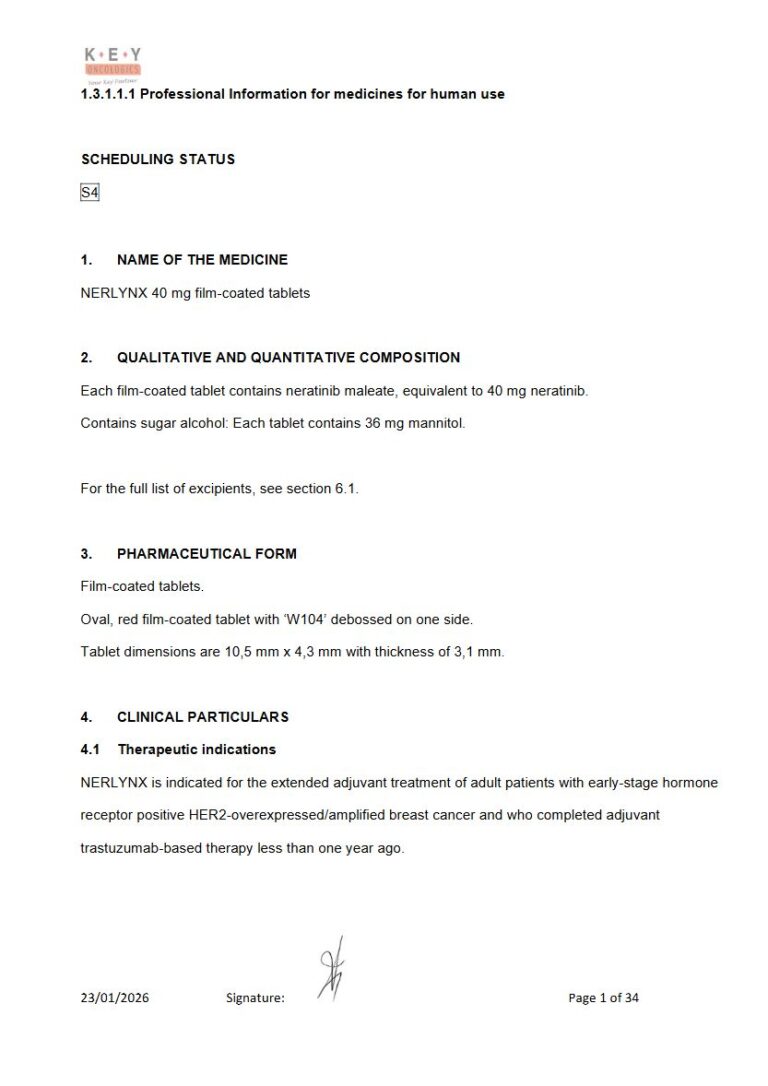
NERLYNX is indicated for the extended adjuvant treatment of adult patients with early-stage hormone receptor positive HER2-overexpressed/amplified breast cancer and who completed adjuvant trastuzumab-based therapy less than one year ago.
4.2 Posology and method of administration
NERLYNX treatment should be initiated and supervised by a medical practioner experienced in the administration of anti-cancer medicines.
Posology
The recommended dose of NERLYNX is 240 mg (six 40 mg tablets) taken orally once daily, continuously for one year. NERLYNX should be taken with food, preferably in the morning. Patients should initiate treatment within 1 year after completion of trastuzumab therapy.
Dose modifications for adverse reactions:
NERLYNX dose modification is recommended based on individual safety and tolerability. Management of some adverse reactions may require dose interruption and/or dose reduction as shown in Table 1, Table 2, Table 3, and Table 4.
Discontinue NERLYNX for patients who:
- Fail to recover to Grade 0 to 1 from treatment-related toxicity,
- for toxicities that result in a treatment delay > 3 weeks, or
- for patients that are unable to tolerate 120 mg daily.
Additional clinical situations may result in dose adjustments as clinically indicated (e.g. intolerable toxicities, persistent Grade 2 adverse reactions, etc.).
Table 1: NERLYNX dose modifications for adverse reactions
| Dose level | NERLYNX dose |
|---|---|
| Recommended starting dose | 240 mg daily |
| First dose reduction | 200 mg daily |
| Second dose reduction | 160 mg daily |
| Third dose reduction | 120 mg daily |
Table 2: NERLYNX dose modifications and management u2013 general toxicities*
Severity of toxicity u2020
Action
- Grade 3: Stop NERLYNX until recovery to Grade < 1 or baseline within 3 weeks of stopping treatment. Then resume NERLYNX at the next lower dose level. If grade 3 toxicity does not recover within 3 weeks, discontinue NERLYNX permanently.
- Grade 4: Discontinue NERLYNX permanently.
* Refer to Table 3 and Table 4 below for management of diarrhoea and hepatotoxicity
u2020 Per CTCAE v4.0
Missed doses:
Missed doses should not be replaced and treatment should resume with the next scheduled daily dose (see section 4.9).
Grapefruit and pomegranate:
Concomitant administration of neratinib with grapefruit or pomegranate/grapefruit or pomegranate juice is not recommended (see sections 4.4 and 4.5).
Use of CYP3A4/P-gp inhibitors:
If the inhibitor cannot be avoided, reduce NERLYNX dose:
- to 40 mg (one 40 mg tablet) taken once daily with a strong CYP3A4/P-gp inhibitor,
- to 40 mg (one tablet) taken once daily with a moderate CYP3A4/P-gp inhibitor.
If well tolerated, increase to 80 mg for at least 1 week, then to 120 mg for at least 1 weeks, and to 160 mg as a maximal daily dose. Patient should be monitored carefully, especially GI effect including diarrhoea and hepatotoxicity.
After discontinuation of a strong or moderate CYP3A4/P-gp inhibitor, resume previous dose of NERLYNX 240 mg (see sections 4.4, 4.5 and 5.2).
H2 receptor antagonists and antacids:
If H2 receptor antagonists are used, NERLYNX should be taken at least 2 hours before or 10 hours after the intake of the H2 receptor antagonist. Separate dosing of NERLYNX and antacids by at least 3 hours should be applied (see sections 4.4, 4.5 and 5.2).
Special populations
Patients with renal impairment: No dose adjustment is necessary in patients with mild to moderate renal impairment. NERLYNX has not been studied in patients with severe renal impairment including patients on dialysis. Treatment of patients with severe renal impairment or on dialysis is not recommended (see section 5.2).
Patients with hepatic impairment: No dose adjustment is required in patients with Child-Pugh A or B (mild to moderate) hepatic impairment (see section 5.2).
Elderly: No dose adjustment is required. There is no data in patients u2265 85 years of age.
Paediatric population: There is no relevant use of NERLYNX in the paediatric population in the indication of breast cancer.
Method of administration
NERLYNX is for oral use. The tablets should be swallowed whole preferably with water and should not be crushed or dissolved, and should be taken with food, preferably in the morning (see section 5.2).
4.3 Contraindications
Hypersensitivity to the neratinib maleate or to any of the excipients of NERLYNX (see section 6.1).
Co-administration with the following medicines that are strong or moderate inducers of the CYP3A4/P-gp isoform of cytochrome P450, such as (see sections 4.5 and 5.2):
- carbamazepine, phenobarbital, phenytoin (antiepileptics),
- St Johnu2019s wort (Hypericum perforatum) (herbal product),
- rifampicin (antimycobacterial).
Severe hepatic impairment (Child-Pugh C) (see section 5.2).
4.4 Special warnings and precautions for use
Diarrhoea: Diarrhoea has been reported during treatment with NERLYNX (see sections 4.2 and 4.8). The diarrhoea may be severe and associated with dehydration.
Diarrhoea generally occurs early during the first or second week of treatment with NERLYNX and may be recurrent. Patients should be instructed to initiate prophylactic treatment with an anti-diarrhoeal medicine with the first dose of NERLYNX and maintain regular dosing of the anti-diarrhoeal medicine during the first 1 u2013 2 months of NERLYNX treatment, titrating to 1 u2013 2 bowel movements per day.
Elderly: Elderly patients (u2265 65 years of age) are at a higher risk of renal insufficiency and dehydration which may be a complication of diarrhoea and these patients should be carefully monitored.
Patients with a significant chronic gastrointestinal disorder: Patients with a significant chronic gastrointestinal disorder with diarrhoea as a major symptom were not included in the pivotal study and should be carefully monitored.
Renal impairment: Patients with renal impairment are at a higher risk of complications of dehydration if they develop diarrhoea, and these patients should be carefully monitored (see sections 4.2 and 5.2).
Liver function: Hepatotoxicity has been reported in patients treated with NERLYNX. Liver function tests including alanine aminotransferase (ALT), aspartate aminotransferase (AST), and total bilirubin should be monitored at 1 week, then monthly for the first 3 months and every 6 weeks thereafter while on treatment or as clinically indicated (see section 4.2).
Patients who experience u2265 Grade 3 diarrhoea requiring IV fluid treatment or any signs or symptoms of hepatotoxicity, such as worsening of fatigue, nausea, vomiting, jaundice, right upper quadrant pain or tenderness, fever, rash, or eosinophilia, should be evaluated for changes in liver function tests. Fractionated bilirubin and prothrombin time should also be collected during hepatotoxicity evaluation.
Left ventricular function: Left ventricular dysfunction has been associated with HER2 inhibition. NERLYNX has not been studied in patients with less than lower limit of normal left ventricular ejection fraction (LVEF) or with significant cardiac history. In patients with known cardiac risk factors, conduct cardiac monitoring, including assessment of LVEF, as clinically indicated.
Proton pump inhibitors, H2 receptor antagonists and antacids: Treatments that increase gastrointestinal pH may lower the absorption of neratinib, thus decreasing systemic exposure. Co-administration with proton pump inhibitors (PPIs) is not recommended (see sections 4.5 and 5.2).
In case of H2 receptor antagonists or antacids, modalities of administration should be adapted (see sections 4.2, 4.5 and 5.2).
Pregnancy: Neratinib may cause fetal harm when administered to pregnant women (see section 4.6).
Skin and subcutaneous tissue disorders: NERLYNX is associated with skin and subcutaneous tissue disorders. Patients with symptomatic skin and subcutaneous tissue disorders should be carefully monitored (see section 4.8).
Concomitant treatment with inhibitors of CYP3A4 and P-gp: Concomitant treatment with strong or moderate CYP3A4 and P-gp inhibitors is not recommended due to risk of increased exposure to neratinib. If the inhibitor cannot be avoided, NERLYNX dose adjustment should be applied (see sections 4.2, 4.5 and 5.2).
Grapefruit and pomegranate: Grapefruit or pomegranate juice should be avoided during treatment with NERLYNX (see sections 4.2 and 4.5).
Concomitant treatment with moderate inducers of CYP3A4 and P-gp: Concomitant treatment with moderate CYP3A4 and P-gp inducers is not recommended as it may lead to a loss of neratinib efficacy (see sections 4.5 and 5.2).
Concomitant treatment with substrates of P-gp: Patients who are treated concomitantly with therapeutic medicines with a narrow therapeutic window whose absorption involves P-gp transporters in the gastrointestinal tract should be carefully monitored (see sections 4.5 and 5.2).
4.5 Interactions with other medicines and other forms of interaction
Effects of other substances on neratinib
Neratinib is primarily metabolised by CYP3A4 and is a P-gp substrate.
CYP3A4/P-gp inducers: Clinical study demonstrated that concomitant use of strong CYP3A4/P-gp inducers significantly decreased neratinib exposure, therefore concurrent use of neratinib with strong CYP3A4/P-gp inducers is contraindicated (e.g. strong inducers: phenytoin, carbamazepine, rifampicin, or herbal preparations containing St Johnu2019s wort (Hypericum perforatum)). Concurrent use of neratinib with moderate CYP3A4/P-gp inducers is not recommended as it may also lead to loss of efficacy (e.g. moderate inducers: bosentan, efavirenz, etravirine, phenobarbital (phenobarbitone), primidone, dexamethasone) (see sections 4.3 and 5.2).
CYP3A4/P-gp inhibitors: A clinical study and model-based predictions have demonstrated that concomitant use of strong or moderate CYP3A4/P-gp inhibitors significantly increased neratinib systemic exposure, therefore, concomitant use of neratinib with strong and moderate CYP3A4/P-gp inhibitors is not recommended (e.g. strong inhibitors: atazanavir, indinavir, nefazodone, nelfinavir, ritonavir, saquinavir, lopinavir, ketoconazole, itraconazole, clarithromycin, troleandomycin, voriconazole and cobicistat; moderate inhibitors: ciprofloxacin, cyclosporine, diltiazem, fluconazole, erythromycin, fluvoxamine and verapamil). If the inhibitor cannot be avoided, NERLYNX dose adjustment should be applied (see sections 4.2, 4.4 and 5.2).
Grapefruit/pomegranate or grapefruit/pomegranate juice may also increase neratinib plasma concentrations and should be avoided (see sections 4.2 and 4.4).
Proton pump inhibitors, H2 receptor antagonists and antacids: The in vitro solubility of neratinib is pH dependent. Concomitant treatment with substances that increase gastric pH may lower the absorption of neratinib, thus decreasing systemic exposure. Co-administration with proton pump inhibitors (PPIs) is not recommended (e.g. omeprazole or lansoprazole) (see sections 4.4 and 5.2).
NERLYNX should be taken at least 2 hours before or 10 hours after the intake of the H2 receptor antagonist (see sections 4.2, 4.4 and 5.2). Separate dosing of NERLYNX with antacids by at least 3 hours (see sections 4.2, 4.4 and 5.2).
Anti-diarrhoeal loperamide: A clinical study has demonstrated that there were no clinically significant differences in the exposure of subjects to neratinib with or without concurrent dosing with loperamide (see section 5.2).
Effects of neratinib on other substances
Hormonal contraceptives: It is currently unknown whether NERLYNX reduces the effectiveness of systemically acting hormonal contraceptives. Therefore, women using systemically acting hormonal contraceptives should add a barrier method (see section 4.6).
P-glycoprotein efflux transporter: In vitro studies demonstrated that neratinib is an inhibitor of P-glycoprotein (P-gp) efflux transporters. This has been confirmed by clinical study using digoxin as probe substrate leading to an increase of 54 and 32 % in C max and AUC, respectively. This might be clinically relevant for patients who are treated concomitantly with therapeutic medicines with a narrow therapeutic window whose absorption involves P-gp transporters in the gastrointestinal tract (e.g. digoxin, colchicine, dabigatran, phenytoin, statins, ciclosporin, everolimus, sirolimus, tacrolimus). They should be carefully monitored (see sections 4.4 and 5.2).
Breast cancer resistance protein efflux transporter: Neratinib may inhibit breast cancer resistance protein (BCRP) at intestinal level as suggested by in vitro studies. A clinical study with BCRP substrates has not been conducted. As co-administration of neratinib with BCRP substrates may lead to an increase of their exposure, patients who are treated with BCRP substrates (e.g. rosuvastatin, sulfasalazine and irinotecan) should be monitored carefully (section 5.2).
4.6 Fertility, pregnancy and lactation
Women of childbearing potential/contraception in males and females: Based on findings in animals, neratinib may cause fetal harm when administered to pregnant women. Women should avoid becoming pregnant while taking NERLYNX and for up to 1 month after ending treatment. Therefore, women of child-bearing potential must use highly effective contraceptive measures while taking NERLYNX and for 1 month after stopping treatment.
It is currently unknown whether neratinib may reduce the effectiveness of systemically acting hormonal contraceptives, and therefore women using systemically acting hormonal contraceptives should add a barrier method.
Men: Men should use a barrier method of contraception during treatment and for 3 months after stopping treatment.
Pregnancy: There are no data from the use of NERLYNX in pregnant women. Studies in animals have shown embryo-fetal lethality and fetal morphological anomalies (see section 5.3). The potential risk for humans is unknown. NERLYNX should not be used during pregnancy unless the clinical condition of the woman requires treatment with neratinib. If neratinib is used during pregnancy, or if the patient becomes pregnant while taking NERLYNX, the patient should be informed of the potential hazard to the fetus.
Breastfeeding: It is not known whether neratinib is excreted in human milk. A risk to the breast-fed infant cannot be excluded. A decision must be made whether to discontinue breast-feeding or to discontinue NERLYNX, taking into account the importance of NERLYNX to the mother and the benefit of breast-feeding to the child.
Fertility: No fertility studies in women or men have been conducted. No significant changes in fertility parameters in male and female rats were detected in dosing up to 12 mg/kg/day (see section 5.3).
4.7 Effects on ability to drive and use machines
NERLYNX has minor or moderate influence on the ability to drive and use machines. Fatigue, dizziness, dehydration, and syncope have been reported as adverse reactions with neratinib. The clinical status of the patient should be considered when assessing the patientu2019s ability to perform tasks that require judgment, motor, or cognitive skills.
4.8 Undesirable effects
Summary of safety profile
The most common adverse reactions of any grade were diarrhoea (93,6 %), nausea (42,5 %), fatigue (27,3 %), vomiting (26,8 %), abdominal pain (22,7 %), rash (15,4 %), decreased appetite (13,7 %), abdominal pain upper (13,2 %), stomatitis (11,2 %), and muscle spasms (10,0 %).
The most common Grade 3-4 adverse reactions were diarrhoea (Grade 3, 36,9 % and Grade 4, 0,2 %) and vomiting (Grade 3, 3,4 % and Grade 4, 0,1 %).
Adverse reactions reported as serious included diarrhoea (1,9 %), vomiting (1,3 %), dehydration (1,1 %), nausea (0,5 %), alanine aminotransferase increased (0,4 %), aspartate aminotransferase increased (0,4 %), abdominal pain (0,3 %), fatigue (0,3 %) and decreased appetite (0,2 %).
Tabulated list of adverse reactions
The table below lists adverse reactions observed with neratinib based on the assessment of pooled data from 1 710 patients. The MedDRA frequency convention and system organ class database has been utilised for the classification of frequency:
Very common (u22651/10) Common (u22651/100 to <1/10) Uncommon (u22651/1 000 to <1/100) Rare (u22651/10 000 to <1/1 000) Very rare (<1/10 000) Not known (cannot be estimated from the available data
Within each frequency grouping, adverse reactions are presented in order of decreasing seriousness.
Table 5: Adverse drug reactions due to NERLYNX in monotherapy breast cancer studies
| System organ class | Frequency | Adverse drug reaction |
|---|---|---|
| Infections and infestations | Common | Urinary tract infection |
| Metabolism and nutrition disorders | Very Common | Decreased appetite |
| Common | Dehydration | |
| Nervous system disorders | Common | Syncope |
| Respiratory, thoracic and mediastinal disorders | Common | Epistaxis |
| Gastrointestinal disorders | Very Common | Diarrhoea, vomiting, nausea, abdominal pain, abdominal pain upper, and stomatitis |
| Common | Abdominal distension, dry mouth and dyspepsia | |
| Hepatobiliary disorders | Common | Alanine aminotransferase increased, and aspartate aminotransferase increased |
| Uncommon | Blood bilirubin increased | |
| Skin and subcutaneous tissue disorders | Very Common | Rash |
| Common | Nail disorder, skin fissures and dry skin | |
| Musculoskeletal and connective tissue disorders | Very Common | Muscle spasms |
| Renal and urinary disorders | Common | Blood creatinine increased |
| Uncommon | Renal failure | |
| General disorders and administration site conditions | Very Common | Fatigue |
| Investigations | Common | Weight decreased |
1 Includes stomatitis, aphthous stomatitis, mouth ulceration, oral mucosal blistering and mucosal inflammation.
2 Includes rash, rash erythematous, rash follicular, rash generalised, rash pruritic and rash pustular.
3 Includes nail disorder, paronychia, onychoclasis, and nail discolouration.
Description of selected adverse reactions
Diarrhoea: Of the 1 660 patients treated with NERLYNX monotherapy without loperamide prophylaxis, 94,6 % experienced at least 1 episode of diarrhoea. Grade 3 diarrhoea was reported in 37,5 % of NERLYNX patients. 0,2 % of patients had diarrhoea classified as Grade 4. Diarrhoea led to hospitalisation in 1,9 % of NERLYNX-treated patients. Diarrhoea generally occurred in the first month, with 83,6 % of patients reporting this toxicity in the first week, 46,9 % in the second week, 40,2 % in the third week and 43,2 % in the fourth week (median time to first onset was 2 days). The median duration of a single episode of any grade diarrhoea was 2 days. The median cumulative duration of any grade diarrhoea was 59 days and the median cumulative duration of Grade 3 diarrhoea was 5 days. Diarrhoea was also the most common adverse reaction leading to discontinuation, 14,4 % of patients treated with NERLYNX without loperamide prophylaxis discontinued treatment due to diarrhoea. Dose reductions occurred in 24,7 % of NERLYNX-treated patients.
Rash: In the NERLYNX monotherapy group, 16,7 % of patients experienced rash. The incidence of Grade 1 and Grade 2 was 13,3 % and 2,9 % respectively; 0,4 % of NERLYNX-treated patients experienced Grade 3 rash.
Nail disorders: In the NERLYNX monotherapy group, 7,8 % patients experience nail disorders. The incidence of Grade 1 and Grade 2 was 6,2 % and 1,4 % respectively. There were 0,2 % of NERLYNX treated patients who experienced Grade 3 nail disorder. Both rash and nail disorders led to treatment discontinuation in 0,6 % of NERLYNX-treated patients.
Hepatotoxicity: Hepatic-associated adverse reactions in the pivotal phase III study, ExteNET (3004), were reported more frequently in the NERLYNX arm compared to the placebo arm (12,4 % vs 6,6 %), due primarily to alanine aminotransferase (ALT) increased (8,5 % vs 3,2 %), aspartate aminotransferase (AST) increased (7,4 vs 3,3 %) and blood alkaline phosphatase increased (2,1 % vs 1,1 %). Grade 3 adverse reactions were reported in 1,6 % vs 0,5 % and Grade 4 adverse reactions were reported in 0,2 % vs 0,1 %, NERLYNX- and placebo-treated patients, respectively. Grade 3 ALT increased was reported in 1,1 % vs 0,2 % and Grade 4 ALT increased was reported in 0,2 % vs 0,0 % of NERLYNX- vs placebo-treated patients. Grade 3 AST increased was reported in 0,5 % vs 0,3 % and Grade 4 AST increased was reported in 0,2 % vs 0,0 %, of NERLYNX- vs placebo-treated patients. There were no Grade 3 or 4 adverse reactions of blood bilirubin increased.
4.9 Overdose
There is no specific antidote, and the benefit of haemodialysis in the treatment of NERLYNX overdose is unknown. In the event of an overdose, administration should be withheld, and general supportive measures undertaken. In the clinical trial setting, adverse reactions associated with overdose were most commonly diarrhoea, with or without nausea, vomiting and dehydration. In a dose escalation study in healthy volunteers, single oral doses of NERLYNX up to 800 mg were administered. The frequency and severity of gastrointestinal disorders (diarrhoea, abdominal pain, nausea and vomiting) appeared to be dose related. Single doses of NERLYNX greater than 800 mg have not been administered in the clinical studies.
