
Nomowake 25 25 mg Tablet
PDF Leaflet Revision Date: 8 November 2022
Clinical Summary
Quick overview from the medicine insert
Indication
Alleviation of insomnia.
Dosage (summary)
1-2 tablets at bedtime for adults over 12 years.
Onset of Action / Duration
Onset: 30 mins, Duration: 6-8 hours
Special Populations
- Elderly patients
- Hepatic impairment
- Renal impairment
Pregnancy & Breastfeeding
Contraindicated in pregnancy and breastfeeding.
Key Drug Interactions
- CNS depressants
- MAOIs
- QT prolonging medications
Contraindications
- Hypersensitivity to doxylamine
- Severe cardiovascular disorders
- Epilepsy
- Acute asthma attack
Common side effects
- Drowsiness
- Dry mouth
- Constipation
- Blurred vision
- Urinary retention
Counselling Points
- Avoid alcohol during treatment
- Do not operate machinery if drowsy
- Consult doctor if insomnia persists
Serious warnings
- Short treatment duration recommended
- Caution in elderly patients
- Risk of falls in elderly
Important Disclaimer
The Nomowake 25 25 mg Tablet professional information leaflet below is the property of Lebasi Pharmaceuticals and is provided on Medinsert exactly as issued, with no.. alterations or editorial changes. We make every effort to keep content current by updating documents as soon as new versions become available. Medinsert serves as a trusted access point for healthcare professionals, but does not replace official sources or clinical judgement. For more details, please read our full disclaimer. read more>>
 Healthcare Professionals Only
This content is for registered healthcare professionals
Sign in or create a free account to read the full package insert.
Free for HPCSA-registered professionals. Powered by Medinsert.
Clinical Particulars
Section 4 of the official insert — extracted exactly as issued, no alterations
4.1 Therapeutic indications
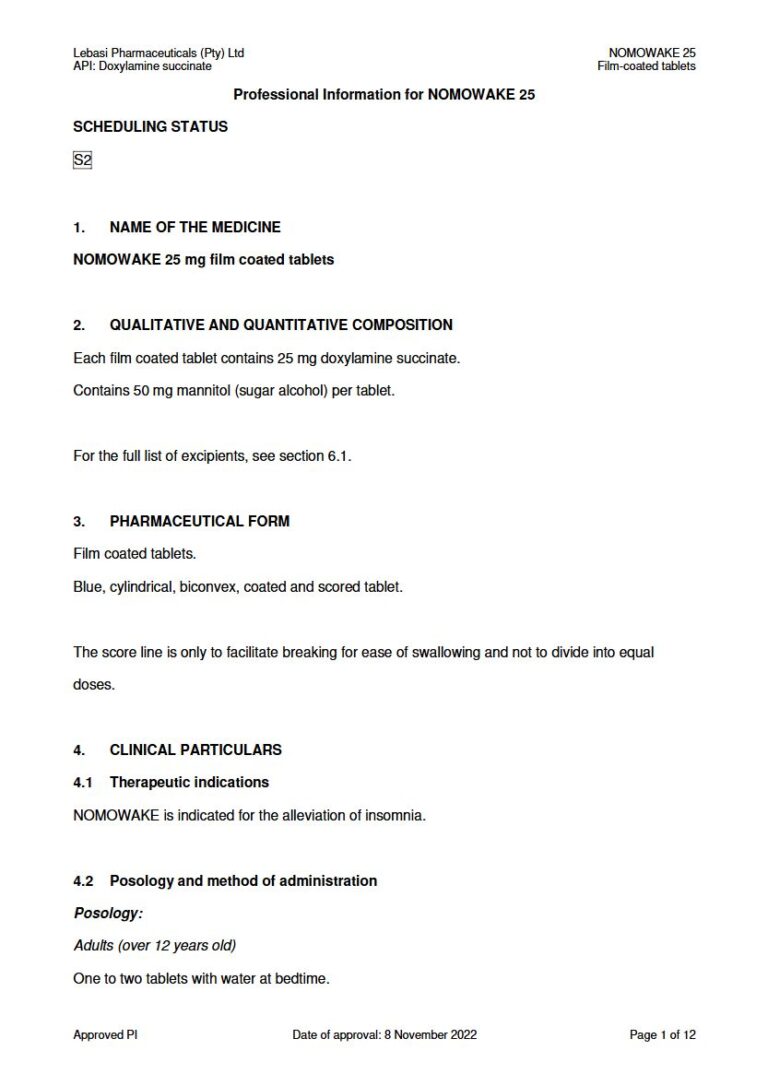
NOMOWAKE is indicated for the alleviation of insomnia.
4.2 Posology and method of administration
Posology: Adults (over 12 years old) One to two tablets with water at bedtime.
This product should be used occasionally and should not be used successively for periods exceeding several days. If insomnia persists consult your doctor.
Paediatric population NOMOWAKE should not be used in children under 12 years.
Method of administration: Orally.
4.3 Contraindications
- Hypersensitivity to doxylamine succinate, or to any of the excipients listed in section 6.1.
- Hypersensitivity to other antihistamines.
- Pregnancy and lactation (see section 4.6).
- Epileptics.
- Patients with severe cardiovascular disorders.
- Acute asthma attack.
- Concomitant use of monoamine oxidase inhibitors (MAOIs) (see section 4.5).
4.4 Special warnings and precautions for use
The treatment period should be as short as possible. Treatment usually lasts from a few days to a week. NOMOWAKE should not be taken for more than 7 days unless advised by the medical practitioner.
Concomitant use of other CNS depressant medicines: Alcohol intake should be avoided during treatment with NOMOWAKE (see section 4.5).
Hepatic and/or renal impairment: Caution is advised in patients with hepatic and/or renal impairment. The dose should be reduced to 12,5 mg per day.
Cardiovascular disorders: NOMOWAKE should be used with caution in patients with QT prolongation. Even though extension of this interval has not been observed with doxylamine succinate, other antihistamines may produce an extension of this interval. NOMOWAKE is contraindicated in severe cardiovascular disorders (see section 4.3).
Epilepsy: NOMOWAKE is contraindicated in patients with epilepsy (see section 4.3). Antihistamines sometimes produce hyperexcitability, even at therapeutic doses, which could decrease the seizure threshold.
Hearing: Antihistamines may mask ototoxic effects of some medicines such as parenteral aminoglycosides, carboplatin, cisplatin, chloroquine and erythromycin. Periodical auditory function assessment is recommended with concomitant use of NOMOWAKE.
Dehydration: NOMOWAKE could aggravate the symptoms of dehydration and heat stroke due to decreased sweating caused by anticholinergic effects.
Elderly patients: Caution is advised in elderly patients (over 65 years of age) because of the increased susceptibility to side effects. The effectiveness of treatment should be continuously assessed. Higher risk of falls has been reported in elderly patients (see section 4.8).
Daytime sleepiness: If daytime sleepiness occurs, it is recommended to reduce the dose or NOMOWAKE should be taken earlier to ensure a minimum interval of 8 hours until awakening.
Other conditions that require caution: NOMOWAKE should be used with caution in patients with the following conditions:
- Chronic bronchitis and emphysema.
- Angle closure glaucoma
- Prostate hyperplasia.
- Pyloroduodenal obstruction.
- Duodenal stenosis.
- Bladder neck obstruction.
- Hypokalaemia or other electrolyte abnormalities.
4.5 Interaction with other medicines and other forms of interaction
NOMOWAKE may enhance the sedative effects of central nervous system (CNS) depressants including alcohol, barbiturates, hypnotics, opioid analgesics, anxiolytic sedatives and antipsychotics.
Epinephrine (adrenaline) should not be used to treat hypotension in patients taking NOMOWAKE, because the administration of epinephrine can cause a greater drop in blood pressure. Norepinephrine can be used to treat severe states of shock (see section 4.9).
Some antihistamines can prolong the QT interval. The concomitant use of NOMOWAKE with medicines (antidysrhythmic medicines, certain antibiotics, certain medicines for malaria, certain antihistamines, certain anti-hyperlipidaemic medicines or certain neuroleptic medicines) that prolong the QT interval should be avoided, although this effect has not been observed with doxylamine succinate.
Antihypertensive medicines with an effect on the central nervous system (CNS), such as clonidine, may intensify the sedative effect of NOMOWAKE when taken concomitantly.
NOMOWAKE has additive antimuscarinic action with other antimuscarinic medicines, such as some antidepressants and monoamine oxidase inhibitors (MAOIs) (see section 4.3)
Interactions with food: Food does not affect the bioavailability of NOMOWAKE.
Interactions with diagnostic tests: NOMOWAKE may interfere with skin allergy tests that use allergens. NOMOWAKE should be discontinued at least three days before allergy tests.
Impact of other medicines on the pharmacokinetics of doxylamine: Enzymes responsible for metabolising doxylamine succinate are not known. Therefore, strong CYP450 inhibitors should not be used concurrently with doxylamine succinate, given the increased exposure to these medicines, and therefore the increased risk of adverse events and sedation during the day. These include selective serotonin reuptake inhibitors (fluoxetine, fluvoxamine, paroxetine), macrolide antibiotics (clarithromycin, erythromycin, telithromycin), antidysrhythmic medicines (amiodarone), antiviral protease inhibitors (indinavir, ritonavir), and compounds with antifungal azoles (fluconazole, ketoconazole, itraconazole, voriconazole), terbinafine and bupropion.
Effects of doxylamine on the pharmacokinetics of other medicines: Knowledge of the potential of doxylamine to inhibit the metabolism of other medicines is limited. Therefore, medicines with a narrow therapeutic index should not be used in combination with NOMOWAKE given the risk of increased exposure to these medicines.
4.6 Fertility, pregnancy and lactation
Pregnancy: It is known that doxylamine succinate crosses the placenta. NOMOWAKE should not be used during pregnancy (see section 4.3).
Breastfeeding: NOMOWAKE should not be used during breastfeeding (see section 4.3).
Fertility: There are no fertility data available.
4.7 Effects on ability to drive and use machines
NOMOWAKE may lead to drowsiness and impaired concentration that may be aggravated by the simultaneous intake of alcohol or other central nervous system depressants. Patients should be advised, particularly at the initiation of treatment with NOMOWAKE, against taking charge of vehicles or machinery or performing potentially hazardous tasks where loss of concentration could lead to accidents.
4.8 Undesirable effects
Summary of the safety profile: Adverse reactions are generally mild and transient, being more frequent in the first days of treatment. The most common adverse reactions are drowsiness and anticholinergic effects, such as dry mouth, constipation, blurred vision, urinary retention, increased bronchial secretion and dizziness.
Tabulated list of adverse reactions:
Blood and lymphatic system disorders: Less frequent: Haemolytic anaemia, thrombocytopenia, leucopenia, agranulocytosis.
Psychiatric disorders: Frequent: Insomnia, nervousness. Less frequent: Nightmares, agitation, euphoria, depression.
Nervous system disorders: Frequent: Drowsiness, dizziness, headache. Less frequent: Tremor, seizures.
Eye disorders: Frequent: Blurred vision. Less frequent: Diplopia.
Ear and labyrinth disorders: Frequent: Vertigo. Less frequent: Tinnitus.
Cardiac disorders: Less frequent: Tachycardia.
Vascular disorders: Less frequent: Orthostatic hypotension.
Respiratory, thoracic and mediastinal disorders: Frequent: Increased bronchial secretions. Less frequent: Dyspnoea, chest tightness.
Gastrointestinal disorders: Frequent: Dry mouth, constipation, pain in the upper abdomen. Less frequent: Nausea, vomiting, diarrhoea, dyspepsia, anorexia, increased appetite.
Skin and subcutaneous tissue disorders: Less frequent: Rash.
Renal and urinary disorders: Frequent: Urinary retention. Less frequent: Difficulty in micturition, dysuria.
General disorders and administration site conditions: Frequent: Fatigue. Less frequent: Asthenia, peripheral oedema, feeling of relaxation. Frequency unknown: Malaise.
Reporting of suspected adverse reactions: Reporting suspected adverse reactions after authorisation of NOMOWAKE is important. It allows continued monitoring of the benefit/risk balance of NOMOWAKE. Health care providers are asked to report any suspected adverse reactions to the South African Health Products Regulatory Authority (SAHPRA) via the u201c6.04 Adverse Drug Reaction Reporting Formu201d, found online under SAHPRAu2019s publications: https://www.sahpra.org.za/Publications/Index/8.
4.9 Overdose
NOMOWAKE overdose should be considered a multiple intoxication, i.e. by ingestion of various medicines. The most common symptom is impaired consciousness. Other symptoms include psychotic behaviour, antimuscarinic symptoms such as tachycardia and mydriasis, cardiovascular collapse, respiratory depression, seizures, loss of consciousness, coma and death. A serious complication can be rhabdomyolysis, with subsequent renal failure. Therefore, it is justified by a systematic review to determine the creatine kinase activity (CPK). Since there is no specific antidote for overdose with an antihistamine, such as NOMOWAKE, treatment is symptomatic and supportive. NOMOWAKE elimination is usually complete within 24 u2013 48 hours. Using haemodialysis, peritoneal dialysis and haemofiltration in the context of an overdose with NOMOWAKE has not been studied. Forced diuresis is effective only to a limited extent.
