
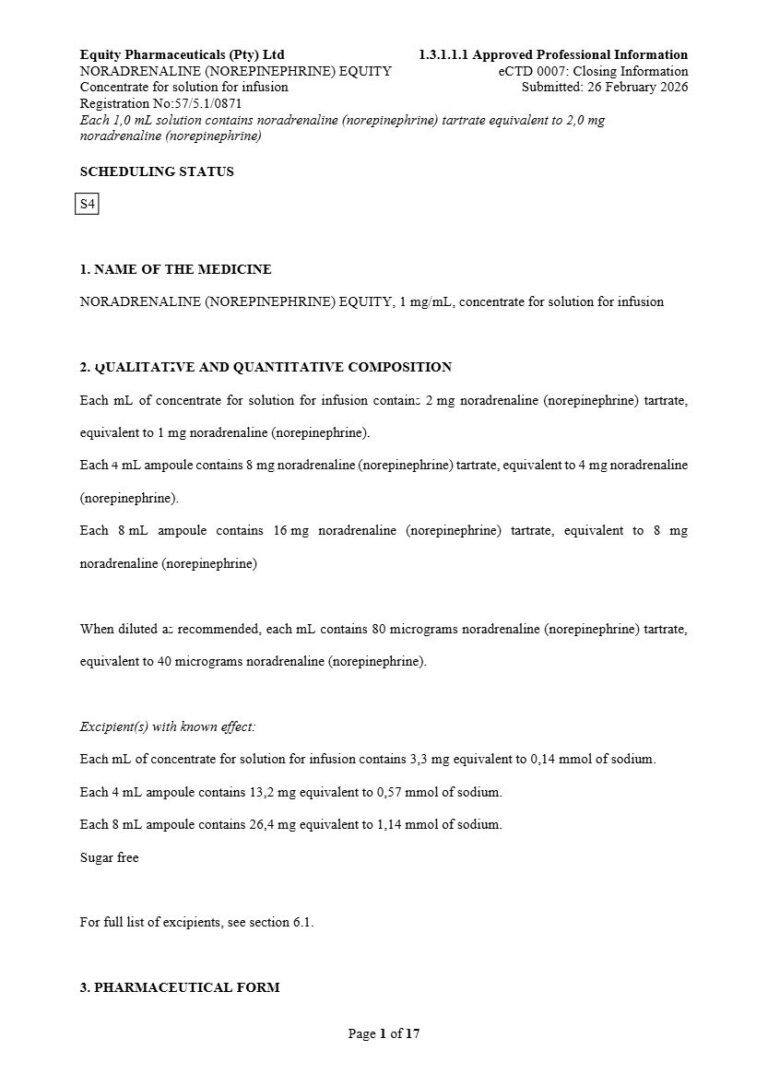
Noradrenaline Equity 1 mg Solution
PDF Leaflet Revision Date: 23 February 2026
Clinical Summary
Quick overview from the medicine insert
Indication
Emergency restoration of blood pressure in acute hypotension.
Dosage (summary)
Initial infusion rate: 10-20 mL/hour (0.4-0.8 mg/hour) for 70 kg adults; titrate as needed.
Special Populations
- Renal impairment
- Hepatic impairment
- Elderly
Pregnancy & Breastfeeding
May impair placental perfusion; safety in breastfeeding not established.
Key Drug Interactions
- Volatile halogen anaesthetics
- Tricyclic antidepressants
- Digitalis glycosides
Contraindications
- Hypersensitivity to noradrenaline
- Hypotension due to hypovolaemia
Common side effects
- Tachycardia
- Hypertension
- Anxiety
- Nausea
Counselling Points
- Dilute before use
- Monitor blood pressure continuously
- Report any adverse effects
Serious warnings
- Risk of extravasation
- Monitor for ischemia
- Use only under medical supervision
Important Disclaimer
The Noradrenaline Equity 1 mg Solution professional information leaflet below is the property of Equity Pharmaceuticals and is provided on Medinsert exactly as issued, with no.. alterations or editorial changes. We make every effort to keep content current by updating documents as soon as new versions become available. Medinsert serves as a trusted access point for healthcare professionals, but does not replace official sources or clinical judgement. For more details, please read our full disclaimer. read more>>
 Healthcare Professionals Only
This content is for registered healthcare professionals
Sign in or create a free account to read the full package insert.
Free for HPCSA-registered professionals. Powered by Medinsert.
Clinical Particulars
Section 4 of the official insert — extracted exactly as issued, no alterations
4.1 Therapeutic indications
NORADRENALINE (NOREPINEPHRINE) EQUITY is indicated in adults for the emergency restoration of blood pressure in cases of acute hypotension.
4.2 Posology and method of administration
Posology
Adults: Initial rate of infusion: When diluted as recommended in section 6.6 (the concentration of the prepared infusion is 40 mg/litre noradrenaline (norepinephrine) (80 mg/litre noradrenaline (norepinephrine) tartrate)), the initial rate of infusion, at a body weight of 70 kg, should be between 10 mL/hour and 20 mL/hour (0,16 mL/min to 0,33 mL/min). This is equivalent to 0,4 mg/hour to 0,8 mg/hour noradrenaline (norepinephrine) (0,8 mg/hour to 1,6 mg/hour noradrenaline (norepinephrine) tartrate). Some clinicians may wish to start at a lower initial infusion rate of 5 mL/hour (0,08 mL/min), equivalent to 0,2 mg/hour noradrenaline (norepinephrine) (0,4 mg/hour noradrenaline (norepinephrine) tartrate.
Titration of dose: Once an infusion of NORADRENALINE (NOREPINEPHRINE) EQUITY has been established the dose should be titrated in steps of 0,05 u2013 0,1 u03bcg/kg/min of noradrenaline (norepinephrine) according to the pressor effect observed. There is great individual variation in the dose required to attain and maintain normotension.
The aim should be to establish a low normal systolic blood pressure (100 u2013 120 mm Hg) or to achieve an adequate mean arterial blood pressure (greater than 65 u2013 80 mm Hg u2013 depending on the patientu2019s condition).
NORADRENALINE (NOREPINEPHRINE) EQUITY infusion solution 40 mg/litre (40 u03bcg/mL) noradrenaline (norepinephrine)
Patientu2019s weight Posology (u03bcg/kg/min) noradrenaline (norepinephrine) Posology (mg/hour) noradrenaline (norepinephrine) Infusion rate (mL/hour)
50 kg 0,05 0,15 3,75 0,1 0,3 7,5 0,25 0,75 18,75 0,5 1,5 37,5 1 3 75
60 kg 0,05 0,18 4,5 0,1 0,36 9 0,25 0,9 22,5 0,5 1,8 45 1 3,6 90
70 kg 0,05 0,21 5,25 0,1 0,42 10,5 0,25 1,05 26,25 0,5 2,1 52,5 1 4,2 105
80 kg 0,05 0,24 6 0,1 0,48 12
90 kg 0,05 0,27 6,75 0,1 0,54 13,5 0,25 1,35 33,75 0,5 2,7 67,5 1 5,4 135
Some medical practitioners may prefer to dilute to other concentrations. If dilutions other than 40 mg/litre are used, check the infusion rate calculation carefully before starting treatment.
Duration of treatment and monitoring: NORADRENALINE (NOREPINEPHRINE) EQUITY should be continued for as long as vasoactive medicine support is indicated. The patient should be monitored carefully for the duration of therapy. Blood pressure should be carefully monitored for the duration of therapy.
Withdrawal of therapy: NORADRENALINE (NOREPINEPHRINE) EQUITY infusion should be gradually decreased since abrupt withdrawal can result in acute hypotension.
Special populations
Patients with renal or hepatic impairment: There is no experience in treatment of renally or hepatically impaired patients.
Elderly population: As for adults but see section 4.4.
Paediatric population: The safety and efficacy of NORADRENALINE (NOREPINEPHRINE) EQUITY in children and adolescents have not been established.
Method of administration: For intravenous use. NORADRENALINE (NOREPINEPHRINE) EQUITY solution for infusion is infused as a diluted solution intravenously. To avoid ischemic necrosis (skin, extremities) a cannula placed in a sufficiently larger vein or a central venous access to the infusion should be used. The infusion should be at a controlled rate using either a syringe pump or an infusion pump or a drip counter. For dilution instructions see section 6.6.
4.3 Contraindications
- Hypersensitivity to noradrenaline (norepinephrine) or to any of the excipients of NORADRENALINE (NOREPINEPHRINE) EQUITY as listed in section 6.1.
- Hypotension due to blood volume deficit (hypovolaemia).
- Do not use with cyclopropane and halothane anaesthetics as this may cause serious cardiac dysrhythmias including ventricular fibrillation. For interactions see section 4.5.
4.4 Special warnings and precautions for use
NORADRENALINE (NOREPINEPHRINE) EQUITY should only be administered by healthcare professionals who are familiar with its use.
Warning:
- Do not use undiluted.
- NORADRENALINE (NOREPINEPHRINE) EQUITY is contraindicated in hypotensive patients due to hypovolemia, however, may still be considered as a short-term emergency measure to support blood supply to coronary and cerebral arteries until general blood or solution infusion can be initiated.
- NORADRENALINE (NOREPINEPHRINE) EQUITY should be used only in conjunction with appropriate blood volume replacement.
- When infusing NORADRENALINE (NOREPINEPHRINE) EQUITY, the blood pressure and rate of flow should be checked frequently to avoid hypertension.
- The products administrated by injection must always be visually inspected and cannot be used if the presence of particles or a change of colouring is noted.
- The patients receiving NORADRENALINE (NOREPINEPHRINE) EQUITY should be closely monitored in order to identify early symptoms of vasopressor-induced limb ischaemia and implement the appropriate measures (e.g. elevation of the extremity, splinting, warming of affected limb with ad hoc device, use of vasodilating agents) to prevent progression and minimize the risks associated with necrosis of the extremities.
- Extravasation risk: The infusion site should be checked frequently for free flow. Care should be taken to avoid extravasation that would cause a necrosis of the tissues surrounding the vein used for the injection. Because of the vasoconstriction of the vein wall with increased permeability, there might be some leakage of noradrenaline (norepinephrine) in the tissues surrounding the infused vein causing a blanching of the tissues which is not due to an obvious extravasation. Hence if blanching occurs, consideration should be given to changing the infusion site to allow the effects of local vasoconstriction to subside.
- Treatment of the ischemia due to extravasation: During an extravascular leak of the product or an injection besides the vein, tissue destruction can appear resulting from the vasoconstrictive action of the medicine on the blood vessels. The area should be infiltrated as quickly as possible with 10 to 15 mL of physiological salt solution containing 5 to 10 mg of phentolamine mesilate, an adrenergic blocking agent. For this purpose, it is necessary to use a syringe provided with a fine needle and to inject locally throughout the area, which is easily identified by its cold, hard and pallid appearance.
Precautions for use:
- Caution and respect of the strict indication must be retained in case of: Major left ventricular dysfunction associated with acute hypotension; a careful evaluation of patientu2019s blood pressure is needed. Supportive therapy should be initiated simultaneously with diagnostic evaluation. NORADRENALINE (NOREPINEPHRINE) EQUITY should be reserved for patients with cardiogenic shock and refractory hypotension, in particular those without elevated systemic vascular resistance. It should be started at a dosage of 2 to 4 u03bcg/min and titrated upwards and titrated as necessary. If systemic perfusion or systolic pressure cannot be maintained at > 90 mm Hg with a dosage of 15 u03bcg/min, it is unlikely that a further increase will be beneficial.
- Particular caution should be observed in patients with coronary, mesenteric or peripheral vascular thrombosis because noradrenaline (norepinephrine) may increase the ischaemia and extend the area of infarction. Similar caution should be observed in patients with hypotension following myocardial infarction and in patients with Prinzmetalu2019s variant angina.
- Occurrence of heart rhythm disorders during the treatment must lead to a reduction in the dosage.
- Caution is advised in patients with hyperthyroidism or diabetes mellitus.
- The elderly may be especially sensitive to the effects of noradrenaline (norepinephrine) e.g., NORADRENALINE (NOREPINEPHRINE) EQUITY, due to the greater frequency of hepatic, renal or cardiac function and concomitant disease or other medicine therapy.
- The use of NORADRENALINE (NOREPINEPHRINE) EQUITY in children is not recommended (see section 4.2).
Perfusion of NORADRENALINE (NOREPINEPHRINE) EQUITY must be performed with continuous monitoring of blood pressure and cardiac frequency. Prolonged administration of any potent vasopressor may result in plasma volume depletion which should be continuously corrected by appropriate fluid and electrolyte replacement therapy. If plasma volumes are not corrected, hypotension may recur when the infusion is discontinued, or blood pressure may be maintained at the risk of severe peripheral and visceral vasoconstriction (e.g., decreased renal perfusion) with diminution in blood flow and tissue perfusion with subsequent tissue hypoxia and lactic acidosis and possible ischaemic injury. Gangrene of extremities has been reported less frequently.
The vasopressor effect (resulting from the adrenergic action in the vessels) can be reduced by the concomitant administration of an alpha-blocking medicine (phentolamine mesilate) whereas the administration of a beta-blocking medicine (propranolol) may result in a reduction of the stimulating effect of the product on the heart and in an increase of the hypertensive effect (through reduction of arteriolar dilatation), resulting from beta-1-adrenergic stimulation.
In cases where it is necessary to administer NORADRENALINE (NOREPINEPHRINE) EQUITY at the same time as total blood or plasma, the latter must be administered in a separate drip. NORADRENALINE (NOREPINEPHRINE) EQUITY contains sodium. NORADRENALINE (NOREPINEPHRINE) EQUITY contains 3,3 mg sodium per mL, equivalent to 0,16 % of the WHO recommended maximum daily intake of 2 g sodium for an adult.
4.5 Interaction with other medicines and other forms of interaction
Contraindicated combinations
- Volatile halogen anaesthetics: severe ventricular dysrhythmia (increase in cardiac excitability). The use of pressor amines with cyclopropane, halothane, chloroform, enflurane or other halogenated anaesthetics may cause serious cardiac dysrhythmias, because of the possibility of increasing the risk of ventricular fibrillation. Noradrenaline (norepinephrine) is contraindicated in combination with these medicines. See section 4.3.
Inadvisable combinations
- Tricyclic antidepressants: paroxysmal hypertension with the possibility of dysrhythmia (inhibition of the entry of sympathomimetics into sympathetic fibres).
- Serotoninergic-adrenergic antidepressants: paroxysmal hypertension with the possibility of dysrhythmia (inhibition of the entry of sympathomimetics into sympathetic fibres).
- Desipramine: significantly increase the toxicity of noradrenaline (norepinephrine).
- Digitalis glycosides: may occasionally cause dysrhythmias.
- Levodopa: may enhance the effects of noradrenaline (norepinephrine).
- Antihistamines, as some may block the intake of catecholamines by peripheral tissues and increase the toxicity of injected noradrenaline (norepinephrine).
- Chlorpheniramine hydrochloride, tripelennamine hydrochloride: significantly increase the toxicity of noradrenaline (norepinephrine).
Combinations requiring precautions for use
- Non-selective MAO inhibitors (or within 14 days of cessation of such therapy): increase in the pressor action of the sympathomimetic which is usually moderate. Should only be used under close medical supervision.
- Selective MAO-A inhibitors: by extrapolation from non-selective MAO inhibitors, risk of increase in the pressor action. Should only be used under close medical supervision.
- Linezolid: by extrapolation from non-selective MAO inhibitors, risk of increase in the pressor action. Should only be used under close medical supervision.
- Alpha and beta blockers: caution is required as severe hypertension may result.
- Thyroid hormones, cardiac glycosides, anti-dysrhythmics: caution is required as they may cause increased cardiac effects.
- Ergot alkaloids or oxytocin: may enhance the vasopressor and vasoconstrictive effects.
- Desmopressin or vasopressin: its antidiuretic effect is diminished.
- Lithium decreases the effect of noradrenaline (norepinephrine).
- Guanethidine, guanadrel, reserpine, methyldopa or amphetamine, doxapram, mazindol, rauwolfia alkaloids: may enhance the effects of noradrenaline (norepinephrine).
- Propofol: concomitant administration may lead to propofol infusion syndrome (PRIS).
4.6 Fertility, pregnancy and lactation
Pregnancy
Noradrenaline (norepinephrine) may impair placental perfusion and induce foetal bradycardia. It may also exert a contractile effect on the pregnant uterus and lead to foetal asphyxia in late pregnancy. Safety has not been established in pregnant woman.
Breastfeeding
No information is available on the use of NORADRENALINE (NOREPINEPHRINE) EQUITY in lactation. The safety of NORADRENALINE (NOREPINEPHRINE) EQUITY during breastfeeding has not been established.
4.7 Effects on ability to drive and use machines
Not applicable.
4.8 Undesirable effects
Tabulated list of adverse reactions
System Organ Class (SOC) Undesirable effect (Frequency unknown)
- Metabolism and nutrition disorders: Anorexia.
- Psychiatric disorders: Anxiety, insomnia, confusion, weakness, psychotic state.
- Nervous system disorders: Headache, tremor, lower vigilance.
- Eye disorders: Acute glaucoma (very frequent in patients anatomically predisposed with the closing of the iridocorneal angle).
- Cardiac disorders: Tachycardia, bradycardia (probably as a reflex result of blood pressure rising), dysrhythmias, palpitations, increase in the contractility of the cardiac muscle resulting from the beta-adrenergic effect on the heart (inotrope and chronotrope), acute cardiac insufficiency, stress cardiomyopathy.
- Vascular disorders: Arterial hypertension and tissue hypoxia; ischemic injury due to potent vasoconstrictor action may result in coldness and paleness of the skin, members (peripheries) and the face, and gangrene of the extremities, cyanosis, hot flushes or skin redness.
- Respiratory, thoracic and mediastinal disorders: Respiratory insufficiency or difficulty, dyspnoea.
- Skin and subcutaneous tissue disorders: Scarification of the skin, skin rash, hives or itching.
- Gastrointestinal disorders: Nausea, vomiting.
- Renal and urinary disorders: Retention of urine.
- General disorders and administration site conditions: Possibility of irritation, sloughing and necrosis at the injection site.
Description of selected adverse reactions
The continuous administration of vasopressor to maintain blood pressure in absence of blood volume replacement may cause the following symptoms:
- severe peripheral and visceral vasoconstriction
- decrease in renal blood flow
- decrease in urine production
- tissue hypoxia
- lactic acidosis.
In case of hypersensitivity or overdose, the following effects may appear more frequently: hypertension, photophobia, retrosternal pain, pharyngeal pain, pallor, intense sweating and vomiting.
Reporting of suspected adverse reactions
Reporting suspected adverse reactions after authorisation of the medicine is important. It allows continued monitoring of the benefit/risk balance of the medicine. Health care providers are requested to report any suspected adverse drug reactions to SAHPRA via the Med Safety APP (Medsafety X SAHPRA) and eReporting platform (who-umc.org) found on SAHPRA website.
4.9 Overdose
Symptoms
Overdosage may result in headache, severe hypertension, reflex bradycardia, marked increase in peripheral resistance and decreased cardiac output. These may be accompanied by violent headache, cerebral haemorrhage, photophobia, retrosternal pain, pallor, fever, intense sweating, pulmonary oedema and vomiting. The following may also be observed: cutaneous vasoconstriction, bed sores.
Treatment
In the event of accidental overdose, as evidenced by excessive blood pressure elevation, discontinue the medicine until the condition of the patient stabilises.
