
Pedea 5 mg, 10 mg Solution for injection
PDF Leaflet Revision Date: 04 April 2025
Clinical Summary
Quick overview from the medicine insert
Indication
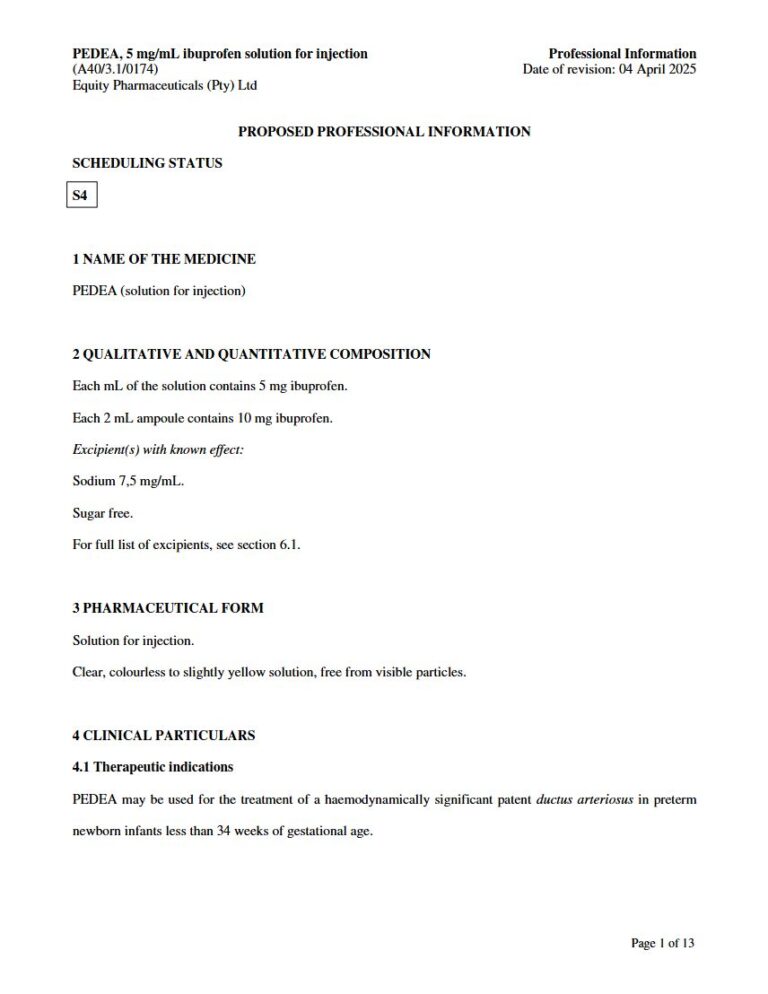
Treatment of haemodynamically significant patent ductus arteriosus in preterm newborns <34 weeks gestational age.
Dosage (summary)
IV: 10 mg/kg (1st dose), 5 mg/kg (2nd & 3rd doses) at 24-hour intervals.
Special Populations
- Preterm infants
- Neonates
Key Drug Interactions
- Diuretics
- Anticoagulants
- Corticosteroids
- Nitric oxide
- Other NSAIDs
- Zidovudine
- Ritonavir
- Aminoglycosides
Contraindications
- Hypersensitivity to ibuprofen
- Life-threatening infection
- Active bleeding
- Thrombocytopenia
- Significant renal impairment
- Congenital heart disease requiring ductus arteriosus patency
- Necrotising enterocolitis
Common side effects
- Thrombocytopenia
- Intraventricular haemorrhage
- Bronchopulmonary dysplasia
- Necrotising enterocolitis
- Oliguria
Counselling Points
- Administer in neonatal intensive care unit
- Monitor for signs of bleeding
- Avoid prophylactic use in preterm infants
- Discard unused solution after opening
Serious warnings
- Increased risk of pulmonary and renal adverse events in preterm infants <28 weeks
- Risk of bilirubin encephalopathy
- Serious skin reactions
- Monitor for bleeding
Important Disclaimer
The Pedea 5 mg, 10 mg Solution for injection professional information leaflet below is the property of Equity Pharmaceuticals and is provided on Medinsert exactly as issued, with no.. alterations or editorial changes. We make every effort to keep content current by updating documents as soon as new versions become available. Medinsert serves as a trusted access point for healthcare professionals, but does not replace official sources or clinical judgement. For more details, please read our full disclaimer. read more>>
 Healthcare Professionals Only
This content is for registered healthcare professionals
Sign in or create a free account to read the full package insert.
Free for HPCSA-registered professionals. Powered by Medinsert.
Clinical Particulars
Section 4 of the official insert — extracted exactly as issued, no alterations
4.1 Therapeutic indications
PEDEA may be used for the treatment of a haemodynamically significant patent ductus arteriosus in preterm newborn infants less than 34 weeks of gestational age.
4.2 Posology and method of administration
Treatment with PEDEA should only be carried out in a neonatal intensive care unit under the supervision of an experienced neonatologist.
Posology
A course of therapy is defined as three IV doses of PEDEA given at 24 hour intervals. The first injection should be given after the first 6 hours of life.
The PEDEA dose is adjusted to the body weight as follows:
- 1st injection: 10 mg/kg
- 2nd and 3rd injections: 5 mg/kg.
If anuria or manifest oliguria occurs after the first or second dose, the next dose should be withheld until urine output returns to normal.
If the ductus arteriosus does not close within 48 hours after the last injection or if it reopens, a second course of 3 doses, as above, may be given. If the condition in unchanged after the second course of therapy, surgery of the patent ductus arteriosus may be necessary.
Method of administration
For intravenous infusion only. PEDEA should be administered as a short infusion over 15 minutes, preferably undiluted. If necessary, the injection volume may be adjusted with either sodium chloride 9 mg/mL (0,9 %) solution for injection or glucose 50 mg/mL (5 %) solution for injection. Any unused portion of the solution should be discarded. The total volume of solution injected should take into account the total daily fluid volume administered.
4.3 Contraindications
PEDEA is contraindicated in neonates with:
- hypersensitivity to ibuprofen or to any of the excipients listed in section 6.1
- life-threatening infection
- active bleeding, especially intracranial or gastrointestinal haemorrhage
- thrombocytopenia or coagulation defects
- significant impairment of renal function
- congenital heart disease in which patency of the ductus arteriosus is necessary for satisfactory pulmonary or systemic blood flow (e.g. pulmonary atresia, tetralogy of Fallot, severe coarctation of the aorta)
- known or suspected necrotising enterocolitis
4.4 Special warnings and precautions for use
Before administration of PEDEA an adequate echocardiographic examination should be performed in order to detect a haemodynamically significant patent ductus arteriosus and to exclude pulmonary hypertension and ductal-dependent congenital heart disease.
As the prophylactic use in the first 3 days of life (starting within 6 hours of birth) in preterm newborn infants less than 28 weeks of gestational age was associated with increased pulmonary and renal adverse events, PEDEA should not be used prophylactically in preterm infants.
If hypoxaemia occurs during or following PEDEA infusion, close attention should be paid to pulmonary artery pressure.
Since PEDEA was shown in vitro to displace bilirubin from its binding site to albumin, the risk of bilirubin encephalopathy in premature newborn infants may be increased (see section 5.2). Therefore, PEDEA should not be used in infants with a markedly elevated bilirubin concentration.
As PEDEA may inhibit platelet aggregation, premature neonates should be monitored for signs of bleeding.
As PEDEA may decrease the clearance of aminoglycosides, strict surveillance of their serum levels is recommended during co-administration with PEDEA (see section 4.5) since acute renal failure has recurred when aminoglycosides were given together with PEDEA. Acute renal failure often presents with oliguria and increased weight.
Careful monitoring of both renal and gastrointestinal function is recommended. When gastrointestinal bleeding or ulceration occurs in patients receiving PEDEA, treatment with PEDEA should be stopped (see section 4.3).
Serious skin reactions, some of them fatal, including exfoliative dermatitis, Stevens-Johnson syndrome, and toxic epidermal necrolysis have been reported with the use of non-steroidal anti-inflammatory drugs (NSAIDSs) such as PEDEA (see section 4.8). Patients appear to be at highest risk of these reactions early in the course of therapy, the onset of the reaction occurring in the majority of cases within the first month of treatment. Acute generalised exanthematous pustulosis (AGEP) has been reported in relation to ibuprofen-containing medicines such as PEDEA. PEDEA should be discontinued at the first appearance of signs and symptoms of severe skin reactions, such as skin rash, mucosal lesions, or any other sign of hypersensitivity.
PEDEA may mask the usual signs and symptoms of infection. PEDEA must therefore be used cautiously in the presence of an infection (see section 4.3).
PEDEA should be administered carefully to avoid extravasation and potential irritation to tissues.
In preterm newborn infants less than 27 weeks of gestational age, the closure rate of the ductus arteriosus (33 to 50 %) was shown to be low at the recommended dose regimen.
PEDEA contains less than 1 mmol sodium (15 mg) per 2 mL that is to say essentially u201csodium - freeu201d.
4.5 Interaction with other medicines and other forms of interaction
The potential adverse medicine reactions of particular concern with PEDEA, result from its high degree of binding to albumin in the plasma. The effects of PEDEA on renal function may lead to reduced excretion of some medicines.
The concomitant use of PEDEA with the following medicines is not recommended:
- Diuretics and other antihypertensive medicines: Diuretics can increase the risk of nephrotoxicity of PEDEA in dehydrated patients. The antihypertensive effects of some antihypertensive medicines including ACE inhibitors, beta blockers and diuretics may be reduced. There may also be an increased risk of hyperkalaemia with ACE inhibitors and potassium sparing diuretics.
- Anticoagulants: PEDEA may increase the effect of anticoagulants and enhance the risk of bleeding.
- Corticosteroids: PEDEA may increase the risk of gastrointestinal bleeding and ulceration.
- Nitric oxide: Since both PEDEA and nitric oxide inhibit platelet function, their combination may increase the risk of bleeding.
- Other NSAIDs (including aspirin): The concomitant use of more than one NSAID should be avoided because of the increased risk of adverse effects.
- Zidovudine: There may be an increased risk of haemotoxicity during concomitant use of zidovudine and PEDEA; blood counts one to two weeks after starting use together are recommended.
- Ritonavir: Concomitant use may increase the plasma concentrations of PEDEA.
- Aminoglycosides: Since PEDEA may decrease the clearance of aminoglycosides, their co-administration may increase the risk of nephrotoxicity and ototoxicity (see section 4.4).
4.6 Fertility, pregnancy and lactation
Not applicable. PEDEA is indicated for preterm infants.
4.7 Effects on ability to drive and use machines
Not applicable. PEDEA is indicated for preterm infants.
4.8 Undesirable effects
Data are currently available on approximately 1 000 preterm newborn from both the literature concerning ibuprofen and clinical trials with PEDEA. Causality of adverse events reported in the preterm newborn is difficult to assess since they may be related to the haemodynamic consequences of the patent ductus arteriosus as well as to direct effects of ibuprofen.
Adverse reactions reported are listed below, by MEDRA system organ class and by CIOMS frequency categories. Frequencies are defined as: very common (u2265 1/10), common (u2265 1/100, < 1/10), uncommon (u2265 1/1 000, < 1/100), rare (u2265 1/10 000, < 1/1 000), very rare (< 1/10 000).
Within each frequency grouping, adverse reactions are presented in order of decreasing seriousness.
Blood and lymphatic system disorders:
Very common: Thrombocytopenia, neutropenia
Nervous system disorders:
Common: Intraventricular haemorrhage, periventricular leukomalacia
Cardiac disorders:
Frequency unknown: Hypertension, cardiac failure
Respiratory, thoracic and mediastinal disorders:
Very common: Bronchopulmonary dysplasia
Common: Pulmonary haemorrhage
Uncommon: Hypoxaemia *, pulmonary hypertension
Gastrointestinal disorders:
The most commonly observed adverse events are gastrointestinal in nature.
Common: Necrotising enterocolitis, peptic ulcers, intestinal perforation or gastrointestinal bleeding, sometimes fatal. Nausea, vomiting, diarrhoea, flatulence, constipation, dyspepsia, abdominal pain, melena, hematemesis, ulcerative stomatitis, exacerbation of colitis and Crohnu2019s disease, gastritis
Frequency unknown: Gastric perforation
Skin and subcutaneous tissue disorders:
Frequency unknown: Bullous reactions, including Stevens-Johnson syndrome and toxic epidermal necrolysis, acute generalised exanthematous pustulosis (AGEP)
Renal and urinary disorders:
Common: Oliguria, fluid retention, haematuria
Uncommon: Acute renal failure
Investigations:
Very common: Blood creatinine increased, blood sodium decreased
* In a clinical trial where PEDEA was administered prophylactically during the first 6 hours of life, severe hypoxaemia with pulmonary hypertension was reported in 3 newborn infants less than 28 weeks of gestational age. This occurred within one hour of the first infusion and was reversed within 30 minutes after the inhalation of nitric oxide. There have also been post-marketing reports of pulmonary hypertension where PEDEA was administered to premature neonates in the therapeutic setting (see section 4.4).
Reporting of suspected adverse reactions
Reporting suspected adverse reactions after authorisation of the medicine is important. It allows continued monitoring of the benefit/risk balance of the medicine. Healthcare providers are asked to report any suspected adverse reactions to SAHPRA via the Med Safety APP (Medsafety X SAHPRA) and eReporting platform (who- umc.org) found on SAHPRA website.
4.9 Overdose
No case of overdose has been reported with intravenous ibuprofen such as PEDEA in preterm newborn infants. However, overdose has been described in infants and children administered oral ibuprofen: CNS, depression, seizures, gastrointestinal disturbances, bradycardia, hypotension, apnoea, abnormal renal function, haematuria have been observed. Massive overdose (up to more than 1 000 mg/kg) has been reported to induce coma, metabolic acidosis and transient renal failure. All patients recovered with conventional treatment. Only one recorded death has been published: after an overdosage of 469 mg/kg, a 16 month old child developed an apnoeic episode with seizures and a fatal aspiration pneumonia. Prolonged use at higher than recommended doses or overdose may result in renal tubular acidosis and hypokalaemia. The management of PEDEA overdose is supportive and symptomatic.
