
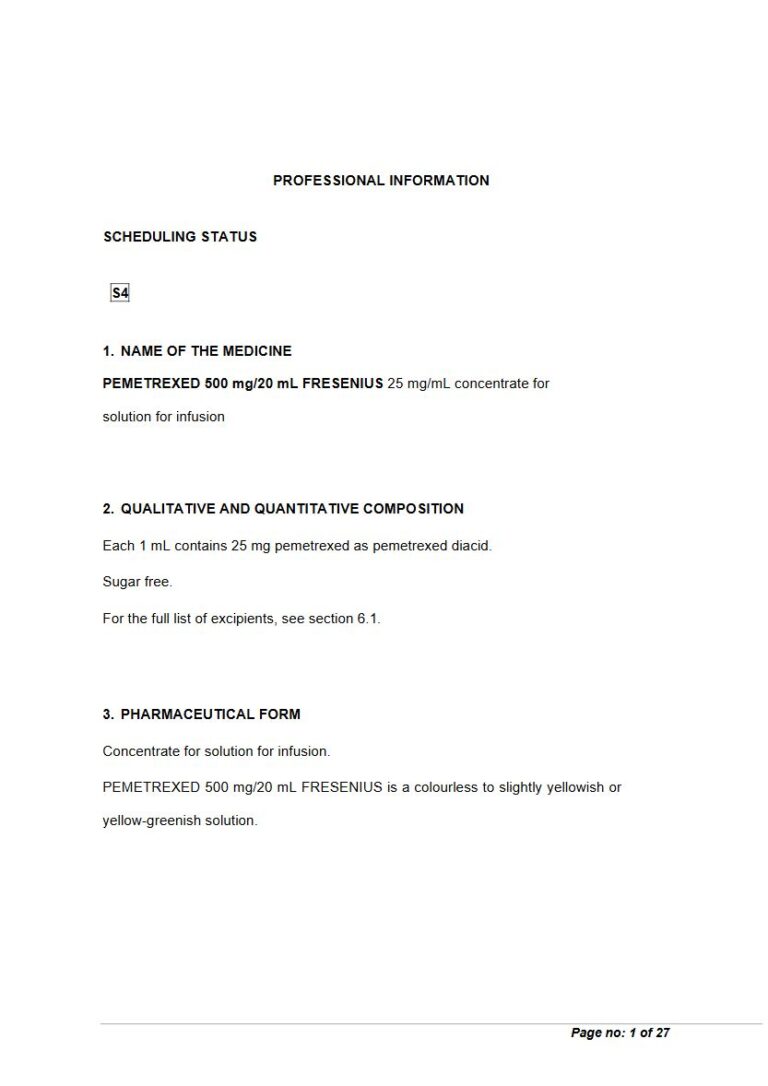
Pemetrexed 500 Mg/20 Ml Solution
PDF Leaflet Revision Date: 08 April 2025
Clinical Summary
Quick overview from the medicine insert
Indication
Treatment of malignant pleural mesothelioma and non-small cell lung cancer.
Dosage (summary)
500 mg/mu00b2 IV infusion over 10 mins on day 1 of each 21-day cycle.
Special Populations
- Renal impairment
- Hepatic impairment
Pregnancy & Breastfeeding
Avoid in pregnancy; not known if excreted in breast milk.
Key Drug Interactions
- NSAIDs
- Nephrotoxic agents
- Live attenuated vaccines
Contraindications
- Hypersensitivity to pemetrexed
- Concomitant yellow fever vaccine
Common side effects
- Neutropenia
- Nausea
- Fatigue
- Rash
Counselling Points
- Take folic acid and vitamin B12
- Avoid pregnancy
- Monitor for signs of infection
Serious warnings
- Myelosuppression
- Potential for renal toxicity
- Genotoxic effects
Important Disclaimer
The Pemetrexed 500 Mg/20 Ml Solution professional information leaflet below is the property of Fresenius Kabi South Africa and is provided on Medinsert exactly as issued, with no.. alterations or editorial changes. We make every effort to keep content current by updating documents as soon as new versions become available. Medinsert serves as a trusted access point for healthcare professionals, but does not replace official sources or clinical judgement. For more details, please read our full disclaimer. read more>>
 Healthcare Professionals Only
This content is for registered healthcare professionals
Sign in or create a free account to read the full package insert.
Free for HPCSA-registered professionals. Powered by Medinsert.
Clinical Particulars
Section 4 of the official insert — extracted exactly as issued, no alterations
4.1 Therapeutic indications
PEMETREXED 500 mg/20 mL FRESENIUS is indicated for the treatment of patients with malignant pleural mesothelioma in combination with cisplatin. PEMETREXED 500 mg/20 mL FRESENIUS is indicated in combination with cisplatin therapy for the initial treatment of patients with locally advanced or metastatic non-small cell lung cancer other than predominantly squamous cell histology. PEMETREXED 500 mg/20 mL FRESENIUS is indicated as monotherapy for the treatment of patients with locally advanced or metastatic adenocarcinoma of the lung after prior chemotherapy. PEMETREXED 500 mg/20 mL FRESENIUS is indicated as monotherapy for the maintenance treatment of locally advanced or metastatic adenocarcinoma of the lung in patients whose disease has not progressed immediately following standard chemotherapy.
4.2 Posology and method of administration
PEMETREXED 500 mg/20 mL FRESENIUS should only be administered under the supervision of a medical practitioner qualified in the use of anti-cancer chemotherapy.
Posology
Malignant pleural mesothelioma:
Combination use with cisplatin: Adults: In patients treated for malignant pleural mesothelioma, the recommended dose of PEMETREXED 500 mg/20 mL FRESENIUS is 500 mg/m2 administered as an intravenous infusion over 10 minutes on the first day of each 21-day cycle. The recommended dose of cisplatin is 75 mg/m2 infused over 2 hours approximately 30 minutes after completion of PEMETREXED 500 mg/20 mL FRESENIUS infusion on the first day of each 21-day cycle. Patients should receive appropriate hydration prior to and/or after receiving cisplatin.
Adenocarcinoma of the lung:
Single medicine use: Adults: In patients treated for adenocarcinoma of the lung, the recommended dose of PEMETREXED 500 mg/20 mL FRESENIUS is 500 mg/m2 administered as an intravenous infusion over 10 minutes on the first day of each 21-day cycle.
Combination use with cisplatin: Adults: In patients treated for non-small cell lung cancer: the recommended dose of PEMETREXED 500 mg/20 mL FRESENIUS is 500 mg/m2 administered as an intravenous infusion over 10 minutes on the first day of each 21-day cycle. The recommended dose of cisplatin is 75 mg/m2 infused over 2 hours approximately 30 minutes after completion of the PEMETREXED 500 mg/20 mL FRESENIUS infusion on the first day of each 21-day cycle. Patients should receive appropriate hydration prior to and/or after receiving cisplatin.
Premedication regimen:
To reduce the incidence and severity of skin reactions, a corticosteroid should be given the day prior to, on the day of, and the day after PEMETREXED 500 mg/20 mL FRESENIUS administration. The corticosteroid should be equivalent to 4 mg of dexamethasone administered orally twice a day (see section 4.4). To reduce toxicity, patients treated with PEMETREXED 500 mg/20 mL FRESENIUS should also receive vitamin supplementation (see section 4.4). Patients must take oral folic acid or multivitamin containing folic acid (350 to 1 000 mcg) on a daily basis. At least 5 daily doses of folic acid must be taken during the 7 days preceding the first dose of PEMETREXED 500 mg/20 mL FRESENIUS, and dosing should continue during the full course of therapy and for 21 days after the last dose of PEMETREXED 500 mg/20 mL FRESENIUS. Patients must also receive an intramuscular injection of vitamin B12 (1 000 mcg) in the week preceding the first dose of PEMETREXED 500 mg/20 mL FRESENIUS and every 3 cycles thereafter.
Monitoring:
Patients receiving PEMETREXED 500 mg/20 mL FRESENIUS should be monitored before each dose with a full blood count, including a differential and platelet count. Periodic blood chemistry tests should be collected to evaluate renal and hepatic function. Absolute Neutrophil Count (ANC) should be u22651 500 cells/mm3 and platelets should be u2265100 000 cells/mm3 prior to the start of each cycle.
Dose adjustments:
Dose adjustments at the start of a subsequent cycle should be based on nadir haematologic counts or maximum non-haematologic toxicity from the preceding cycle of therapy. Treatment may be delayed to allow sufficient time for recovery. Upon recovery, patients may be retreated using the guidelines in Tables 1, 2 and 3, which are applicable for PEMETREXED 500 mg/20 mL FRESENIUS used as a single medicine or in combination with cisplatin. If patients develop non-haematologic toxicities (excluding neurotoxicity) u2265 Grade 3 treatment should be withheld until resolution to less than or equal to the patientu2019s pre-therapy value. Treatment should be resumed according to the guidelines in Table 2.
4.3 Contraindications
- Hypersensitivity to pemetrexed, or to any of the excipients (see section 6.1)
- Concomitant yellow fever vaccine (see section 4.5).
4.4 Special warnings and precautions for use
PEMETREXED 500 mg/20 mL FRESENIUS can suppress bone marrow function as manifested by neutropenia, thrombocytopenia, anaemia or pancytopenia (see sections 4.4, 4.8). Myelosuppression is usually the dose-limiting toxicity. Patients should be monitored for myelosuppression during therapy and PEMETREXED 500 mg/20 mL FRESENIUS should not be given to patients until absolute neutrophil count (ANC) returns to u22651 500 cells/mm3 and platelet count returns to u2265100 000 cells/mm3. Dose reductions for subsequent cycles are based on nadir ANC, platelet count and maximum non-haematologic toxicity seen from the previous cycle (see section 4.2).
Less toxicity and reduction in Grade 3/4 haematologic and non-haematologic toxicities such as neutropenia, febrile neutropenia and infection with Grade 3/4 neutropenia were reported when pre-treatment with folic acid and vitamin B12 was administered. Therefore, all patients treated with PEMETREXED 500 mg/20 mL FRESENIUS must be instructed to take folic acid and vitamin B12 as a prophylactic measure to reduce treatment-related toxicity (see section 4.2).
Skin reactions have been reported in patients not pre-treated with a corticosteroid. Pre-treatment with dexamethasone or equivalent can reduce the incidence and severity of skin reactions (see section 4.2).
An insufficient number of patients has been studied with creatinine clearance of <45 mL/min. Therefore, the use of PEMETREXED 500 mg/20 mL FRESENIUS in patients with creatinine clearance of <45 mL/min is not recommended (see section 4.2).
Patients with mild to moderate renal insufficiency (creatinine clearance from 45 u2013 79 mL/min) should avoid taking non-steroidal anti-inflammatory drugs (NSAIDs) with short-elimination half-lives for at least 2 days prior to, on the day of, and at least 2 days after administration of PEMETREXED 500 mg/20 mL FRESENIUS. All patients eligible for PEMETREXED 500 mg/20 mL FRESENIUS therapy should avoid taking NSAIDs with long elimination half-lives at least 5 days prior to, on the day of, and at least 2 days after PEMETREXED 500 mg/20 mL FRESENIUS administration (see section 4.5).
Serious renal events, including acute renal failure, have been reported with pemetrexed alone or in association with other chemotherapeutic medicines. Many of the patients in whom these occurred had underlying risk factors for the development of renal events including dehydration or pre-existing hypertension or diabetes. Nephrogenic diabetes insipidus and renal tubular necrosis were also reported with pemetrexed alone or with other chemotherapeutic medicines. Most of these events resolved after pemetrexed withdrawal. Patients should be regularly monitored for acute tubular necrosis, decreased renal function and signs and symptoms of nephrogenic diabetes insipidus (e.g. hypernatraemia).
The effect of third space fluid, such as pleural effusion or ascites, on PEMETREXED 500 mg/20 mL FRESENIUS is not fully defined. Drainage of third space fluid collection prior to PEMETREXED 500 mg/20 mL FRESENIUS treatment in patients with normal renal function should be considered but may not be necessary.
Due to the gastrointestinal toxicity of PEMETREXED 500 mg/20 mL FRESENIUS given in combination with cisplatin, severe dehydration has been observed. Therefore, patients should receive adequate antiemetic treatment and appropriate hydration prior to and/or after receiving treatment.
Serious cardiovascular events, including myocardial infarction and cerebrovascular events have been less frequently reported with pemetrexed, usually when given in combination with another cytotoxic medicine. Most of the patients in whom these events have been observed had pre-existing cardiovascular risk factors (see section 4.8).
Immunodepressed status is common in cancer patients. As a result, concomitant use of live attenuated vaccines is not recommended (see sections 4.3, 4.5).
PEMETREXED 500 mg/20 mL FRESENIUS can have genetically damaging effects. Sexually mature males are advised not to father a child during the treatment and up to 6 months thereafter. Contraceptive measures or abstinence are recommended. Owing to the possibility of PEMETREXED 500 mg/20 mL FRESENIUS treatment causing irreversible infertility, men are advised to seek counselling on sperm storage before starting treatment. Women of childbearing potential must use effective contraception during treatment with PEMETREXED 500 mg/20 mL FRESENIUS (see section 4.6).
Cases of radiation pneumonitis have been reported in patients treated with radiation either prior, during or subsequent to their pemetrexed therapy. Particular attention should be paid to these patients and caution exercised with use of other radiosensitising medicines. Cases of radiation recall have been reported in patients who received radiotherapy weeks or years previously.
4.5 Interaction with other medicines and other forms of interaction
Pemetrexed is primarily eliminated unchanged renally as a result of glomerular filtration and tubular secretion. Pemetrexed is actively secreted by OAT3 (organic anion transporter 3). Concomitant administration of nephrotoxic medicines (e.g. aminoglycosides, loop diuretics, platinum compounds, ciclosporin) could result in delayed clearance of pemetrexed. Concomitant administration of substances that are tubularly secreted (e.g. probenecid, penicillin) could potentially result in delayed clearance of pemetrexed.
Although NSAIDs in moderate doses can be administered with PEMETREXED 500 mg/20 mL FRESENIUS in patients with normal renal function (creatinine clearance u226580 mL/min), caution should be used when administering NSAIDs concurrently with PEMETREXED 500 mg/20 mL FRESENIUS to patients with renal insufficiency (creatinine clearance 45 u2013 79 mL/min). A decrease was shown in pemetrexed clearance following co-administration of ibuprofen. It is recommended that patients with mild to moderate renal insufficiency should avoid taking NSAIDs with short elimination half-lives at least 2 days prior to, on the day of, and at least 2 days after administration of PEMETREXED 500 mg/20 mL FRESENIUS. In the absence of data regarding potential interaction between PEMETREXED 500 mg/20 mL FRESENIUS and NSAIDs with longer half-lives, such as piroxicam or rofecoxib patients with mild to moderate renal insufficiency taking these NSAIDs should interrupt dosing for at least 5 days before, on the day of, and at least 2 days after PEMETREXED 500 mg/20 mL FRESENIUS administration. If concomitant administration of NSAIDs is necessary, patients should be monitored closely for toxicity, especially myelosuppression and gastrointestinal toxicity.
Acetylsalicylic acid, administered in low to moderate doses (325 mg orally every 6 hours) does not affect the pharmacokinetics of PEMETREXED 500 mg/20 mL FRESENIUS. The pharmacokinetics of pemetrexed are not influenced by concurrently administered cisplatin or carboplatin. Similarly, the pharmacokinetics of total platinum are unaltered by pemetrexed. Oral folic acid and intramuscular vitamin B12 supplementation do not affect the pharmacokinetics of pemetrexed.
PEMETREXED 500 mg/20 mL FRESENIUS undergoes limited hepatic metabolism. PEMETREXED 500 mg/20 mL FRESENIUS would not be predicted to cause clinically significant inhibition of the metabolic clearance of medicines metabolised by CYP3A, CYP2D6, CYP2C9 and CYP1A2.
Interactions common to all cytotoxics
Due to the increased thrombotic risk in patients with cancer, the use of anticoagulation treatment is frequent. The high intra-individual variability of the coagulation status during diseases and the possibility of interaction between oral anticoagulants and anticancer chemotherapy require increased frequency of INR (International Normalised Ratio) monitoring, if it is decided to treat the patient with oral anticoagulants.
Concomitant use contraindicated: Yellow fever vaccine: risk of fatal generalised vaccinale disease (see section 4.3).
Concomitant use not recommended: Live attenuated vaccines (except yellow fever, for which concomitant use is contraindicated): risk of systemic, possibly fatal, disease. The risk is increased in subjects who are already immunosuppressed by their underlying disease. Use an inactivated vaccine where it exists (poliomyelitis) (see section 4.4).
4.6 Fertility, pregnancy and lactation
Women of childbearing potential / Contraception in males and females
Women of childbearing potential must use effective contraception during treatment with PEMETREXED 500 mg/20 mL FRESENIUS. Woman should be advised to avoid becoming pregnant while being treated with PEMETREXED 500 mg/20 mL FRESENIUS, due to the potential hazard to the foetus. PEMETREXED 500 mg/20 mL FRESENIUS can have genetically damaging effects. Sexually mature males are advised not to father a child during the treatment and up to 6 months thereafter. Contraceptive measures or abstinence are recommended.
Pregnancy
There is no data on the use of PEMETREXED 500 mg/20 mL FRESENIUS in pregnant women. Animal studies have shown reproductive toxicity such as birth defects and other defects on the development of the foetus, the course of gestation and peri- and post-development. The potential risk for humans is unknown. Therefore, the use of PEMETREXED 500 mg/20 mL FRESENIUS should be avoided during pregnancy due to the potential hazard to the foetus.
Breastfeeding
It is not known whether PEMETREXED 500 mg/20 mL FRESENIUS is excreted in human milk. Therefore, it is not recommended that breastfeeding be continued during PEMETREXED 500 mg/20 mL FRESENIUS therapy.
Fertility
Owing to the possibility of PEMETREXED 500 mg/20 mL FRESENIUS treatment causing irreversible infertility, men are advised to seek counselling on sperm storage before starting treatment.
4.7 Effects on ability to drive and use machines
No studies on the effects on the ability to drive and use machines have been performed. However, it has been reported that PEMETREXED 500 mg/20 mL FRESENIUS may cause fatigue, eye disorders or neuropathy. Therefore, patients should be cautioned against driving or operating machinery.
4.8 Undesirable effects
a) Summary of the safety profile
The most frequently reported undesirable effects related to PEMETREXED 500 mg/20 mL FRESENIUS, whether used as monotherapy or in combination, are bone marrow suppression manifested as anaemia, neutropenia, leukopenia, thrombocytopenia; and gastrointestinal toxicities, manifested as anorexia, nausea, vomiting, diarrhoea, constipation, pharyngitis, mucositis, and stomatitis. Other undesirable effects include renal toxicities, increased aminotransferases, alopecia, fatigue, dehydration, rash, infection/sepsis and neuropathy. Less frequently seen events include Stevens-Johnson syndrome and toxic epidermal necrolysis.
b) Tabulated summary of adverse reactions
System Organ Class Frequent Less frequent
Infections and infestations Infection a , pharyngitis, sepsis b Dermo-hypodermitis
Blood and lymphatic system disorders Neutropenia, leukopenia, decreased haemoglobin, febrile neutropenia, decreased platelet count Pancytopenia, autoimmune haemolytic anaemia
Immune system disorders Hypersensitivity Anaphylactic shock
Metabolism and nutrition disorders Dehydration
Nervous system disorders Taste disorder, peripheral motor neuropathy, sensory neuropathy dizziness Cerebrovascular accident, ischaemia stroke, intracranial haemorrhage
Eye disorders Conjunctivitis, dry eye, increased lacrimation, keratoconjunctivitis sicca, eyelid oedema, ocular surface disease
Cardiac disorders Cardiac failure, dysrhythmia Angina, myocardial infarction, coronary artery disease, supraventricular dysrhythmia
Vascular disorders Peripheral ischaemia c
Gastrointestinal disorders Stomatitis, anorexia, vomiting, diarrhoea, nausea, dyspepsia, constipation, abdominal pain, mucositis Rectal haemorrhage, gastrointestinal haemorrhage, intestinal perforation
Hepatobiliary disorders Increased alanine aminotransferase (ALT), increased aspartate aminotransferase (AST) Hepatitis
Skin and subcutaneous tissue disorders Rash, skin exfoliation, hyperpigmentation, pruritus, erythema multiforme, alopecia, urticaria, desquamation Erythema, pemphigoid, acquired epidermolysis bullosa, erythematous oedema e , pseudocellulitis, dermatitis, eczema, prurigo
Renal and urinary disorders Decreased creatinine clearance, increased blood creatinine d , renal failure, decreased glomerular filtration rate Nephrogenic diabetes insipidus, renal tubular necrosis
General disorders and administration site conditions Fatigue, pyrexia, pain, chest pain, mucosal inflammation
a with and without neutropenia b in some cases fatal c sometimes leading to extremity necrosis d seen only in combination with cisplatin e mainly of the lower limbs
Post-Marketing data:
Investigations Increased gamma-glutamyl transferase
Injury, poisoning and procedural complications Radiation oesophagitis, radiation pneumonitis
System organ class Less frequent Respiratory, thoracic and mediastinal disorders Interstitial pneumonitis Pulmonary embolism
Gastrointestinal disorders Colitis
Skin and subcutaneous tissue disorders Bullous conditions Stevens-Johnson syndrome 1 Toxic epidermal necrolysis 2
General disorders and administrative site conditions Oedema
Injury, poisoning and procedural complications Radial recall 3
c) Description of selected adverse reactions
Sepsis which in some cases was fatal occurred in approximately 1 % of patients. Nephrogenic diabetes insipidus and renal tubular necrosis were reported with PEMETREXED 500 mg/20 mL FRESENIUS alone or with other chemotherapeutic medicines. The frequency of these events is unknown and most of these events resolved after PEMETREXED 500 mg/20 mL FRESENIUS withdrawal (see section 4.4). Serious cardiovascular events, including myocardial infarction and cerebrovascular events have been less frequently reported with PEMETREXED 500 mg/20 mL FRESENIUS, usually when given in combination with another cytotoxic medicine (see section 4.4).
d) Special populations
There has been no indication that patients 65 years of age or older are at increased risk of adverse events compared to patients younger than 65 years old (see section 4.2).
Reporting of suspected adverse reactions
Reporting suspected adverse reactions after authorisation of the medicine is important. It allows continued monitoring of the benefit/risk balance of the medicine. Health care providers are requested to report any suspected adverse drug reactions to SAHPRA 1, 2 Were fatal in some cases 3 In patients who previously received radiotherapy via the Med Safety APP (Medsafety X SAHPRA) and eReporting platform (who- umc.org) found on SAHPRA website. Healthcare providers are asked to report any suspected adverse drug reactions to the Holder of the Certificate of Registration at the following email address: [email protected] and to the relevant medicineu2019s regulatory authority in the country where the product is marketed.
4.9 Overdose
Symptoms
Reported symptoms of overdose include neutropenia, anaemia, thrombocytopenia and rash. Anticipated complications of overdose include bone marrow suppression as manifested by neutropenia, thrombocytopenia and anaemia. In addition, infection with or without fever, diarrhoea and mucositis may be seen.
Treatment
In the event of suspected overdose, patients should be monitored with blood counts and should receive supportive therapy as necessary. The use of leucovorin in the management of PEMETREXED 500 mg/20 mL FRESENIUS overdosage should be considered.
