
Penthrop Inhalation 5 ml
PDF Leaflet Revision Date: 5 October 2021
Clinical Summary
Quick overview from the medicine insert
Indication
Emergency relief of pain in conscious patients.
Dosage (summary)
Adults: Up to 6 ml/day; max 15 ml/week. Children: 1-11 years: Up to 3 ml/day; 12-17 years: Up to 6 ml/day.
Special Populations
- Elderly
- Renal impairment
- Hepatic impairment
Pregnancy & Breastfeeding
Caution in pregnancy; potential CNS and respiratory depression in newborns. Use with caution in breastfeeding.
Key Drug Interactions
- Enzyme inducers
- CNS depressants
- Tetracycline
Contraindications
- Hypersensitivity to methoxyflurane
- Renal impairment
- Severe hepatic impairment
- Cardiovascular instability
- Respiratory depression
Common side effects
- Dizziness
- Headache
- Nausea
- Somnolence
Counselling Points
- Use lowest effective dose
- Monitor cumulative dose
- Avoid driving until fully recovered
Serious warnings
- Nephrotoxicity
- Potential for abuse
- CNS effects
Important Disclaimer
The Penthrop Inhalation 5 ml professional information leaflet below is the property of Equity Pharmaceuticals and is provided on Medinsert exactly as issued, with no.. alterations or editorial changes. We make every effort to keep content current by updating documents as soon as new versions become available. Medinsert serves as a trusted access point for healthcare professionals, but does not replace official sources or clinical judgement. For more details, please read our full disclaimer. read more>>
 Healthcare Professionals Only
This content is for registered healthcare professionals
Sign in or create a free account to read the full package insert.
Free for HPCSA-registered professionals. Powered by Medinsert.
Clinical Particulars
Section 4 of the official insert — extracted exactly as issued, no alterations
4.1 Therapeutic indications
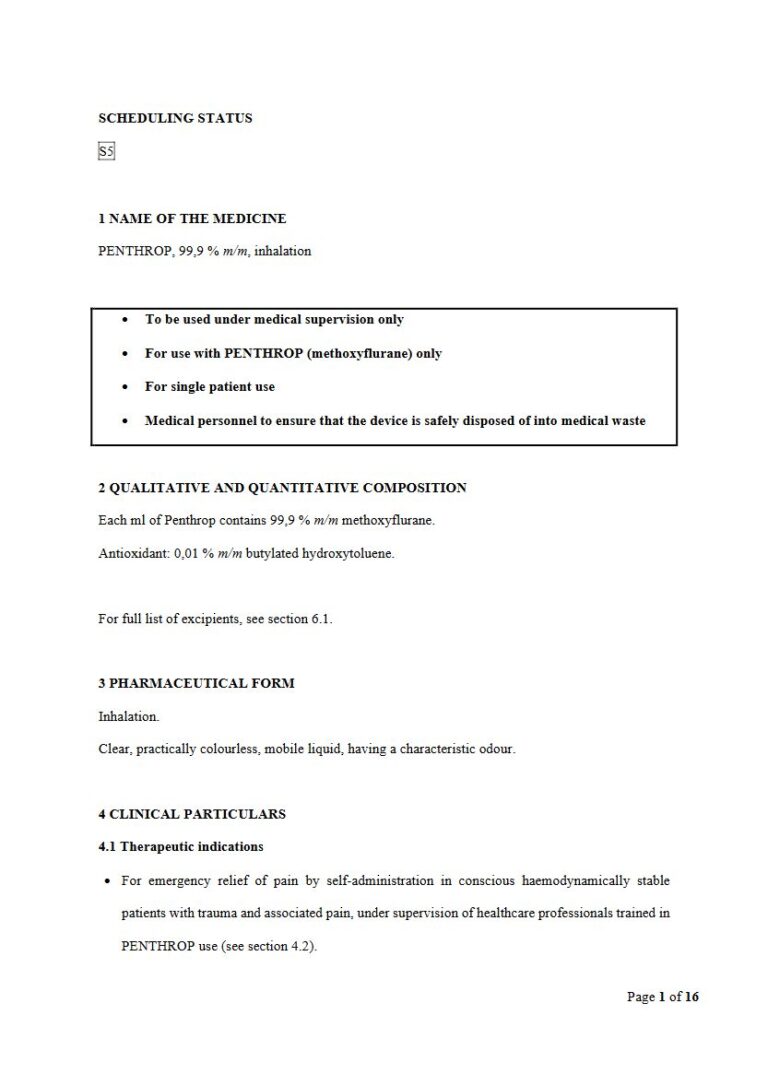
u2022 For emergency relief of pain by self-administration in conscious haemodynamically stable patients with trauma and associated pain, under supervision of healthcare professionals trained in PENTHROP use (see section 4.2).
u2022 For the relief of pain in monitored conscious patients who require analgesia for surgical procedures such as the change of dressings (see section 4.2).
Note: The total maximum dose must not be exceeded (see section 4.2).
4.2 Posology and method of administration
Posology
For use only as an analgesic medicine, see section 4.3.
Dosage (adults)
Up to 6 ml (2 x 3 ml bottles) of PENTHROP per day, vaporised in a PENTHROP Inhaler. If refilling the inhaler with a second bottle of PENTHROP, this should occur only once and must be conducted in a well-ventilated area to reduce environmental exposure to PENTHROP vapour.
To maximise safety, the lowest effective dosage of PENTHROP to provide analgesia should be used, particularly for children and the elderly. The total weekly dose should not exceed 15 ml. Administration on consecutive days is not recommended. The cumulative dose received by patients receiving intermittent doses of PENTHROP for painful procedures (such as wound dressings) must be carefully monitored to ensure that the recommended dose of PENTHROP is not exceeded. PENTHROP may cause renal failure if the recommended dose is exceeded. PENTHROP-associated renal failure is generally irreversible.
Paediatric population
1 to 11 years of age: Up to 3 ml (1 x 3 ml) of PENTHROP per day or 15 ml (5 x 3 ml bottles) per week.
12 to 17 years of age: Up to 6 ml (2 x 3 ml) of PENTHROP per day or 15 ml (5 x 3 ml bottles) per week. The total weekly dose should not exceed 15 ml. Administration on consecutive days is not recommended.
Method of administration
PENTHROP is self-administered, under observation and supervision (and assisted if necessary) by a person trained in its administration, using the hand held PENTHROP Inhaler. Instructions on the preparation of the PENTHROP Inhaler and correct administration are provided in Figure 1. Only PENTHROP is to be used in the PENTHROP Inhaler. No other inhalational anaesthetics or inhalational analgesic may be used.
4.3 Contraindications
u2022 Hypersensitivity to methoxyflurane, or other inhalation anaesthetics or any of the ingredients of PENTHROP.
u2022 Use as an anaesthetic medicine
u2022 Renal impairment, including reduced glomerular filtration rate (GFR), urine output and reduced renal blood flow
u2022 Renal failure
u2022 Severe hepatic impairment
u2022 Hypersensitivity to fluorinated anaesthetics
u2022 Cardiovascular instability
u2022 Respiratory depression
u2022 Head injury or loss of consciousness
u2022 A history of possible adverse reactions in either patient or relatives to any of the halogenated inhalational anaesthetic medicines
u2022 Malignant hyperthermia: patients with known or genetically susceptible to malignant hyperthermia
u2022 Porphyria
4.4 Special warnings and precautions for use
Nephrotoxicity
Methoxyflurane as contained in PENTHROP impairs renal function in a dose-related manner due to the effect of the released fluoride on the distal tubule and may cause polyuric or oliguric renal failure, oxaluria being the prominent feature. To ensure the safe use of methoxyflurane as contained in PENTHROP as an analgesic the following precautions should be observed.
- Use the lowest effective dose to control pain.
- Use with caution in the elderly or other patients with known risk factors for renal disease.
- Use with caution in patients diagnosed with clinical conditions which may pre-dispose to renal injury.
Nephrotoxicity is greater with methoxyflurane as contained in PENTHROP, than with other halogenated anaesthetics because of the slower metabolism over several days resulting in prolonged production of fluoride ions and metabolism to other potentially nephrotoxic substances. Because of the potential nephrotoxic effects, methoxyflurane as contained in PENTHROP must not be used as an anaesthetic medicine (see section 4.3). The risk is related to the total dose (time and concentration) and frequent exposure. Daily use of PENTHROP is not recommended because of nephrotoxic potential.
Liver disease
Methoxyflurane as contained in PENTHROP is metabolised in the liver, therefore increased exposures in patients with hepatic impairment can cause toxicity. It is advisable not to administer PENTHROP to patients who have shown signs of liver damage, especially after previous methoxyflurane use (as contained in PENTHROP) or halothane anaesthesia (see section 4.3). There have been reports of hepatic dysfunction, jaundice, and fatal hepatic necrosis. PENTHROP should be used with care in patients with underlying hepatic conditions or with risks for hepatic dysfunction (such as enzyme inducers, see section 4.1).
Diabetic patients
Diabetic patients have an increased likelihood of developing nephropathy if they have impaired renal function or polyuria, are obese, or are not optimally controlled.
Interactions
In patients receiving treatment with enzyme inducing medicines (e.g. rifampicin) the metabolism of methoxyflurane as contained in PENTHROP may be enhanced resulting in increased risk of nephrotoxicity. Intravenous epinephrine (adrenaline) or norepinephrine (nor-adrenaline) should be employed cautiously during methoxyflurane as contained in PENTHROP administration due to the risk of developing a cardiac dysrhythmia.
Caution in hot climates
Do not expose to temperatures above 40 u00b0C, especially when used in conjunction with oxygen.
Use in the elderly
Caution should be exercised in the elderly due to possible reduction in blood pressure or heart rate.
Central nervous system effects
Secondary pharmacodynamic effects including potential central nervous system effects such as sedation, euphoria, amnesia, ability to concentrate, altered sensorimotor coordination and change in mood are also known class-effects. Self-administration of methoxyflurane as contained in PENTHROP in analgesic doses will be limited by occurrence of CNS effects, such as sedation. Additionally, the CNS effects can be a risk factor for potential abuse.
Health workers
Health workers who are regularly exposed to patients using PENTHROP Inhalers should be aware of any relevant occupational health and safety guidelines for the use of inhalational medicines. The use of methods to reduce occupational exposure to methoxyflurane as contained in PENTHROP, including the attachment of the PENTHROP Activated Carbon (AC) Chamber, should be considered. Multiple use of PENTHROP Inhalation without the AC Chamber creates additional risk. Elevation of liver enzymes, and deterioration in renal function has been reported in exposed maternity ward staff. There have been reports of non-serious and transient reactions such as dizziness, headache, nausea or malaise, and reports of hypersensitivity reactions to methoxyflurane or other ingredients in healthcare professionals exposed to PENTHROP. Measurements of exposure levels to methoxyflurane in hospital staff showed levels significantly lower than those associated with nephrotoxicity.
Use in children
Limited data is available regarding the use of PENTHROP Inhaler in children. The minimum effective dose to produce analgesia should be administered to children (see section 4.2).
Frequent repeated use
Patients receiving PENTHROP on repeated occasions (such as wound dressings) must be carefully monitored to ensure that the recommended dose of PENTHROP is not exceeded (see section 4.2).
Butylated hydroxytoluene
PENTHROP contains the excipient, butylated hydroxytoluene (E321), a stabiliser. Butylated hydroxytoluene may cause local skin reactions (e.g. contact dermatitis), or irritation to the eyes and mucous membranes (see section 6.1).
Special Precautions
Hepatic toxicity in association with methoxyflurane as contained in PENTHROP has been observed with analgesic use. Malignant hyperthermia.
4.5 Interaction with other medicines and other forms of interaction
The concurrent use of tetracycline and methoxyflurane as contained in PENTHROP for anaesthesia has been reported to result in fatal renal toxicity. The possibility exists that PENTHROP may enhance the adverse renal effects of other medicines e.g. contrast medicines including certain antibiotics of known nephrotoxic potential such as gentamicin, kanamycin, colistin, polymyxin B, cephaloridine and amphotericin B. Dosage for the subsequent administration of narcotics may be reduced. Interactions may occur with u03b2-blockers, with an increased risk of hypotension. The metabolism of methoxyflurane is mediated by the CYP 450 enzymes particularly CYP 2E1, CYP 2B6 and to some extent CYP 2A6. It is possible that enzyme inducers (such as alcohol or isoniazid for CYP 2E1 and phenobarbital or rifampicin for CYP 2A6 and carbamazepine, efavirenz, rifampicin or nevirapine for CYP 2B6) which increase the rate of methoxyflurane metabolism might increase its potential toxicity and they should be avoided concomitantly with methoxyflurane as contained in PENTHROP (see section 4.4). Concomitant use of methoxyflurane as contained in PENTHROP with CNS depressants e.g. opioids, sedatives or hypnotics, general anaesthetics, phenothiazines, tranquillisers, skeletal muscle relaxants, sedating antihistamines and alcohol may produce additive depressant effects. If opioids are given concomitantly with PENTHROP, the patient should be observed closely, as is normal clinical practice with opioids.
4.6 Fertility, pregnancy and lactation
Safety and efficacy during pregnancy and lactation have not been established.
Pregnancy
PENTHROP crosses the placenta and carries the potential to produce central nervous system and respiratory depression in the new born infant. In a compromised foetus, careful consideration should be given to this potential depression and to the selection of anaesthetic medicines, doses and techniques. Neonates delivered of mothers who used methoxyflurane analgesia for childbirth had transient raised serum uric acid.
Breastfeeding
Caution should be exercised when PENTHROP is administered to a mother who is breastfeeding her baby.
4.7 Effects on ability to drive and use machines
Patients should be warned to take extra care as a pedestrian and not to drive a vehicle or operate a machine until the patient has completely recovered from the effects of PENTHROP, such as drowsiness. The treating doctor should decide when activities such as driving a vehicle or operating a machine may be resumed.
4.8 Undesirable effects
The frequent non-serious reactions are central nervous system type reactions such as dizziness, and somnolence, and are generally easily reversible.
Metabolism and nutrition disorders:
Less frequent: Increased appetite
Nervous system disorders:
Frequent: Headache, dizziness, dysgeusia, somnolence
Less frequent: Amnesia, dysarthria, paraesthesia, peripheral sensory neuropathy
Psychiatric disorders:
Frequent: Euphoric mood
Less frequent: Anxiety, depression, disturbance in attention, inappropriate affect, verbigeration
Eye disorders:
Less frequent: Vision impairment
Vascular disorders:
Less frequent: Flushing, hypertension, hypotension
Respiratory, thoracic and mediastinal disorders:
Frequent: Cough
Gastrointestinal disorders:
Frequent: Nausea
Less frequent: Dry mouth, oral discomfort, oral pruritus, salivary hypersecretion, vomiting
Skin and subcutaneous tissue disorders:
Less frequent: Hyperhidrosis
General disorders and administrative site conditions:
Frequent: Feeling drunk
Less frequent: Fatigue, feeling abnormal, chills, feeling of relaxation
Post-marketing experience
Immune system disorders: Unknown frequency: Hypersensitivity
Psychiatric disorders: Unknown frequency: Affect lability, agitation, confusional state, dissociation, restlessness
Nervous system disorders: Unknown frequency: Altered state of consciousness, nystagmus
Respiratory, thoracic and mediastinal disorders: Unknown frequency: Choking, hypoxia
Hepato-biliary disorders: Unknown frequency: Hepatitis, jaundice, liver injury, hepatic failure
Renal and urinary disorders: Unknown frequency: Renal failure
Investigations: Unknown frequency: Increased hepatic enzymes, increased blood urea, increased blood creatinine, increased blood uric acid
4.9 Overdose
Adverse effects will include those for anaesthetic doses, see section 4.8 and section 4.4. In the event of overdose, anaesthetic effects may occur with signs of excessive drowsiness (including loss of consciousness), lowering blood pressure, respiratory depression, pallor and muscle relaxation. After PENTHROP discontinuation such overdose effects usually resolve quickly often with no other intervention required but cardiorespiratory supportive measures can be implemented if necessary. In the event of excessive urinary output following overdosage, fluid and electrolyte losses should be promptly replaced.
