
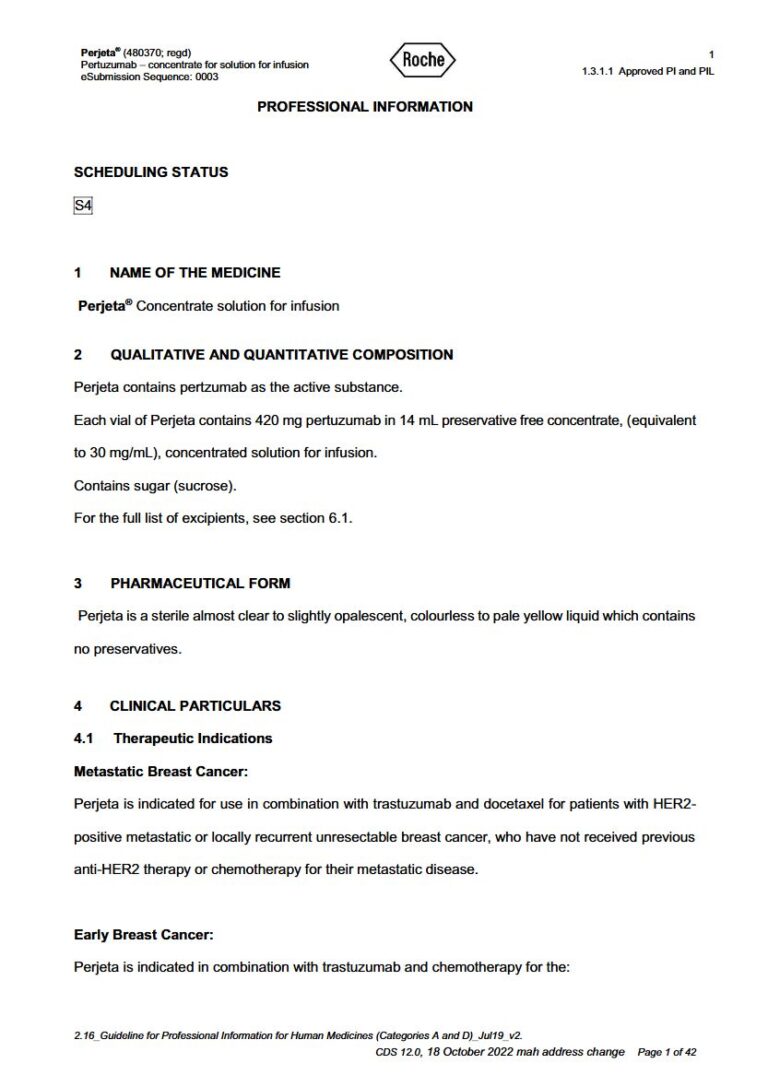
Perjeta 420 mg Concentrate solution for infusion
PDF Leaflet Revision Date: 18 October 2022
Clinical Summary
Quick overview from the medicine insert
Indication
HER2-positive metastatic or locally recurrent unresectable breast cancer.
Dosage (summary)
Initial: 840 mg IV infusion over 60 mins; Maintenance: 420 mg IV every 3 weeks over 30-60 mins.
Special Populations
- Elderly
- Renal impairment
- Hepatic impairment
Pregnancy & Breastfeeding
Contraindicated in pregnancy; avoid breastfeeding during treatment.
Key Drug Interactions
- No significant interactions with trastuzumab or docetaxel
Contraindications
- Hypersensitivity to pertuzumab or excipients
Common side effects
- Diarrhoea
- Alopecia
- Nausea
- Fatigue
- Neutropenia
- Vomiting
Counselling Points
- Monitor for infusion reactions
- Use effective contraception during treatment
- Do not breastfeed while on treatment
Serious warnings
- Infusion-related reactions
- Hypersensitivity reactions
- Left ventricular dysfunction
Important Disclaimer
The Perjeta 420 mg Concentrate solution for infusion professional information leaflet below is the property of Roche Products and is provided on Medinsert exactly as issued, with no.. alterations or editorial changes. We make every effort to keep content current by updating documents as soon as new versions become available. Medinsert serves as a trusted access point for healthcare professionals, but does not replace official sources or clinical judgement. For more details, please read our full disclaimer. read more>>
 Healthcare Professionals Only
This content is for registered healthcare professionals
Sign in or create a free account to read the full package insert.
Free for HPCSA-registered professionals. Powered by Medinsert.
Clinical Particulars
Section 4 of the official insert — extracted exactly as issued, no alterations
4.1 Therapeutic Indications
Metastatic Breast Cancer: Perjeta is indicated for use in combination with trastuzumab and docetaxel for patients with HER2- positive metastatic or locally recurrent unresectable breast cancer, who have not received previous anti-HER2 therapy or chemotherapy for their metastatic disease.
Early Breast Cancer: Perjeta is indicated in combination with trastuzumab and chemotherapy for the:
- neoadjuvant treatment of patients with HER2 positive, locally advanced, inflammatory, or early stage breast cancer (either > 2 cm in diameter or node positive) as part of a complete regimen for early breast cancer.
- adjuvant treatment of patients with HER-2 positive breast cancer at high risk of recurrence.
4.2 Posology and method of administration
Perjeta should only be initiated under the supervision of a medical practitioner experienced in the administration of anti-cancer medicines. Perjeta should be administered by a medical practitioner prepared to manage anaphylaxis and in an environment where full resuscitation service is immediately available. Patients treated with Perjeta must have HER2-positive tumour status, defined as a score of 3+ by immunohistochemistry (IHC) and/or a ratio of u2265 2,0 by in situ hybridisation (ISH) assessed by a validated test. To ensure accurate and reproducible results, the testing must be performed in a specialised laboratory, which can ensure validation of the testing procedures. Perjeta must be diluted by a healthcare professional and administered as an intravenous infusion. Do not administer as an intravenous push or bolus.
Dosage of Perjeta in combination with trastuzumab and docetaxel
Metastatic and Early Breast Cancer
The recommended initial dose of Perjeta is 840 mg administered as a 60 minutes intravenous infusion, followed every 3 weeks thereafter by a maintenance dose of 420 mg administered over a period 30 to 60 minutes. An observation period of 30 - 60 minutes is recommended after completion of each Perjeta infusion. The observation period should be completed prior to any subsequent dose of trastuzumab or chemotherapy (see section 4.4).
Perjeta and trastuzumab should be administered sequentially and can be given in any order. When administered with Perjeta, the recommendation is to follow a 3-weekly schedule for trastuzumab administered either as:
- an IV infusion with an initial dose of 8 mg/kg followed every 3 weeks thereafter by a dose of 6 mg/kg body weight or
- a fixed dose of trastuzumab subcutaneous (SC) injection (600 mg) for the initial dose and every 3 weeks thereafter irrespective of the patientu2019s body weight
In patients receiving a taxane, Perjeta and trastuzumab should be administered prior to the taxane. When administered with Perjeta, the recommended initial dose of docetaxel is 75 mg/m2. In patients receiving an anthracycline-based regimen, Perjeta and trastuzumab should be administered following completion of the entire anthracycline regimen.
Duration of treatment
Metastatic Breast Cancer (MBC)
It is recommended that patients are treated with Perjeta until disease progression or unmanageable toxicity.
Early Breast Cancer (EBC)
In the neoadjuvant setting (before surgery), it is recommended that patients are treated with Perjeta for 3 to 6 cycles depending on the regimen chosen, in combination with trastuzumab and chemotherapy. In the adjuvant setting (after surgery), Perjeta should be administered in combination with trastuzumab for a total of one year (maximum 18 cycles or until disease recurrence, or unmanageable toxicity, whichever occurs first), as part of a complete regimen for early breast cancer, including standard anthracycline- and/or taxane-based chemotherapy. Perjeta and trastuzumab should start on Day 1 of the first taxane-containing cycle and should continue even if chemotherapy is discontinued.
Patients who start Perjeta and trastuzumab in the neoadjuvant setting should continue to receive adjuvant Perjeta and trastuzumab to complete 1 year of treatment (maximum 18 cycles).
Delayed or Missed doses
For recommendations on delayed or missed doses, please refer to Table 1 below.
Table 1 Recommendations regarding delayed or missed doses
Time between two sequential doses
- < 6 weeks
The 420 mg dose of Perjeta IV should be administered as soon as possible. Do not wait until the next planned dose. The 6 mg/kg dose of trastuzumab IV should be administered as soon as possible. Do not wait until the next planned dose. The fixed dose of 600 mg trastuzumab SC should be administered as soon as possible. Do not wait until the next planned dose.
- u2265 6 weeks
The loading dose of 840 mg Perjeta IV should be re-administered as a 60 minute infusion, followed by a maintenance dose of 420 mg IV administered over a period of 30 to 60 minutes every 3 weeks thereafter. The loading dose of 8 mg/kg of trastuzumab IV should be re-administered over approximately 90 minutes, followed by a maintenance dose of 6 mg/kg IV administered over a period of 30 or 90 minutes every 3 weeks thereafter.
Dose modifications
Dose reductions are not recommended for Perjeta. Patients may continue therapy during periods of reversible chemotherapy-induced myelosuppression but they should be monitored carefully for complications of neutropenia during this time. For docetaxel and other chemotherapy dose modifications, see relevant professional informations. For trastuzumab, dose reductions are not recommended, see trastuzumab professional information. If trastuzumab treatment is discontinued, treatment with Perjeta should be discontinued. If docetaxel is discontinued, treatment with Perjeta and trastuzumab may continue until disease progression or unmanageable toxicity in the metastatic setting.
Left ventricular dysfunction : See section 4.4, Table 2 for information on dose recommendations in the event of left ventricular dysfunction.
Infusion-related reactions: The infusion rate may be slowed or interrupted if the patient develops an infusion-related reaction (see sections 4.4 and 4.8). The infusion may be resumed when symptoms abate. Treatment including oxygen, beta agonists, antihistamines, rapid i.v. fluids and antipyretics may also help alleviate symptoms.
Hypersensitivity reactions/anaphylaxis: The infusion should be discontinued immediately and permanently if the patient experiences a serious hypersensitivity reaction (e.g. anaphylaxis), bronchospasm or acute respiratory distress syndrome (see section 4.4).
Special Dosage Instructions
Elderly patients: No overall differences in efficacy of Perjeta were observed in patients u2265 65 and < 65 years of age. The incidence of the following all grade adverse events was at least 5 % higher in patients aged u2265 65 years of age, compared to patients aged <65 years of age: decreased appetite, anaemia, decreased weight, asthenia, dysgeusia, peripheral neuropathy, hypomagnesemia and diarrhoea. No dose adjustment is necessary in the elderly population u2265 65 years of age.
Patients with renal impairment: Dose adjustments of Perjeta are not needed in patients with mild or moderate renal impairment. No dose recommendations can be made for patients with severe renal impairment because of the limited pharmacokinetic data available (see section 5.2 Pharmacokinetic properties).
Patients with hepatic impairment: The safety and efficacy of Perjeta have not been studied in patients with hepatic impairment. No specific dose recommendations can be made.
Paediatric population: The safety and efficacy of Perjeta in children and adolescents below 18 years of age have not been established. There is no relevant use of Perjeta in the paediatric population in the indication of breast cancer.
Method of administration
Perjeta is administered intravenously by infusion. It should not be administered as an intravenous push or bolus. For instructions on dilution of Perjeta prior to administration, see below. For the initial dose, the recommended infusion period is 60 minutes. If the first infusion is well tolerated, subsequent infusions may be administered over a period of 30 minutes to 60 minutes (see section 4.4).
Instructions for dilution: see Special Instructions for use, Handling and Disposal : see section 6.6
Incompatibilities: see section 6.2
4.3 Contraindications
Perjeta is contraindicated in patients with known hypersensitivity to pertuzumab or any of its excipients. Pregnancy and Lactation (see section 4.6).
4.4 Special warnings and precautions for use
In order to improve traceability of biological medicines, the trade-name of the administered product should be clearly recorded (or stated) in the patient file.
Infusion-related reactions
Perjeta has been associated with infusion-related reactions, including events with fatal outcomes (see section 4.8). Close observation of the patient during and for 60 minutes after the first infusion, and during and for 30 minutes following subsequent infusions of Perjeta is recommended. If a significant infusion-related reaction occurs, the infusion should be slowed down or interrupted and appropriate medical therapies should be administered. Patients should be evaluated and carefully monitored until complete resolution of signs and symptoms. Permanent discontinuation should be considered in patients with severe infusion reactions. This clinical assessment should be based on the severity of the preceding reaction and response to administered treatment for the adverse reaction (see section 4.2).
Hypersensitivity reactions/anaphylaxis
Patients should be observed closely for hypersensitivity reactions. Severe hypersensitivity reactions, including anaphylaxis and events with fatal outcomes, have been observed in patients treated with Perjeta (see section 4.8). Medications to treat such reactions, as well as emergency equipment, should be available for immediate use. Perjeta is contraindicated in patients with known hypersensitivity to pertuzumab or to any of its excipients (see section 4.3).
Left ventricular dysfunction (including congestive heart failure)
Decreases in LVEF have been reported with medicines that block HER2 activity, including Perjeta. The incidence of symptomatic left ventricular systolic dysfunction (LVD [congestive heart failure]) was higher in patients treated with Perjeta in combination with trastuzumab and chemotherapy compared to trastuzumab and chemotherapy. Patients who have received prior anthracyclines or prior radiotherapy to the chest area may be at higher risk of decreased LVEF. The majority of cases of symptomatic heart failure reported in the adjuvant setting were in patients who received anthracycline-based chemotherapy (see section 4.8).
Perjeta has not been studied in patients with: a pre-treatment LVEF value of u2264 50 %; a prior history of congestive heart failure (CHF); decreases in LVEF to 360 mg/m2 of doxorubicin or its equivalent. Assess LVEF prior to initiation of Perjeta and at regular intervals during treatment to ensure that LVEF is within normal limits (see Table 2 below). If the LVEF declines as indicated in Table 2 and has not improved, or has declined further at the subsequent assessment, discontinuation of Perjeta and trastuzumab should be strongly considered.
Table 2 Dose recommendations for left ventricular dysfunction
Pre-treatment LVEF: Monitor LVEF every: Withhold Perjeta and trastuzumab for at least 3 weeks for an LVEF decrease to: Resume Perjeta and trastuzumab after 3 weeks if LVEF has recovered to:
Metastatic Breast Cancer
u2265 50 % ~12 weeks Either Either 45 % 40 %-45 % with a fall of <10 %- points below pre-treatment value u2265 55 %*
Early Breast Cancer
~12 weeks (once during neoadjuvant therapy) <50 % with a fall of u226510 %-points below pre-treatment value u2265 50 % < 10 %- points below pre-treatment value
*for patients receiving anthracycline-based chemotherapy, a LVEF of u2265 50 % is required after completion of anthracyclines, before starting Perjeta and traztuzumab
Febrile neutropenia: Patients treated with Perjeta, trastuzumab and docetaxel are at increased risk of febrile neutropenia especially during the first 3 cycles of treatment. The higher incidence of febrile neutropenia may be associated with the higher incidence of mucositis and diarrhoea in these patients. Symptomatic treatment for mucositis and diarrhoea should be considered.
Sugars: Contains sucrose which may have an effect on the glycaemic control of patients with diabetes mellitus. Patients with rare hereditary conditions such as fructose intolerance, glucose- galactose mal-absorption or sucrase-isomaltase insufficiency should not take Perjeta.
4.5 Interaction with other medicines and other forms of interaction
No pharmacokinetic (PK) interactions were observed between Perjeta and trastuzumab, or between Perjeta and docetaxel. In the population PK analysis, no evidence of a medicine interaction has been shown between Perjeta and trastuzumab and between Perjeta and docetaxel. This lack of interaction was confirmed by pharmacokinetic data from the additional neoadjuvant and early breast cancer studies. Five studies have evaluated the effects of Perjeta on the pharmacokinetics of co-administered cytotoxic agents, docetaxel, paclitaxel, gemcitabine, carboplatin, erlotinib and capecitabine, respectively. There was no evidence of any pharmacokinetics interaction between Perjeta and any of these agents. The pharmacokinetics of Perjeta in these studies were comparable to those observed in single-agent studies.
4.6 Fertility, pregnancy and lactation
Pregnancy
Perjeta should not be used during pregnancy (see section 4.3). Women of child bearing potential and female partners of male patients of child bearing potential should use effective contraception while receiving Perjeta and for 6 months following the last dose of Perjeta. Combined hormonal and barrier methods are recommended. In animal studies, Perjeta administered to cynomolgus monkeys during organogenesis led to oligohydramnios, delayed renal development and embryo foetal death.
Breastfeeding
Because human IgG is secreted in human milk, and animal data that indicate Perjeta is foetotoxic, women receiving Perjeta must not breastfeed their infants.
4.7 Effects on ability to drive and use machines
Patients experiencing headache, dizziness or infusion reactions should be advised not to drive and use machines until symptoms abate.
4.8 Undesirable effects
a. Summary of the safety profile : Clinical Trials
The safety of Perjeta has been evaluated in more than 6 000 patients in trials conducted in patients with various malignancies and predominantly treated with Perjeta in combination with other anti-neoplastic medicines. The safety of Perjeta was generally consistent across studies, although the incidence and most common adverse drug reactions (ADRs) varied depending on whether Perjeta was administered as monotherapy or in combination with other anti-neoplastic medicines.
Metastatic and Early Breast Cancer
Table 3 summarises the ADRs from the pivotal clinical trials, in which Perjeta was given:
- in combination with docetaxel and trastuzumab to patients with metastatic breast cancer (n=453)
- from the neoadjuvant trials, in which Perjeta was given in combination with trastuzumab and chemotherapy to patients with locally advanced, inflammatory or early breast cancer (n=309 and n=218)
- in which adjuvant Perjeta was given in combination with trastuzumab and anthracycline-based or non-anthracycline based, taxane-containing chemotherapy to patients with EBC (n=2 364).
As Perjeta is used with trastuzumab and chemotherapy, it is difficult to ascertain the causal relationship of an adverse reaction to a particular medicine.
b. Tabulated list of adverse reactions
The ADRs are listed below by system organ class (SOC) and categories of frequency: Very common (u2265 1/10), Common (u2265 1/100 to < 1/10), Uncommon (u2265 1/1 000 to < 1/100), Rare (u2265 1/10 000 to < 1/1 000), Very rare (< 1/10 000). Within each frequency grouping and SOC, adverse reactions are presented in the order of decreasing seriousness.
The most common ADRs (u2265 30 %) from this pooled data were diarrhoea, alopecia, nausea, fatigue, neutropenia, and vomiting. The most common NCI-CTCAE Grade 3-4 ADRs (u2265 10 %) were neutropenia and febrile neutropenia.
Table 3: Summary of ADRs in patients treated with Perjeta in the Metastatic and Neoadjuvant setting
System Organ Class
- Very Common
Common
- Uncommon
Infections and infestations
- Upper respiratory tract infection
- Nasopharyngitis
- Paronychia
Blood and lymphatic system disorders
- Febrile neutropenia*
- Neutropenia
- Leucopenia
Anaemia
Immune system disorders
- Hypersensitivity/ anaphylactic reactionu00b0
- Infusion-related reaction, Cytokine release syndromeu00b0u00b0
Metabolism and nutrition disorders
- Decreased appetite
Psychiatric disorders
- Insomnia
Nervous system disorders
- Peripheral neuropathy
- Headache
- Dysgeusia
- Peripheral sensory neuropathy
- Dizziness
- Paraesthesia
Eye disorders
- Increased lacrimation
Cardiac disorders
- Left ventricular dysfunction**
- Congestive heart failure**
Vascular disorders
- Hot flush
Respiratory, thoracic and mediastinal disorders
- Cough
- Epistaxis
- Dyspnoea
- Pleural effusion
- Interstitial lung disease
Gastrointestinal disorders
- Diarrhoea
- Vomiting
- Stomatitis
- Nausea
- Constipation
- Dyspepsia
- Abdominal pain
Skin and subcutaneous tissue disorders
- Alopecia
- Rash
- Nail disorder
- Pruritis
- Dry skin
Musculoskeletal and connective tissue disorders
- Myalgia
- Arthralgia
- Pain in extremity
General disorders and administration site conditions
- Mucositis/mucosal inflammation
- Pain
- Peripheral oedema
- Pyrexia
- Fatigue
- Asthaenia
- Chills
- Oedema
* Including adverse reactions with a fatal outcome. ** For the overall treatment period across the 4 studies. u00b0 Hypersensitivity/anaphylactic reaction is based on a group of terms. u00b0u00b0 Infusion related reaction/cytokine release syndrome includes a range of different terms within a time window, see u201cDescription of selected adverse reactionsu201d below.
c. Description of selected adverse events
ADRs reported in patients receiving Perjeta and trastuzumab after discontinuation of docetaxel were reported less frequently after discontinuation of docetaxel treatment. After discontinuation of docetaxel, all ADRs in the Perjeta and trastuzumab treated group occurred in < 10 % of patients with the exception of diarrhoea (19,1 %), upper respiratory tract infection (12,8 %), rash (11,7 %), headache (11,4 %) and fatigue (11,1 %).
Further information on selected adverse reactions
Left ventricular dysfunction (LVD) In metastatic breast cancer pivotal trial, the incidence of LVD during study treatment was higher in the placebo-treated group than in the Perjeta-treated group (8,6 % and 6,6 %, respectively). The incidence of symptomatic LVD was also lower in the Perjeta-treated group (1,8 % in the placebo-treated group vs. 1,5 % in the Perjeta-treated group) (see section 4.4). In a neoadjuvant trial, in which patients received 4 cycles of Perjeta as neoadjuvant treatment, the incidence of LVD (during the overall treatment period) was 7,5 % in the Perjeta, trastuzumab and docetaxel-treated group. In a second neoadjuvant trial, the group treated with Perjeta plus trastuzumab and FEC had an incidence of LVD of 8,3 %. In the neoadjuvant period of the early breast cancer trial, the incidence of asymptomatic LVD was 7 % in the group treated with dose dense AC followed by Perjeta plus trastuzumab and paclitaxel and 3,5 % in the group treated with FEC followed by Perjeta plus trastuzumab and docetaxel. In the early breast cancer trial, the incidence of symptomatic heart failure (NYHA class III or IV) with a LVEF decline of at least 10 %-points from baseline and to < 50 % was < 1 %.
Infusion-related reactions An infusion-related reaction was defined in pivotal trials as any event reported as hypersensitivity, anaphylactic reaction, acute infusion reaction or cytokine release syndrome occurring during an infusion or on the same day as the infusion. When only Perjeta was administered, the overall frequency of infusion reactions was 13,2 %. The most common infusion reactions (> 1,0 %) were pyrexia, chills, fatigue, headache, asthaenia, hypersensitivity and vomiting. During the second cycle when all medicines were administered on the same day, the most common infusion related reactions (> 1,0 %) were fatigue, dysgeusia, hypersensitivity, myalgia and vomiting. In the neoadjuvant and adjuvant trials, Perjeta was administered on the same day as the other study treatments. Infusion-related reactions occurred in 18,6 % - 25,0 % of patients on the first day of Perjeta administration (in combination with trastuzumab and chemotherapy). The type and severity of events were consistent with those observed in the MBC trial, with a majority of reactions being mild or moderate.
Hypersensitivity reactions/anaphylaxis In the MBC pivotal trial, the overall frequency of hypersensitivity/anaphylaxis events (not including acute infusion reactions/cytokine release syndrome) during the treatment period was 11,3 %, of which 2 % were NCI-CTCAE Grade 3-4, respectively. Overall, 4 patients experienced events described as anaphylaxis (see section 4.4). In the neoadjuvant and EBC trials, the overall frequency of hypersensitivity/anaphylaxis was highest in the Perjeta group (13,2 %), of which 2,6 % were NCI-CTCAE grade 3-4.
Febrile neutropenia The majority of patients experienced at least one leucopenic event, 63,0 % of patients, of which the majority were neutropenic events. Febrile neutropenia occurred in 13,7 %. The proportion of patients experiencing febrile neutropenia was highest in the first cycle of therapy and declined steadily thereafter. An increased incidence of febrile neutropenia was observed for Asian patients compared with patients of other races and from other geographic regions. Among Asian patients, the incidence of febrile neutropenia was 26 %.
Diarrhoea In metastatic breast cancer, diarrhoea occurred in 68,8 % of patients. Most events were mild- moderate in severity and occurred in the first few cycles of treatment. The incidence of NCI-CTCAE Grade 3-4 diarrhoea was 9,3 %. The median duration of the longest episode was 18 days.
Rash
Rash occurred in 45,2 % of patients. Most events of Grade 1 or 2 in severity, occurred in the first two cycles. Rash occurred in 40,2 % of patients treated with neoadjuvant Perjeta, trastuzumab and docetaxel compared with 29,0 % of patients treated with trastuzumab and docetaxel.
Laboratory abnormalities In the pivotal trials, the incidence of NCI-CTCAE Grade 3-4 decreases in neutrophil counts were balanced in the Perjeta treated groups.
Post Marketing
The following adverse drug reaction has been identified from post marketing experience with Perjeta: Metabolism and nutrition disorders: Tumour lysis syndrome.
Reporting of suspected adverse reactions
Reporting suspected adverse reactions after authorisation of the medicine is important. It allows continued monitoring of the benefit/risk balance of the medicine. Healthcare professionals are asked to report any suspected adverse reactions to SAHPRA via the u201c6.04 Adverse Drug Reaction Report Formu201d, found online under SAHPRAu2019s publications: https://www.sahpra.org.za/Publications/Index/8
4.9 Overdose
In case of overdose, patients must be closely monitored for signs or symptoms of adverse reactions and appropriate symptomatic treatment initiated.
