
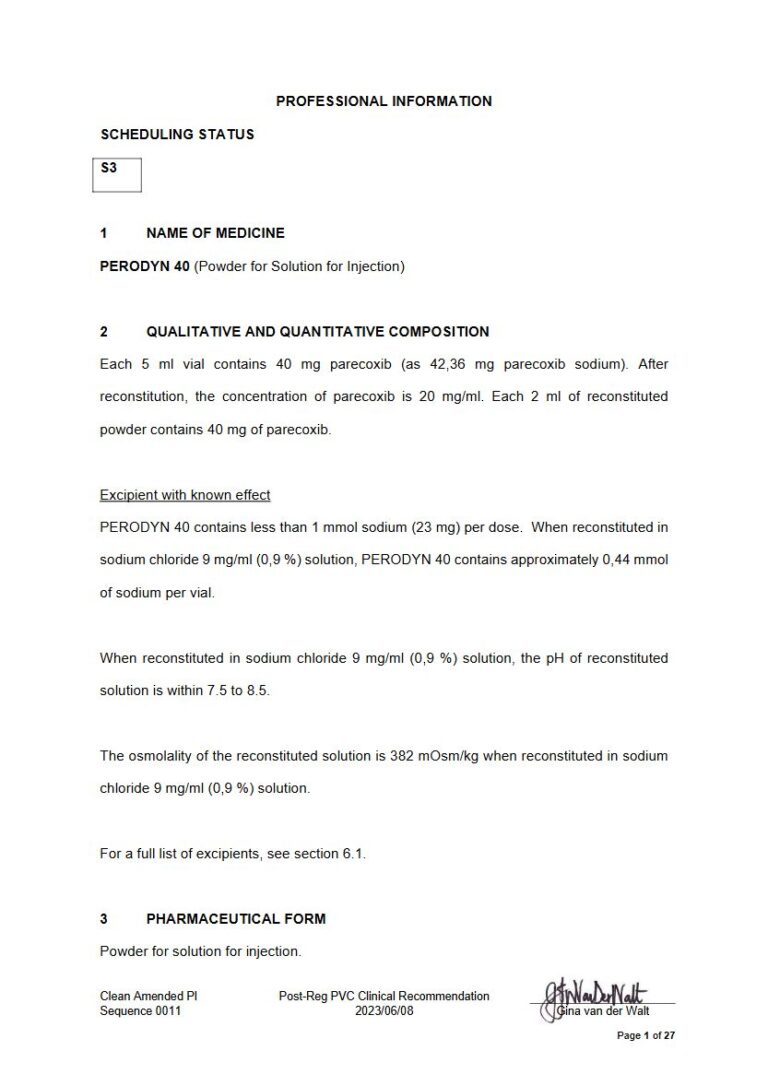
Perodyn 5 ml Powder for Solution for Injection
PDF Leaflet Revision Date: 08 June 2023
Clinical Summary
Quick overview from the medicine insert
Indication
Short-term management of post-operative pain.
Dosage (summary)
Initial 40 mg IV/IM, then 20-40 mg every 6-12 hours, max 80 mg/day.
Onset of Action / Duration
Onset: 7-14 mins, Duration: 7+ hours.
Special Populations
- Elderly
- Hepatic impairment
- Renal impairment
Pregnancy & Breastfeeding
Contraindicated in pregnancy and lactation.
Key Drug Interactions
- Warfarin
- ACE-inhibitors
- Lithium
- Ciclosporin
Contraindications
- Hypersensitivity to parecoxib
- Active peptic ulceration
- Severe hepatic impairment
- Severe renal impairment
- Coronary artery bypass surgery
Common side effects
- Dizziness
- Nausea
- Hypertension
- Pruritus
Counselling Points
- Monitor for skin reactions.
- Avoid use in dehydration.
- Report any signs of hypersensitivity.
Serious warnings
- Risk of cardiovascular events
- Gastrointestinal complications
- Serious skin reactions
Important Disclaimer
The Perodyn 5 ml Powder for Solution for Injection professional information leaflet below is the property of Trinity Pharma and is provided on Medinsert exactly as issued, with no.. alterations or editorial changes. We make every effort to keep content current by updating documents as soon as new versions become available. Medinsert serves as a trusted access point for healthcare professionals, but does not replace official sources or clinical judgement. For more details, please read our full disclaimer. read more>>
 Healthcare Professionals Only
This content is for registered healthcare professionals
Sign in or create a free account to read the full package insert.
Free for HPCSA-registered professionals. Powered by Medinsert.
Clinical Particulars
Section 4 of the official insert — extracted exactly as issued, no alterations
4.1 Therapeutic indications
PERODYN 40 is indicated for:
- The short-term management of post-operative pain in patients who need parenteral therapy and for when a similar benefit could not be obtained from oral therapy. (It is reminded that patients be transferred to alternative oral therapy as soon as clinically indicated);
- The reduction of post-operative opioid use in patients who have undergone hip replacement surgery, for up to 48 hours.
4.2 Posology and method of administration
Posology
PERODYN 40 is only indicated for patients with a need for parenteral therapy and for whom a similar benefit could not be obtained from alternative oral therapy. It is recommended that patients be transitioned to alternative oral therapy as soon as clinically indicated. As the cardiovascular risk of PERODYN 40 may increase with dose and duration of exposure, the shortest duration possible and the lowest effective daily dose should be used. However, the relevance of these findings for the short-term use of PERODYN 40 in the post-operative setting has not been evaluated. Safety and efficacy of PERODYN 40 injection have not been established for periods of use exceeding 96 hours.
Management of post-operative pain
The usual recommended dose is a single or initial 40 mg administered intravenously (IV) or intramuscularly (IM), followed every 6 to 12 hours by 20 mg or 40 mg as required, not to exceed 80 mg/day. When given at the recommended doses for management of acute pain, the onset of analgesia was 7 u2013 14 minutes and reached a peak effect within 2 hours. After a single dose, the duration of analgesia was dose and clinical pain model dependent and ranged from 7 to greater than 24 hours.
Concomitant use with opioid analgesia
Opioid analgesia can be used concurrently with PERODYN 40 dosing as described in the paragraph above, for the management of post-operative pain for up to 48 hours. In a hip replacement surgery trial, the daily requirements for opioid were significantly reduced (20 u2013 40 %) when co-administered with PERODYN 40. An optimal effect is achieved when PERODYN 40 is given at the end of hip replacement surgery, prior to opioid administration. In all clinical assessments PERODYN 40 was administered at a fixed time interval (i.e., 12 hourly), whereas the opioids were administered when needed (PRN basis).
Special populations
Elderly
Dosage adjustment in the elderly is not generally necessary, however, for elderly female patients weighing less than 50 kg, initiate treatment with half the usual recommended dose of PERODYN 40 and reduce the maximum daily dose to 40 mg.
Hepatic impairment
No dosage adjustment is generally necessary in patients with mild hepatic impairment (Child-Pugh scale 5 u2013 6). Introduce PERODYN 40 with caution and at half the usual recommended dose in patients with moderate hepatic impairment (Child-Pugh scale 7 u2013 9) and reduce the maximum daily dose to 40 mg. There is no clinical experience in patients with severe hepatic impairment (Child-Pugh scale > 9); therefore, its use is not recommended in these patients (see section 4.3).
Renal impairment
Based on pharmacokinetics, no dosage adjustment is necessary in patients with mild to moderate (creatinine clearance of 30 u2013 80 ml/min) renal impairment. In patients with severe (creatinine clearance < 30 ml/min) renal impairment or patients who may be predisposed to fluid retention, PERODYN 40 should not be used (see section 4.3).
Paediatric populations
PERODYN 40 has not been studied in patients under 18 years old. Therefore, its use is not recommended in these patients.
Method of administration
The IV bolus injection may be given rapidly and directly into a vein or into an existing IV line. The IM injection should be given slowly and deeply into the muscle. For instructions on reconstitution of the medicinal product before administration, see section 6.6. Precipitation may occur when PERODYN 40 is combined in a solution with other medicinal products and therefore PERODYN 40 must not be mixed with any other medicinal product, either during reconstitution or injection. In those patients where the same IV line is to be used to inject another medicinal product, the line must be adequately flushed prior to and after with a solution of known compatibility.
After reconstitution with acceptable solvents, PERODYN 40 may only be injected IV or IM, or into IV lines delivering the following:
- Sodium chloride 9 mg/ml (0,9 %) solution for injection/infusion;
- Glucose 50 mg/ml (5 %) solution for infusion;
- Sodium chloride 4,5 mg/ml (0,45 %) and glucose 50 mg/ml (5 %) solution for injection/infusion; or
- Ringer-Lactate solution for injection.
Injection into an IV line delivering glucose 50 mg/ml (5 %) in Ringer-Lactate solution for injection, or other IV fluids not listed above, is not recommended as this may cause precipitation from solution. For instructions on reconstitution of the medicinal product before administration, see section 6.6.
4.3 Contraindications
- Hypersensitivity to parecoxib or to any of the excipients listed in section 6.1;
- History of previous serious allergic medicine reaction of any type, especially cutaneous reactions such as Stevens-Johnson syndrome, drug reaction with eosinophilia and systemic symptoms syndrome (DRESS syndrome), toxic epidermal necrolysis, erythema multiforme or patients with known hypersensitivity to sulphonamides (see sections 4.4 and 4.8);
- Active peptic ulceration or gastrointestinal (GI) bleeding;
- Patients who have experienced bronchospasm, acute rhinitis, nasal polyps, angioedema, urticaria or allergic-type reactions after taking acetylsalicylic acid or NSAIDs or other cyclooxygenase-2 (COX-2) specific inhibitors;
- Severe impairment of hepatic function;
- Inflammatory bowel disease;
- Severe renal impairment;
- Post- and peri-operative analgesia in the setting of coronary artery bypass surgery (CABG);
- Established ischaemic heart disease and/or cerebrovascular disease (stroke) and peripheral arterial disease;
- Congestive heart failure (NYHA II-IV);
- Pregnancy and lactation (see section 4.6);
- Children younger than 18 years.
4.4 Special warnings and precautions for use
PERODYN 40 may predispose to cardiovascular events, cerebrovascular events, gastrointestinal events, or cutaneous reactions which may be fatal.
Modes of administration
Modes of administration other than IV or IM (e.g., intra-articular, intrathecal) have not been studied and should not be used.
Cardiovascular effects
There appears to be a higher risk for cardiovascular events and thrombotic adverse events with higher doses and longer duration of treatment with PERODYN 40. The exact magnitude of the risk associated with a single dose has not been determined, nor has the exact duration of therapy been associated with increased risk.
Two separate studies in coronary artery bypass graft (CABG) surgery showed that patients receiving parecoxib for a minimum of 3 days followed by valdecoxib (the active metabolite of parecoxib) for 7 u2013 14 days, had increased incidence of cardiovascular/thromboembolic events (e.g., myocardial infarction and cerebrovascular accident) compared to those receiving placebo. Caution is advised when PERODYN 40 is prescribed to patients with cardiovascular risk factors e.g., hypertension, diabetes, smoking and hypercholesterolaemia.
Acetylsalicylic acid and other NSAIDs
Because of its lack of platelet effects, PERODYN 40 is not a substitute for aspirin for cardiovascular prophylaxis. Therefore, antiplatelet therapies should not be discontinued (see section 5.1). Caution should be exercised when co-administering PERODYN 40 with warfarin and other oral anticoagulants (see section 4.5). Oral anticoagulants include warfarin/coumarin-type and novel oral anticoagulants (e.g., apixaban, dabigatran, and rivaroxaban) (see section 4.5). The concomitant use of PERODYN 40 with other non-acetylsalicylic acid NSAIDs should be avoided.
PERODYN 40 may mask fever and other signs of inflammation (see section 5.1). In isolated cases, an aggravation of soft tissue infections has been described in connection with the use of NSAIDs and in nonclinical studies with parecoxib, as contained in PERODYN 40. Caution should be exercised with respect to monitoring the incision for signs of infection in surgical patients receiving PERODYN 40.
Concomitant use of PERODYN 40 with other anti-coagulant medicines may increase the risk of intra- and post-operative bleeding.
Because of the possibility for increased adverse reactions at higher doses of parecoxib, other COX-2 inhibitors and NSAIDs, patients treated with parecoxib should be reviewed following dose increase and, in the absence of an increase in efficacy, other therapeutic options should be considered (see section 4.2).
PERODYN 40 may cause to the onset of new hypertension or worsening of pre-existing hypertension, either of which may contribute to the increased incidence of cardiovascular events. PERODYN 40 should be used with caution in patients with hypertension. Blood pressure should be monitored closely during the initiation of therapy with PERODYN 40 and throughout the course of therapy. If blood pressure rises significantly, alternative treatment should be considered.
Gastrointestinal (GI) effects
Upper gastrointestinal (GI) complications (perforations, ulcers or bleedings [PUBs]), some of them resulting in fatal outcome, have occurred in patients treated with parecoxib. Caution is advised in the treatment of patients most at risk of developing a gastrointestinal complication with NSAIDs; the elderly, or patients with a prior history of gastrointestinal disease, such as ulceration and GI bleeding, or patients using acetylsalicylic acid concomitantly. The NSAIDs class is also associated with increased GI complications when co-administered with glucocorticoids, selective serotonin reuptake inhibitors, other antiplatelet medicines, other NSAIDs or patients ingesting alcohol. There is further increase in the risk of gastrointestinal adverse effects (gastrointestinal ulceration or other gastrointestinal complications), when PERODYN 40 is given concomitantly with acetylsalicylic acid (even at low doses).
Skin effects
Serious skin reactions which may be fatal, including exfoliative dermatitis, Stevens-Johnson syndrome, and toxic epidermal necrolysis, may occur when using PERODYN 40. PERODYN 40 should be discontinued at the first appearance of skin rash or any other sign of hypersensitivity. Appropriate measures should be taken by medical practitioners to monitor for any serious skin reactions with therapy, e.g., additional patient consultations. Patients should be advised to immediately report any emergent skin condition to their physician. Serious skin reactions are known to occur with NSAIDs including COX-2 selective inhibitors as well as other medicinal products. However, the reported rate of serious skin events appears to be greater for valdecoxib (the active metabolite of parecoxib) as compared to other COX-2 selective inhibitors. Patients with a history of sulphonamide allergy may be at greater risk of skin reactions (see section 4.3). Patients without a history of sulphonamide allergy may also be at risk for serious skin reactions.
Renal and hepatic effects
Acute renal failure has been reported through post-marketing surveillance in patients receiving parecoxib (see section 4.8). Since prostaglandin synthesis inhibition may result in deterioration of renal function and fluid retention, caution should be observed when administering PERODYN 40 in patients with impaired renal function (see section 4.2) or hypertension, or in patients with compromised cardiac or hepatic function or other conditions predisposing to fluid retention. PERODYN 40 should be used with caution in patients with severe renal impairment (creatinine clearance 9) therefore PERODYN 40 is not recommended for use in these patients (see also sections 4.2 and 4.3). Caution should be used when initiating treatment with PERODYN 40 in patients with any form of dehydration. It is advisable to rehydrate patients first and then start therapy with PERODYN 40.
Fluid retention and oedema
Due to inhibition of prostaglandin synthesis, fluid retention and oedema may occur in patients receiving PERODYN 40; therefore, PERODYN 40 should not be used in patients with compromised cardiac function and other conditions predisposing to, or worsened by, fluid retention those taking diuretic treatment or those otherwise at risk of hypovolemia. Patients with pre-existing congestive heart failure or hypertension should be closely monitored (see section 4.3). If there is clinical evidence of deterioration in the condition of these patients, appropriate measures including discontinuation of parecoxib should be taken. Caution should be used when initiating treatment with PERODYN 40 in patients with dehydration. In this case, it is advisable to rehydrate patients first and then start therapy with PERODYN 40.
Anaphylactoid reactions
Hypersensitivity reactions such as anaphylaxis and angioedema have been reported in post-marketing experience with valdecoxib and cannot be ruled out for parecoxib, as contained in PERODYN 40. Some of these reactions have occurred in patients with a history of allergic-type reactions to sulphonamides. PERODYN 40 should be discontinued at the first sign of hypersensitivity.
Cases of severe hypotension shortly following parecoxib administration have been reported in post-marketing experiences. Some of these cases have occurred without other signs of anaphylaxis. The physician should be prepared to treat severe hypotension.
Risk of Drug Reaction with Eosinophilia and Systemic Symptoms (DRESS)
Drug Reaction with Eosinophilia and Systemic Symptoms (DRESS) has been reported in patients taking NSAIDs such as PERODYN 40. Some of these events have been fatal or life-threatening. DRESS typically, although not exclusively, presents with fever, rash, lymphadenopathy, and/or facial swelling. Other clinical manifestations may include hepatitis, nephritis, haematological abnormalities, myocarditis, or myositis. Sometimes symptoms of DRESS may resemble an acute viral infection. Eosinophilia is often present. Because this disorder is variable in its presentation, other organ systems not noted here may be involved. It is important to note that early manifestations of hypersensitivity, such as fever or lymphadenopathy, may be present even though rash is not evident. If such signs or symptoms are present, discontinue PERODYN 40 and evaluate the patient immediately.
Risk of hypokalaemia and renal tubular acidosis
Severe hypokalaemia and renal tubular acidosis have been reported due to prolonged use of Non-steroidal Anti-inflammatory Agents (NSAIDs) at higher than recommended doses. This risk is increased with the use of codeine/NSAIDs as patients may become dependent on the codeine component. Presenting signs and symptoms included reduced level of consciousness and generalised weakness. NSAID-induced renal tubular acidosis should be considered in patients with unexplained hypokalaemia and metabolic acidosis.
Children
PERODYN 40 has not been studied in patients under 18 years old. Therefore, its use is not recommended in these patients.
4.5 Interaction with other medicines and other forms of interaction
General
In vitro studies with human hepatic microsomal systems showed no significant inhibitory effects on CYP3A4, 2D6, 2E1, and 1A2 isoforms by parecoxib or valdecoxib. Weak inhibitory activity was found for 2C9 and 2C19 isozymes. PERODYN 40 is rapidly hydrolysed to the active substance valdecoxib. In humans, studies demonstrated that valdecoxib metabolism is predominantly mediated via cytochrome P450 CYP3A4 and 2C9 isoenzymes. Glucuronidation is a further route of metabolism. The alternate CYP-mediated and non-CYP-mediated metabolic pathways may reduce the likelihood of individuals with genetic polymorphisms having substantially higher plasma concentrations due to impaired metabolism.
Aspirin
Parecoxib had no effect on aspirin-mediated inhibition of platelet aggregation or bleeding times in volunteers. Clinical trials indicate that parecoxib can be given with low dose aspirin (u2264 325 mg). Because of its lack of platelet effects, PERODYN 40 is not a substitute for aspirin for cardiovascular prophylaxis. There is no evidence that concurrent use of aspirin mitigates the increased risk of serious cardiovascular thrombotic events associated with PERODYN 40.
ACE-inhibitors
Inhibition of PERODYN 40 may diminish the antihypertensive effect of angiotensin converting enzyme (ACE) inhibitors. This interaction should be given consideration in patients receiving PERODYN 40 concomitantly with ACE-inhibitors.
Ciclosporin or tacrolimus
Co-administration of PERODYN 40 and ciclosporin or tacrolimus may increase the nephrotoxic effect of ciclosporin and tacrolimus. Renal function should be monitored when PERODYN 40 and any of these medicines are co-administered.
Diuretics
PERODYN 40 may reduce the natriuretic effect of furosemide and thiazides by inhibition of renal prostaglandin synthesis.
Fluconazole and ketoconazole
Plasma exposure (AUC and C max) to valdecoxib was increased (62 % and 19 %, respectively) when co-administered with fluconazole, indicating that the dose of PERODYN 40 should be reduced in those patients who are receiving fluconazole therapy. Plasma exposure (AUC and C max) to valdecoxib was increased (38 % and 24 %, respectively) when co-administered with ketoconazole; however, a dosage adjustment should not generally be necessary for patients receiving ketoconazole.
Lithium
PERODYN 40 may produce significant decreases in lithium serum clearance (25 %) and renal clearance (30 %) with a 34 % higher serum exposure compared to lithium alone. Lithium serum concentration should be monitored closely when initiating or changing PERODYN 40 therapy in patients receiving lithium.
Warfarin or similar medicines
Anticoagulant therapy should be monitored, particularly during the first few days after initiating PERODYN 40 therapy in patients receiving warfarin or similar medicines, since these patients have an increased risk of bleeding complications (see section 4.4).
Dextromethorphan and medicinal products that are predominantly metabolised by CYP2D6
Treatment with valdecoxib (40 mg twice daily for 7 days) produced a 3-fold increase in plasma concentrations of dextromethorphan (CYP2D6 substrate). Therefore, caution should be observed when co-administering parecoxib, as contained in PERODYN 40 and medicinal products that are predominantly metabolised by CYP2D6 and which have narrow therapeutic margins (e.g., flecainide, propafenone, metoprolol).
Glibenclamide
Co-administration of parecoxib, as contained in PERODYN 40 with glibenclamide (CYP3A4 substrate) did not affect either the pharmacokinetics (exposure) or the pharmacodynamics (blood glucose and insulin levels) of glibenclamide.
Substrates of CYP2C19
Plasma exposure of omeprazole (CYP 2C19 substrate) 40 mg once daily was increased by 46% following administration of valdecoxib 40 mg twice daily for 7 days, while the plasma exposure to valdecoxib was unaffected. These results indicate that although valdecoxib is not metabolised by CYP2C19, it may be an inhibitor of this isoenzyme. Therefore, caution should be observed when administering PERODYN 40 with medicinal products known to be substrates of CYP2C19 (e.g., phenytoin, diazepam, or imipramine).
Methotrexate
In rheumatoid arthritis patients receiving weekly methotrexate, PERODYN 40 do not have a clinically significant effect on the plasma exposure to methotrexate.
Injectable anaesthetics
Co-administration of PERODYN 40 with propofol (CYP2C9 substrate) or midazolam (CYP3A4 substrate) do not affect either the pharmacokinetics (metabolism and exposure) or the pharmacodynamics of IV propofol or IV midazolam. Additionally, co-administration with PERODYN 40 has no significant effect on the pharmacokinetics of either IV fentanyl or IV alfentanil (CYP3A4 substrates).
Inhalation anaesthetics
In a post-orthopaedic study, parenteral parecoxib was administered preoperatively and no evidence of medicine interaction was observed in patients receiving parenteral parecoxib and the inhalation anaesthetic agents, nitrous oxide, and isoflurane.
4.6 Fertility, pregnancy and lactation
Use of PERODYN 40 is contraindicated in pregnancy and lactation (see section 4.3).
Pregnancy
Regular use of non-steroidal inflammatory drugs may result in:
First trimester
Inhibition of prostaglandin synthesis may adversely affect the pregnancy and/or the embryo/foetal development. Data from epidemiological studies raise concern about an increased risk of miscarriage and of cardiac malformation and gastroschisis after use of a prostaglandin synthesis inhibitor in early pregnancy. The absolute risk for cardiovascular malformation was increased from less than 1 %, up to approximately 1,5 %. In animals, administration of a prostaglandin synthesis inhibitor has been shown to result in increased pre- and post-implantation loss and embryo-foetal lethality. In addition, increased incidences of various malformations including cardiovascular, have been reported in animals given a prostaglandin synthesis inhibitor during the organogenetic period.
Second and third trimester
During the third trimester of pregnancy, prostaglandin synthesis inhibitors, may expose the foetus to: cardiopulmonary toxicity (with premature closure of the ductus arteriosus and pulmonary hypertension); renal dysfunction, which may progress to renal failure with oligo-hydroamniosis. At the end of pregnancy, the mother and the neonate may be exposed to possible prolongation of bleeding time, an anti-aggregating effect which may occur even at very low doses; inhibition of uterine contractions resulting in delayed or prolonged labour.
Breastfeeding
Administration of a single dose of parecoxib to lactating women following caesarean section resulted in the transfer of a relatively small amount of parecoxib and its active metabolite valdecoxib into human milk, and this resulted in a low relative dose for the infant. PERODYN 40 must not be administered to women who breastfeed (see section 4.3).
Fertility
The use of parecoxib inhibits cyclooxygenase/prostaglandin synthesis and is not recommended in women attempting to conceive. Based on the mechanism of action, the use of NSAIDs, may delay or prevent rupture of ovarian follicles, which has been associated with reversible infertility in women.
4.7 Effects on ability to drive and use machines
Dizziness may occur during the use of PERODYN 40 and should be considered before patients drive or use machines.
4.8 Undesirable effects
a. Tabulated summary of adverse reactions
System Organ Class Frequency Undesirable effect
Infections and infestations Frequent Pharyngitis, alveolar osteitis (dry socket) Less frequent Abnormal sternal serous wound drainage, wound infection
Blood and lymphatic system disorders Frequent Post-operative anaemia Less frequent Thrombocytopenia
Immune system disorders Less frequent Anaphylactoid reaction, Drug Reaction with Eosinophillia and Systemic Symptoms (DRESS) (see section 4.4)
Metabolism and nutrition disorders Frequent Hypokalaemia Less frequent Hyperglycaemia, anorexia
Psychiatric disorders Frequent Agitation, insomnia
Nervous system disorders Frequent Hypoaesthesia, dizziness Less frequent Cerebrovascular disorder, dry mouth
Ear and labyrinth disorders Less frequent Ear pain
Cardiac disorders Less frequent Bradycardia, peripheral oedema, aggravated hypertension, dysrhythmia, hypertension, palpitations, tachycardia, congestive cardiac failure, myocardial infarction, cardiovascular thrombotic events Frequency unknown Circulatory collapse
Neurological disorders Less frequent Cerebrovascular incidents (strokes)
Vascular disorders Frequent Hypotension; hypertension Less frequent Hypertension (aggravated), orthostatic
Respiratory, thoracic and mediastinal disorders Frequent Respiratory insufficiency Less frequent Pulmonary embolism Frequency unknown Dyspnoea, bronchospasm
Gastrointestinal disorders Frequent Dyspepsia, flatulence, constipation, nausea, vomiting, abdominal pain Less frequent Gastroduodenal ulceration, gastroesophageal reflux disease, dry mouth, gastrointestinal sounds abnormal, pancreatitis, oesophagitis, oedema mouth (perioral swelling)
Skin and subcutaneous tissue disorders Frequent Pruritus, increased sweating Less frequent Ecchymosis, rash, skin post-operative complications, urticaria Frequency unknown Stevens-Johnson syndrome, erythema multiforme, exfoliative dermatitis, toxic epidermal necrolysis
Musculoskeletal and connective tissue disorders Frequent Back pain Less frequent Arthralgia
Renal and urinary disorders Frequent Oliguria Less frequent Acute renal failure Frequency unknown Renal failure, renal tubular acidosis
General disorders and administration site conditions Frequent Oedema peripheral Less frequent Asthenia, injection site pain, injection site reaction Frequency unknown Hypersensitivity reactions including anaphylaxis and angioedema
Investigations Frequent Blood creatinine increased Less frequent Increased AST, increased ALT increased blood urea, Blood CPK increased, blood LDH increased, SGOT increased, SGPT increased, BUN increased
b. Post-marketing surveillance
In post-marketing experience, the following serious adverse events may occur in association with the use of PERODYN 40: Erythema multiforme, Stevens-Johnson syndrome, toxic epidermal necrolysis, renal failure, acute renal failure and hypersensitivity reactions including anaphylaxis and angioedema. Gastrointestinal disorders include nausea and vomiting. Renal tubular acidosis and hypokalaemia have been reported in the post-marketing setting typically following prolonged use of the NSAID component at higher than recommended doses due to dependence on the codeine component.
c. Paediatric populations
Use of PERODYN 40 is not recommended for children younger than 18 years.
d. Reporting of suspected adverse reactions
Reporting suspected adverse reactions after authorisation of the medicine is important. It allows continued monitoring of the benefit/risk balance of the medicine. Health care providers are asked to report any suspected adverse reactions to SAHPRA via the u201c6.04 Adverse Drug Reactions Reporting Formu201d, found online under SAHPRAu2019s publications: https://www.sahpra.org.za/Publications/Index/8
4.9 Overdose
No symptoms of overdose have been observed with single IV doses of up to 200 mg of PERODYN 40 injection in healthy subjects. PERODYN 40 injection doses of 50 mg BID IV for 7 days did not result in any signs of toxicity. Prolonged use at higher than recommended doses may result in severe hypokalaemia and renal tubular acidosis. Symptoms may include reduced level of consciousness and generalised weakness (see section 4.4 and section 4.8). In case of overdose, patients should be managed by symptomatic and supportive care.
