
Picolax 60 mg Powder for oral solution
PDF Leaflet Revision Date: 20 May 2022
Clinical Summary
Quick overview from the medicine insert
Indication
Bowel cleansing prior to gastrointestinal examinations.
Dosage (summary)
Adults: 1 sachet evening before and 1 sachet morning of procedure. Children: u00bd to 1 sachet based on age.
Special Populations
- Elderly
- Renal impairment
- Children under 2 years
Pregnancy & Breastfeeding
Safety not established during pregnancy and breastfeeding.
Key Drug Interactions
- NSAIDs
- Diuretics
- Corticosteroids
- Antiepileptics
- Anticoagulants
Contraindications
- Hypersensitivity
- Congestive heart failure
- Gastric retention
- Ileus
- Severe dehydration
Common side effects
- Nausea
- Vomiting
- Abdominal pain
- Headache
Counselling Points
- Maintain hydration
- Follow dosing schedule
- Avoid prolonged use
Serious warnings
- Risk of electrolyte imbalance
- Use with caution in heart disease
- Monitor in renal impairment
Important Disclaimer
The Picolax 60 mg Powder for oral solution professional information leaflet below is the property of Ferring and is provided on Medinsert exactly as issued, with no.. alterations or editorial changes. We make every effort to keep content current by updating documents as soon as new versions become available. Medinsert serves as a trusted access point for healthcare professionals, but does not replace official sources or clinical judgement. For more details, please read our full disclaimer. read more>>
 Healthcare Professionals Only
This content is for registered healthcare professionals
Sign in or create a free account to read the full package insert.
Free for HPCSA-registered professionals. Powered by Medinsert.
Clinical Particulars
Section 4 of the official insert — extracted exactly as issued, no alterations
4.1 Therapeutic Indications
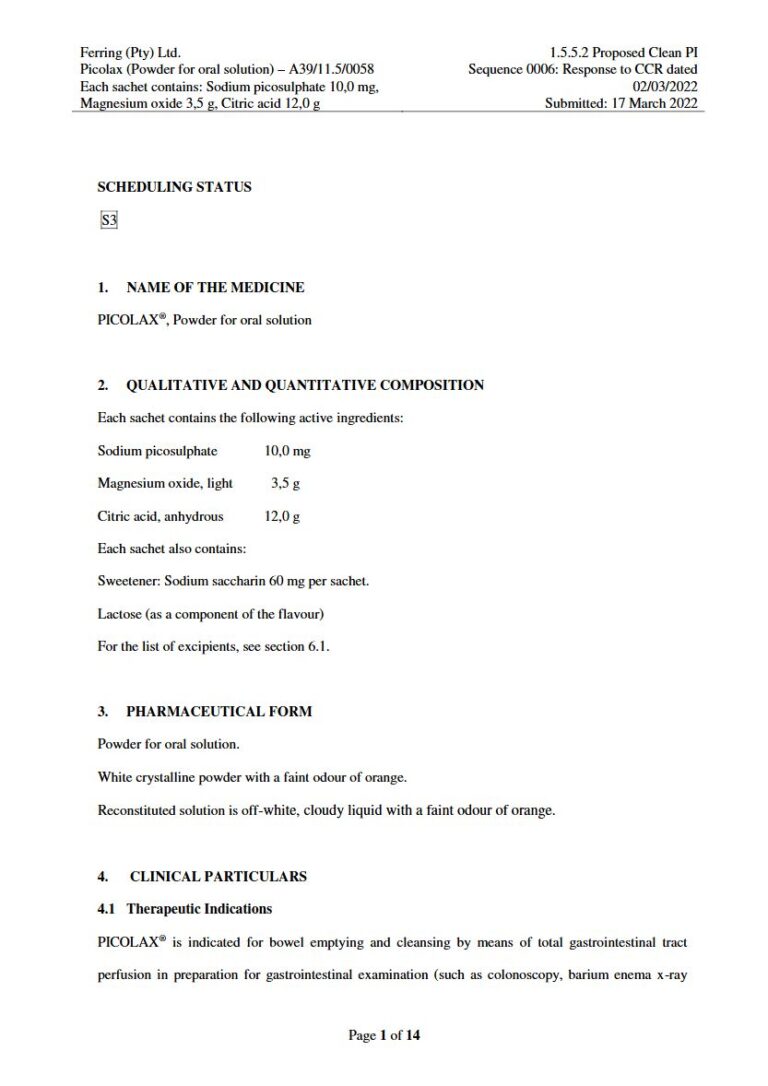
PICOLAX u00ae is indicated for bowel emptying and cleansing by means of total gastrointestinal tract perfusion in preparation for gastrointestinal examination (such as colonoscopy, barium enema x-ray examination), prior to intravenous pyelograms (IVP), surgery or in severe constipation.
4.2 Posology and method of administration
Posology
Adults (including elderly): The first PICOLAX u00ae sachet (see method of Administration section below for reconstitution guidance) is taken the night before the procedure, and the second is taken the next day, in the morning prior to the procedure.
On the day before the procedure u2013 1 sachet:
- The first reconstituted sachet is taken in the late afternoon / evening (e.g., 5:00 to 9:00 PM), followed by at least 5 x 250 ml drinks of clear liquids (not only water), spread over several hours.
On the day of the procedure u2013 1 sachet:
- The second reconstituted sachet is taken in the morning (5-9 hours before the procedure), followed by at least 3 x 250 ml drinks of clear liquids (not only water), spread over several hours. Clear liquids (not only water) may be consumed until 2 hours before the time of the procedure.
Paediatric population
Children from 2 up to 9 years: The first dose reconstituted in water as directed (see Method of Administration section below for reconstitution guidance), should be taken before 8 AM on the day before the procedure. Second dose to be taken 6 to 8 hours later.
- From 2 up to 4 years: u00bd sachet in the morning and u00bd sachet in the afternoon.
- From 4 up to 9 years: 1 sachet morning and u00bd sachet in the afternoon.
Maintaining hydration in children is very important. Guidelines for treating dehydration in children should be followed to ensure adequate hydration during treatment with PICOLAX.
Children from age 9 and above: The same dose, scheduling of dose and liquid intake as for adults should be applied.
Method of administration
Route of administration: Oral
A low residue diet is recommended on the day prior to the procedure. A clear liquid diet is recommended on the day of the procedure. To avoid dehydration, it is important to follow the liquid intake recommendation as advocated together with the PICOLAX dosing whilst the effects of PICOLAX persist (see section Posology). Apart from the liquid intake together with the treatment regimen (PICOLAX + additional liquids), a normal, thirst driven intake of clear liquids is recommended.
Clear liquids should include a variety of soft drinks, clear soup, tea, coffee (without milk, soy or cream), fruit juice without pulp, and water. Liquid intake should not be restricted to only drinking water.
Directions for reconstitution in adults (including elderly): Reconstitute a fresh sachet immediately prior to each dose. Reconstitute the contents of one sachet in a cup of cold water (approximately 150 ml). Stir for 2-3 minutes, the solution should now become an off-white, cloudy liquid with a faint odour of orange. Drink the solution. If it has become warm, wait until it cools sufficiently to drink.
Directions for reconstitution in children: Reconstitute a fresh sachet immediately prior to each dose. Reconstitute the required amount of powder in a cup containing approximately 100 ml cold water per u00bd sachet. Stir for 2-3 minutes, the solution should now become an off-white, cloudy liquid with a faint odour of orange. Drink the solution. If it has become warm, wait until it cools sufficiently to drink. Discard the remaining contents of the sachet.
For directions on reconstitution of the full sachet for children from 4 up to 9 years, refer to the instructions given for adults.
4.3 Contraindications
- Hypersensitivity to the active substances or to any of the excipients listed in section 6.1
- Congestive heart failure
- Gastric retention
- Gastrointestinal ulceration
- Toxic colitis
- Toxic megacolon
- Ileus
- Nausea and vomiting
- Acute surgical abdominal conditions such as acute appendicitis
- Known or suspected gastrointestinal obstruction or perforation.
- Severe dehydration
- Rhabdomyolysis
- Hypermagnesemia
- Active inflammatory bowel disease
- Patients with a stoma
- Undiagnosed rectal bleeding
- Diabetes mellitus
- Hypertension
- Renal impairment
- Hypersensitivity to oral saline laxatives and dehydration.
4.4 Special warnings and precautions for use
PICOLAX u00ae should not be used if there is a sudden change in bowel habits that persists for a period greater than 2 weeks, rectal bleeding or failure to have a bowel movement after use of a laxative. This may indicate a serious condition.
Because a clinically relevant benefit of bowel cleansing prior to elective, open colorectal surgery could not be proven, bowel cleansers should only be administered before bowel surgery if clearly needed. The risks of the treatment should be carefully weighed against possible benefits and needs depending on surgical procedures performed.
PICOLAX u00ae should not be given to children younger than 2 years.
PICOLAX u00ae should not be used in the presence of hypertension, a low salt diet and kidney disease except under the supervision of a doctor.
PICOLAX u00ae should not be used in the presence of abdominal pain, nausea, vomiting or recent gastrointestinal surgery.
Frequent or prolonged use of PICOLAX u00ae may result in loss of normal bowel function and dependence on laxatives.
The period of bowel cleansing should not exceed 24 hours because longer preparation may increase the risk of water and electrolyte imbalance.
It is important that the patient follow the recommended dosing schedule and take adequate fluids (at least 6 to 8 glasses of liquids each day when using PICOLAX u00ae ).
Adequate fluid intake or replacement should be ensured as PICOLAX u00ae is likely to cause transient hypovolaemia (see section 4.2).
An insufficient or excessive oral intake of water and electrolytes could create clinically significant abnormalities, particularly in less fit patients. In this regard patients with low body weight, children, the elderly, debilitated individuals and patients at risk of hypokalaemia or hyponatraemia may need particular attention. Prompt corrective action should be taken to restore fluid/electrolyte balance in patients with signs or symptoms of hypokalaemia or hyponatraemia.
Drinking only water to replace the fluid losses may lead to electrolyte imbalance, which may in severe cases lead to complications such as seizures and coma. In rare cases, PICOLAX u00ae can cause severe or life-threatening electrolyte problems or impaired renal function in fragile or debilitated patients.
Patients with pre-existing electrolyte disturbances should be closely monitored.
Care should also be taken in patients with heart disease or inflammatory bowel disease.
Use with caution in patients on medicine that might affect water and/or electrolyte balance e.g. diuretics, corticosteroids, lithium (see section 4.5).
PICOLAX u00ae may modify the absorption of regularly prescribed oral medication and should be used with caution e.g., there have been isolated reports of seizures in patients on antiepileptics, with previously controlled epilepsy (see sections 4.5 and 4.8).
Patients, who are unconscious or semi-unconscious; with impaired gag reflex; who are prone to regurgitation or aspiration should be carefully observed during the administration of PICOLAX u00ae.
PICOLAX u00ae contains 5 mmol (or 195 mg) potassium per sachet. This should be taken into consideration by patients with reduced kidney function or patients on a controlled potassium diet.
PICOLAX u00ae contains lactose as a component of the flavour. Patients with rare hereditary problems of galactose intolerance, total lactase deficiency or glucose-galactose malabsorption should not take PICOLAX u00ae.
4.5 Interaction with other medicines and other forms of interaction
As a purgative, PICOLAX u00ae increases the gastrointestinal transit rate. The absorption of other orally administered medicines (e.g., anti-epileptics, contraceptives, anti-diabetics, antibiotics) may therefore be modified during the treatment period (see section 4.4).
Caution is also advised when PICOLAX u00ae is used in patients on non-steroidal anti-inflammatory drugs (NSAIDs) or medicines known to induce syndrome of inappropriate antidiuretic hormone secretion (SIADH) e.g., tricyclic antidepressants, selective serotonin re-uptake inhibitors, antipsychotic medicines and carbamazepine as these medicines may increase the risk of water retention and/or electrolyte imbalance.
Care should be taken with patients already receiving medicines which may be associated with hypokalaemia (such as diuretics or corticosteroids, lithium or medicines where hypokalaemia is a particular risk i.e., cardiac glycosides).
PICOLAX u00ae may reduce the effectiveness of anticoagulants, digoxin and phenothiazines (especially chlorpromazine).
Concurrent use of PICOLAX u00ae and ciprofloxacin and etidronate is not recommended since it decreases the absorption of these medicines.
Medicines with the potential to chelate with magnesium (e.g., tetracycline and fluoroquinolone antibiotics, iron, digoxin, chlorpromazine and penicillamine) should be taken not later than 2 hours before and not earlier than 6 hours after administration of PICOLAX u00ae.
The efficacy of PICOLAX u00ae is lowered by bulk-forming laxatives.
Co-administration of sodium polystyrene sulfonate and PICOLAX u00ae should be avoided as it may lead to severe systemic alkalosis.
4.6 Fertility, pregnancy and lactation
Pregnancy
The safety during pregnancy has not been established.
Breastfeeding
The safety during breastfeeding has not been established.
Fertility
There are no data on the effect of PICOLAX u00ae on fertility in humans.
4.7 Effects on ability to drive and use machines
Adverse events have been reported where PICOLAX u00ae may less frequently cause dizziness, light-headedness or confusion. Patients should be advised that their physical and/or mental abilities required for operating machinery or driving vehicles may be impaired, if these effects are experienced.
4.8 Undesirable effects
The most frequent adverse reactions are vomiting, nausea, abdominal pain and headache. Hyponatraemia is rare but is the most frequently reported serious adverse reaction.
MedDRA Organ Class
| Common (u22651/100 to u22641/10) | Uncommon (u22651/1000 to u22641/100) | Rare (u2265 1/10 000 to <1/1 000) |
|---|
- Immune system disorder: Anaphylactic reaction, hypersensitivity
- Metabolism and nutrition disorders: Hypokalaemia, Hyponatraemia
- Psychiatric disorders: Confusional state including disorientation
- Nervous system disorders: Headache, Epilepsy, Generalised tonic-clonic seizure, Seizure, Loss of or depressed level of consciousness, Syncope, Dizziness, Presyncope
- Gastrointestinal disorders: Vomiting, Nausea and abdominal pain, Diarrhoea, Ileal ulcers, Anal incontinence, Proctalgia
- Skin and subcutaneous tissue disorders: Rash (including erythematous and maculo-papular rash, urticaria, purpura)
a Defined as grand mal convulsion in previous MedDRA versions. In epileptic patients, there have been isolated reports of seizure/grand mal convulsion without associated hyponatraemia.
b Defined as convulsions in previous MedDRA versions.
c Isolated cases of severe diarrhoea have been reported post-marketing.
d Isolated cases of mild reversible aphthoid ileal ulcers have been reported.
e Defined as faecal incontinence in previous MedDRA versions.
The frequencies of the side effects are based on post-marketing experience. Diarrhoea and faecal incontinence are the primary clinical effect of PICOLAX u00ae. Hyponatraemia has been reported with or without associated convulsions. In epileptic patients, there have been isolated reports of seizure/grand mal convulsion without associated hyponatraemia. There have been isolated reports of anaphylactoid reaction.
Reporting of suspected adverse reactions
Reporting suspected adverse reactions after authorisation of the medicine is important. It allows continued monitoring of the benefit/risk balance of the medicine. Healthcare providers are asked to report any suspected adverse reactions to SAHPRA via the u201c6.04 Adverse Drug Reactions Reporting Formu201d, found online under SAHPRAu2019s publications: https://www.sahpra.org.za/Publications/Index/8.
4.9 Overdose
Overdose would lead to profuse diarrhoea. Treatment is by general supportive measures and correction of fluid and electrolyte balance. The symptoms of an overdosage are those of the electrolyte imbalance that occurs such as confusion, irregular heartbeat, muscle cramps, unusual tiredness or weakness. In the event of overdosage the most important treatment would be rehydration of the patient. The electrolyte levels should be carefully monitored, and immediate corrective action should be taken to restore electrolyte balance with appropriate fluid replacements.
