
Povidone Iodine Scrub B. Braun 100 mL Liquid
PDF Leaflet Revision Date: 10 February 2023
Clinical Summary
Quick overview from the medicine insert
Indication
Surgical scrub for hand degerming and skin preparation.
Dosage (summary)
Use undiluted; apply as needed.
Special Populations
- Renal insufficiency
- Children under 2 years
Pregnancy & Breastfeeding
Iodine crosses placenta and is in breast milk; monitor thyroid function in offspring.
Key Drug Interactions
- Lithium therapy
- Thyroid function tests
Contraindications
- Hypersensitivity to iodine
- History of abnormal thyroid function
- Children under 2 years
Common side effects
- Local irritation
- Skin burns
- Sensitivity reactions
Counselling Points
- Avoid use if allergic to iodine
- Remove white gold jewellery before use
- Report any adverse reactions
Serious warnings
- May interfere with thyroid function tests
- Risk of hypothyroidism in neonates
- Severe metabolic acidosis in extensive burns
Important Disclaimer
The Povidone Iodine Scrub B. Braun 100 mL Liquid professional information leaflet below is the property of B Braun Medical and is provided on Medinsert exactly as issued, with no.. alterations or editorial changes. We make every effort to keep content current by updating documents as soon as new versions become available. Medinsert serves as a trusted access point for healthcare professionals, but does not replace official sources or clinical judgement. For more details, please read our full disclaimer. read more>>
 Healthcare Professionals Only
This content is for registered healthcare professionals
Sign in or create a free account to read the full package insert.
Free for HPCSA-registered professionals. Powered by Medinsert.
Clinical Particulars
Section 4 of the official insert — extracted exactly as issued, no alterations
4.1 Therapeutic indications
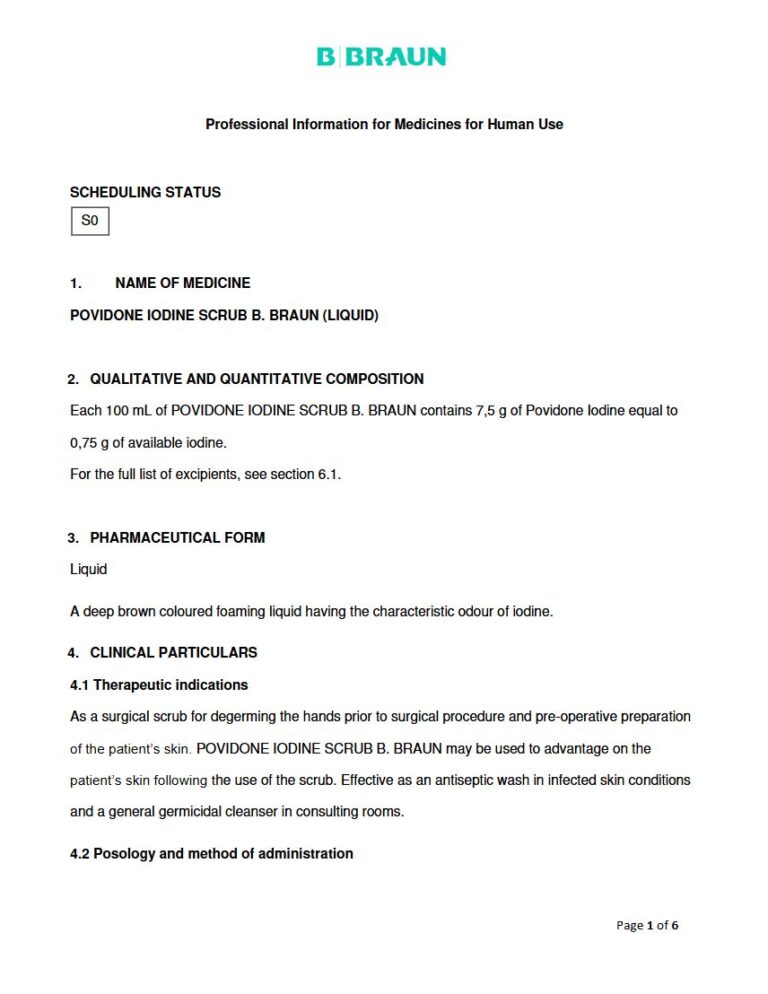
As a surgical scrub for degerming the hands prior to surgical procedure and pre-operative preparation of the patientu2019s skin. POVIDONE IODINE SCRUB B. BRAUN may be used to advantage on the patientu2019s skin following the use of the scrub. Effective as an antiseptic wash in infected skin conditions and a general germicidal cleanser in consulting rooms.
4.2 Posology and method of administration
POVIDONE IODINE SCRUB B. BRAUN should be used undiluted.
4.3 Contraindications
Sensitivity to Povidone Iodine or other Iodine containing products. Hypersensitivity to iodine, polyvinylpyrrolidone or to any excipient. History of abnormal thyroid function or goitre (in particular nodular colloid goitre, endemic goitre and Hashimotou2019s thyroiditis). Use in children under two years of age. Regular use should be avoided in patients on concurrent lithium therapy.
4.4 Special warnings and precautions for use
Not to be used by persons allergic to iodine. Use of this preparation may interfere with tests of thyroid function. Iodine is absorbed through burns and broken skin and to a lesser extent through intact skin and may lead to toxic levels of iodine in the blood, particularly in patients with renal insufficiency. If symptoms occur, suggesting changes in thyroid function, these should be monitored. If local irritation and hypersensitivity develop, then discontinue treatment. Hypothyroidism can result from topical application of Povidone Iodine to neonates. Severe metabolic acidosis may occur in patients suffering from burns greater than 20 % of the body surface. The use of Povidone Iodine in such cases should be discontinued. It may permanently discolour white gold jewellery and it is recommended that this type of jewellery be removed before using Povidone Iodine Scrub B. Braun.
4.5 Interaction with other medicines and other forms of interaction
Use with concurrent lithium therapy has been shown to exhibit additive hypothyroidic effects. Absorption of iodine from povidone iodine through either intact skin or broken skin may interfere with thyroid function tests. Contamination with povidone iodine of several types of tests for the detection of occult blood in faeces or blood in urine may produce false-positive results.
4.6 Fertility, pregnancy, and lactation
Fertility: No data available. Pregnancy: Iodine freely crosses the placenta and is secreted in breast milk. Thyroid function disorders have been reported in the offspring of mothers exposed to pharmacological doses of iodine.
4.7 Effects on ability to drive and use machines
None stated.
4.8 Undesirable effects
Local irritation, skin burns, and sensitivity reactions have been reported rarely. Anaphylactic reactions, anaphylactoid reactions and anaphylactic shock have been reported uncommonly with products containing povidone-iodine or povidone. Excess iodine can produce goitre and hypothyroidism or hyperthyroidism. Such effects have occasionally been seen with extensive or prolonged use of povidone iodine. Other effects that have been reported are metabolic acidosis and acute renal failure. Reporting of suspected adverse reactions: Reporting suspected adverse reactions after authorisation of the medicinal product is important. It allows continued monitoring of the benefit/risk balance of the medicinal product. Healthcare professionals are asked to report any suspected adverse reactions to SAHPRA via the u20186.04 Adverse Drug Reactions Reporting Formu2019. Found under SAHPRAu2019s publications: https://www/sahpra.org.za/Publications/Index/8.
4.9 Overdose
The symptoms of acute poisoning from ingestion of iodine are mainly due to its corrosive effects on the gastro-intestinal tract. A disagreeable metallic taste, vomiting, abdominal pain and diarrhoea may occur. If the stomach contains starch the vomit is coloured blue. Anuria may occur one to three days later, or death may be due to circulatory failure, oedema of the glottis resulting in asphyxia or pulmonary oedema. The fatal dose is usually 2 u2013 3 g. The prognosis is generally favourable. Treatment is symptomatic and supportive. Deliberate or accidental ingestion of large quantities of povidone iodine will result in high blood concentrations of iodine and gastrointestinal corrosive effects including vomiting, diarrhoea and abdominal pain. Systemic toxicity may result in shock, hypotension, tachycardia, fever, metabolic acidosis and renal impairment. Symptomatic and supportive treatment should be started with special attention to monitoring electrolyte balance, renal function, thyroid function and liver function. Haemodialysis effectively clears iodine and should be employed in severe cases of iodine poisoning particularly if renal failure is present. Continuous venovenous haemodiafiltration is less effective than haemodialysis.
