
Septisooth Antiseptic Gel 1 g Gel
PDF Leaflet Revision Date: 25 June 2023
Clinical Summary
Quick overview from the medicine insert
Indication
General antiseptic for skin infections, wounds, and burns.
Dosage (summary)
For external use only; apply liberally to cleaned affected area.
Special Populations
- Renal insufficiency
- Neonates
- Infants
Pregnancy & Breastfeeding
Not established; avoid use in pregnancy and lactation.
Key Drug Interactions
- Lithium may increase hypothyroidism risk
- Interferes with thyroid function tests
Contraindications
- Hypersensitivity to povidone iodine
- Non-toxic nodular colloid goitre
- Neonates
Common side effects
- Hypersensitivity
- Local irritation
- Urticaria
Counselling Points
- Apply to clean skin
- Monitor for irritation
- Avoid large area application
Serious warnings
- Systemic absorption may occur with large skin areas
- Risk of metabolic acidosis in extensive burns
Important Disclaimer
The Septisooth Antiseptic Gel 1 g Gel professional information leaflet below is the property of Pharmacorp and is provided on Medinsert exactly as issued, with no.. alterations or editorial changes. We make every effort to keep content current by updating documents as soon as new versions become available. Medinsert serves as a trusted access point for healthcare professionals, but does not replace official sources or clinical judgement. For more details, please read our full disclaimer. read more>>
 Healthcare Professionals Only
This content is for registered healthcare professionals
Sign in or create a free account to read the full package insert.
Free for HPCSA-registered professionals. Powered by Medinsert.
Clinical Particulars
Section 4 of the official insert — extracted exactly as issued, no alterations
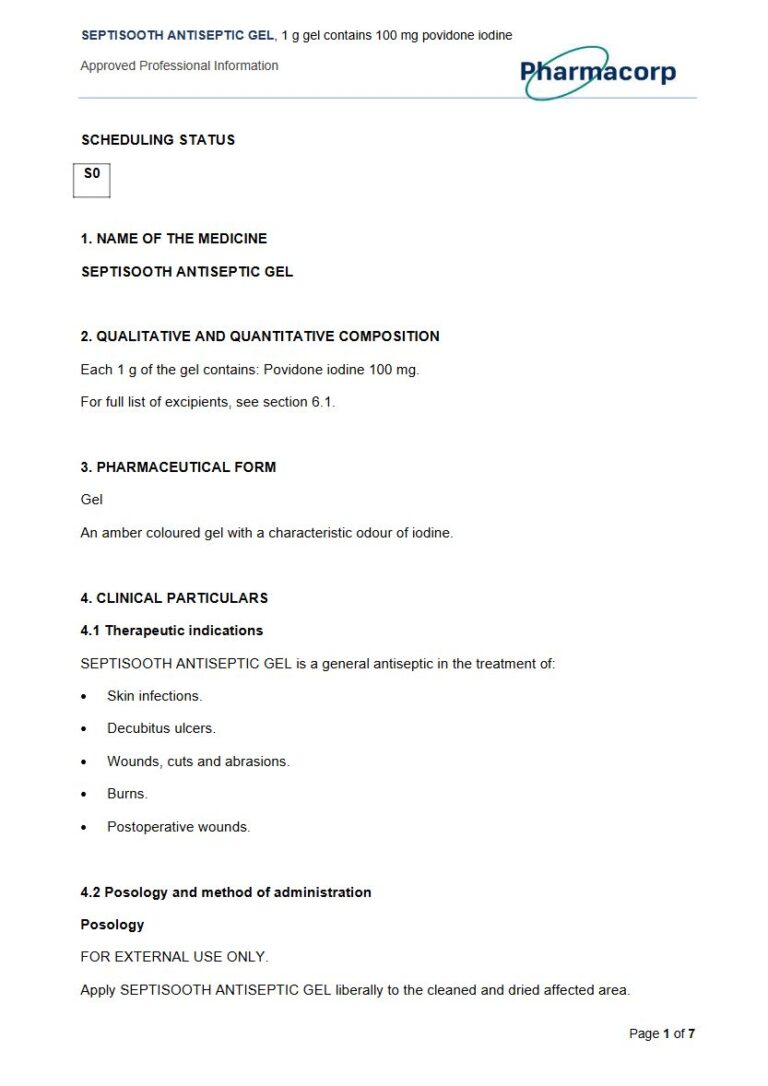
4.1 Therapeutic indications
SEPTISOOTH ANTISEPTIC GEL is a general antiseptic in the treatment of:
- Skin infections.
- Decubitus ulcers.
- Wounds, cuts and abrasions.
- Burns.
- Postoperative wounds.
4.2 Posology and method of administration
Posology
FOR EXTERNAL USE ONLY. Apply SEPTISOOTH ANTISEPTIC GEL liberally to the cleaned and dried affected area. Cover with a dressing or bandage if required.
4.3 Contraindications
- Hypersensitivity to the povidone iodine, iodine or to any of the excipients listed in section 6.1.
- Patients with non-toxic nodular colloid goitre or on neonates.
- Pregnancy and lactation (see section 4.6).
Application to large areas of broken skin should be avoided as excessive absorption of iodine may occur.
4.4 Special warnings and precautions for use
Hypersensitivity
Hypersensitivity reactions and local irritation may occur. However, treatment should be discontinued if irritation, swelling or redness occur.
Systemic absorption
Povidone iodine as in SEPTISOOTH ANTISEPTIC GEL can be absorbed systemically during the topical treatment of burns and large areas of broken skin. The degree of absorption is proportional to the depth and extent of the burn or broken skin.
Prolonged treatment with povidone iodine of patients with severe and extensive burns may cause metabolic acidosis, hypernatraemia and renal impairment. In patients at risk SEPTISOOTH ANTISEPTIC GEL should be used with caution.
Renal insufficiency, neonates and infants
Special caution is needed in patients with pre-existing renal insufficiency and in neonates and infants up to 6 months of age. In such cases monitoring of thyroid function should be considered.
NOTE: Stains on synthetic fabrics may be removed by washing and rinsing in dilute ammonia.
4.5 Interactions with other medicines and other forms of interaction
- Lithium: Use with concurrent lithium therapy has been shown to increase the risk of (transient) hypothyroidism.
- Laboratory tests: Absorption of iodine from povidone iodine through either intact skin or broken skin may interfere with thyroid function tests. Contamination with povidone iodine of several types of tests for the detection of occult blood in faeces or blood in urine may produce false-positive results.
- Other disinfectants and/or antiseptics: Do not mix or co-administer with disinfectants and/or antiseptics or other medicines used for the treatment of wounds.
4.6 Fertility, pregnancy and lactation
Safety and efficacy during pregnancy and lactation have not been established. Pregnant and women who are breastfeeding should not use SEPTISOOTH ANTISEPTIC GEL (see section 4.3).
4.7 Effects on ability to drive and use machines
SEPTISOOTH ANTISEPTIC GEL has no or negligible influence on the ability to drive and use machines.
4.8 Undesirable effects
a. Tabulated summary of adverse reactions
| System Organ Class | Frequency | Adverse reactions |
|---|---|---|
| Immune system disorders | Less frequent | Hypersensitivity, anaphylactic reaction |
| Endocrine disorders | Less frequent | Hyperthyroidism |
| Metabolism and nutrition disorders | Frequency unknown | Metabolic acidosis, hypernatraemia |
| Skin and subcutaneous tissue disorders | Less frequent | Urticaria, angioedema, cutaneous haemorrhage, purpura |
| Renal and urinary disorders | Frequency unknown | Renal impairment |
| General disorders and administrative site conditions | Frequency unknown | Local irritation, swelling, redness* |
| Investigations | Frequency unknown | Interference with thyroid function tests |
b. Description of selected adverse reactions
* Skin reactions Povidone iodine may produce local skin reactions although it is considered to be less irritant than iodine.
Iodine associated effects Severe burns or too large areas otherwise denuded of skin may produce the systemic effects associated with iodine which may include metabolic acidosis, hypernatraemia and renal impairment.
c. Paediatric population Hypothyroidism may occur after topical application to neonates.
Reporting of suspected adverse reactions Reporting suspected adverse reactions after authorisation of the medicine is important. It allows continued monitoring of the benefit/risk balance of the medicine. Healthcare professionals are asked to report any suspected adverse reactions to SAHPRA via the u201c6.04 Adverse Drug Reaction Reporting Formu201d, found online under SAHPRAu2019s publications: https://www.sahpra.org.za/Publications/Index/8
4.9 Overdose
With normal topical application, iodine absorption is so low that the risk of overdose can be virtually excluded. If ingested, the povidone iodine contained in SEPTISOOTH ANTISEPTIC GEL is unlikely to have any toxic effects. Iodine ingested in large amounts can produce goitre and hypothyroidism as well as hyperthyroidism and may lead to a range of adverse effects, often called iodism, such as metallic taste, vomiting, abdominal pain or bloody diarrhoea, although some of the effects may be due to hypersensitivity.
Treatment In severe cases, treat with sodium thiosulphate 1 u2013 5 % as a specific antidote. Gastric irritation can be reduced with milk. Monitoring of the fluid and electrolyte balance could be useful. High serum iodine levels resulting from excessive use can be reduced by haemodialysis.
