
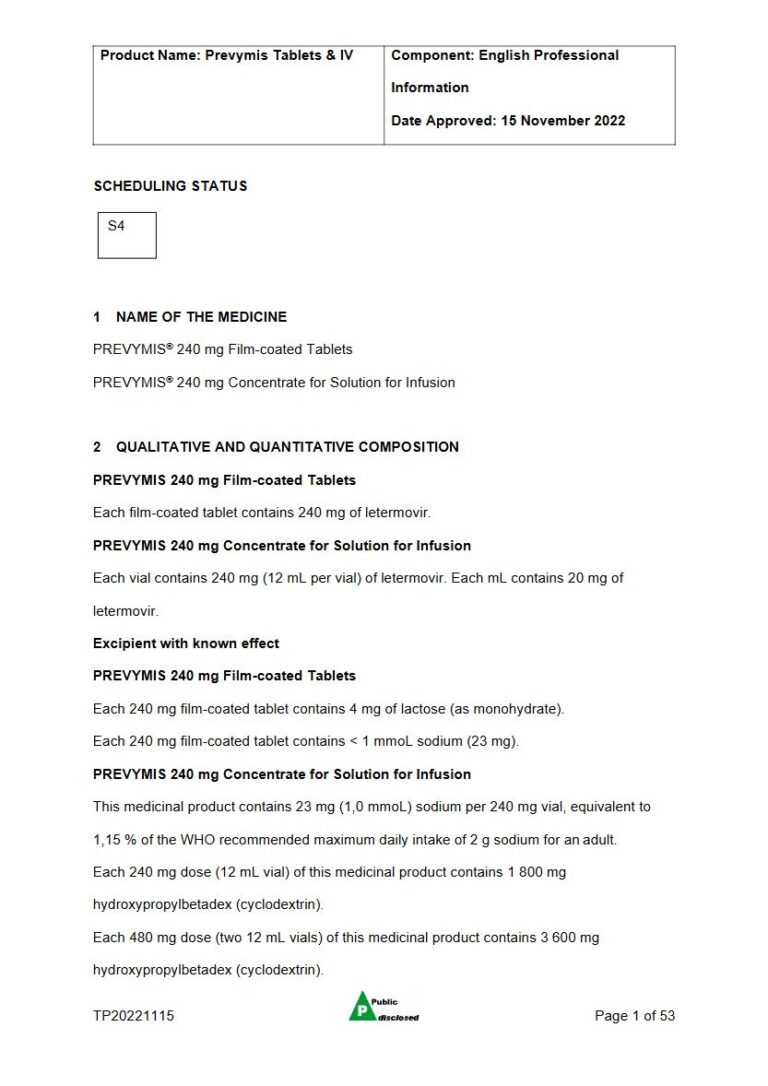
Prevymis 240 Mg Tablets
PDF Leaflet Revision Date: 15 November 2022
Clinical Summary
Quick overview from the medicine insert
Indication
Prophylaxis of CMV reactivation in adult HSCT recipients.
Dosage (summary)
480 mg once daily, starting post-HSCT.
Onset of Action / Duration
Onset: 28 days, Duration: 100 days
Special Populations
- Elderly
- Hepatic impairment
- Renal impairment
Pregnancy & Breastfeeding
Not recommended in pregnancy; avoid breastfeeding.
Key Drug Interactions
- CYP3A substrates
- Ciclosporin
- Statins
Contraindications
- Hypersensitivity
- Pimozide
- Ergot alkaloids
- St. John's wort
- Ciclosporin combination
Common side effects
- Nausea
- Diarrhoea
- Vomiting
Counselling Points
- Take missed dose as soon as remembered
- Do not double dose
- Monitor for nausea and vomiting
Serious warnings
- Monitor CMV DNA
- Risk of adverse reactions with interactions
Important Disclaimer
The Prevymis 240 Mg Tablets professional information leaflet below is the property of Msd and is provided on Medinsert exactly as issued, with no.. alterations or editorial changes. We make every effort to keep content current by updating documents as soon as new versions become available. Medinsert serves as a trusted access point for healthcare professionals, but does not replace official sources or clinical judgement. For more details, please read our full disclaimer. read more>>
 Healthcare Professionals Only
This content is for registered healthcare professionals
Sign in or create a free account to read the full package insert.
Free for HPCSA-registered professionals. Powered by Medinsert.
Clinical Particulars
Section 4 of the official insert — extracted exactly as issued, no alterations
4.1 Therapeutic indications
PREVYMIS is indicated for prophylaxis of cytomegalovirus (CMV) reactivation and disease in adult CMV-seropositive recipients [R+] of an allogeneic haematopoietic stem cell transplant (HSCT). Consideration should be given to official guidance on the appropriate use of antiviral medicines.
4.2 Posology and method of administration
PREVYMIS should be initiated by a medical practitioner experienced in the management of patients who have had an allogeneic haematopoietic stem cell transplant. Posology
PREVYMIS tablets and concentrate for solution for infusion may be used interchangeably at the discretion of the medical practitioner, and no dose adjustment is necessary. The recommended dosage of PREVYMIS is 480 mg once daily. PREVYMIS should be started after HSCT. PREVYMIS may be started on the day of transplant and no later than 28 days post-transplant. PREVYMIS may be started before or after engraftment. Prophylaxis with PREVYMIS should continue through 100 days post-transplant. The safety and efficacy of letermovir use for more than 100 days has not been studied in clinical trials. Prolonged letermovir prophylaxis beyond 100 days post-transplant may be of benefit in some patients at high risk for late CMV reactivation (see section 5.1). Use of letermovir prophylaxis for greater than 100 days requires a careful assessment of the benefit-risk balance.
Dosage adjustment
If PREVYMIS is co-administered with ciclosporin, the dosage of PREVYMIS should be decreased to 240 mg once daily (see sections 4.5 and 5.2).
u2022 If ciclosporin is initiated after starting PREVYMIS, the next dose of PREVYMIS should be decreased to 240 mg once daily.
u2022 If ciclosporin is discontinued after starting PREVYMIS, the next dose of PREVYMIS should be increased to 480 mg once daily.
u2022 If ciclosporin dosing is temporarily interrupted due to high ciclosporin levels, no dose adjustment of PREVYMIS is needed.
Missed dose
Patients should be instructed that if they miss a dose of PREVYMIS, they should take it as soon as they remember. If they do not remember until it is time for the next dose, they should skip the missed dose and go back to the regular schedule. Patients should not double their next dose or take more than the prescribed one.
Special populations
Elderly
No dose adjustment of PREVYMIS is required based on age (see sections 5.1 and 5.2).
Hepatic impairment
No dose adjustment of PREVYMIS is required based on mild (Child-Pugh Class A) to moderate (Child-Pugh Class B) hepatic impairment. PREVYMIS is not recommended for patients with severe (Child-Pugh Class C) hepatic impairment (see section 5.2).
Combined hepatic and renal impairment
PREVYMIS is not recommended in patients with moderate hepatic impairment combined with moderate or severe renal impairment (see section 5.2).
Renal impairment
No dose adjustment of PREVYMIS is recommended for patients with mild, moderate or severe renal impairment. No dose recommendation can be made for patients with end stage renal disease (ESRD) with or without dialysis. Efficacy and safety has not been demonstrated for patients with ESRD. PREVYMIS Concentrate for Solution for Infusion contains hydroxypropylbetadex. The anticipated clinical exposure to hydroxypropylbetadex with intravenously administered letermovir is expected to be approximately 3 600 mg/day for a letermovir dose of 480 mg. There were no cases of kidney injury caused by hydroxypropylbetadex in human studies of intravenously administered letermovir with treatment durations of up to 47 days. In patients with moderate or severe renal impairment (creatinine clearance < 50 mL/min) receiving PREVYMIS, accumulation of hydroxypropylbetadex could occur (see section 5.3). Serum creatinine levels should be closely monitored in these patients.
Paediatric population
The safety and efficacy of PREVYMIS in patients below 18 years of age have not been established. No data are available (see section 5.1).
Method of administration
For oral use. The tablet(s) should be swallowed whole and may be taken with or without food. The tablet(s) should not be divided, crushed or chewed.
For intravenous use only. PREVYMIS Concentrate for Solution for Infusion requires dilution (see section 6.6) prior to administration. PREVYMIS diluted solution must be administered through a sterile 0,2 micron or 0,22 micron polyethersulfone (PES) in-line filter. Do not administer the diluted solution through a filter other than a sterile 0,2 micron or 0,22 micron PES in-line filter. PREVYMIS should be administered as an intravenous (IV) infusion only. PREVYMIS should not be administered as an intravenous push or bolus. After dilution, PREVYMIS should be administered by intravenous infusion via peripheral or central venous catheter using a total time of approximately 60 minutes. The entire contents of the IV bag should be administered.
4.3 Contraindications
- Hypersensitivity to the active substance or to any of the excipients listed in section 6.1.
- Concomitant administration with pimozide (see sections 4.4 and 4.5).
- Concomitant administration with ergot alkaloids (see sections 4.4 and 4.5).
- Concomitant administration with St. Johnu2019s wort (Hypericum perforatum) (see section 4.5).
- When letermovir is combined with ciclosporin.
- Concomitant use of dabigatran, atorvastatin, simvastatin, rosuvastatin or pitavastatin is contraindicated (see section 4.5).
4.4 Special warnings and precautions for use
Monitoring of CMV DNA
The safety and efficacy of letermovir has been established in patients with a negative CMV DNA test result prior to initiation of prophylaxis. CMV DNA was monitored on a weekly basis until post-transplant Week 14 and subsequently bi-weekly until Week 24. In cases of clinically significant CMV DNAemia or disease, letermovir prophylaxis was stopped and standard-of-care pre-emptive therapy (PET) or treatment was initiated. In patients in whom letermovir prophylaxis was initiated and the baseline CMV DNA test was subsequently found to be positive, prophylaxis could be continued if PET criteria had not been met (see section 5.1).
Risk of adverse reactions or reduced therapeutic effect due to medicinal product interactions
The concomitant use of PREVYMIS and certain medicinal products may result in known or potentially significant medicinal product interactions, some of which may lead to:
u2022 possible clinically significant adverse reactions from greater exposure of concomitant medicinal products or letermovir.
u2022 significant decrease of concomitant medicinal product plasma concentrations which may lead to reduced therapeutic effect of the concomitant medicinal product.
See Table 1 for steps to prevent or manage these known or potentially significant medicinal product interactions, including dosing recommendations (see sections 4.3 and 4.5).
Medicine interactions
PREVYMIS should be used with caution with medicinal products that are CYP3A substrates with narrow therapeutic ranges (e.g. alfentanil, fentanyl and quinidine) as co-administration may result in increases in the plasma concentrations of CYP3A substrates. Close monitoring and/or dose adjustment of co-administered CYP3A substrates is recommended (see section 4.5). Increased monitoring of ciclosporin, tacrolimus, sirolimus is recommended the first 2 weeks after initiating and ending letermovir (see section 4.5) as well as after changing route of administration of letermovir. Letermovir is a moderate inducer of enzymes and transporters. Induction may give rise to reduced plasma concentrations of some metabolised and transported medicinal products (see section 4.5). Therapeutic drug monitoring (TDM) is therefore recommended for voriconazole. Concomitant use of dabigatran should be avoided due to risk of reduced dabigatran efficacy.
Letermovir may increase the plasma concentrations of medicinal products transported by OATP1B1/3 such as many of the statins (see section 4.5 and Table 1).
Excipients
PREVYMIS Tablets contain lactose monohydrate. Patients with rare hereditary problems of galactose intolerance, the Lapp lactase deficiency or glucose-galactose malabsorption should not take this medicinal product. PREVYMIS 240 mg Concentrate for Solution for Infusion contains 23 mg (or 1,0 mmoL) sodium per dose. This should be taken into consideration by patients on a controlled sodium diet.
4.5 Interaction with other medicinal products and other forms of interaction
General information about differences in exposure between different letermovir treatment regimens
u2212 The estimated letermovir plasma exposure is different depending on the dose regimen used (see table in section 5.2.). Therefore, the clinical consequences of drug interactions for letermovir will be dependent on which letermovir regimen is used and whether or not letermovir is combined with ciclosporin.
u2212 The combination of ciclosporin and letermovir may lead to more marked or additional effects on concomitant medicinal products as compared to letermovir alone (see Table 1).
Effect of other medicinal products on letermovir
The elimination pathways of letermovir in vivo are biliary excretion and glucuronidation. The relative importance of these pathways is unknown. Both elimination pathways involve active uptake into the hepatocyte through the hepatic uptake transporters OATP1B1/3. After uptake, glucuronidation of letermovir is mediated by UGT1A1 and 3. Letermovir also appears to be subject to P-gp and BCRP mediated efflux in the liver and intestine (see section 5.2).
Inducers of drug metabolising enzymes or transporters
Co-administration of PREVYMIS (with or without ciclosporin) with strong and moderate inducers of transporters (e.g. P-gp) and/or enzymes (e.g. UGTs) is not recommended, as it may lead to subtherapeutic letermovir exposure (see Table 1).
u2212 Examples of strong inducers include rifampicin, phenytoin, carbamazepine, St Johnu2019s wort (Hypericum perforatum), rifabutin and phenobarbital.
u2212 Examples of moderate inducers include thioridazine, modafinil, ritonavir, lopinavir, efavirenz and etravirine. Rifampicin co-administration resulted in an initial increase in letermovir plasma concentrations (due to OATP1B1/3 and/or P-gp inhibition) that is not clinically relevant, followed by clinically relevant decreases in letermovir plasma concentrations (due to induction of P-gp/UGT) with continued rifampicin co-administration (see Table 1).
Additional effects of other products on letermovir relevant when combined with ciclosporin
Inhibitors of OATP1B1 or 3
Co-administration of PREVYMIS with medicinal products that are inhibitors of OATP1B1/3 transporters may result in increased letermovir plasma concentrations. If PREVYMIS is co-administered with ciclosporin (a potent OATP1B1/3 inhibitor), the recommended dose of PREVYMIS is 240 mg once daily (see Table 1 and sections 4.2 and 5.2). Caution is advised if other OATP1B1/3 inhibitors are added to letermovir combined with ciclosporin.
u2212 Examples of OATP1B1 inhibitors include gemfibrozil, erythromycin, clarithromycin and several protease inhibitors (atazanavir, simeprevir).
Inhibitors of P-gp/BCRP
In vitro results indicate that letermovir is a substrate of P-gp/BCRP. Changes in letermovir plasma concentrations due to inhibition of P-gp/BCRP by itraconazole were not clinically relevant.
Effect of letermovir on other medicinal products
Medicinal products mainly eliminated through metabolism or influenced by active transport
Letermovir is a general inducer in vivo of enzymes and transporters. Unless a particular enzyme or transporter is also inhibited (see below) induction can be expected. Therefore, letermovir may potentially lead to decreased plasma exposure and possibly reduced efficacy of co-administered medicinal products that are mainly eliminated through metabolism or by active transport. The size of the induction effect is dependent on letermovir route of administration and whether ciclosporin is concomitantly used. The full induction effect can be expected after 10 to 14 days of letermovir treatment. The time needed to reach steady state of a specific affected medicinal product will also influence the time needed to reach full effect on the plasma concentrations.
In vitro, letermovir is an inhibitor of CYP3A, CYP2C8, CYP2B6, BCRP, UGT1A1, OATP2B1 and OAT3 at in vivo relevant concentrations. In vivo studies are available investigating the net effect on CYP3A4, P-gp, OATP1B1/3 additionally on CYP2C19. The net effect in vivo on the other listed enzymes and transporters is not known. Detailed information is presented below.
It is unknown whether letermovir may affect the exposure of piperacillin/tazobactam, amphotericin B and micafungin. The potential interaction between letermovir and these medicinal products have not been investigated. There is a theoretical risk of reduced exposure due to induction, but the size of the effect and thus clinical relevance is presently unknown.
Medicinal products metabolised by CYP3A
Letermovir is a moderate inhibitor of CYP3A in vivo. Co-administration of PREVYMIS with oral midazolam (a CYP3A substrate) results in 2- to 3-fold increased midazolam plasma concentrations. Co-administration of PREVYMIS may result in clinically relevant increases in the plasma concentrations of co-administered CYP3A substrates (see sections 4.3, 4.4 and 5.2).
u2212 Examples of such medicinal products include certain immunosuppressants (e.g. ciclosporin, tacrolimus, sirolimus), HMG-CoA reductase inhibitors and amiodarone (see Table 1). Pimozide and ergot alkaloids are contraindicated (see section 4.3). The size of the CYP3A inhibitory effect is dependent on letermovir route of administration and whether ciclosporin is concomitantly used. Due to time dependent inhibition and simultaneous induction the net enzyme inhibitory effect may not be reached until after 10 to 14 days. The time needed to reach steady-state of a specific affected medicinal product will also influence the time needed to reach full effect on the plasma concentrations. When ending treatment, it takes 10 to 14 days for the inhibitory effect to disappear. If monitoring is applied, this is recommended the first 2 weeks after initiating and ending letermovir (see section 4.4) as well as after changing route of letermovir administration.
Medicinal products transported by OATP1B1/3
Letermovir is an inhibitor of OATP1B1/3 transporters. Administration of PREVYMIS may result in a clinically relevant increase in plasma concentrations of co-administered medicinal products that are OATP1B1/3 substrates.
u2212 Examples of such medicinal products include HMG CoA reductase inhibitors, fexofenadine, repaglinide and glyburide (see Table 1). Comparing letermovir regimen administered without ciclosporin, the effect is more marked after IV than oral letermovir. The magnitude of the OATP1B1/3 inhibition on co-administered medicinal products is likely greater when PREVYMIS is co-administered with ciclosporin (a potent OATP1B1/3 inhibitor). This needs to be considered when the letermovir regimen is changed during treatment with an OATP1B1/3 substrate.
Medicinal products metabolised by CYP2C9 and/or CYP2C19
Co-administration of PREVYMIS with voriconazole (a CYP2C19 substrate) results in significantly decreased voriconazole plasma concentrations, indicating that letermovir is an inducer of CYP2C19. CYP2C9 is likely also induced. Letermovir has the potential to decrease the exposure of CYP2C9 and/or CYP2C19 substrates potentially resulting in subtherapeutic levels.
u2212 Examples of such medicinal products include warfarin, voriconazole, diazepam, lansoprazole, omeprazole, esomeprazole, pantoprazole, tilidine, tolbutamide (see Table 1). The effect is expected to be less pronounced for oral letermovir without ciclosporin, than IV letermovir with or without ciclosporin or oral letermovir with ciclosporin. This needs to be considered when the letermovir regimen is changed during treatment with a CYP2C9 or CYP2C19 substrate. See also general information on induction above regarding time courses of the interaction.
Medicinal products metabolised by CYP2C8
Letermovir inhibits CYP2C8 in vitro but may also induce CYP2C8 based on its induction potential. The net effect in vivo is unknown.
u2212 An example of a medicinal product which is mainly eliminated by CYP2C8 is repaglinide (see Table1). Concomitant use of repaglinide and letermovir with or without ciclosporin is not recommended.
Medicinal products transported by P-gp in the intestine
Letermovir is an inducer of intestinal P-gp. Administration of PREVYMIS may result in a clinically relevant decrease in plasma concentrations of co-administered medicinal products that are significantly transported by P-gp in the intestine such as dabigatran and sofosbuvir.
Medicinal products metabolised by CYP2B6, UGT1A1 or transported by BCRP or OATP2B1
Letermovir is a general inducer in vivo but has also been observed to inhibit CYP2B6, UGT1A1, BCRP and OATP2B1 in vitro. The net effect in vivo is unknown. Therefore, the plasma concentrations of medicinal products that are substrates of these enzymes or transporters may increase or decrease when co-administered with letermovir. Additional monitoring may be recommended; refer to the prescribing information for such medicinal products.
u2212 Examples of medicinal products that are metabolised by CYP2B6 include bupropion.
u2212 Examples of medicinal products metabolised by UGT1A1 are raltegravir and dolutegravir.
u2212 Examples of medicinal products transported by BCRP include rosuvastatin and sulfasalazine.
u2212 An example of a medicinal product transported by OATP2B1 is celiprolol.
Medicinal products transported by the renal transporter OAT3
In vitro data indicate that letermovir is an inhibitor of OAT3; therefore, letermovir may be an OAT3 inhibitor in vivo. Plasma concentrations of medicinal products transported by OAT3 may be increased.
u2212 Examples of medicinal products transported by OAT3 includes ciprofloxacin, tenofovir, imipenem and cilastatin.
General information
If dose adjustments of concomitant medicinal products are made due to treatment with PREVYMIS, doses should be readjusted after treatment with PREVYMIS is completed. A dose adjustment may also be needed when changing route of administration or immunosuppressant. Table 1 provides a listing of established or potentially clinically significant medicinal product interactions. The medicinal product interactions described are based on studies conducted with PREVYMIS or are predicted medicinal product interactions that may occur with PREVYMIS (see sections 4.3, 4.4, 5.1 and 5.2).
4.6 Fertility, pregnancy and lactation
Pregnancy
There are no data from the use of letermovir in pregnant women. Studies in animals have shown reproductive toxicity (see section 5.3). PREVYMIS is not recommended during pregnancy and in women of childbearing potential not using contraception.
Breastfeeding
Available pharmacodynamic/toxicological data in animals have shown excretion of letermovir in milk (see section 5.3). A risk to the newborns/infants cannot be excluded. Mothers should not breastfeed their infants while receiving PREVYMIS.
Fertility
There were no effects on female fertility in rats. Irreversible testicular toxicity and impairment of fertility was observed in male rats, but not in male mice or male monkeys.
4.7 Effects on ability to drive and use machines
PREVYMIS may have an influence on the ability to drive or use machines. Fatigue and vertigo have been reported in some patients during treatment with PREVYMIS, which may influence a patientu2019s ability to drive and use machines (see section 4.8).
4.8 Undesirable effects
a) Summary of safety profile
The safety assessment of PREVYMIS was based on a Phase 3 clinical trial (P001) in HSCT recipients who received PREVYMIS or placebo through Week 14 post-transplant and were followed for safety through Week 24 post-transplant (see section 5.1). The most commonly reported adverse reactions occurring in at least 1 % of subjects in the PREVYMIS group and at a frequency greater than placebo were: nausea (7,2 %), diarrhoea (2,4 %) and vomiting (1,9 %). The most frequently reported adverse reactions that led to discontinuation of PREVYMIS were nausea (1,6 %), vomiting (0,8 %) and abdominal pain (0,5 %).
b) Tabulated summary of adverse reactions
The following adverse reactions were identified in patients taking PREVYMIS in clinical trials. The adverse reactions are listed below by body system organ class and frequency. Frequencies are defined as follows: very common (u2265 1/10), common (u2265 1/100 to < 1/10), uncommon (u2265 1/1 000 to < 1/100), rare (u2265 1/10 000 to < 1/1 000) or very rare (< 1/10 000).
Table 2: Adverse reactions identified with PREVYMIS
Frequency Adverse reactions
Immune system disorders Uncommon hypersensitivity
Metabolism and nutrition disorders Uncommon decreased appetite
Nervous system disorders Uncommon dysgeusia, headache
Ear and labyrinth disorders Uncommon vertigo
Gastrointestinal disorders Common nausea, diarrhoea, vomiting
Uncommon abdominal pain
Hepatobiliary disorders Uncommon alanine aminotransferase increased, aspartate aminotransferase increased
Musculoskeletal and connective tissue disorders Uncommon muscle spasms
Renal and urinary disorders Uncommon blood creatinine increased
General disorders and administration site conditions Uncommon fatigue, oedema peripheral
Reporting of suspected adverse reactions
Reporting suspected adverse reactions after authorisation of the medicine is important. It allows continued monitoring of the benefit/risk balance of the medicine. Healthcare providers are asked to report adverse reactions to SAHPRA via the u201c6.04 Adverse Drug Reactions Reporting Formu201d, found online under SAHPRAu2019s publications: https://www.sahpra.org.za/Publications/Index/8.
4.9 Overdose
There is no experience with human overdose with PREVYMIS. During Phase 1 clinical trials, 86 healthy subjects received doses ranging from 720 mg/day to 1 440 mg/day of PREVYMIS for up to 14 days. The adverse reaction profile was similar to that of the clinical dose of 480 mg/day. There is no specific antidote for overdose with PREVYMIS. In case of overdose, it is recommended that the patient be monitored for adverse reactions and appropriate symptomatic treatment instituted. It is unknown whether dialysis will result in meaningful removal of PREVYMIS from systemic circulation.
