
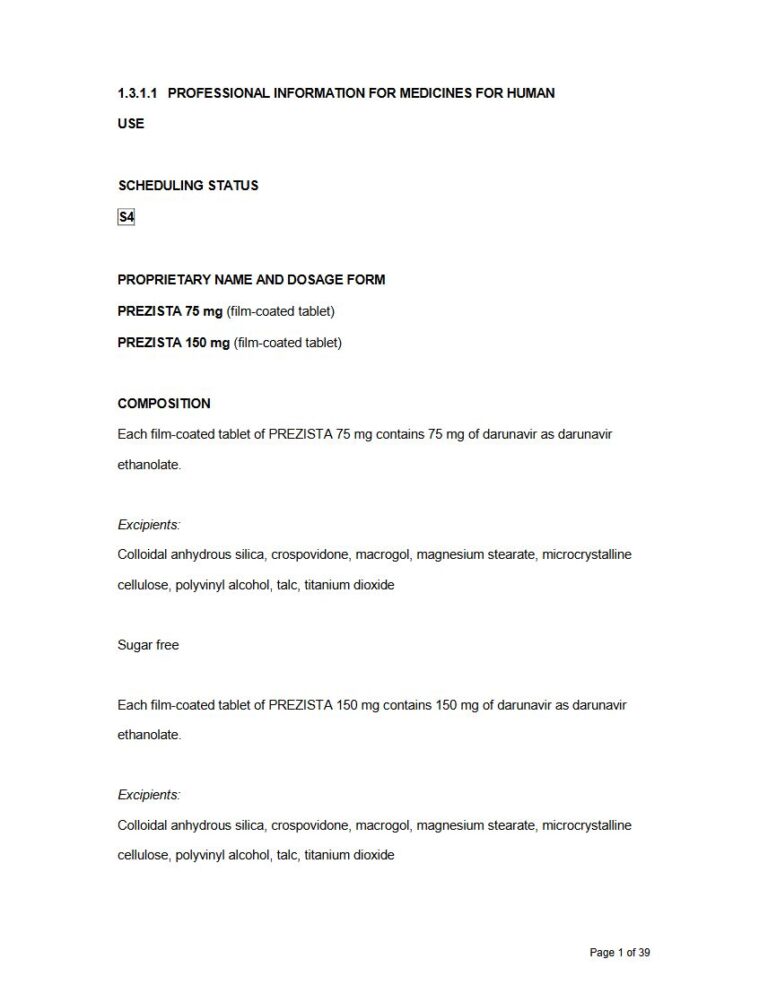
Prezista 150 Mg/75 mg Tablets
PDF Leaflet Revision Date: 20 June 2013
Clinical Summary
Quick overview from the medicine insert
Indication
Treatment of HIV infection in antiretroviral treatment-experienced patients.
Dosage (summary)
600 mg PREZISTA with 100 mg ritonavir twice daily with food.
Special Populations
- Elderly
- Hepatic impairment
- Renal impairment
Pregnancy & Breastfeeding
Safety not established; avoid breastfeeding.
Key Drug Interactions
- CYP3A inhibitors
- Rifampicin
- St. John's Wort
Contraindications
- Hypersensitivity to darunavir
- Children < 3 years
- Severe hepatic impairment
Common side effects
- Diarrhoea
- Headache
- Nausea
- Fatigue
- Rash
Counselling Points
- Take with food and ritonavir
- Do not alter dosage without consulting
- Monitor for skin reactions
Serious warnings
- Severe skin reactions
- Hepatotoxicity
- Diabetes mellitus
Important Disclaimer
The Prezista 150 Mg/75 mg Tablets professional information leaflet below is the property of Aspen Pharmacare and is provided on Medinsert exactly as issued, with no.. alterations or editorial changes. We make every effort to keep content current by updating documents as soon as new versions become available. Medinsert serves as a trusted access point for healthcare professionals, but does not replace official sources or clinical judgement. For more details, please read our full disclaimer. read more>>
 Healthcare Professionals Only
This content is for registered healthcare professionals
Sign in or create a free account to read the full package insert.
Free for HPCSA-registered professionals. Powered by Medinsert.
Clinical Particulars
Section 4 of the official insert — extracted exactly as issued, no alterations
4.1 Therapeutic indications
PREZISTA, in combination with low dose ritonavir (PREZISTA/rtv) and with other antiretroviral agents, is indicated for the treatment of HIV-infection in antiretroviral treatment-experienced paediatric patients of 6 years to < 18 years. Treatment history, and when available, genotypic or phenotypic testing, should guide the use of PREZISTA/rtv.
4.2 Posology and method of administration
PREZISTA must always be given with low-dose ritonavir as a pharmacokinetic enhancer and in combination with other antiretroviral medicinal products. The prescribing information of ritonavir, including the contraindications and warnings, must therefore be consulted prior to initiation of therapy with PREZISTA/rtv. After therapy with PREZISTA has been initiated, patients should be advised not to alter the dosage or discontinue therapy without instruction of their medical practitioner.
Paediatric patients Antiretroviral treatment-experienced paediatric patients (6 to < 18 years of age) The recommended dose of PREZISTA/rtv for paediatric patients (6 to < 18 years of age and weighing at least 20 kg) is based on body weight (see table below) and should not exceed the recommended adult dose (600/100 mg twice daily). PREZISTA tablets should be taken with ritonavir twice daily and with food. The type of food does not affect exposure to darunavir.
Recommended dose for treatment-experienced paediatric patients (6 to < 18 years of age) for PREZISTA tablets and ritonavir Body weight (kg) Dose u2265 20 kg to < 30 kg 375 mg PREZISTA/50 mg ritonavir twice daily u2265 30 kg to < 40 kg 450 mg PREZISTA/60 mg ritonavir twice daily u2265 40 kg 600 mg PREZISTA/100 mg ritonavir twice daily
4.3 Contraindications
- Hypersensitivity to darunavir or to any of the excipients of PREZISTA.
- Children below the age of 3 years (see WARNINGS AND SPECIAL PRECAUTIONS).
- The presence of a contraindication to ritonavir. Darunavir and ritonavir are both inhibitors of the cytochrome P450 3A4 (CYP3A4) isoform. PREZISTA/rtv should not be co-administered with medicinal products that are highly dependent on CYP3A4 for clearance and for which increased plasma concentrations are associated with serious and/or life-threatening events (narrow therapeutic index). These medicinal products are included in the table below:
Medicines that are contraindicated with PREZISTA/rtv
- Anticonvulsants: Carbamazepine, Phenobarbital, Phenytoin
- Antimycobacterial: Rifampicin
- PDE-5 inhibitors: Sildenafil - when intended for the treatment of pulmonary arterial hypertension.
- Alpha 1- adrenoreceptor antagonist: Alfuzosin
- Ergot Derivatives: Dihydroergotamine, Ergonovine, Ergotamine, Methylergonovine
- Herbal Products: St. Johnu2019s wort (Hypericum perforatum)
- HMG-CoA Reductase Inhibitors: Lovastatin, Simvastatin
- Neuroleptic: Pimozide
- Sedatives/Hypnotics: Midazolam, Triazolam
- Antifungals: Ketoconazole, Itraconazole and Voriconazole
4.4 Special warnings and precautions for use
PREZISTA should not be used in patients with severe hepatic impairment (see DOSAGE AND DIRECTIONS FOR USE).
General PREZISTA must be co-administered with ritonavir and food every day to exert its therapeutic effect (see DOSAGE AND DIRECTIONS FOR USE). The type of food does not affect exposure to PREZISTA. Failure to correctly administer PREZISTA with ritonavir and food will result in reduced plasma concentrations of darunavir that will be insufficient to achieve the desired antiviral effect. Patients should be instructed to swallow whole tablets with a drink such as water or milk. PREZISTA must always be used with 100 mg of ritonavir in combination with other antiretroviral medicines. Patients should not alter the dose of either PREZISTA or ritonavir, discontinue ritonavir, or discontinue therapy with PREZISTA without consulting their medical practitioner. If a patient misses a dose of PREZISTA or ritonavir by more than 6 hours, the patient should be told to wait and then take the next dose of PREZISTA and ritonavir at the regularly scheduled time. If the patient misses a dose of PREZISTA or ritonavir by less than 6 hours, the patient should be told to take PREZISTA and ritonavir immediately, and then take the next dose of PREZISTA and ritonavir at the regularly scheduled time. If a dose of PREZISTA or ritonavir is skipped, the patient should not double the next dose.
Skin rash During the clinical development program, severe skin reactions, which may be accompanied with fever and/or elevations of transaminases, have been reported. Stevens-Johnson Syndrome has been reported; and during post-marketing experience toxic epidermal necrolysis has been also reported. Discontinue PREZISTA immediately if signs or symptoms of severe skin reactions develop. These can include but are not limited to severe rash or rash accompanied with fever, general malaise, fatigue, muscle or joint aches, blisters, oral lesions, conjunctivitis, hepatitis and/or eosinophilia. Rash (all grades, regardless of causality) occurred in 10,3 % of patients treated with PREZISTA. Rash was mostly mild to moderate, often occurring within the first four weeks of treatment and usually resolving with continued dosing. The discontinuation rate due to rash in patients using PREZISTA/rtv was 0,5 %.
Sulpha allergy Darunavir contains a sulphonamide moiety. PREZISTA should be used with caution in patients with a known sulphonamide allergy.
4.5 Interactions with other medicines
PREZISTA and ritonavir are both inhibitors of CYP3A. Co-administration of PREZISTA/rtv with medicines primarily metabolised by CYP3A may result in increased plasma concentrations of such medicines, which could increase or prolong their therapeutic effect and adverse events (see CONTRAINDICATIONS and INTERACTIONS).
Diabetes mellitus/Hyperglycaemia New onset diabetes mellitus, exacerbation of pre-existing diabetes mellitus, and hyperglycaemia have been reported during post-marketing surveillance in HIV-infected patients receiving PREZISTA. Some patients required either initiation or dose adjustments of insulin or oral hypoglycaemic medicines for treatment of these events. In some of these patients the hyperglycaemia was severe, and in some cases, diabetic ketoacidosis has occurred. In those patients who discontinued PREZISTA, hyperglycaemia persisted in some cases. Because these events have been reported voluntarily during clinical practice, estimates of frequency cannot be made and causal relationships between PREZISTA and these events have not been established. Many patients had confounding medical conditions, some of which required therapy with medicines that have been associated with the development of diabetes mellitus or hyperglycaemia.
Oestrogen-based contraceptives Plasma concentrations of ethinylestradiol are decreased by induction of its metabolism by ritonavir and alternative methods of non-hormonal contraception are recommended. (see INTERACTIONS).
4.6 Fertility, pregnancy and lactation
Pregnancy Safety and efficacy have not been demonstrated. In animal studies the exposure was lower than in human exposure, and no conclusions were possible.
Lactation It is not known whether darunavir is excreted in human milk. Studies in rats have demonstrated that darunavir is excreted in milk. Because of the potential for serious adverse events in nursing infants, mothers should be instructed not to breastfeed if they are receiving PREZISTA.
Fertility There was no effect on mating or fertility with PREZISTA treatment in rats.
4.7 Effects on ability to drive and use machines
No trials have been performed on the effect of PREZISTA in combination with ritonavir on the ability to drive or use machines. However, dizziness has been reported in some patients during treatment with regimens containing PREZISTA/rtv and should be borne in mind when considering a patientu2019s ability to drive or operate machinery.
4.8 Undesirable effects
Adverse drug reactions (ADRs) identified in the safety assessment in adults The safety assessment is based on all safety data from the Phase IIb clinical trials reported with the recommended dose of PREZISTA/rtv 600/100 mg twice daily in patients who immediately started treatment with the recommended dose (de novo patients). In clinical trials, the most frequent (u2265 10 %) ADRs were diarrhoea, headache, abdominal pain, nausea and fatigue. The most frequent grade 3 or 4 ADRs were increased hepatic and pancreatic enzymes, hypertriglyceridaemia, diarrhoea, hypercholesterolaemia, headache, abdominal pain and vomiting. All other grade 3 or 4 ADRs were reported in less than 1 % of the patients. 2,1 % of the patients discontinued treatment due to ADRs.
Adverse reactions to PREZISTA/rtv 600/100 mg twice daily all grades in antiretroviral treatment-experienced HIV-1-infected adult patients in the pooled Phase IIb Clinical trials are mentioned in the table below: * excluding laboratory abnormalities reported as ADRs
Within each System Organ Class, the ADRs are ranked under CIOMS headings of frequency, using the following convention: Very common (u2265 1/10); common (u2265 1/100, < 1/10); uncommon (u2265 1/1 000, < 1/100); rare (u2265 1/10 000, < 1/1 000); very rare (u2264 1/10 000), including isolated reports
4.9 Overdose
Human experience of acute overdose with PREZISTA/rtv is limited. Treatment There is no specific antidote for overdose with PREZISTA. Treatment of overdose with PREZISTA consists of general supportive measures including monitoring of vital signs and observation of the clinical status of the patient. If indicated, elimination of unabsorbed active substance is to be achieved by emesis or gastric lavage. Administration of activated charcoal may also be used to aid in removal of unabsorbed active substance. Since darunavir is highly protein bound, dialysis is unlikely to be beneficial in significant removal of the active substance.
