
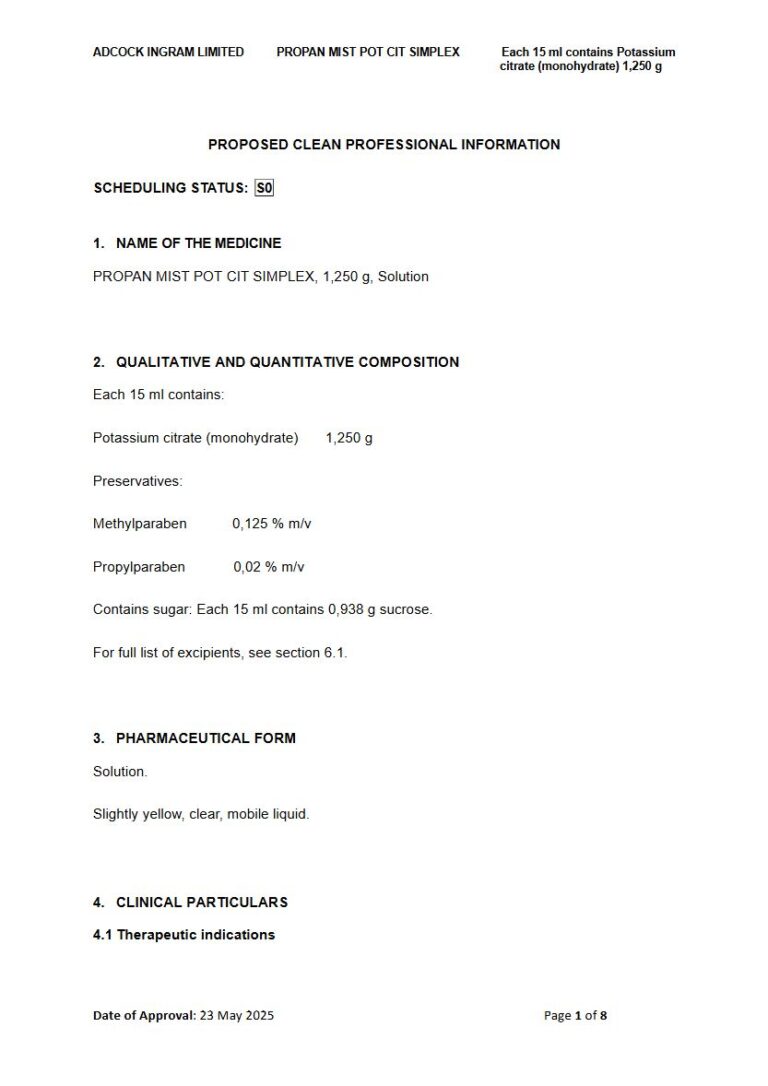
Propan Mist Pot Cit Simplex 1,250 g Solution.
PDF Leaflet Revision Date: 23 May 2025
Clinical Summary
Quick overview from the medicine insert
Indication
Urinary alkaliser for bladder inflammation symptoms.
Dosage (summary)
Adults: 10 ml three times daily; Children 6-12 years: 5 ml three times daily.
Special Populations
- Renal insufficiency
- Hypersensitivity to potassium citrate
Pregnancy & Breastfeeding
Not recommended during pregnancy or lactation due to insufficient safety data.
Key Drug Interactions
- Urinary antiseptics requiring acid urine
- Potassium-sparing diuretics
- ACE inhibitors
Contraindications
- Renal failure
- Hyperkalaemia
- Irregular heartbeat
- Addison's Disease
Common side effects
- Nausea
- Vomiting
- Diarrhoea
- Abdominal cramps
Counselling Points
- Dilute with water before taking
- Monitor for signs of hyperkalaemia
- Report any adverse reactions
Serious warnings
- Risk of metabolic alkalosis
- May cause hyperkalaemia
- Use with caution in renal impairment
Important Disclaimer
The Propan Mist Pot Cit Simplex 1,250 g Solution. professional information leaflet below is the property of Adcock Ingram and is provided on Medinsert exactly as issued, with no.. alterations or editorial changes. We make every effort to keep content current by updating documents as soon as new versions become available. Medinsert serves as a trusted access point for healthcare professionals, but does not replace official sources or clinical judgement. For more details, please read our full disclaimer. read more>>
 Healthcare Professionals Only
This content is for registered healthcare professionals
Sign in or create a free account to read the full package insert.
Free for HPCSA-registered professionals. Powered by Medinsert.
Clinical Particulars
Section 4 of the official insert — extracted exactly as issued, no alterations
4.1 Therapeutic indications
PROPAN MIST POT CIT SIMPLEX is used as a urinary alkaliser to alleviate symptoms associated with inflammatory conditions of the bladder. PROPAN MIST POT CIT SIMPLEX may also be used during treatment with sulphonamides to prevent crystalluria.
4.2 Posology and method of administration
Posology
Adults: Two medicine measures (10 ml) well-diluted with water, three times per day with or immediately after meals.
Children: 6 to 12 years: One medicine measure (5 ml) well-diluted with water, three times per day with or immediately after meals.
Method of administration
To be taken orally.
4.3 Contraindications
PROPAN MIST POT CIT SIMPLEX should not be given with urinary antiseptics which require acid urine, such as methenamine mandelate and methenamine hippurate. Hypersensitivity to potassium citrate or to any of the excipients of PROPAN MIST POT CIT SIMPLEX (see section 6.1). PROPAN MIST POT CIT SIMPLEX should not be given to patients with renal failure or hyperkalaemia, irregular heartbeat and Addison's Disease.
4.4 Special warnings and precautions for use
- Use with care in patients suffering from renal insufficiency.
- Excessive administration may lead to metabolic alkalosis especially in patients with impaired renal function. Symptoms may include shortness of breath, muscle weakness and mental disturbances such as restlessness, convulsions and coma. Muscle hypertonicity, twitch and tetany may develop especially in hypocalcaemic patients.
- Alkalinizing agents do not eradicate bacteriuria, although they may temporarily relieve lower urinary tract symptoms.
- Concomitant use of PROPAN MIST POT CIT SIMPLEX with an antacid by patients with compromised renal function, may result in the absorption of dangerously high amounts of aluminium.
- Excessive intake of PROPAN MIST POT CIT SIMPLEX may result in hyperkaleamia, with resulting paraesthesia of the extremities, muscle weakness, paralysis, hypotension, cardiac dysrhythmia, heart block and cardiac arrest.
- Administer with care to patients receiving potassium sparing diuretics, in adrenal cortical insufficiency, acidosis and after tissue trauma.
- Patients with rare hereditary problems of fructose intolerance, glucose-galactose malabsorption or sucrase-isomaltase insufficiency should not take this medicine.
4.5 Interaction with other medicines and other forms of interaction
PROPAN MIST POT CIT SIMPLEX should not be given with urinary antiseptics which require acid urine, such as methenamine mandelate and methenamine Hippurate (see section 4.3). Concurrent administration of potassium-containing drugs, potassium sparing diuretics or other drugs that increase potassium levels (e.g. ACE inhibitors, ciclosporin, aliskiren) may lead to hyperkalaemia.
Citrates alkalinise the urine and thus may alter the urinary excretion of a number of medicines. This results in increased renal clearance of medicine such as salicylates, tetracyclines and barbiturates, and prolongation of the half-life of medicine such as sympathomimetics and stimulants. Anti-bacterial activity of nitrofurantoin and methenamine may diminish.
4.6 Fertility, pregnancy and lactation
Pregnancy
Safety in pregnancy has not yet been established. In the absence of sufficient data, the use during pregnancy is not recommended.
Lactation
Safety in lactation has not yet been established. In the absence of sufficient data, the use during lactation is not recommended.
Fertility
No fertility data available.
4.7 Effects on ability to drive and use machines
No studies on the effect on the ability to drive and use of machines have been performed.
4.8 Undesirable effects
b) Tabulated summary of adverse reactions
The undesirable effects listed are based on the MedDRAsystem organ classes (SOC) classification system. The frequency groupings listed conform to the following convention: Frequent, Less frequent and frequency unknown*
*Frequency unknown: the frequency of the side effect cannot be estimated from the available data.
System Organ class
Frequency
Adverse reaction
Gastrointestinal disorder
Frequency unknown
nausea, vomiting, diarrhoea and/or abdominal cramps.
Reporting of suspected adverse reactions
Reporting suspected adverse reactions after authorisation of the medicine is important. It allows continued monitoring of the benefit/risk balance of the medicine. Health care providers are requested to report any suspected adverse drug reactions to SAHPRA via the Med Safety APP (Medsafety x SAHPRA) and eReporting platform (who-umc.org) found on SAHPRA website. You may also report to Adcock Ingram Limited Pharmacovigilance department by email [email protected]
4.9 Overdose
In overdosage, side effects can be precipitated and/or be of increased severity (see section 4.8).
Overdosage is accompanied by nausea, vomiting, abdominal pain symptoms due to hyperkalaemia and metabolic acidosis. Fluid and electrolyte balance together with Electrocardiogram (ECG) should be closely monitored. Moderate to severe hyperkalaemia is a medical emergency requiring prompt correction. Treatment is symptomatic and supportive and consists mainly of correction of fluid and electrolyte balance. Consult a doctor in known cases of overdosage.
