
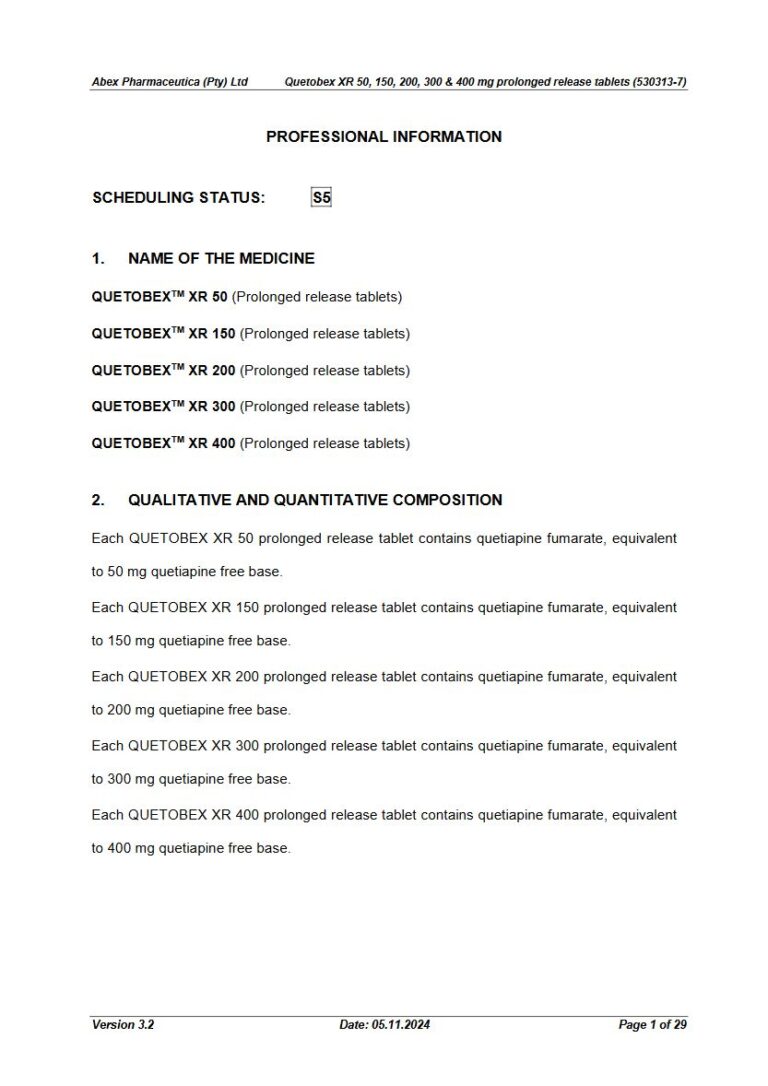
Quetobex XR 400 mg Prolonged-Release Tablets
PDF Leaflet Revision Date: 05 November 2024
Clinical Summary
Quick overview from the medicine insert
Indication
Treatment of schizophrenia, bipolar disorder, and major depressive disorder.
Dosage (summary)
Initial dose for schizophrenia and manic episodes: 300 mg on Day 1, 600 mg on Day 2, up to 800 mg thereafter. For MDD: Start at 50 mg, titrate to 150 mg by Day 3.
Special Populations
- Elderly patients
- Hepatic impairment
- Renal impairment
Pregnancy & Breastfeeding
Contraindicated in pregnancy and lactation; safety not established.
Key Drug Interactions
- CYP3A4 inhibitors
- CYP3A4 inducers
- Alcohol
Contraindications
- Hypersensitivity to quetiapine
- Elderly patients with dementia
- Co-administration with CYP3A4 inhibitors
Common side effects
- Somnolence
- Dizziness
- Weight gain
- Dry mouth
- Constipation
Counselling Points
- Avoid driving if experiencing somnolence
- Monitor for signs of hyperglycemia
- Gradual withdrawal recommended
Serious warnings
- Increased risk of death in elderly patients with dementia
- QT prolongation
- Neutropenia
Important Disclaimer
The Quetobex XR 400 mg Prolonged-Release Tablets professional information leaflet below is the property of Abex Pharmaceutica and is provided on Medinsert exactly as issued, with no.. alterations or editorial changes. We make every effort to keep content current by updating documents as soon as new versions become available. Medinsert serves as a trusted access point for healthcare professionals, but does not replace official sources or clinical judgement. For more details, please read our full disclaimer. read more>>
 Healthcare Professionals Only
This content is for registered healthcare professionals
Sign in or create a free account to read the full package insert.
Free for HPCSA-registered professionals. Powered by Medinsert.
Clinical Particulars
Section 4 of the official insert — extracted exactly as issued, no alterations
4.1 Therapeutic indications
QUETOBEX XR is indicated for the treatment of:
- Schizophrenia.
- Preventing relapse in stable schizophrenic patients who have been maintained on QUETOBEX XR.
- Bipolar disorder including:
- manic episodes associated with bipolar disorder;
- depressive episodes associated with bipolar disorder;
- preventing recurrence in the maintenance treatment of bipolar disorder (mania, mixed or depressive episodes), as monotherapy or in combination with mood stabilisers.
- Major depressive disorder.
- Preventing relapse in stable major depressive disorder patients who have been maintained on QUETOBEX XR.
4.2 Posology and method of administration
Posology
Adults
Treatment of schizophrenia: The initial daily dose is 300 mg on Day 1; 600 mg on Day 2 and up to 800 mg after Day 2. The dose should be adjusted within the effective dose range of 400 mg to 800 mg per day, depending on the clinical response and tolerability of the patient. For maintenance therapy in schizophrenia no dosage adjustment is necessary.
Treatment of manic episodes associated with bipolar disorder: The daily dose at start of therapy is 300 mg on Day 1, 600 mg on Day 2 and up to 800 mg after Day 2. The dose should be adjusted within the effective dose range of 400 to 800 mg per day, depending on the clinical response and tolerability of the patient.
Treatment of depressive episodes associated with bipolar disorder: QUETOBEX XR should be administered once daily in the evening. QUETOBEX XR should be titrated as follows: 50 mg (Day 1), 100 mg (Day 2), 200 mg (Day 3) and 300 mg (Day 4). QUETOBEX XR may be titrated to 400 mg on Day 5 and up to 600 mg by Day 8. Antidepressant efficacy was demonstrated with quetiapine (as in QUETOBEX XR) at 300 mg and 600 mg, however no additional benefit has been reported in the 600 mg group during short-term treatment.
Prevention of recurrence in maintenance treatment of bipolar disorder Patients who have responded to QUETOBEX XR in combination therapy to a mood stabiliser (lithium or valproate) for acute treatment of bipolar disorder should continue QUETOBEX XR at the same dose. The QUETOBEX XR dose may be re-adjusted, depending on clinical response and tolerability of the individual patient within the dose range of 400 mg to 800 mg/day. Patients who have responded to QUETOBEX XR for acute treatment of bipolar disorder should continue QUETOBEX XR therapy at the same dosing regimen. QUETOBEX XR dose may be re-adjusted depending on clinical response and tolerability of the individual patient within the dose range of 300 to 800 mg per day.
Treatment of major depressive disorder (MDD): QUETOBEX XR should be administered once daily, in the evening. Initial dosing should begin at 50 mg on Day 1 and 2, increased to 150 mg on Day 3 and 4. Further adjustments may be made upwards or downwards within the recommended dose range of 50 to 300 mg, depending upon the clinical response and tolerability of the patient. For maintenance therapy in MDD the effective dose during initial treatment should be continued. The dose may be adjusted within the recommended dose range, depending upon the clinical response and tolerability of the patient.
Switching from a quetiapine immediate-release tablet: For more convenient dosing, patients who are currently being treated with divided doses of immediate-release quetiapine tablets may be switched to QUETOBEX XR at the equivalent total daily dose, taken once daily. Individual dose adjustments may be necessary.
Special populations
Elderly population: QUETOBEX XR should be used with caution in the elderly, especially during the initial dosing period (see section 4.4, u201cElderly patientsu201d). The rate of dose-titration of QUETOBEX XR may need to be slower, and the daily therapeutic dose lower, than that used in younger patients. The mean plasma clearance of quetiapine may be reduced by 30 to 50 % in elderly patients when compared to younger patients. Elderly patients should be started on 50 mg/day. The dose may be increased in increments of 50 mg/day to an effective dose, depending on the clinical response and tolerability of the individual patient. In elderly patients with MDD, initial dosing should begin at 50 mg/day on Days 1 to 3; the dose may be increased to 100 mg/day on Day 4 and 150 mg/day on Day 8 and then up to 300 mg/day, depending on clinical response and tolerability.
Paediatric population: The safety and efficacy of QUETOBEX XR has not been evaluated in children and adolescents. QUETOBEX XR is therefore not recommended for use in children and adolescents below 18 years of age.
Renal impairment: Dose adjustment is not necessary in patients with renal impairment.
Hepatic impairment: Quetiapine is extensively metabolised by the liver. Therefore, QUETOBEX XR should be used with caution in patients with known hepatic impairment, especially during the initial dosing period. Patients with hepatic impairment should be started with 50 mg/day. The dose may be increased in increments of 50 mg/day to an effective dose, depending on the clinical response and tolerability of the individual patient.
Method of administration
QUETOBEX XR should be taken once daily, with or without food. The tablets should be swallowed whole and not split, chewed or crushed.
4.3 Contraindications
- Known hypersensitivity to quetiapine fumarate, or to any component of QUETOBEX XR (see section 6.1).
- Elderly patients with dementia, exhibiting behavioural disturbances.
- Co-administration with cytochrome P450 3A4 inhibitors, such as HIV-protease inhibitors, azole-antifungal medicines, erythromycin, clarithromycin and nefazodone. (See section 4.5).
4.4 Special warnings and precautions
Elderly patients with dementia
QUETOBEX XR is not approved for the treatment of elderly patients with dementia, exhibiting behavioural disturbances (see section 4.3). Elderly patients with dementia-related psychosis are at an increased risk of death, compared to placebo. Before prescribing, medical practitioners are advised to carefully assess the risks and benefits of the use of atypical antipsychotics in elderly patients with dementia, considering risk predictions for stroke in the individual patients (e.g. hypertension, diabetes, current smoking, atrial fibrillation and age > 80 years).
Dysphagia
Dysphagia and aspiration (see section 4.8) have been reported with quetiapine and it should therefore be used with caution in patients at risk of aspiration pneumonia.
Constipation and intestinal obstruction
Constipation represents a risk factor for intestinal obstruction. Constipation and intestinal obstruction have been reported with quetiapine (see section 4.8). This includes fatal reports in patients who are at higher risk of intestinal obstruction, including those that are receiving multiple concomitant medications that decrease intestinal motility and/or may not report symptoms of constipation. Patients with intestinal obstruction/ileus should be managed with close monitoring and urgent care.
Metabolic risk and endocrine effects
Given the observed risk for worsening of their metabolic profile, including changes in weight, blood glucose (see u201cHyperglycaemia and diabetes mellitusu201d) and lipids, patients' metabolic parameters should be assessed at the time of treatment initiation and changes in these parameters should be regularly controlled during treatment. Worsening in these parameters should be managed as clinically appropriate.
Hyperglycaemia and diabetes mellitus
Hyperglycaemia, in some cases extreme and associated with ketoacidosis or hyperosmolar coma or death, has been reported in patients treated with QUETOBEX XR (see section 4.8). Patients with an established diagnosis of diabetes mellitus who are started on QUETOBEX XR should be monitored regularly for worsening of glucose control. Patients with risk factors for diabetes mellitus (e.g. obesity, family history of diabetes), who are started on QUETOBEX XR should be monitored regularly for worsening of glucose control or for emerging symptoms of hyperglycaemia including polydipsia, polyuria, polyphagia and weakness. Patients who develop symptoms of hyperglycaemia during treatment with QUETOBEX XR should undergo fasting blood glucose testing. In some cases, hyperglycaemia may be resolved when QUETOBEX XR is discontinued; however, some patients require continuation of antidiabetic treatment despite discontinuation of QUETOBEX XR.
Weight gain
Weight gain frequently occurs, particularly during early treatment. Weight should be monitored and managed as clinically appropriate and in accordance with antipsychotic guidelines (see section 4.8).
Lipids
Increases in triglycerides, LDL and total cholesterol, and decreases in HDL cholesterol may occur with QUETOBEX XR (see section 4.8). Lipid changes should be managed as clinically appropriate.
Pancreatitis
Pancreatitis has been reported, mainly in patients with increased triglycerides, gallstones and with alcohol consumption.
Thyroid hormone levels
QUETOBEX XR treatment is associated with dose-related decreases in thyroid hormone levels, particularly total T4 and free T4. The reduction in total and free T4 is maximal within the first 2 to 4 weeks of quetiapine (as in QUETOBEX XR) treatment, with no further reduction during long-term treatment. There is no evidence of clinically significant changes in thyroid stimulating hormone (TSH) concentration over time. In nearly all cases, cessation of QUETOBEX XR treatment is associated with a reversal of the effects on total and free T4, irrespective of the duration of treatment. Smaller decreases in total T3 and reverse T3 occur only at higher doses. Levels of thyroxine binding globulin (TBG) are unchanged and in general, reciprocal increases in TSH are not observed, with any indication that QUETOBEX XR causes clinically relevant hypothyroidism.
Neutropenia and agranulocytosis
Severe neutropenia (neutrophil count < 0,5 X 10 9 /L) has been reported in quetiapine (as in QUETOBEX XR). Most cases of severe neutropenia have occurred within a couple of months of starting therapy. There was no apparent dose relationship. During post-marketing experience, some cases were fatal. Possible risk factors for neutropenia include pre-existing low white blood cell count (WBC) and history of medicine induced neutropenia. However, some cases occurred in patients without pre-existing risk factors. QUETOBEX XR should be discontinued in patients with a neutrophil count < 1,0 X 10 9 /L. Patients should be observed for signs and symptoms of infection and neutrophil counts followed (until they exceed 1,5 X 10 9 /L). Neutropenia should be considered in patients presenting with infection or fever, particularly in the absence of obvious predisposing factor(s) and should be managed as clinically appropriate. Patients should be advised to immediately report the appearance of signs/symptoms consistent with agranulocytosis or infection (e.g., fever, weakness, lethargy, or sore throat) at any time during therapy with QUETOBEX XR. Such patients should have a WBC count and an absolute neutrophil count (ANC) performed promptly, especially in the absence of predisposing factors.
QT prolongation
QT prolongation has been reported (see sections 4.8 and 4.9). Caution should be exercised in patients with cardiovascular disease or family history of QT prolongation. Caution should also be exercised if QUETOBEX XR is prescribed either with medicines known to increase QT interval, or with concomitant antipsychotics, especially for patients with increased risk of QT prolongation, i.e. the elderly, patients with congenital long QT syndrome, congestive heart failure, heart hypertrophy, hypokalaemia or hypomagnesaemia (see section 4.5).
Cardiomyopathy and myocarditis
Cardiomyopathy and myocarditis have been reported in clinical trials and during the post-marketing experience, however, a causal relationship to quetiapine has not been established. Treatment with QUETOBEX XR should be reassessed in patients with suspected cardiomyopathy or myocarditis.
Somnolence
Quetiapine, as in QUETOBEX XR, treatment has been associated with somnolence and related symptoms, such as sedation (see section 4.8). Patients experiencing somnolence of severe intensity may require more frequent contact for a minimum of 2 weeks from onset of somnolence, or until symptoms improve and treatment discontinuation may need to be considered.
Orthostatic hypotension and dizziness
QUETOBEX XR may induce orthostatic hypotension and related dizziness (see section 4.8), which, like somnolence has onset usually during the initial dose-titration period. This could increase the occurrence of accidental injury (fall), especially in the elderly population. Therefore, patients should be advised to exercise caution until they are familiar with the potential effects of QUETOBEX XR. QUETOBEX XR should be used with caution in patients with known cardiovascular disease, cerebrovascular disease, or other conditions predisposing to hypotension. Dose reduction or more gradual titration should be considered if orthostatic hypotension occurs, especially in patients with underlying cardiovascular disease.
Venous thromboembolism (VTE)
Cases of venous thromboembolism (VTE) have been reported with antipsychotic medicines (such as QUETOBEX XR). Since patients treated with these medicines often present with acquired risk factors for VTE, all possible risk factors for VTE should be identified before and during treatment with QUETOBEX XR and preventive measures should be undertaken.
Suicide/suicidal thoughts or clinical worsening
Depression is associated with an increased risk of suicidal thoughts, self-harm and suicide (suicide-related events). This risk persists until significant remission occurs. Improvement may not occur during the first few weeks or more of treatment, patients should therefore be closely monitored until such improvement occurs. The risk of suicide may increase in the initial stages of recovery. Medical practitioners should also consider the potential risk of suicide-related events after abrupt cessation of QUETOBEX XR treatment, due to the known risk factors for the disease being treated. Other psychiatric conditions for which QUETOBEX XR is prescribed can also be associated with an increased risk of suicide-related events. In addition, these conditions may be co-morbid with major depressive episodes. The same precautions observed when treating patients with major depressive episodes should therefore be observed when treating patients with other psychiatric disorders. Patients with a history of suicide-related events, or those exhibiting a significant degree of suicidal ideation prior to commencement of treatment are known to be at greater risk of suicidal thoughts or suicide attempts and should be monitored closely for the emergence of worsening of depression, suicidal thoughts or behaviour, or any unusual changes in mood or behaviour.
Neuroleptic malignant syndrome (NMS)
NMS has been associated with antipsychotic treatment, including QUETOBEX XR treatment (see section 4.8). Clinical manifestations include altered mental status, hyperthermia, muscular rigidity, autonomic instability and increased creatine phosphokinase. In such an event, QUETOBEX XR should be discontinued and appropriate medical treatment given.
Tardive dyskinesia / extrapyramidal symptoms (TD/EPS)
Tardive dyskinesia is a syndrome of potentially irreversible, involuntary, dyskinetic movements that may develop in patients treated with antipsychotic medicines including QUETOBEX XR. If signs and symptoms of tardive dyskinesia appear, dose reduction or discontinuation of QUETOBEX XR should be considered. The symptoms of tardive dyskinesia may worsen or even arise after discontinuation of treatment (see section 4.8). In schizophrenia and bipolar mania, the incidence of extrapyramidal symptoms is not different from placebo. In bipolar depression and major depressive disorder QUETOBEX XR may cause an increased incidence of extrapyramidal side effects (see section 4.8). The use of quetiapine (as in QUETOBEX XR) has been associated with the development of akathisia, characterised by a subjectively unpleasant or distressing restlessness and need to move often accompanied by an inability to sit or stand still. This is most likely to occur within the first few weeks of treatment. In patients who develop these symptoms, increasing the dose may be detrimental.
Seizures
No data is available about the incidence of seizures in patients with a history of seizure disorder. QUETOBEX XR should however be used with caution in patients with a history of seizures, or a decreased seizure threshold.
Sleep apnoea syndrome
Sleep apnoea syndrome has been reported in patients taking QUETOBEX XR (see section 4.8). In patients receiving concomitant central nervous system depressants and who have a history of or are at risk for sleep apnoea, such as those who are overweight/obese or are male, QUETOBEX XR should be used with caution.
Withdrawal
Acute withdrawal symptoms such as insomnia, nausea, vomiting, headache, dizziness and irritability have been described after abrupt cessation of antipsychotic medicines, including QUETOBEX XR. Gradual withdrawal of QUETOBEX XR, over a period of at least 1 to 2 weeks is recommended (see section 4.8).
Misuse and abuse
Cases of misuse and abuse have been reported. Caution may be needed when prescribing QUETOBEX XR to patients with a history of alcohol or substance abuse.
Anticholinergic (muscarinic) effects
Norquetiapine, an active metabolite of quetiapine, has moderate to strong affinity for several muscarinic receptor subtypes. This contributes to side effects reflecting anticholinergic effects when QUETOBEX XR is used at recommended doses, when used concomitantly with other medicines having anticholinergic effects, and in the setting of overdose. QUETOBEX XR should be used with caution in patients receiving medicines having anticholinergic (muscarinic) effects (see section 4.5). QUETOBEX XR should be used with caution in patients with a current diagnosis or prior history of urinary retention, clinically significant prostatic hypertrophy, intestinal obstruction or related conditions, increased intraocular pressure or narrow angle glaucoma (see section 4.8).
4.5 Interactions with other medicines and other forms of interaction
Cytochrome CYP3A4 inhibitors
CYP3A4 is the main enzyme responsible for cytochrome P450-mediated metabolism of quetiapine, as in QUETOBEX XR. Concomitant use of QUETOBEX XR and potent CYP3A4 inhibitors (such as azole antifungals, macrolide antibiotics such as erythromycin, clarithromycin and nefazodone, and HIV-protease inhibitors) may significantly increase plasma concentrations of quetiapine and is contraindicated (see section 4.3). The consumption of grapefruit juice while taking QUETOBEX XR is contraindicated (see section 4.3). The pharmacokinetics of QUETOBEX XR are not altered following co-administration with cimetidine (a known P450 enzyme inhibitor).
Cytochrome CYP3A4 inducers
Quetiapine does not induce the hepatic enzyme systems involved in the metabolism of antipyrine. Co-administration of carbamazepine significantly increases the clearance of quetiapine and reduces systemic quetiapine exposure (as measured by AUC) to an average of 13 % of the exposure during administration of quetiapine alone; although a greater effect can be seen in some patients. This could affect the efficacy of QUETOBEX XR therapy. Co-administration with phenytoin (another microsomal enzyme inducer) causes a greatly increased clearance of quetiapine by approximately 450 %. In patients receiving a hepatic enzyme inducer, initiation of QUETOBEX XR treatment should only occur if the medical practitioner considers that the benefits of quetiapine outweigh the risks of removing the hepatic enzyme inducer. It is important that any change in the inducer is gradual, and if required, replaced with a non-inducer (e.g. sodium valproate) (see section 4.4 and u201cAnticonvulsantsu201d below).
Medicines that prolong the QT interval
Caution should be exercised when QUETOBEX XR is used concomitantly with medicines known to cause electrolyte imbalance or to increase QT interval (see section 4.4).
4.6 Fertility, pregnancy and lactation
Pregnancy
QUETOBEX XR is contraindicated during pregnancy and lactation, as safety has not been demonstrated.
Breastfeeding
QUETOBEX XR is distributed into breast milk; the degree to which it is distributed is unknown. Women should be advised to avoid breastfeeding their babies while taking QUETOBEX XR.
Fertility
The effects of quetiapine on human fertility have not been assessed.
4.7 Effects on ability to drive and use machines
QUETOBEX XR may cause somnolence and dizziness. Patients should be cautioned not to drive, operate hazardous machinery or perform hazardous tasks, while taking QUETOBEX XR.
4.8 Undesirable effects
Summary of the safety profile
The most commonly reported adverse events with quetiapine are somnolence, dizziness, headache, dry mouth, withdrawal (discontinuation) symptoms, elevations in serum triglyceride levels, elevations in total cholesterol (predominantly LDL cholesterol), decreases in HDL cholesterol, weight gain, decreased haemoglobin and extrapyramidal symptoms.
Tabulated list of adverse reactions
Infections and infestations
Frequent: Urinary tract infection
Immune system disorders
Less frequent: Hypersensitivity, anaphylactic reaction, angioedema
Blood and lymphatic system disorders
Frequent: Decreased haemoglobin, leucopenia, decreased neutrophil count, increased eosinophils
Less frequent: Neutropenia, thrombocytopenia, anaemia, decreased platelet count, agranulocytosis
Endocrine disorders
Frequent: Hyperprolactinaemia, decreases in total T4, decreases in free T4, decreases in total T3, increases in TSH
Less frequent: Decreases in free T3, hypothyroidism, inappropriate antidiuretic hormone (ADH) secretion
Metabolism and nutritional disorders
Frequent: Increased serum triglyceride levels, elevations in total cholesterol (predominantly LDL cholesterol), decreases in HDL cholesterol, weight gain, increased appetite, blood glucose increased to hyperglycaemic levels
Less frequent: Hyponatraemia, diabetes mellitus, exacerbation of pre-existing diabetes, metabolic syndrome
Psychiatric disorders
Frequent: Abnormal dreams, nightmares, suicidal ideation and suicidal behaviour (see section 4.4), somnolence
Less frequent: Somnambulism and related reactions such as sleep talking and sleep related eating disorder
Nervous system disorders
Frequent: Dizziness, headache, extrapyramidal symptoms, dysarthria
Less frequent: Seizure, restless legs syndrome; tardive dyskinesia, syncope, parkinsonian symptoms, neuroleptic malignant syndrome
Eye disorders
Less frequent: Blurred/abnormal vision
Vascular disorders
Frequent: Orthostatic hypotension
Less frequent: Venous thromboembolism
Frequency unknown: Stroke
Cardiac disorders
Frequent: Tachycardia, palpitations
Less frequent: Prolongation of the QTc interval, bradycardia
Respiratory, thoracic and mediastinal disorders
Frequent: Dyspnoea
Less frequent: Rhinitis
Gastro-intestinal disorders
Frequent: Dry mouth, constipation, dyspepsia, vomiting
Less frequent: Dysphagia, pancreatitis, intestinal obstruction/ileus
Hepato-biliary disorders
Frequent: Elevations in serum alanine amino-transferase (AST), elevations in gamma-GT levels
Less frequent: Elevations in serum aspartate amino-transferase (AST), jaundice, hepatitis
Skin and subcutaneous tissue disorders
Less frequent: Stevens Johnson syndrome
Frequency unknown: Erythema multiforme, toxic epidermal necrolysis, Drug Reaction with Eosinophilia and Systemic Symptoms (DRESS)
Musculoskeletal and connective tissue disorders
Less frequent: Rhabdomyolysis
Renal and urinary disorders
Less frequent: Urinary retention
Pregnancy, puerperium and perinatal conditions
Frequency unknown: Neonatal medicine withdrawal syndrome
Reproductive system and breast disorders
Less frequent: Sexual dysfunction, priapism, galactorrhoea, breast swelling, menstrual disorder
General disorders and administration site disorders
Frequent: Withdrawal (discontinuation) symptoms, asthenia, peripheral oedema, irritability, pyrexia
Less frequent: Hypothermia
Investigations
Frequent: Increase in serum prolactin
Less frequent: Elevations in blood creatine phosphokinase
NOTES:
1) See section 4.4. 2) Somnolence may occur, usually during the first two weeks of treatment and generally resolves with the continued administration of QUETOBEX XR. 3) Shift in neutrophils from u2265 1,5 x 10 9 /L at baseline to 7 % increase in body weight from baseline. Occurs predominantly during the early weeks of treatment in adults. 5) Elevations in serum transaminase (ALT, AST) or gamma-GT levels have been observed in some patients administered quetiapine. These elevations were usually reversible on continued quetiapine treatment. 6) QUETOBEX XR may induce orthostatic hypotension, associated with dizziness, tachycardia and, in some patients, syncope, especially during the initial dose-titration period. (See section 4.4). 7) Manifestations of hypersensitivity may include angioedema and urticaria/rash. 8) Fasting blood glucose u2265 7,0 mmol/L or a non-fasting blood glucose u2265 11,1 mmol/L on at least one occasion. 9) An increase in the rate of dysphagia with quetiapine vs. placebo was only observed in bipolar depression. 10) The following withdrawal symptoms have been observed most frequently: insomnia, nausea, headache, diarrhoea, vomiting, dizziness, and irritability. The incidence of these reactions had decreased significantly after 1 week post-discontinuation. 11) Triglycerides u2265 200 mg/dl on at least one occasion (patients u2265 18 years of age). 12) Cholesterol u2265 240 mg/dl on at least one occasion (patients u2265 18 years of age). 13) Adverse event reports of blood creatine phosphokinase increase not associated with neuroleptic malignant syndrome. 14) Platelets u2264 100 x 10 9 /L on at least one occasion. 15) Prolactin levels (patients > 18 years of age): > 20 u03bcg/ L for males; > 30 u03bcg/ L for females at any time. 16) May lead to falls. 17) HDL cholesterol: < 40 mg/dl for males; < 50 mg/dl for females at any time. 18) Causality with QUETOBEX XR has not been established. 19) Based on post-marketing published reports.
4.9 Overdose
Symptoms
Overdose of quetiapine alone (as in QUETOBEX XR), that resulted in death or coma has been reported. Death has been reported following an acute overdose of 13,6 g quetiapine alone. However, survival has also been reported following acute overdoses of up to 30 g. Cases of QT prolongation with overdose have been reported (see section 4.4 and 4.8). Patients with pre-existing severe cardiovascular disease may be at an increased risk of the effect of overdose (see section 4.4, u201cConcomitant illnessu201d). In general, reported signs and symptoms were those resulting from an exaggeration of the active substance's known pharmacological effects, i.e., drowsiness and sedation, tachycardia and hypotension (see section 4.8).
Management
There is no specific antidote to quetiapine. In cases of severe intoxication, the possibility of multiple medicines involvement should be considered, and intensive care procedures are recommended, including establishing and maintaining a patent airway, ensuring adequate oxygenation and ventilation, and monitoring and support of the cardiovascular system. Close medical supervision and monitoring should be continued until the patient recovers.
