
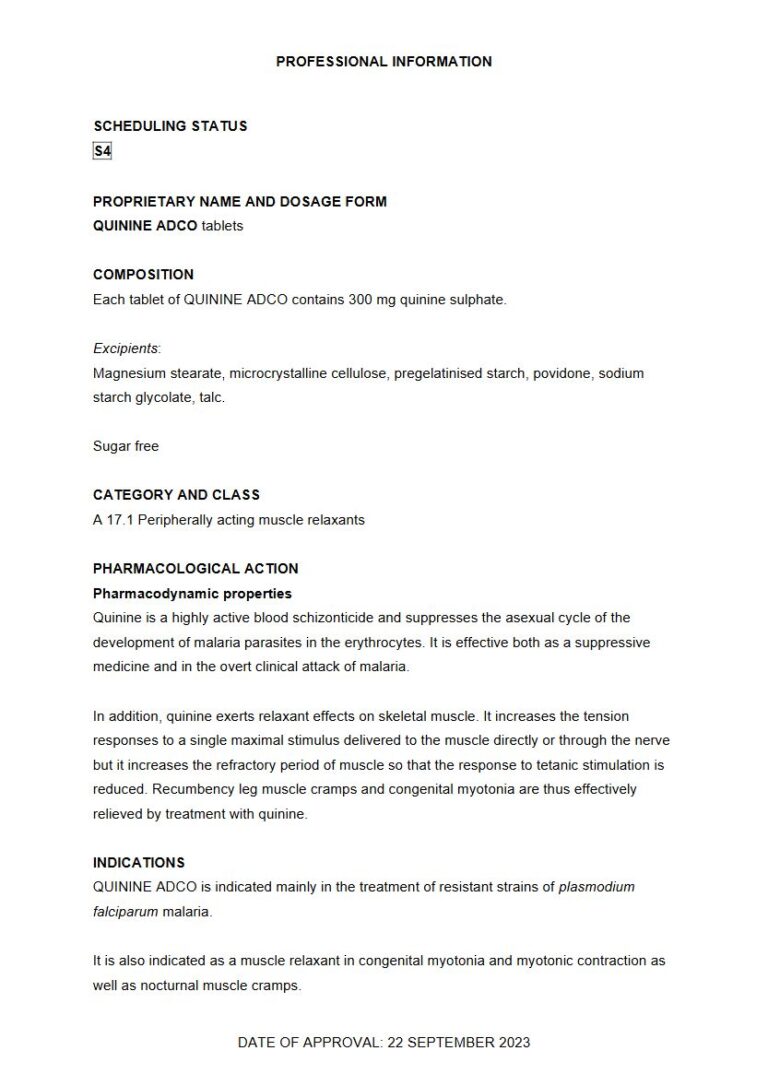
Quinine Adco 300 mg Tablets
PDF Leaflet Revision Date: 22 September 2023
Clinical Summary
Quick overview from the medicine insert
Indication
Treatment of resistant plasmodium falciparum malaria and muscle relaxant for myotonia.
Dosage (summary)
Adults: 300-600 mg at night for cramps; 600 mg every 8 hours for malaria. Children: 10 mg/kg every 8 hours.
Special Populations
- Renal impairment
- Hepatic impairment
Pregnancy & Breastfeeding
Use in pregnancy is not contraindicated due to malaria risks.
Key Drug Interactions
- Mefloquine may increase side effects and seizures
Contraindications
- Hypersensitivity to quinine
- Tinnitus
- Optic neuritis
- Myasthenia gravis
Common side effects
- Cinchonism
- Tinnitus
- Nausea
- Vomiting
- Visual disturbances
Counselling Points
- Monitor for signs of cinchonism
- Avoid in myasthenia gravis
- Report any visual changes
Serious warnings
- Risk of seizures with mefloquine
- Cardiotoxicity in overdose
- Hypoglycaemia in malaria
Important Disclaimer
The Quinine Adco 300 mg Tablets professional information leaflet below is the property of Adcock Ingram and is provided on Medinsert exactly as issued, with no.. alterations or editorial changes. We make every effort to keep content current by updating documents as soon as new versions become available. Medinsert serves as a trusted access point for healthcare professionals, but does not replace official sources or clinical judgement. For more details, please read our full disclaimer. read more>>
 Healthcare Professionals Only
This content is for registered healthcare professionals
Sign in or create a free account to read the full package insert.
Free for HPCSA-registered professionals. Powered by Medinsert.
Clinical Particulars
Section 4 of the official insert — extracted exactly as issued, no alterations
4.1 Therapeutic indications
QUININE ADCO is indicated mainly in the treatment of resistant strains of plasmodium falciparum malaria. It is also indicated as a muscle relaxant in congenital myotonia and myotonic contraction as well as nocturnal muscle cramps. A secondary indication is its use in the diagnostic test for myasthenia gravis.
4.2 Posology and method of administration
Adults: 300 mg to 600 mg given at night for nocturnal cramps. Treatment is discontinued after several cramp-free nights. For the treatment of falciparum malaria, a course usually lasts 7 days. Adults: 600 mg every eight hours for 7 days. Children: 10 mg per kg body-weight every 8 hours for 7 days. In severe or complicated falciparum malaria or when the patient is unable to take oral medication, quinine should be given parenterally, preferably by slow intravenous infusion, but this can be hazardous and patients generally need monitoring for signs of cardiotoxicity.
4.3 Contraindications
- Quinine and its salts, as contained in QUININE ADCO, are contraindicated in patients with a history of hypersensitivity to quinine or any of the excipients and in patients with tinnitus or optic neuritis and especially when this takes the form of cutaneous, angioedematous, visual, or auditory symptoms.
- QUININE ADCO should be discontinued immediately if evidence of haemolysis appears.
- Pregnancy in a patient with malaria is not generally regarded as a contraindication to the use of QUININE ADCO, as malaria infection is potentially serious during pregnancy and poses a threat to the mother and foetus, there appears to be little justification in withholding treatment in the absence of a suitable alternative.
- QUININE ADCO should be avoided in patients with myasthenia gravis, as it may aggravate their condition.
4.4 Special warnings and precautions for use
Use of mefloquine with QUININE ADCO may increase the chance of side effects. Concurrent use with QUININE ADCO may result in an increased incidence of seizures and of electrocardiogram abnormalities, predisposing the patient to dysrhythmias. It is recommended that mefloquine be administered at least 12 hours after the last dose of QUININE ADCO. Patients taking weekly mefloquine prophylaxis may be found to have mefloquine-resistant malaria that requires treatment with QUININE ADCO, because mefloquine has a very long half-life (approximately 20 days) it will remain in the body long after the medicine has been discontinued. Although there is insufficient information available, if QUININE ADCO must be given to the patient, it is recommended that the patient be hospitalised during administration if possible, and monitored for QT prolongation and possible rhythm disturbances. Seizure activity may also be potentiated in these patients. In patients considered to be at high risk for a seizure, additional precautions and interventions may be indicated. QUININE ADCO should be used with caution in patients with atrial fibrillation or other serious heart disease. QUININE ADCO may also cause haemolysis in some types of glucose-6-phosphate dehydrogenase deficiency and should be used with care. Hypoglycaemia is now recognised to be a frequent complication encountered in falciparum malaria, it is important to recognise that hypoglycaemia may be the cause of coma rather than cerebral malaria and that hypoglycaemia may also be induced by antimalarial therapy.
4.5 Interactions with other medicines
See WARNINGS AND SPECIAL PRECAUTIONS.
4.6 Fertility, pregnancy and lactation
Pregnancy in a patient with malaria is not generally regarded as a contraindication to the use of QUININE ADCO, as malaria infection is potentially serious during pregnancy and poses a threat to the mother and foetus, there appears to be little justification in withholding treatment in the absence of a suitable alternative (see CONTRAINDICATIONS).
4.7 Effects on ability to drive and use machines
Not provided in the text.
4.8 Undesirable effects
Administration of QUININE ADCO in usual therapeutic doses may give rise to a train of symptoms known as cinchonism, characterised by tinnitus, impaired hearing, headache, nausea and disturbed vision in its mild form. In addition, vomiting, abdominal pain, diarrhoea and vertigo occur in its more severe manifestations. Rashes frequently appear. Visual disturbances consist of blurred vision, disturbed colour perception, photophobia, diplopia, night blindness, constricted visual fields, scotomata, mydriasis, and very rarely, even blindness. Cinchonism may also occur after small doses in patients hypersensitive to QUININE ADCO, but urticaria and flushing of the skin with intense pruritus are the most frequent reactions seen in these patients, other effects include fever, skin rashes and dyspnoea. Angioedema especially of the face may also occur and asthma can be precipitated. Thrombocytopenic purpura has been associated with quinine hypersensitivity. Haemoglobinuria occurs rarely. Other adverse effects of QUININE ADCO may include hypoprothrombinaemia and agranulocytosis.
4.9 Overdose
Main symptoms of overdosage, which can be fatal, include gastrointestinal effects, oculotoxicity, central nervous system disturbances, and cardiotoxicity. Visual disturbances including sudden blindness are usually slowly reversible but there may be residual damage. QUININE ADCO can produce cardiovascular toxicity similar to that seen with quinidine including conduction disturbances, dysrhythmias, anginal symptoms and hypotension leading to cardiac arrest and circulatory failure. In acute overdosage with QUININE ADCO, the stomach should be emptied by lavage if ingestion has been recent. Oral administration of activated charcoal may also be of some benefit. Treatment is mostly symptomatic with attention being given to maintaining blood pressure, respiration and renal function and to treating dysrhythmias. Central nervous system symptoms are noted in more severe grades of poisoning, particularly noted are: headache, fever, vomiting, apprehension, excitement, confusion, delirium, and syncope. Respiration is first stimulated and is then shallow and depressed. The skin becomes cold and cyanotic as poisoning progresses, the body temperature and the blood pressure fall, weakness is extreme, the pulse is feeble, coma ensues, and death occurs from respiratory arrest.
