
Qutenza 50 g Cutaneous patch
PDF Leaflet Revision Date: 11 February 2022
Clinical Summary
Quick overview from the medicine insert
Indication
Treatment of peripheral neuropathic pain.
Dosage (summary)
Apply up to 4 patches for 30-60 mins, repeat every 90 days.
Special Populations
- Renal impairment
- Hepatic impairment
- Not recommended in children
Pregnancy & Breastfeeding
Safety in pregnancy not established; avoid breastfeeding on application day.
Contraindications
- Hypersensitivity to capsaicin or inactive ingredients
Common side effects
- Application site pain
- Erythema
- Pruritus
Counselling Points
- Wear nitrile gloves when handling
- Use topical anaesthetic before application
- Monitor blood pressure during treatment
Serious warnings
- Use only on intact skin
- Avoid contact with eyes and mucous membranes
Important Disclaimer
The Qutenza 50 g Cutaneous patch professional information leaflet below is the property of Adcock Ingram and is provided on Medinsert exactly as issued, with no.. alterations or editorial changes. We make every effort to keep content current by updating documents as soon as new versions become available. Medinsert serves as a trusted access point for healthcare professionals, but does not replace official sources or clinical judgement. For more details, please read our full disclaimer. read more>>
 Healthcare Professionals Only
This content is for registered healthcare professionals
Sign in or create a free account to read the full package insert.
Free for HPCSA-registered professionals. Powered by Medinsert.
Clinical Particulars
Section 4 of the official insert — extracted exactly as issued, no alterations
4.1 Therapeutic indications
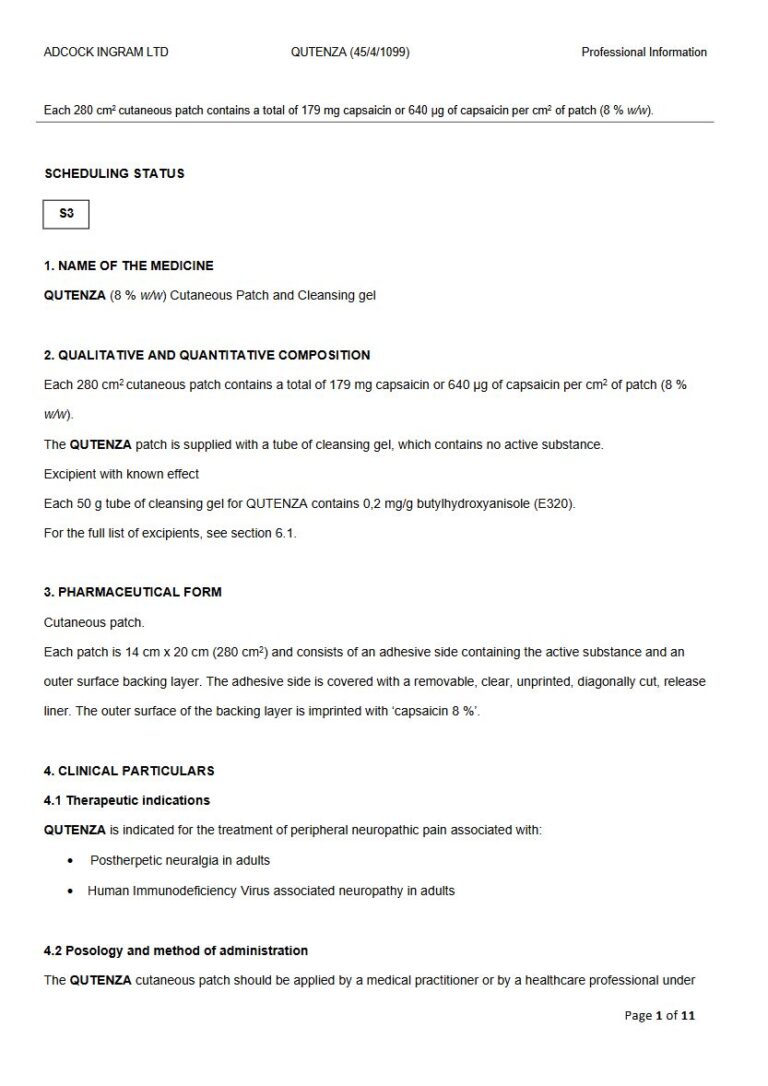
QUTENZA is indicated for the treatment of peripheral neuropathic pain associated with:
- Postherpetic neuralgia in adults
- Human Immunodeficiency Virus associated neuropathy in adults
4.2 Posology and method of administration
The QUTENZA cutaneous patch should be applied by a medical practitioner or by a healthcare professional under the supervision of a medical practitioner.
Posology
QUTENZA should be applied to the most painful skin areas (using up to a maximum of 4 patches). The painful area should be determined by the medical practitioner and marked on the skin. QUTENZA must be applied to intact, non-irritated, dry skin, and allowed to remain in place for 30 minutes for the feet (e.g. HIV-associated neuropathy) and 60 minutes for other locations (e.g. postherpetic neuralgia). QUTENZA treatments may be repeated every 90 days, as warranted by the persistence or return of pain. The treatment area should be pre-treated with a topical anaesthetic prior to application of QUTENZA to reduce application related discomfort. The topical anaesthetic should be applied to cover the entire QUTENZA treatment area and surrounding 1 to 2 cm. The topical anaesthetic should be used in accordance with the productu2019s instructions for use. In clinical trials, patients were pre-treated with topical lidocaine (lignocaine) 4 % or lidocaine (lignocaine) 2,5 % /prilocaine (2,5 %) for 60 minutes.
Renal and/or hepatic impairment
No dose adjustment is required for patients with renal or hepatic impairment.
Paediatric population
QUTENZA is not recommended for use in children and adolescents due to lack of data on safety and efficacy.
Method of administration
Precautions to taken before handling or administering the medicinal product: Nitrile gloves should be worn at all times while handling QUTENZA and cleaning treatment areas. Latex gloves should NOT be worn as they do not provide adequate protection. Patches should not be held near eyes or mucous membranes. Direct contact with QUTENZA, used gauze or used cleansing gel should be avoided. If necessary, hairs in the affected area should be clipped to promote patch adherence (do not shave). The treatment area(s) should be gently washed with soap and water. Following hair removal and washing, the skin should be thoroughly dried. Instructions for use: QUTENZA is a single use patch and can be cut to match the size and shape of the treatment area. QUTENZA should be cut prior to removal of the release liner. The release liner should NOT be removed until just prior to application. There is a diagonal cut in the release liner to aid in its removal. A section of the release liner should be peeled and folded and the adhesive side of the printed patch placed on the treatment area. The patch should be held in place. The release liner should slowly and carefully be peeled from underneath with one hand while the patch should simultaneously be smoothed onto the skin with the other. To ensure QUTENZA maintains contact to the treatment area, stretchable socks or rolled gauze may be used. The QUTENZA patches should be removed gently and slowly by rolling them inward to minimise the risk of aerosolisation of capsaicin. After removal of QUTENZA, cleansing gel should be applied liberally to the treatment area and left on for at least one minute. Cleansing gel should be wiped off with dry gauze to remove any remaining capsaicin from the skin. After the cleansing gel has been wiped off, the area should be gently washed with soap and water. Acute pain during and following the procedure should be treated with local cooling (such as a cool compress) and oral analgesics (e.g., short-acting opioids). For instructions on handling and disposal of the treatment materials see section 6.6.
4.3 Contraindications
Hypersensitivity to capsaicin or to any of the inactive ingredients of QUTENZA (see section 6.1).
4.4 Special warnings and precautions for use
Healthcare professionals should wear nitrile gloves when handling patches and cleansing treatment areas. QUTENZA should be used only on dry, intact (unbroken) skin and not on the face, above the hairline of the scalp, and/or in proximity to mucous membranes. Care must be taken to avoid unintentional contact with the patches or other materials that have come in contact with the treated areas. Exposure of the skin to capsaicin results in transient erythema and burning sensation, with mucous membranes being particularly susceptible. Inhalation of airborne capsaicin can result in coughing or sneezing. Used patches should be disposed of immediately after use in an appropriate medical waste container (see section 6.6). If QUTENZA comes in contact with skin not intended to be treated, cleansing gel should be applied for one minute and wiped off with dry gauze to remove any remaining capsaicin from the skin surface. After the cleansing gel has been wiped off, the area should be gently washed with soap and water. If burning of eyes, skin, or airway occurs, the affected individual should be removed from the vicinity of QUTENZA. Eyes or mucous membranes should be flushed or rinsed with water. Appropriate medical care should be provided if shortness of breath develops. As a result of treatment-related increases in pain, transient increases in blood pressure (on average < 8,0 mm Hg) may occur during and shortly after the QUTENZA treatment. Blood pressure should be monitored during the treatment procedure. Patients experiencing increased pain should be provided with supportive treatment such as local cooling or oral analgesics (i.e., short acting opioids). For patients with unstable or poorly controlled hypertension or a recent history of cardiovascular events, the risk of adverse cardiovascular reactions due to the potential stress of the procedure should be considered prior to initiating QUTENZA treatment. Patients using high doses of opioids may not respond to oral opioid analgesics when used for acute pain during and following the treatment procedure. A thorough history should be reviewed prior to initiating treatment and an alternative pain reduction strategy in place prior to QUTENZA treatment in patients with suspected high opioid tolerance. Changes in sensory function (e.g., heat detection) have been reported following administration of capsaicin. Patients with increased risk for adverse reactions due to minor changes in sensory function should be cautious when using QUTENZA. Care must be taken to avoid unintentional contact with the patches or other materials that have come in contact with the treated areas. Exposure of the skin to capsaicin results in transient erythema and burning sensation, with mucous membranes being particularly susceptible. Inhalation of airborne capsaicin can result in coughing or sneezing. Used patches should be disposed of immediately after use in an appropriate medical waste container (see section 6.6). The cleansing gel for QUTENZA contains butylhydroxyanisole, which may cause local skin reactions (e.g. contact dermatitis) or irritation of the eyes and mucous membranes.
4.5 Interaction with other medicines and other forms of interaction
No formal interaction studies with other medicines have been performed.
4.6 Fertility, pregnancy and lactation
Pregnancy
Safety in pregnancy has not been established.
Lactation
QUTENZA must be kept away from contact with babies. Mothers must not breastfeed their babies on the day of application.
Fertility
There is no data in humans available on fertility.
4.7 Effects on ability to drive and use machines
When QUTENZA has been applied to hands or feet, changes in sensation may impair the ability to drive or to use machines.
4.8 Undesirable effects
a. Summary of safety profile
Of the 1,327 patients treated with QUTENZA in randomised controlled trials, 883 (67 %) reported adverse reactions considered related to the medicinal product by the investigator. The most commonly reported adverse reactions were transient local applications site burning, pain, erythema and pruritus.
b. Tabulated list of adverse reactions
In Table 1 below all adverse reactions, which occurred at an incidence greater than control and in more than one patient in controlled clinical trials in patients with PHN and painful HIV-AN, are listed by system organ class and frequency: very common (u2265 1/10), common (u2265 1/100 to < 1/10) and uncommon (u2265 1/1,000 to < 1/100). Within each frequency grouping, adverse reactions are presented in order of decreasing seriousness.
Table 1: Treatment-emergent related adverse reaction incidence in controlled trials
System organ class Adverse reaction and frequency
Infections and infestations Uncommon Herpes zoster
Nervous system disorders Uncommon Dysgeusia, hypoesthaesia, burning sensation
Eye disorders Uncommon Eye irritation
Cardiac disorders Uncommon First degree atrio-ventricular (AV) block, tachycardia, palpitations
Vascular disorders Uncommon Hypertension
Respiratory, thoracic and mediastinal disorders Uncommon Cough, throat irritation
Gastrointestinal disorders Uncommon Nausea
Skin and subcutaneous tissue disorders Uncommon Pruritus
Musculoskeletal and connective tissue disorders Uncommon Pain in extremity, muscle spasms
General disorders and administration site conditions Very common Application site pain, application site erythema
Common Application site pruritus, application site papules, application site vesicles, application site oedema, application site swelling, application site dryness
Uncommon Application site urticaria, application site paraesthesia, application site dermatitis, application site hyperaesthesia, application site inflammation, application site reaction, application site irritation, application site bruising, peripheral oedema
Investigations Uncommon Increased blood pressure
4.9 Overdose
Treatment: QUTENZA is required to be administered by a medical practitioner or under the supervision of a medical practitioner. In case of suspected overdose, the patches should be removed gently, cleansing gel should be applied for one minute and then wiped off with dry gauze and the area should be gently washed with soap and water. Supportive measures should be taken as clinically needed. There is no antidote to capsaicin.
Symptoms: Overdose may be associated with severe application site reactions, e.g. application site pain, application site erythema, application site pruritus.
