
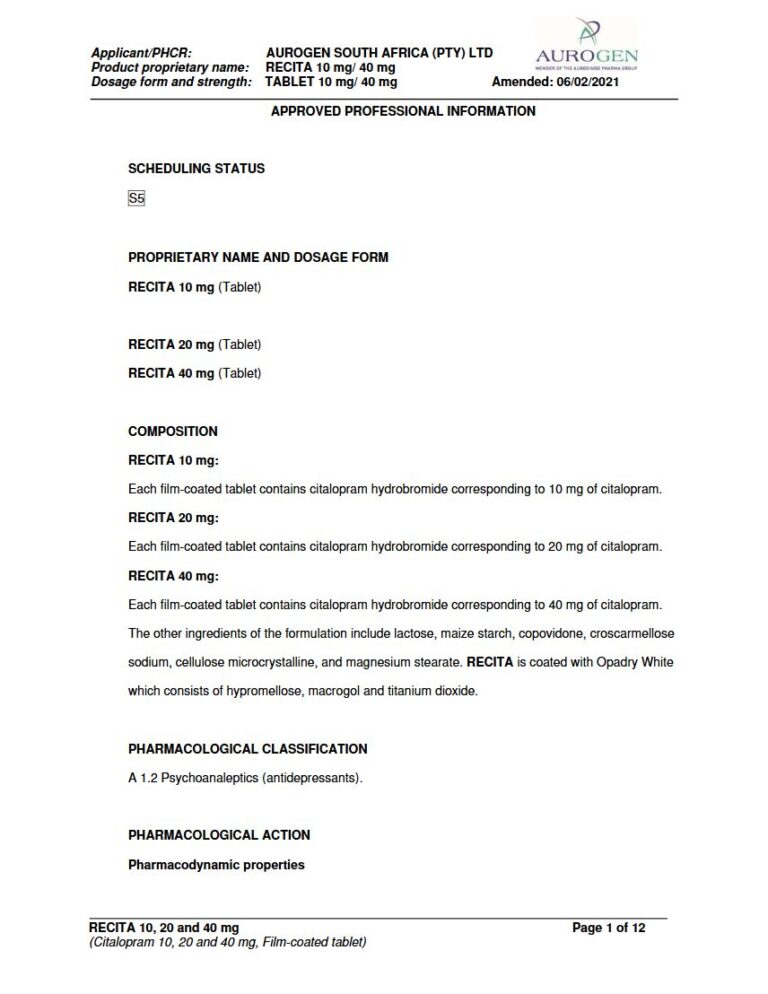
Recita 10 Mg/40 Mg Tablets
PDF Leaflet Revision Date: 18 March 2023
Clinical Summary
Quick overview from the medicine insert
Indication
Treatment of depression, panic disorders, and OCD.
Dosage (summary)
Depression: 20 mg/day, max 40 mg. Panic disorder: 10 mg/day, increase to 20 mg. OCD: 20 mg/day, max 40 mg.
Onset of Action / Duration
Onset: 2-4 weeks
Special Populations
- Elderly: 10-20 mg/day
- Hepatic impairment: halve dose
- Renal impairment: mild/moderate no adjustment
Pregnancy & Breastfeeding
Safety in pregnancy/lactation not established; excreted in breast milk.
Key Drug Interactions
- MAOIs: contraindicated
- Serotonergic drugs: risk of serotonin syndrome
- Alcohol: increased effects
- Warfarin: increased anticoagulant effect
- Cimetidine: increased plasma levels
Contraindications
- Hypersensitivity to citalopram
- Concurrent MAOI use
- Severe renal impairment
- Congenital long QT syndrome
- Children under 18
Common side effects
- Nausea
- Dry mouth
- Sleep disturbances
- Somnolence
- QT prolongation
Counselling Points
- Take with or without food
- Do not abruptly discontinue
- Monitor for mood changes
- Avoid alcohol
Serious warnings
- Risk of suicidal ideation in patients with depression
- QT prolongation risk
- Monitor for serotonin syndrome
Important Disclaimer
The Recita 10 Mg/40 Mg Tablets professional information leaflet below is the property of Aurogen South Africa and is provided on Medinsert exactly as issued, with no.. alterations or editorial changes. We make every effort to keep content current by updating documents as soon as new versions become available. Medinsert serves as a trusted access point for healthcare professionals, but does not replace official sources or clinical judgement. For more details, please read our full disclaimer. read more>>
 Healthcare Professionals Only
This content is for registered healthcare professionals
Sign in or create a free account to read the full package insert.
Free for HPCSA-registered professionals. Powered by Medinsert.
Clinical Particulars
Section 4 of the official insert — extracted exactly as issued, no alterations
4.1 Therapeutic indications
RECITA is indicated for the treatment of:
- Depression and prevention of relapse
- Panic disorders with or without agoraphobia
- Obsessive-compulsive disorder (OCD)
4.2 Posology and method of administration
Depression: 20 mg a day as a single dose. Dosage may be increased by 20 mg a day at intervals of at least one week to a maximum of 40 mg depending on the patientu2019s response.
Panic disorder: 10 mg a day as a single dose for the first week then increasing to 20 mg a day. The dose may be increased thereafter as required to a maximum of 40 mg a day depending on the patientu2019s response.
Obsessive compulsive disorder: 20 mg a day as a single dose. This dose can be increased by 20 mg increments to a maximum of 40 mg a day depending on the patientu2019s response.
Special populations:
- Elderly: 10 - 20 mg a day as a single dose. Depending on the patientu2019s response the dose can be increased to a maximum of 20 mg a day.
- Reduced hepatic function: Dose should be halved.
- Reduced renal function: Dose adjustment is not necessary in cases of mild or moderate renal impairment.
The onset of action is seen within 2 to 4 weeks. Treatment should be continued for an appropriate length of time (up to six months) after recovery in order to prevent relapse. The medicine should be gradually withdrawn during a couple of weeks when stopping therapy (See SIDE-EFFECTS). RECITA may be taken with or without food in the morning or evening.
4.3 Contraindications
- Hypersensitivity to citalopram or any of the ingredients in the formulation.
- Concurrent use with a monoamine oxidase inhibitor (MAOI). At least 14 days should elapse between discontinuing the MAOI and initiating therapy with RECITA. MAOIu2019s should not be introduced for 7 days after discontinuation of RECITA (see INTERACTIONS).
- Severe renal impairment (creatine clearance less than 30 mI/min).
- Safety and efficacy in pregnancy and lactation has not been established.
- Children under the age of 18 years. (See WARNINGS AND SPECIAL PRECAUTIONS and SIDE-EFFECTS)
- RECITA is contraindicated in patients with congenital long QT syndrome (see WARNINGS AND SPECIAL PRECAUTIONS, SIDE EFFECTS, and INTERACTIONS).
- Concomitant use with products that prolong QT interval.
4.4 Special warnings and precautions for use
Patients with major depressive disorder, both adults and children, may experience worsening of their depression and or the emergence of suicidal ideation and behaviour, whether or not they are taking antidepressant medicines. This risk may persist until significant remission occurs. A causal role, however, for antidepressant medicines in inducing such behaviour has not been established. Patients being treated with RECITA should, nevertheless, be observed closely for clinical worsening and suicidality, especially at the beginning of a course of therapy, or at any time of dose changes, either increases or decreases.
Because of the possibility of co-morbidity between major depressive disorders and other psychiatric and non-psychiatric disorders, the same precautions observed when treating patients with major depressive disorder should be observed when treating patients with other psychiatric and non-psychiatric disorders.
The following symptoms have been reported in patients being treated with RECITA for major depressive disorders as well as for other indications, both psychiatric and non-psychiatric: anxiety, agitation, panic attacks, insomnia, irritability, hostility, aggressiveness, impulsivity, akathisia, hypomania, and mania. Although a causal link between the emergence of such symptoms and either the worsening of depression and/or the emergence of suicidal impulses has not been established, consideration should be given to changing the therapeutic regimen, including possibly discontinuing RECITA, in patients for whom such symptoms are severe, abrupt in onset, or were not part of the patients presenting symptoms.
If the decision is made to discontinue treatment, RECITA should be tapered in order to avoid the possibility of a withdrawal syndrome.
RECITA should also be used with caution in:
- Patients suffering from seizures or history thereof - There is an increased risk of seizures. RECITA should be used with caution in patients with controlled epilepsy and avoided in patients who are poorly controlled epileptics. Care is advised in patients receiving electroconvulsive therapy.
- Elderly patients u2014 Longer half-life and decreased clearance due to a reduced rate of metabolism. A lower dose is recommended in the elderly.
- Hepatic impairment u2014 Clearance of RECITA is reduced. Cautious dosage titration and a lower maximum dose are recommended.
- Renal impairment u2014 Elimination is decreased. If creatine clearance is less than 30 mI/mm RECITA should not be used. (See CONTRA-INDICATIONS)
- Mania or history of mania u2014 Condition may be re-activated. RECITA should be discontinued if the patient enters the manic phase.
- RECITA may cause a reduction in heart rate. Caution is advised in patients with a pre-existing slow heart rate.
- Diabetes mellitus - Occurrences of hypoglycaemia have been reported.
- RECITA should not be used with monoamine oxidase inhibitors; imipramine; other serotonergic medicines; moclobemide; alcohol; warfarin; and cimetidine (See INTERACTIONS).
Serotonin syndrome is more likely to occur after an increase in dose.
Safety and efficacy in children under 18 years of age have not been established. In clinical trials in Major Depressive Disorder, there were increased reports of hostility and suicide-related adverse events such as suicidal ideation and self-harm.
Concomitant administration of pimozide with citalopram has been associated with a mean increase in QTc values compared to when pimozide was given alone.
A rare but potentially fatal hyperserotonergic state may occur when RECITA is co-administered with other drugs that may affect the serotonergic neurotransmitter systems such as linezolid or St. Johnu2019s Wort.
QT-Prolongation and Torsade de Pointes: RECITA causes dose-dependent QT prolongation and should not be dosed above 40 mg/day. RECITA should not be used in patients with congenital long QT syndrome. Hypokalaemia and hypomagnesaemia should be corrected prior to initiation of treatment and periodically monitored. ECG monitoring is recommended in patients with congestive heart failure, bradydysrhythmias, or patients on concomitant medications that prolong the QT interval. Dose escalations over 20 mg/day in CYP2C19 poor metabolisers or patients taking concomitant cimetidine or another CYP2C19 inhibitor is not recommended.
4.5 Interactions with other medicines
- Monoamine oxidase inhibitors (MAOI) - Concurrent use is contra-indicated. Serious and potentially fatal reactions have occurred such as: hyperthermia, rigidity, myoclonus, autonomic instability with rapid fluctuation of vital signs and mental status changes including extreme agitation progressing to delirium and coma. (See CONTRA-INDICATIONS)
- Imipramine - An increase in the concentration of desimipramine (the active metabolite of imipramine) may occur. It appears that RECITA does not cause a marked increase in plasma levels of some tricyclic antidepressants.
- Other serotonergic medicines or medicines with serotonergic activity - Increased risk of developing the serotonin syndrome, a rare but potentially fatal hyperserotonergic state may occur when RECITA is co-administered with other drugs that may affect the serotonergic neurotransmitter systems such as linezolid or St. Johnu2019s Wort.
- Moclobemide - Serotonin syndrome has developed after taking high doses of moclobemide and RECITA.
- Alcohol - The effects of alcohol may be increased.
- Warfarin - The anticoagulant activity of warfarin may be increased.
- Cimetidine - The AUC and the maximum plasma concentration of RECITA are increased when RECITA is administered concurrently with cimetidine.
- Medicines that prolong the QT Interval - ECG monitoring is recommended with concomitant medications that have demonstrated prolongation of the QT interval.
- Pimozide u2013 concurrent administration of pimozide with citalopram has been associated with a mean increase in QTc values compared to when pimozide was given alone.
4.6 Fertility, pregnancy and lactation
Safety and efficacy in pregnancy and lactation has not been established. RECITA is excreted into the breast milk.
Effects on neonates: Neonates exposed to citalopram and other selective serotonin reuptake inhibitors (SSRIs) or serotonin u2013 norepinephrine reuptake inhibitors (SNRIs), late in the third trimester, have developed complications requiring prolonged hospitalisation, respiratory support, and tube feeding. Reported clinical findings have included respiratory distress, cyanosis, apnoea, seizures, temperature instability, feeding difficulty, vomiting, hypoglycaemia, hypotonia, hypertonia, hyperreflexia, tremor, jitteriness, irritability, and constant crying. These features are consistent with either a direct toxic effect of SSRIs and SNRIs or, possibly, a drug discontinuation syndrome. Infants exposed to SSRIs in late pregnancy may have an increased risk for persistent pulmonary hypertension of the newborn. When treating a pregnant woman with citalopram during the third trimester, the medical practitioner should carefully consider both the potential risks and benefits of treatment.
4.7 Effects on ability to drive and use machines
RECITA may impair performance of skilled tasks. If affected these patients should not operate machinery or drive.
4.8 Undesirable effects
Immune system disorders: The following side effects have been reported and frequencies are unknown: Anaphylaxis, angioedema.
Endocrine disorders: Frequent: Weight changes.
Psychiatric disorders: Frequent: Sleep disturbances, somnolence. Less frequent: Hostility, suicidal ideation and self harm have been reported in children, agitation, confusion and mania.
Nervous system disorders: Less frequent: Paraesthesia, fatigue, serotonin syndrome. The following side effects have been reported and frequencies are unknown: restlessness, headache, dizziness, impaired concentration, malaise, convulsions, neuroleptic malignant syndrome.
Eye disorders: The following side effects have been reported and frequencies are unknown: Accommodation disturbances, mydriasis.
Cardiac disorders: Less frequent: Bradycardia, tremor, QT prolongation, tosades de pointes. The following side effects have been reported and frequencies are unknown: Palpitations.
Respiratory, thoracic and mediastinal disorders: The following side effects have been reported and frequencies are unknown: Nasal congestion.
Gastrointestinal disorders: Frequent: Nausea, dry mouth. Less frequent: diarrhoea, dyspepsia, salivation. The following side effects have been reported and frequencies are unknown: constipation.
Hepato-biliary disorders: The following side effects have been reported and frequencies are unknown: Hepatitis.
Skin and subcutaneous tissue disorders: Less frequent: Sweating, rash.
Renal and urinary disorders: Less frequent: Micturition disorders.
Reproductive system and breast disorders: Frequent: Sexual dysfunction including ejaculation disorder, decreased libido, anorgasmia.
General disorders and administration site conditions: Less frequent: Yawning, asthenia.
4.9 Overdose
Symptoms of overdose: Tiredness, weakness, sedation, dizziness, tremor, nausea, somnolence and sinus tachycardia.
Treatment of overdose: Treatment is symptomatic and supportive. There is no specific antidote to RECITA. The stomach should be emptied as soon as possible by emesis or gastric lavage. Monitoring of cardiac and vital signs is necessary and medical surveillance is advisable for about 24 hours.
