
Rifapentine/Isoniazid 300 mg Film-Coated Tablets
PDF Leaflet Revision Date: 25 March 2025
Clinical Summary
Quick overview from the medicine insert
Indication
Prevention of active tuberculosis in high-risk patients with latent tuberculosis infection.
Dosage (summary)
Once-weekly for 12 weeks; adults: rifapentine 900 mg, isoniazid 15 mg/kg; children: rifapentine based on weight, isoniazid 25 mg/kg.
Special Populations
- Elderly patients
- Hepatic impairment
- Renal impairment
Pregnancy & Breastfeeding
Not recommended during pregnancy or breastfeeding due to potential harm.
Key Drug Interactions
- CYP3A4 inducers/inhibitors
- Antiretroviral therapy
- Hormonal contraceptives
Contraindications
- Hypersensitivity to rifapentine or isoniazid
- Acute or chronic liver disease
- Severe renal failure
- Alcoholism
- Uncontrolled seizures
Common side effects
- Hypersensitivity
- Hepatitis
- Nausea
- Headache
Counselling Points
- Take with food
- Avoid tyramine-rich foods
- Monitor for liver function
- Report any skin reactions immediately
Serious warnings
- Hepatotoxicity
- Severe cutaneous adverse reactions
- Clostridium difficile-associated diarrhoea
Important Disclaimer
The Rifapentine/Isoniazid 300 mg Film-Coated Tablets professional information leaflet below is the property of Adcock Ingram and is provided on Medinsert exactly as issued, with no.. alterations or editorial changes. We make every effort to keep content current by updating documents as soon as new versions become available. Medinsert serves as a trusted access point for healthcare professionals, but does not replace official sources or clinical judgement. For more details, please read our full disclaimer. read more>>
 Healthcare Professionals Only
This content is for registered healthcare professionals
Sign in or create a free account to read the full package insert.
Free for HPCSA-registered professionals. Powered by Medinsert.
Clinical Particulars
Section 4 of the official insert — extracted exactly as issued, no alterations
4.1 Therapeutic indications
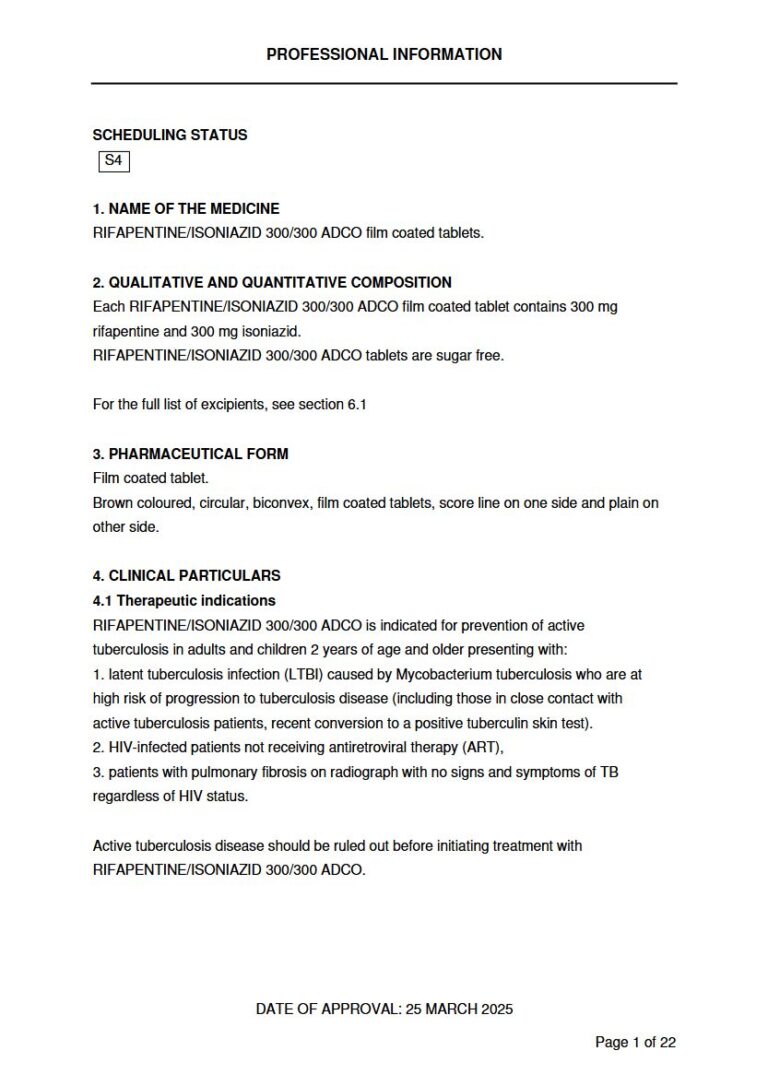
RIFAPENTINE/ISONIAZID 300/300 ADCO is indicated for prevention of active tuberculosis in adults and children 2 years of age and older presenting with:
- latent tuberculosis infection (LTBI) caused by Mycobacterium tuberculosis who are at high risk of progression to tuberculosis disease (including those in close contact with active tuberculosis patients, recent conversion to a positive tuberculin skin test).
- HIV-infected patients not receiving antiretroviral therapy (ART),
- patients with pulmonary fibrosis on radiograph with no signs and symptoms of TB regardless of HIV status.
Active tuberculosis disease should be ruled out before initiating treatment with RIFAPENTINE/ISONIAZID 300/300 ADCO.
4.2 Posology and method of administration
Posology: RIFAPENTINE/ISONIAZID 300/300 ADCO is to be administered once-weekly for 12 weeks as directly observed therapy (DOT).
Adults and children 12 years and older: The recommended dose of rifapentine should be determined based on weight of the patient up to a maximum of 900 mg once-weekly for 12 weeks (see Table 1). The recommended dose of isoniazid is 15 mg/kg (rounded to the nearest 50 mg or 100 mg) up to a to a maximum of 900 mg once-weekly for 12 weeks (see Table 1).
Children 2 to 11 years: The recommended dose of rifapentine should be determined based on weight of the patient up to a maximum of 900 mg once-weekly (see Table 1). The recommended dose of isoniazid is 25 mg/kg (rounded to the nearest 50 mg or 100 mg) up to a maximum of 900 mg once-weekly for 12 weeks.
Table 1: Weight-based dose of RIFAPENTINE/ISONIAZID 300/300 ADCO in the prophylactic treatment of latent tuberculosis infection in adults and children 2 years and older at high risk of progression to tuberculosis disease:
| Weight range | Rifapentine dose | Isoniazid dose | Number of RIFAPENTINE/ISONIAZID 300/300 ADCO tablets once a week for 12 weeks |
|---|---|---|---|
| 10 u2013 14 kg | 300 mg | 300 mg | 1 |
| 14.1 u2013 25 kg | 450 mg | 450 mg | 1 + half |
| 25.1 u2013 32 kg | 600 mg | 600 mg | 2 |
| 32.1 u2013 50 kg | 750 mg | 750 mg | 2 + half |
| > 50 kg | 900 mg | 900 mg | 3 |
Special populations
Elderly patients (65 years of age and older): No dose adjustment is required, but caution should be exercised due to the possible decrease in renal and hepatic function.
Hepatic impairment: No dose adjustment required. However, in the presence of hepatic insufficiency, the half-life of isoniazid may be prolonged, and therefore RIFAPENTINE/ISONIAZID 300/300 ADCO should be used with caution in patients with mild to moderate hepatic impairment (see sections 4.3 and 4.4).
Renal impairment: No dose adjustment required when given to patients with mild renal failure. However, RIFAPENTINE/ISONIAZID 300/300 ADCO is contraindicated in patients with severe renal failure (glomerular filtration rate of less than 10 mL/minute) (creatinine clearance <30 mL/min). (see sections 4.3 and 4.4).
Paediatric population: No data are available for patients below 2 years old.
Method of administration: For oral use. To ensure effective treatment, the strict adherence to the treatment regimen of RIFAPENTINE/ISONIAZID 300/300 ADCO and other medicines, as well as the importance of not missing any doses, should be stressed to the patient. RIFAPENTINE/ISONIAZID 300/300 ADCO should be given with food. For patients who cannot swallow tablets, the tablets may be crushed and added to a small amount of semi-solid food, all of which should be consumed immediately (see section 5.2). Interaction with antacids has not been studied. RIFAPENTINE/ISONIAZID 300/300 ADCO should therefore be taken/administered at least 1 hour before or 2 hours after taking antacids.
4.3 Contraindications
- hypersensitivity to rifapentine, other rifamycins (e.g. rifampicin, rifabutin), isoniazid, ethionamide, pyrazinamide, niacin, or other chemically-related medicines or to any of the ingredients of RIFAPENTINE/ISONIAZID 300/300 ADCO (see section 6.1)
- porphyria. Based on experience with rifampicin, it may be assumed that rifapentine can also induce delta-aminolevulinic acid synthetase and therefore cause an acute attack of porphyria
- in patients with acute or chronic liver disease including medicine-induced liver disease.
- Alcoholism
- in patients with severe renal failure
- in patients with uncontrolled seizures
- pregnancy and lactation
- HIV-infected patients on antiretroviral therapy because of potential interactions leading to loss of efficacy with protease inhibitors and non-nucleoside reverse transcriptase inhibitors (NNRTIs) (see section 4.5).
4.4 Special warnings and precautions for use
Hepatotoxicity: RIFAPENTINE/ISONIAZID 300/300 ADCO may cause serious hepatic disease/injury including severe and sometimes fatal hepatitis. Advanced age, female gender, slow acetylators, malnutrition, HIV infection, pre-existing liver disease, and extra-pulmonary tuberculosis were identified as risk factors for isoniazid-induced hepatotoxicity. Patients with abnormal liver tests and/or liver disease should only be prescribed RIFAPENTINE/ISONIAZID 300/300 ADCO if no safer alternative is available, and then with caution and under strict medical supervision (see section 4.3). All patients should have baseline liver function tests performed and careful monitoring of liver parameters (especially serum transaminases and bilirubin) carried out prior to therapy and then every 2 to 4 weeks during therapy. In the event of any indication of a liver reaction or of the hepatic condition worsening, RIFAPENTINE/ISONIAZID 300/300 ADCO should be discontinued.
Hypersensitivity and related reactions: Hypersensitivity reactions may occur in patients taking RIFAPENTINE/ISONIAZID 300/300 ADCO. Signs and symptoms of hypersensitivity may include hypotension, urticaria, angioedema, acute bronchospasm, conjunctivitis, thrombocytopenia, neutropenia or flu-like syndrome (weakness, fatigue, muscle pain, nausea, vomiting, headache, fever, chills, aches, rash, itching, sweats, dizziness, shortness of breath, chest pain, cough, syncope, palpitations) (see section 4.8). Patients taking RIFAPENTINE/ISONIAZID 300/300 ADCO should be monitored for signs and/or symptoms of hypersensitivity reactions. If these symptoms occur, administer supportive measures, and discontinue RIFAPENTINE/ISONIAZID 300/300 ADCO.
Stevens-Johnson syndrome (SJS) and Toxic Epidermal Necrolysis (TEN): Cases of severe cutaneous adverse reactions including Stevens-Johnson Syndrome (SJS) and Toxic Epidermal Necrolysis (TEN), some with fatal outcome, have been reported with the use of antituberculosis therapy, such as RIFAPENTINE/ISONIAZID 300/300 ADCO (see section 4.8). Patients should be advised of these signs and symptoms and closely monitored for skin reactions. The patient should be advised that if signs or symptoms of SJS or TEN (e.g. progressive skin rash often with blisters or mucosal lesions) develop, they should consult their doctor immediately. RIFAPENTINE/ISONIAZID 300/300 ADCO should be permanently discontinued at the first appearance of skin rash, mucosal lesions, or any other sign of hypersensitivity, and if an alternative etiology for these signs and symptoms cannot be established.
Drug Reaction with Eosinophilia and Systemic Symptoms (DRESS): Severe, systemic hypersensitivity reactions, including fatal cases, such as Drug Reaction with Eosinophilia and Systemic Symptoms (DRESS) syndrome have been observed during antituberculosis therapy such as RIFAPENTINE/ISONIAZID 300/300 ADCO (see section 4.8). It is important to note that early manifestations of hypersensitivity, such as fever, lymphadenopathy, or biological abnormalities (including eosinophilia, liver abnormalities) may be present even though rash is not evident. If such signs or symptoms are present, the patient should be advised to consult their doctor immediately.
RIFAPENTINE/ISONIAZID 300/300 ADCO should be permanently discontinued at the first appearance of skin rash, mucosal lesions, or any other sign of hypersensitivity, and if an alternative etiology for these signs and symptoms cannot be established.
Clostridium difficile-associated diarrhoea: Pseudomembranous colitis has been reported to occur with rifamycins such as RIFAPENTINE/ISONIAZID 300/300 ADCO. Diarrhoea, particularly if severe and/or persistent, occurring during treatment or in the initial weeks following treatment may be symptomatic of Clostridium difficile-associated disease, the most severe form of which is pseudomembranous colitis. If pseudomembranous colitis is suspected, RIFAPENTINE/ISONIAZID 300/300 ADCO should be stopped immediately, and the patient treated appropriately without delay. Medicines inhibiting the peristalsis are contraindicated in this clinical situation.
Concomitant medicine interactions: As RIFAPENTINE/ISONIAZID 300/300 ADCO is an inducer of CYP3A4 and CYP2C8/9, concomitant use with other medicines metabolised by these enzymes, (such as protease inhibitors, certain reverse transcriptase inhibitors, and hormonal contraception) may cause a significant decrease in plasma concentrations and loss of therapeutic effect of these medicines (see sections 4.5 and 5.2). RIFAPENTINE/ISONIAZID 300/300 ADCO has also been shown to inhibit and to induce P-gp which could modify plasma exposure of digoxin (a P-gp substrate with narrow therapeutic index). Appropriate monitoring and dose adjustment of digoxin may be necessary in case of co-administration with RIFAPENTINE/ISONIAZID 300/300 ADCO (see sections 4.5 and 5.2).
Discolouration of body fluids: Patients should be warned that RIFAPENTINE/ISONIAZID 300/300 ADCO may produce a predominantly red-orange discolouration of body tissues and/or fluids (e.g. skin, teeth, tongue, urine, faeces, saliva, sputum, tears, sweat and cerebrospinal fluid). Contact lenses or dentures may become permanently stained. In patients suffering from convulsive disorders and diabetes mellitus, and patients with a history of psychosis, RIFAPENTINE/ISONIAZID 300/300 ADCO should be prescribed with caution.
RIFAPENTINE/ISONIAZID 300/300 ADCO should be used with caution in patients with mild to moderate hepatic or renal impairment (see section 4.2) or patients taking other potentially hepatotoxic medicines. Should symptoms of hepatitis deteriorate in this patient group, RIFAPENTINE/ISONIAZID 300/300 ADCO should be discontinued immediately.
Pyridoxine: In order to prevent or minimise symptoms of peripheral neuritis in high-risk groups such as in patients who are diabetic, alcoholic, malnourished, uraemic, pregnant or infected with HIV (currently not on antiretroviral therapy), the administration of pyridoxine daily is recommended. Pyridoxine, in a dose of 10 mg daily, during treatment with RIFAPENTINE/ISONIAZID 300/300 ADCO, is recommended in patients who are at risk of neuropathy or pyridoxine deficiency, including those in the abovementioned high risk groups. Periodic eye examinations during treatment are recommended as isoniazid in combination with other anti-tuberculosis medicines, such as RIFAPENTINE/ISONIAZID 300/300 ADCO, causes optic neuritis which can lead to optic atrophy and blindness (see section 4.8).
4.5 Interaction with other medicines and other forms of interaction
Food Interaction: Isoniazid, as in RIFAPENTINE/ISONIAZID 300/300 ADCO, is an inhibitor of monoamine oxidase (MAO) and diamine oxidase (DAO), may therefore reduce tyramine and histamine metabolism, causing symptoms such as headache, sweating, palpitations, flushing, conjunctival irritation, tachycardia, tachypnoea and hypotension. Patients should be advised against ingesting foods rich in tyramine and/or histamine during treatment with RIFAPENTINE/ISONIAZID 300/300 ADCO, such as cured meat, some cheeses (e.g. matured cheeses), wine, beer and some fish (e.g. tuna, mackerel, salmon).
RIFAPENTINE Effect of rifapentine on other medicines: Cytochrome P450 substrates: In vitro, rifapentine and its metabolite (25-desacetyl-rifapentine) are potent inducers of CYP3A4. In vivo in humans, rifapentine has also been shown to be a potent CYP3A4 inducer: rifapentine daily (from 5 mg/kg) decreased midazolam exposure by 90 %; rifapentine 600 mg twice-weekly dosing reduced indinavir (protease inhibitor substrate of CYP3A4) exposure by 70 %. There are no clinical data evaluating the interaction between CYP3A substrate and rifapentine at the dosing regimen recommended for latent tuberculosis infection (LTBI) (900 mg weekly dosing). However, rifapentine is also predicted a potent inducer at this dosing regimen. In vitro, rifapentine is an inducer of CYP2C8 and CYP2C9 and its metabolite (25-desacetyl-rifapentine) is a potential inhibitor of CYP2C8. No clinical interaction study was performed to assess in vivo potential of rifapentine to interact with medicines metabolised by CYP2C8/C9, but the risk of interaction is likely. The in vivo net effect, resulting from induction and inhibition of CYP2C8, was not evaluated but a higher impact of induction can be predicted. In vitro studies showed that rifapentine and its metabolite (25-desacetyl-rifapentine) are inducers of CYP2B6 and that rifapentine is an inhibitor of CYP2B6. Interactions with CYP2B6 substrate was evaluated in one clinical study with efavirenz which is known as a very sensitive CYP2B6 substrate. After a single and repeated weekly administration of rifapentine 900 mg, no or minor modification (+ 15 %) of steady-state exposure of efavirenz was observed. In vitro, rifapentine and its metabolite are not inducers of CYP1A2. Based on in vitro data, it is predicted that rifapentine and its metabolite have no potential to inhibit CYP1A2, CYP2C9, CYP2C19, CYP2D6, CYP3A4 and CYP2E1, in vivo in humans. RIFAPENTINE/ISONIAZID 300/300 ADCO may increase the metabolism of other co-administered medicines that are metabolised by these enzymes. Appropriate monitoring and dosage adjustment may be necessary if medicines metabolised by CYP3A4 or CYP2C8/9 are co-administered with RIFAPENTINE/ISONIAZID 300/300 ADCO. Induction of enzyme activities by rifapentine occurred after the first dose of rifapentine. Enzyme activities returned to baseline levels, in general, 14 days after discontinuing rifapentine.
Examples of such medicines include:
- antiretroviral medicines:
- protease inhibitors: indinavir, darunavir, lopinavir, saquinavir, ritonavir
- non-nucleoside reverse transcriptase inhibitors: rilpivirine
- nucleoside reverse transcriptase inhibitor: zidovudine
- antifungals (itraconazole, ketoconazole, voriconazole)
- narcotic analgesics (methadone, alfentanil, buprenorphine)
- hypoglycaemic medicines (repaglinide)
- calcium channel blockers (felodipine, diltiazem, verapamil, nifedipine)
- alpha/beta adrenergic antagonists (alfuzosin, propranolol)
- ergot alkaloid derivatives (ergotamine)
- oral anti-vitamin K anticoagulant (warfarin)
- hormonal contraceptives (oral, transdermal and implant)
- immunosuppressants (ciclosporin, tacrolimus, sirolimus)
- benzodiazepines (midazolam).
Transporter substrates: In vitro, rifapentine has been shown to inhibit several transporters (P-gp, BCRP and OATP1B1/B3, OCT1). However, the risk of clinically significant interaction resulting from inhibition of BCRP and/or OATP1B1/B3, evaluated using a mechanistic static approach, was considered as minimal. Moreover, rifamycins are known to induce some of these transporters (such as P-gp, OATP1B1/OATP1B3) via activation of PXR and could balance the inhibition effect. For P-gp, interactions have been evaluated in humans with 2 substrates of P-gp, raltegravir and tenofovir, suggesting a limited effect. In vitro, rifapentine has been shown to inhibit and to induce P-gp which could modify plasma exposure of digoxin (P-gp substrate). Because of the narrow therapeutic index of digoxin, appropriate monitoring and dose adjustment of digoxin may be necessary in case of co-administration with RIFAPENTINE/ISONIAZID 300/300 ADCO.
Antiretroviral medicines:
- Protease inhibitors and certain reverse transcriptase inhibitors: Concomitant use of rifapentine, as contained in RIFAPENTINE/ISONIAZID 300/300 ADCO, with protease inhibitors and certain reverse transcriptase inhibitors, metabolised by CYP3A4 or CYP2C8/9, may cause a significant decrease in plasma concentrations and loss of therapeutic effect of these medicines.
- Fixed dose combination of efavirenz, emtricitabine and tenofovir: Once-weekly co-administration of 900 mg rifapentine as contained in RIFAPENTINE/ISONIAZID 300/300 ADCO with the antiretroviral fixed dose combination of 600 mg efavirenz, 200 mg emtricitabine and 300 mg tenofovir disoproxyl fumarate in HIV-infected patients did not result in any substantial change in steady state exposures of efavirenz, emtricitabine and tenofovir. No clinically significant change in CD4 cell counts or viral loads were noted. Co-administration of a fixed dose combination of efavirenz, emtricitabine and tenofovir with RIFAPENTINE/ISONIAZID 300/300 ADCO 900 mg once-weekly requires no dose adjustment.
- Raltegravir: Once-weekly co-administration of 900 mg rifapentine, as contained in RIFAPENTINE/ISONIAZID 300/300 ADCO, with raltegravir resulted in a 71 % mean increase in raltegravir AUC0-12, and an 89 % increase in Cmax. No need for dose adjustment of raltegravir, if co-administered with RIFAPENTINE/ISONIAZID 300/300 ADCO 900 mg once-weekly.
Hormonal contraceptives: Rifapentine may reduce the effectiveness of hormonal contraceptives. Women taking oral contraception, using a transdermal patch, or other systemic hormonal contraceptives who need RIFAPENTINE/ISONIAZID 300/300 ADCO therapy should discuss the use of an additional non-hormonal means of contraception or the change of their contraceptive pill with their medical practitioner.
Effect of other medicines on rifapentine: Rifapentine is metabolised by esterases and its main metabolite, 25-desacetyl-rifapentine, is not metabolised. There is a lack of risk of interaction with CYP450 inducer and as well as inhibitor medicines (such as triazole antifungal agents frequently co-administered in HIV-infected patients). Similarly, taking into account the high passive diffusion component in the hepatocyte uptake or the good intestinal permeability, potential interaction with transporters inhibitor/inducer medicines are not expected.
Since rifapentine, as contained in RIFAPENTINE/ISONIAZID 300/300 ADCO, is highly bound to albumin, medicine displacement interactions with non-steroidal anti-inflammatory drugs (NSAIDs), sulfonylureas and oral anticoagulants may also occur.
Interferences with laboratory and diagnostic tests: Therapeutic concentrations of rifampin have been shown to inhibit standard microbiological assays for serum folate and vitamin B 12. Similar interferences should be considered for rifapentine, as contained in RIFAPENTINE/ISONIAZID 300/300 ADCO. Therefore, alternative assay methods should be considered.
ISONIAZID Inhibition of CYP450: Isoniazid, as contained in RIFAPENTINE/ISONIAZID 300/300 ADCO, can inhibit the hepatic metabolism of a number of medicines, in some cases leading to increased toxicity. These include the antiepileptics carbamazepine, primidone, and phenytoin, the benzodiazepines diazepam and triazolam, and others such as warfarin and theophylline. Concomitant administration of benzodiazepines (such as diazepam/carbamazepine) and isoniazid, as contained in RIFAPENTINE/ISONIAZID 300/300 ADCO, has been reported to result in benzodiazepine toxicity (with symptoms such as sedation, respiratory depression, etc.). Other interactions: Administration of isoniazid, as contained in RIFAPENTINE/ISONIAZID 300/300 ADCO, may lead to a higher risk of hepatotoxicity. Increased central nervous system adverse effects have occurred when isoniazid is given with potentially neurotoxic medicines such as cycloserine or disulfiram. Hepatotoxic reactions have been reported when paracetamol is given concurrently with isoniazid, while chronic alcoholism increases the risk of isoniazid induced hepatitis. When isoniazid, as contained in RIFAPENTINE/ISONIAZID 300/300 ADCO, is given to patients receiving para-aminosalicyclic acid concurrently, the plasma concentrations of isoniazid may be increased, and adverse effects are more likely to occur. Prednisolone may increase hepatic metabolism and/or excretion of isoniazid (as contained in RIFAPENTINE/ISONIAZID 300/300 ADCO). Aluminium-containing antacids may delay and decrease absorption and serum concentration of isoniazid. It is therefore recommended that RIFAPENTINE/ISONIAZID 300/300 ADCO be administered at least 1 hour before taking antacids (see section 4.2).
4.6 Fertility, pregnancy and lactation
Women of child-bearing potential should be advised to avoid becoming pregnant while on treatment with RIFAPENTINE/ISONIAZID 300/300 ADCO.
Pregnancy: Isoniazid, as in RIFAPENTINE/ISONIAZID 300/300 ADCO, crosses the placenta. Women who are pregnant should not be treated with RIFAPENTINE/ISONIAZID 300/300 ADCO as safety in pregnancy and lactation has not been established and harm to the embryo/developing foetus cannot be excluded (see section 4.3). Human data: As rifapentine may have a similar effect to rifampicin (known to cause postnatal haemorrhages in the mother and infant when taken during the last few weeks of pregnancy), appropriate coagulation testing should be performed when pregnant women are inadvertently exposed to RIFAPENTINE/ISONIAZID 300/300 ADCO during late pregnancy. Treatment with vitamin K may be indicated.
Breastfeeding: It is not known whether rifapentine or isoniazid are excreted in human milk, therefore mothers on RIFAPENTINE/ISONIAZID 300/300 ADCO therapy should not breastfeed their babies. Rifapentine, as contained in RIFAPENTINE/ISONIAZID 300/300 ADCO, may produce a red-orange discolouration of body fluids, including breast milk.
Fertility: No data is available.
4.7 Effects on ability to drive and use machines
RIFAPENTINE/ISONIAZID 300/300 ADCO may influence the ability to drive and use machines. Adverse reactions such as convulsions have been reported in patients receiving isoniazid (as contained in RIFAPENTINE/ISONIAZID 300/300 ADCO). Patients should be advised not to drive or operate machines if they experience any side effects of RIFAPENTINE/ISONIAZID 300/300 ADCO which could adversely affect their ability to do so (see section 4.8).
4.8 Undesirable effects
Tabulated summary of adverse reactions
RIFAPENTINE
| System Organ Class | Frequency | Side effects |
|---|---|---|
| Infections and infestations | Less frequent | Influenza |
| Frequency unknown | Pneumonia | |
| Immune system disorders | Frequent | Hypersensitivity |
| Nervous system disorders | Less frequent | Headache |
| Gastrointestinal disorders | Less frequent | Nausea, upper abdominal pain |
| Frequency unknown | Pancreatitis, oesophageal irritation | |
| Hepatobiliary disorders | Less frequent | Hepatitis |
| Less frequent | Skin reaction |
Skin and subcutaneous tissue disorders
Frequency unknown
Severe cutaneous adverse reactions (SCARs)* such as Stevens-Johnson syndrome (SJS) and drug reaction with eosinophilia and systemic symptoms (DRESS) syndrome (see section 4.4)
Musculoskeletal, connective tissue and bone disorders
Less frequent
Myalgia
General disorders and administrative site conditions
Less frequent
Influenza-like illness, fatigue, chills, pyrexia, asthenia
ISONIAZID
System Organ Class
| Frequency | Side effects | |
|---|---|---|
| Blood and lymphatic system disorders | Less frequent | Haematological effects (various anaemias, agranulocytosis, thrombocytopenia and eosinophilia). |
| Immune system disorders | Less frequent | Hypersensitivity reactions (fever, skin rashes, joint pain) |
| Metabolism and nutrition disorders | Less frequent | Hyperglycaemia, metabolic acidosis |
| Psychiatric disorders | Less frequent | Neurotoxicity (psychotic reactions) |
| Reproductive system and breast disorders | Less frequent | Gynaecomastia |
Reporting suspected adverse reactions after authorisation of the medicine is important. It allows continued monitoring of the benefit/risk balance of the medicine. Healthcare professionals are asked to report any suspected adverse reactions to SAHPRA via Med Safety APP (Medsafety X SAHPRA) and eReporting platform (who-umc.org) found on SAHPRA website. You may also report to Adcock Ingram Limited using the following e-mail address: [email protected].
4.9 OVERDOSE
Signs and symptoms
RIFAPENTINE: An overdose may precipitate side effects and increase the severity thereof.
ISONIAZID: Symptoms of isoniazid overdose include slurred speech, metabolic acidosis, hyperglycaemia, hallucinations, respiratory and CNS depression, convulsions and coma.
Management of overdose:
RIFAPENTINE: Treatment should be symptomatic and supportive. Rifapentine and 25-desacetyl rifapentine are highly plasma protein bound and have limited urinary excretion. Therefore, neither haemodialysis nor forced diuresis is expected to enhance the systemic elimination.
ISONIAZID: Treatment for significant overdose consists of symptomatic and supportive therapy. This includes use of large doses of pyridoxine (1:1) to prevent and/or control convulsions, and sodium bicarbonate for metabolic acidosis.
