
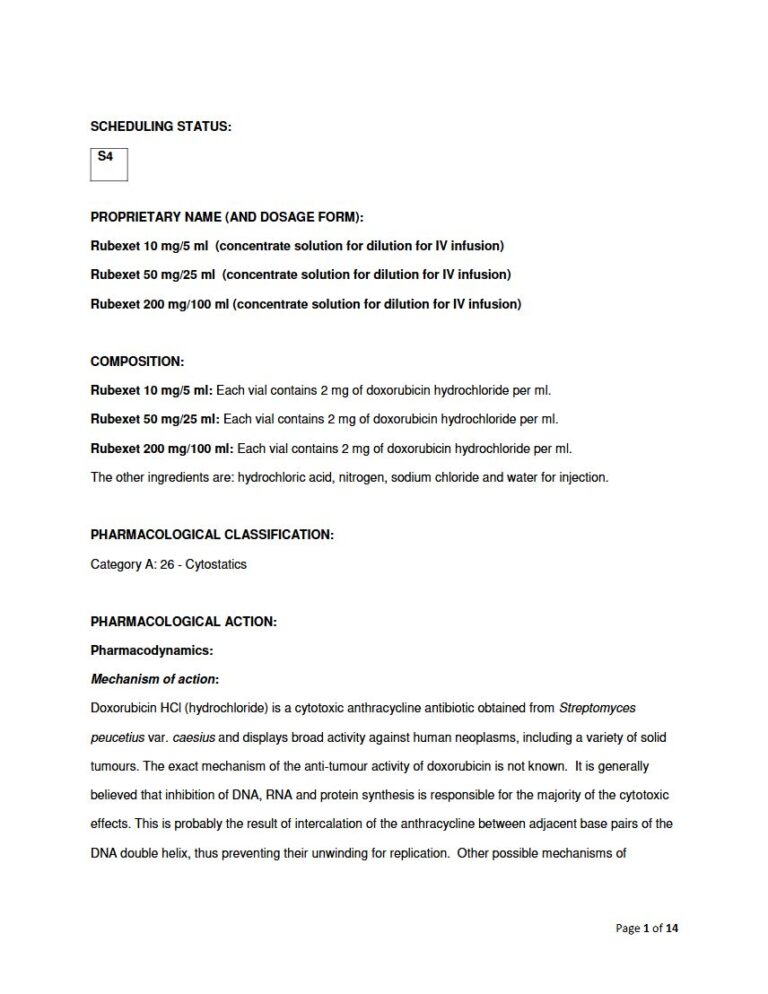
Rubexet 10mg / 5ml. 50mg / 25ml. 200mg / 100ml Infusion
PDF Leaflet Revision Date: 2 October 2014
Clinical Summary
Quick overview from the medicine insert
Indication
Treatment of various cancers including acute leukaemias and solid tumours.
Dosage (summary)
60-90 mg/mu00b2 every 3-4 weeks; adjust for hepatic impairment.
Special Populations
- Elderly
- Hepatic impairment
- Obese patients
Pregnancy & Breastfeeding
Contraindicated in pregnancy and lactation; crosses placenta and enters breast milk.
Key Drug Interactions
- Additive toxicity with other cytotoxic agents
- Cardiotoxic drugs
Contraindications
- Hypersensitivity to doxorubicin
- Persistent myelosuppression
- Hepatic impairment
- Myocardial insufficiency
Common side effects
- Nausea
- Vomiting
- Bone marrow depression
- Alopecia
Counselling Points
- Avoid pregnancy during treatment
- Use effective contraception
- Report signs of extravasation immediately
Serious warnings
- Severe cardiotoxicity risk
- Monitor cardiac function
- Risk of secondary leukaemia
Important Disclaimer
The Rubexet 10mg / 5ml. 50mg / 25ml. 200mg / 100ml Infusion professional information leaflet below is the property of Accord Healthcare and is provided on Medinsert exactly as issued, with no.. alterations or editorial changes. We make every effort to keep content current by updating documents as soon as new versions become available. Medinsert serves as a trusted access point for healthcare professionals, but does not replace official sources or clinical judgement. For more details, please read our full disclaimer. read more>>
 Healthcare Professionals Only
This content is for registered healthcare professionals
Sign in or create a free account to read the full package insert.
Free for HPCSA-registered professionals. Powered by Medinsert.
Clinical Particulars
Section 4 of the official insert — extracted exactly as issued, no alterations
4.1 Therapeutic indications
Rubexet is indicated in:
- Acute leukaemias (Acute Lymphoblastic Leukaemia u2013 ALL and Acute Myelogenous Leukaemia u2013 AML), lymphomas and a number of solid tumours
- Metastatic adenocarcinoma of the breast, carcinoma of the bladder, bronchogenic carcinoma and neuroblastoma.
- Metastatic thyroid carcinoma. Carcinoma of the endometrium, testes, prostate, cervix, head and neck and plasma-cell myeloma.
- It is active against carcinoma of the ovary when administered with cisplatin and cyclophosphamide.
- Concurrently with other cytotoxic medicines when administered for carcinoma of the breast and small (oat)-cell carcinoma of the lung.
- Wide range of sarcomas, including osteogenic, Ewingu2019s and soft-tissue sarcoma
- In the ABVD (doxorubicin / bleomycin / vinblastine / dacarbazine) combination it is effective in Hodgkinu2019s disease.
- Concurrently in the BACOP combination in non-Hodgkinu2019s lymphoma
4.2 Posology and method of administration
Rubexet should not be given orally and should not be injected intramuscularly or subcutaneously. It is administered by intravenous injection.
Intravenous administration: Intravenous administration of doxorubicin should be performed with caution. It is recommended that the diluted solution of doxorubicin be administered into the tubing of a freely flowing intravenous infusion (isotonic sodium chloride or 5 % glucose solution) over a period of 3 to 5 minutes. This technique is intended to minimize the risk of thrombosis or perivenous extravasation. Any unused portion must be discarded as this preparation is intended for single dose administration.
Treatment of solid tumours: When doxorubicin is administered as a single agent, the recommended dose per cycle is 60-90 mg/mu00b2 of body surface area every 3-4 weeks. Administration of doxorubicin in a weekly regimen of 10-20 mg/mu00b2 has also been shown to be effective. The medicine is generally given as a single dose per cycle; however, it is possible to give the medicine dosage per cycle in divided administrations:
- 0,6 mg/kg/day for 3 days (25 mg/mu00b2 for 3 days) OR
- 0,8 mg/kg/day for 2 days (30 mg/mu00b2 for 2 days) OR
- 1,6 mg/kg/day for 1 day (60 mg/mu00b2 for 1 day)
If doxorubicin is used in combination with other antitumour agents, the recommended dose per cycle is in the 30-60 mg/mu00b2 range, repeated every 21 days. As doxorubicin is a myelosuppressive agent, the interval between cycles may need to be increased, or the medicine dosage reduced. In patients whose WBC counts (particularly neutrophils) are below the range of normal values before any treatment cycle. Dosage may also need to be reduced in children. In the elderly, obese patients and in pre-treated patients in whom the marrow reserve may be low.
Hepatic dysfunction: In the presence of impaired hepatic function it is suggested that doxorubicin dosage be reduced as follows:
- Serum Bilirubin Dose reduction
- 1,2-3 mg/100 ml 50 % (i.e. 50 % of normal dose to be given
- > 3 mg/100 ml 75 % (i.e. 25 % of normal dose to be given
Doxorubicin should not be administered to patients with severe hepatic impairment (see CONTRA-INDICATIONS).
Treatment of acute leukaemias: In acute leukaemia the dosage schedule is based on the patientu2019s response. 0,4-0,5 mg/kg/day for 3 days is the recommended starting dose. According to the anti-leukaemia and myelosuppressive effect obtained, this course can be repeated a second or even a third time with an interval between courses of not less than 7-10 days.
4.3 Contraindications
Hypersensitivity to doxorubicin or any other component of the product, other anthracyclines or anthracenediones.
Intravenous (IV) use:
- Persistent myelosuppression
- Hepatic impairment
- Myocardial insufficiency
- Recent myocardial infarction
- Severe dysrhythmias
- Previous treatment with maximum cumulative doses of doxorubicin, daunorubicin, epirubicin, idarubicin, and/or other anthracyclines and anthracenediones (See WARNINGS).
Safety in pregnancy and lactation has not been established.
4.4 Special warnings and precautions for use
Rubexet should be administered only under the supervision of a doctor experienced in cancer chemotherapy. Patients should be advised not to conceive and the use of contraceptives are advised. Patients should recover from acute toxicities of prior cytotoxic treatment (such as stomatitis, neutropenia, thrombocytopenia and generalised infections) before beginning treatment with doxorubicin. Doxorubicin is incompatible with heparin and should also not be mixed with other medicines. Doxorubicin should be given with great care, in reduced doses, to elderly patients and those with hepatic impairment. The systemic clearance of doxorubicin is reduced in obese patients (i.e. > 130 % ideal body weight; (See DOSAGE AND DIRECTIONS FOR USE).
Cardiac function: Initial treatment calls for a careful baseline monitoring of various laboratory parameters and cardiac function. Severe cardiotoxicity is more likely in adults receiving total cumulative doses greater than 550 mg/mu00b2 body surface area of doxorubicin, and may occur up to 6 months after administration. Cardiotoxicity is a risk of anthracycline treatment that may be manifested by early (i.e. acute) or late (i.e. delayed) events.
Early events: This consists mainly of sinus tachycardia and/or ECG abnormalities such as non-specific ST-T wave changes. Tachydysrhythmias, including premature ventricular contractions and ventricular tachycardia, bradycardia, as well as atrioventricular and bundle-branch block have also been reported. These events do not usually predict subsequent development of delayed cardiotoxicity, are rarely of clinical importance, and are generally not a consideration for discontinuation of doxorubicin treatment.
Late Events: Delayed cardiotoxicity usually develops late in the course of therapy with doxorubicin or within 2 to 3 months after treatment termination, but later events, several months to years after completion of treatment, have also been reported. Delayed cardiomyopathy is manifested by reduced left ventricular ejection fraction (LVEF) and/or signs and symptoms of congestive heart failure (CHF) such as dyspnoea, pulmonary oedema, dependent oedema, cardiomegaly and hepatomegaly, oliguria, ascites, pleural effusion, and gallop rhythm. Subacute effects such as pericarditis/myocarditis have also been reported. Life-threatening CHF is the most severe form of anthracycline-induced cardiomyopathy and represents the cumulative dose-limiting toxicity of the medicine. Cardiac function should be assessed before patients undergo treatment with doxorubicin and must be monitored throughout therapy to minimise the risk of incurring severe cardiac impairment. The risk may be decreased through regular monitoring of LVEF during the course of treatment with prompt discontinuation of doxorubicin at the first sign of impaired function. The appropriate quantitative method for repeated assessment of cardiac function (evaluation of LVEF) includes multi-gated radionuclide angiography (MUGA) or echocardiography (ECHO). A baseline cardiac evaluation with an ECG and either a MUGA scan or an ECHO is recommended, especially in patients with risk factors for increased cardiotoxicity. Repeated MUGA or ECHO determinations of LVEF should be performed, particularly with higher, cumulative anthracycline doses.
Haematologic Toxicity: Blood counts and measurement of haemoglobin concentration should be carried out routinely. Rubexet may produce myelosuppression. Haematologic profiles should be assessed before and during each cycle of therapy with doxorubicin, including differential white blood cell (WBC) counts. A dose-dependent, reversible leukopenia and/or granulocytopenia (neutropenia) is the predominant manifestation of doxorubicin haematologic toxicity and is the most common acute dose-limiting toxicity of this medicine. Leukopenia and neutropenia generally reach the nadir between days 10 and 14 after medicine administration; the WBC/neutrophil counts return to normal values in most cases by day 21. Thrombocytopenia and anaemia may also occur. Clinical consequences of severe myelosuppression include fever, infections, sepsis/septicaemia, septic shock, haemorrhage, tissue hypoxia, or death.
Secondary leukaemia: The occurrence of secondary acute myeloid leukaemia with or without a pre-leukaemic phase has been reported in patients concurrently treated with Rubexet in association with DNA-damaging antineoplastic agents. Such cases have a short (1-3 year) latency period.
4.5 Interactions with other medicines
Doxorubicin is mainly used in combination with other cytotoxic medicine. Additive toxicity may occur especially with regard to bone marrow/haematologic and gastro-intestinal effects (see WARNINGS). The use of doxorubicin in combination chemotherapy with other potentially cardiotoxic medicine, as well as the concomitant use of other cardioactive compounds (e.g. calcium channel blockers), requires monitoring of cardiac function throughout treatment. Changes in hepatic function induced by concomitant therapies may affect doxorubicin metabolism, pharmacokinetics, therapeutic efficacy and/or toxicity.
4.6 Fertility, pregnancy and lactation
Rubexet is contra-indicated in:
- Pregnancy and lactation (see CONTRA-INDICATIONS).
- Rubexet crosses the placenta and is distributed into breast milk.
4.7 Effects on ability to drive and use machines
Due to the frequent occurrence of nausea and vomiting, driving and operation of machinery should be discouraged while on treatment.
4.8 Undesirable effects
Blood and lymphatic system disorders: Frequent: Bone marrow depression, Less frequent: Anaemia, thrombocytopenia, bleeding, immunosuppressant effect.
Immune system disorders: Less frequent: Hypersensitivity reactions.
Nervous system disorders: Less frequent: Headache.
Eye disorders: Less frequent: conjunctivitis, lachrymation.
Cardiac disorders: Less frequent: dysrhythmias, congestive heart failure.
Vascular disorders: Less frequent: Hypotension.
Respiratory, thoracic and mediastinal disorders: Frequency unknown: Bronchospasm, radiation pneumonitis.
Gastrointestinal disorders: Frequent: Nausea, vomiting, stomatitis. Less frequent: Diarrhoea, oesophagitis, abdominal pain, intestinal ulceration and perforation, buccal ulceration.
Hepato-biliary disorders: Frequency unknown: Hepatotoxicity, transient increase of liver enzymes.
Skin and subcutaneous tissue disorders: Frequent: Alopecia, facial flushing.
Renal and urinary disorders: Less frequent: Urine discolouration, hyperuricaemia, acute renal failure, nephrotoxicity, hyperphosphataemia.
Reproductive system and breast disorders: Less frequent: Amenorrhoea, inhibition of spermatogenesis, gynaecomastia.
General disorders and administrative site conditions: Less frequent: Fever, malaise, weakness. Frequency unknown: Thrombophlebitis, streaking of the skin, extravasation.
Investigations: Frequency unknown: ECG abnormalities.
4.9 Overdose
Acute overdosage may cause gastrointestinal symptoms, buccal ulceration and bone marrow depression. Should these symptoms occur therapy should be stopped. A cumulative dosage above 500 mg/mu00b2 may cause irreversible cardiac failure. Treatment is supportive and symptomatic.
