
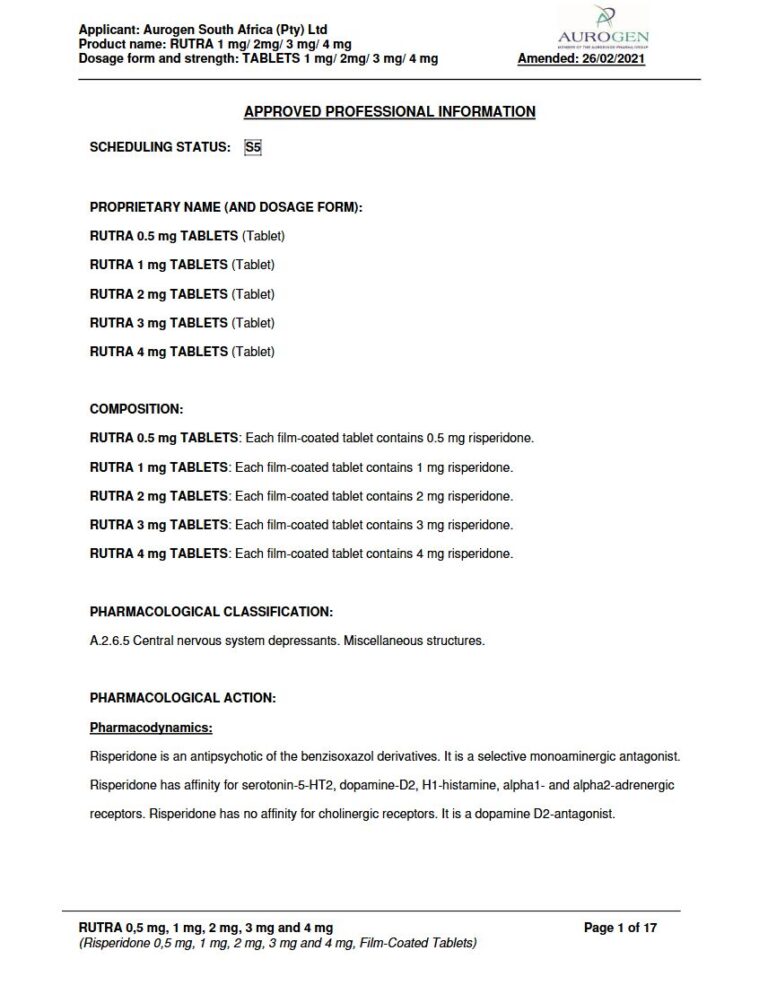
Rutra 1 Mg/2 Mg/3 Mg/4 Mg Tablets
PDF Leaflet Revision Date: 26 February 2021
Clinical Summary
Quick overview from the medicine insert
Indication
Treatment of acute and chronic schizophrenia, behavioral disturbances in dementia, and conduct disorders in children.
Dosage (summary)
Adults: Start at 2 mg/day, may increase to 4-8 mg/day. Elderly: Start at 0.5 mg twice daily.
Onset of Action / Duration
Onset: 1-2 hours, Duration: 24 hours (active metabolite).
Special Populations
- Elderly
- Renal impairment
- Hepatic impairment
Pregnancy & Breastfeeding
Safety not established; may cause extrapyramidal symptoms in neonates. Avoid breastfeeding.
Key Drug Interactions
- Carbamazepine decreases plasma levels
- Fluoxetine increases plasma levels
Contraindications
- Known sensitivity to components
- Children under 5 years
- Lewy body dementia
Common side effects
- Weight gain
- Headache
- Fatigue
- Extrapyramidal symptoms
- Dizziness
Counselling Points
- Monitor for hyperglycemia
- Avoid driving until effects are known
- Caution with alcohol and CNS depressants
Serious warnings
- Tardive dyskinesia
- Neuroleptic Malignant Syndrome
- Higher mortality in elderly with dementia
Important Disclaimer
The Rutra 1 Mg/2 Mg/3 Mg/4 Mg Tablets professional information leaflet below is the property of Aurogen South Africa and is provided on Medinsert exactly as issued, with no.. alterations or editorial changes. We make every effort to keep content current by updating documents as soon as new versions become available. Medinsert serves as a trusted access point for healthcare professionals, but does not replace official sources or clinical judgement. For more details, please read our full disclaimer. read more>>
 Healthcare Professionals Only
This content is for registered healthcare professionals
Sign in or create a free account to read the full package insert.
Free for HPCSA-registered professionals. Powered by Medinsert.
Clinical Particulars
Section 4 of the official insert — extracted exactly as issued, no alterations
4.1 Therapeutic indications
RUTRA TABLETS is indicated for the treatment of:
- Acute and chronic schizophrenic psychoses and related psychosis in which positive symptoms and/or the negative symptoms are prominent. RUTRA TABLETS also alleviates affective symptoms associated with schizophrenia. In patients who have shown an initial treatment response, RUTRA TABLETS is also effective in maintaining the clinical improvement.
- Behavioural disturbances in patients with dementia in whom symptoms such as aggressiveness, activity disturbances or psychotic symptoms are prominent.
- Conduct and other disruptive behaviour disorders in children (aged 5 - 12 years), with sub-average intellectual functioning or mental retardation in whom destructive behaviours are prominent.
4.2 Posology and method of administration
Schizophrenia:
Switching from other antipsychotics to RUTRA TABLETS: When medically appropriate, gradual discontinuation of the previous treatment, while RUTRA TABLETS therapy is initiated, is recommended. Also if medically appropriate, when switching patients from depot antipsychotics, initiate RUTRA TABLETS therapy in place of the next scheduled injection. The need for continuing existing anti-Parkinson medications should be re-evaluated periodically.
Adults: RUTRA TABLETS may be given once or twice daily. Patients should start with RUTRA TABLETS 2 mg/day. The dosage may be increased on the second day to 4 mg/day. From then on, the dosage can be maintained unchanged, or further individualized, if needed. Most patients will benefit from daily doses of between 4 mg/day and 8 mg/day. Doses above 6 mg/day (when administered twice daily) were associated with more extrapyramidal symptoms and other adverse effects and are not generally recommended. In some patients, particularly with first episode acute psychosis, a slower titration phase and a lower starting and maintenance dose may be appropriate. Doses above 10 mg/day have not been shown to be superior in efficacy to lower doses and may cause an increased incidence of side-effects such as extrapyramidal symptoms. Dosages above 10 mg/day should only be considered if the benefits outweigh the risk. The maximum total daily dose is 16 mg/day.
Elderly patients: A starting dose of 0.5 mg twice daily is recommended. This dosage can be individually adjusted with 0.5 mg twice daily increments to 1 - 2 mg twice daily.
Children: Not for children under 15 years as efficacy and safety in children under the age of 15 years have not been demonstrated in schizophrenia.
Behavioural disturbances in adult patients with dementia: A starting dose of 0.25 mg twice daily is recommended. This dosage can be individually adjusted by increments of 0.25 mg twice daily, not more frequently than every other day, if needed. The optimum dose is 0.5 mg twice daily for most patients. Some patients, however, may benefit from doses up to 1 mg twice daily. Once patients have reached their target dose, a once-daily dosing regimen can be considered. The continued use of RUTRA TABLETS must be evaluated and justified on an ongoing basis.
Conduct and other disruptive behaviour disorders in children 5-12 years of age: Subjects < 50 kg A starting dose of 0.01 mg/kg once daily is recommended. This dosage can be individually adjusted by increments of 0.01 mg/kg once daily not more frequently than every other day, if needed. The recommended maintenance dose is 0.02 u2013 0.04 mg/kg once daily. The mean dose is 0.03 mg/kg once daily. The continued use of RUTRA TABLETS must be evaluated and justified on an ongoing basis. Experience is lacking in children aged less than 5 years (see CONTRA-INDICATIONS).
Renal- and liver impairment: Caution should be exercised with these groups of patients, as clinical experience is lacking in these patient populations. It is recommended to halve both the starting dose and the subsequent dose increments.
4.3 Contraindications
RUTRA TABLETS is contra-indicated in patients with known sensitivity to any of the components of the medicine. Conduct and other disruptive behaviour disorders in children: RUTRA TABLETS is contra-indicated in children under 5 years of age as efficacy and safety in these children have not been demonstrated. Lewy antibody dementia (see WARNINGS).
4.4 Special warnings and precautions for use
Tardive dyskinesia: Tardive dyskinesia (TD), a syndrome consisting of potentially irreversible, involuntary dyskinetic movements may develop in patients treated with RUTRA TABLETS. Although this syndrome of TD appears to be most prevalent in the elderly, especially elderly females, it is impossible to predict at the onset of treatment which patients are likely to develop TD (see Special Precautions).
Neuroleptic Malignant Syndrome: Neuroleptic Malignant Syndrome (NMS) is a potentially fatal symptom complex that has been reported in association with the use of RUTRA TABLETS. Clinical manifestations of NMS are hyperthermia, muscle rigidity, altered mental status (including catatonic signs) and evidence of autonomic instability (irregular pulse or blood pressure, tachycardia, cardiac arrhythmias and diaphoresis). Additional signs may include elevated creatine phosphokinase (CPK) levels, myoglobinuria (rhabdomyolysis), and acute renal failure (see Special Precautions).
Concomitant use with furosemide: In RUTRA TABLETS placebo controlled trials in elderly patients with dementia, there was a higher mortality in patients treated with furosemide and RUTRA TABLETS when compared to patients treated with RUTRA TABLETS alone. Caution is advised in these patients. Dehydration was an overall risk for mortality and should be carefully avoided in these patients.
Hyperglycaemia and diabetes mellitus: Hyperglycaemia, in some cases extreme and associated with ketoacidosis and hyperosmolar coma or death, has been reported in patients treated with RUTRA TABLETS. Patients with an established diagnosis of diabetes mellitus who are started on RUTRA TABLETS should be monitored regularly for worsening of glucose control. Patients with risk factors for diabetes mellitus (e.g. obesity, family history of diabetes) who are starting treatment with RUTRA TABLETS should be monitored for symptoms of hyperglycaemia including polydipsia, polyuria, polyphagia and weakness. Patients who develop symptoms of hyperglycaemia during treatment with RUTRA TABLETS should undergo fasting blood glucose testing. In some cases, hyperglycaemia has resolved when RUTRA TABLETS was discontinued. However, some patients required continuation of anti-diabetic treatment despite discontinuation of RUTRA TABLETS.
Cerebrovascular Adverse Events: Cerebrovascular adverse events (CAE), including cerebrovascular accidents and transient ischaemic attacks, have been reported during treatment with RUTRA TABLETS. In placebo-controlled clinical trials in elderly patients with dementia, there was a higher incidence of cerebrovascular adverse events, including cerebrovascular accidents and transient ischaemic attacks, in patients treated with RUTRA TABLETS compared to patients receiving placebo (mean age 85 years; range 73 - 97 years).
Dementia associated with Parkinsonu2019s disease and senile dementia: Doctors should weigh the risks versus the benefits when prescribing RUTRA TABLETS to patients with Parkinsonu2019s disease or Dementia with Lewy bodies (DLB) since both groups may be at risk of Neuroleptic Malignant Syndrome (NMS) as well as having an increased sensitivity to antipsychotic medications such as RUTRA TABLETS. Manifestations of this increased sensitivity can include confusion, obtundation, and postural instability with frequent falls, in addition to extrapyramidal symptoms. In addition, in clinical trials, elderly RUTRA TABLETS treated patients had a higher mortality than placebo treated elderly patients. The risk of using RUTRA TABLETS in combination with other medicines has not been systematically evaluated. Given the primary CNS depressive effects of RUTRA TABLETS, it should be used with caution in combination with alcohol and other centrally acting medicines. RUTRA TABLETS may antagonise the effect of levodopa and other dopamine agonists.
Alpha-blocking activity: Due to the alpha-blocking activity of RUTRA TABLETS, (orthostatic) hypotension can occur, especially during the initial dose-titration period. RUTRA TABLETS should be used with caution in patients with known cardiovascular disease, and the dosage should be gradually titrated, as recommended. A dose reduction should be considered if hypotension occurs.
Other: Seizures have been reported after treatment with RUTRA TABLETS. Caution is recommended when treating patients with epilepsy.
4.5 Interactions with other medicines
Carbamazepine has been shown to decrease the plasma levels of the active antipsychotic fraction of risperidone by about 50%. Similar effects may be observed with other hepatic enzyme inducers. On discontinuation of carbamazepine or other hepatic enzyme inducers the dosage of risperidone should be re-evaluated and, if necessary, decreased. Valproate: valproate Tmax increased from 1.3 hours to 2.0 hours.
Topiramate: modest decrease in risperidone bioavailability, but not that of the active antipsychotic fraction. Therefore, this interaction is unlikely to be of clinical significance.
Phenothiazines, tricyclic antidepressants and some beta-blockers may increase the plasma concentration of risperidone but not that of the antipsychotic fraction. Fluoxetine and paroxetine increased the plasma concentration of risperidone but less so of the antipsychotic fraction. Fluoxetine kinetics was not changed in combination with RUTRA TABLETS. When concomitant fluoxetine or paroxetine is initiated or discontinued, the dosing of RUTRA TABLETS should be re-evaluated.
Amitriptyline: non-significant interactions.
Venlafaxine: Risperidone AUC increased and risperidone clearance decreased, but there was no effect on 9-OH-risperidone and the active moiety.
Quetiapine: no significant interaction.
Clozapine: no significant interaction.
Lithium: Cmax and AUC of lithium were non-significant increased, but Tmax of lithium was increased from 2.4 hours to 3.0 h.
Erythromycin: non-significant increase in risperidone exposure. There were non-significant effects on risperidone kinetics or that of the active fraction in combination with donepezil or galantamine. Cimetidine and ranitidine increased the bioavailability of risperidone, but only marginally that of the active antipsychotic fraction. When RUTRA TABLETS is taken together with other highly protein-bound medicines (e.g. diazepam, warfarin, digoxin, imipramine and propranolol), there is no clinically relevant displacement of either agent from the plasma proteins. See Special Precautions and WARNINGS for use regarding increased mortality in elderly patients with dementia concomitantly receiving furosemide.
4.6 Fertility, pregnancy and lactation
The safety of RUTRA TABLETS in pregnancy and lactating women has not been established. Reversible extrapyramidal symptoms, including hypertonia, hypotonia, jitteriness, tremor, muscle rigidity, twitching and convulsions, feeding disorder and withdrawal symptoms have been observed in neonates following post marketing use of RUTRA TABLETS during the last trimester of pregnancy. Risperidone and 9-hydroxy-risperidone are excreted in human breast milk. Therefore, women receiving RUTRA TABLETS should not breast feed (see CONTRA-INDICATIONS).
4.7 Effects on ability to drive and use machines
RUTRA TABLETS may impair mental alertness. Patients should therefore be advised not to drive or operate machinery until their individual susceptibility is known. It is recommended to halve both the starting dose and the subsequent dose increments in geriatric patients and patients with renal or liver insufficiency. Caution should be used when prescribing RUTRA TABLETS to patients with Parkinson disease since, theoretically, it might cause a deterioration of the disease. Patients may be advised to refrain from excessive eating in view of the possibility of weight gain. Hyperglycaemia and exacerbation of pre-existing diabetes mellitus have been reported on RUTRA TABLETS treatment (see WARNINGS).
4.8 Undesirable effects
The adverse events considered at least possibly related to the treatment are listed below by body system, organ class and frequency (wherever applicable).
General disorders: Frequent: Weight gain, headache, fatigue. The following side-effects have been reported and frequencies are unknown: Angioedema and other allergic reactions.
Blood and the lymphatic system disorders: The following side-effects have been reported and frequencies are unknown: A decrease in neutrophil and/or thrombocyte count has been reported.
Respiratory system disorders: Frequent: Rhinitis.
Endocrine disorders: Less frequent: Body temperature disregulation. The following side-effects have been reported and frequencies are unknown: Water intoxication, either due to polydipsia or the syndrome of inappropriate secretion of the antidiuretic hormone (SIADH). Increased plasma prolactin levels and associated manifestations (see Reproductive system and Special Precautions).
Psychiatric disorders: Frequent: Insomnia, agitation, anxiety, somnolence, impaired concentration. In some instances it has been difficult to differentiate adverse events from symptoms of the underlying psychosis.
Central and peripheral nervous system disorders: Frequent: Extrapyramidal disorder, dizziness. Dose dependent extrapyramidal symptoms, including tremor, rigidity, bradykinesia, oculogyric crisis, akathisia and acute dystonia, hypokinesia. These may be reversible upon dose reduction and/or administration of anti-Parkinson medication, if necessary. Less frequent: Dose dependent extrapyramidal symptoms, including hypersalivation and hyperkinesia. These may be reversible upon dose reduction and/or administration of anti-Parkinson medication, if necessary. Tardive dyskinesia (see Special Precautions). Neuroleptic Malignant Syndrome (see Special Precautions). Cerebrovascular accidents have been observed during treatment with RUTRA TABLETS. The following side-effects have been reported and frequencies are unknown: Sedation.
Eye disorders: Frequent: Blurred vision.
Vascular disorders: Less frequent: (Orthostatic) hypotension, (reflex) tachycardia. The following side-effects have been reported and frequencies are unknown: Hypertension.
Gastro-intestinal disorders: Frequent: Constipation, dyspepsia, nausea. Less frequent: Abdominal pain, vomiting.
Skin and subcutaneous tissue disorders: Frequent: Skin rash.
Urinary system disorders: The following side-effects have been reported and frequencies are unknown: Urinary incontinence.
Reproductive system disorders: Less frequent: Priapism. Galactorrhoea, amenorrhoea (see Special Precautions). The following side-effects have been reported and frequencies are unknown: Erectile dysfunction, ejaculatory dysfunction, orgasmic dysfunction. Gynaecomastia, disturbances in the menstrual cycle (see Special Precautions).
4.9 Overdose
Reported signs and symptoms have been those resulting from an exaggeration of the medicineu2019s known pharmacological effects. Symptoms of acute overdosage include drowsiness, sedation, hypotension, tachycardia and extrapyramidal symptoms. In overdose, cases of QT-prolongation have been reported.
In the case of acute overdosage, the possibility of multiple medicine ingestion should be considered. Treatment: Establish and maintain a clear airway and ensure adequate oxygenation and ventilation. Gastric lavage (after intubation, if the patient is unconscious) and administration of activated charcoal together with a laxative should be considered. Cardiovascular monitoring should commence immediately and should include continuous electrocardiographic monitoring to detect possible arrhythmias. Since there is no known antidote if accidental poisoning or overdosage is suspected, appropriate supportive measures should be instituted. Hypotension and circulatory collapse should be treated with appropriate measures such as intravenous fluids and/or sympathomimetic agents. In case of severe extrapyramidal symptoms, anticholinergic medication should be administered. Close medical supervision and monitoring should continue until the patient recovers.
