
Sevcad 100 Mg/150 Mg Soft Gel Capsules
PDF Leaflet Revision Date: 27 January 2026
Clinical Summary
Quick overview from the medicine insert
Indication
Treatment of Idiopathic Pulmonary Fibrosis and other chronic fibrosing ILDs.
Dosage (summary)
150 mg every 12 hours; 100 mg if 150 mg is not tolerated.
Special Populations
- Elderly patients
- Renal impairment
- Hepatic impairment
Pregnancy & Breastfeeding
Not recommended during pregnancy; use effective contraception. Breastfeeding should be discontinued.
Key Drug Interactions
- P-glycoprotein inhibitors
- P-glycoprotein inducers
Contraindications
- Hypersensitivity to nintedanib or soya
- Pregnancy
Common side effects
- Diarrhoea
- Nausea
- Vomiting
- Increased hepatic enzymes
Counselling Points
- Take with food
- Monitor for gastrointestinal symptoms
- Avoid pregnancy during treatment
Serious warnings
- Risk of gastrointestinal perforation
- Increased risk of bleeding
- Liver injury
Important Disclaimer
The Sevcad 100 Mg/150 Mg Soft Gel Capsules professional information leaflet below is the property of Ingelheim Pharmaceuticals and is provided on Medinsert exactly as issued, with no.. alterations or editorial changes. We make every effort to keep content current by updating documents as soon as new versions become available. Medinsert serves as a trusted access point for healthcare professionals, but does not replace official sources or clinical judgement. For more details, please read our full disclaimer. read more>>
 Healthcare Professionals Only
This content is for registered healthcare professionals
Sign in or create a free account to read the full package insert.
Free for HPCSA-registered professionals. Powered by Medinsert.
Clinical Particulars
Section 4 of the official insert — extracted exactly as issued, no alterations
4.1 THERAPEUTIC INDICATIONS
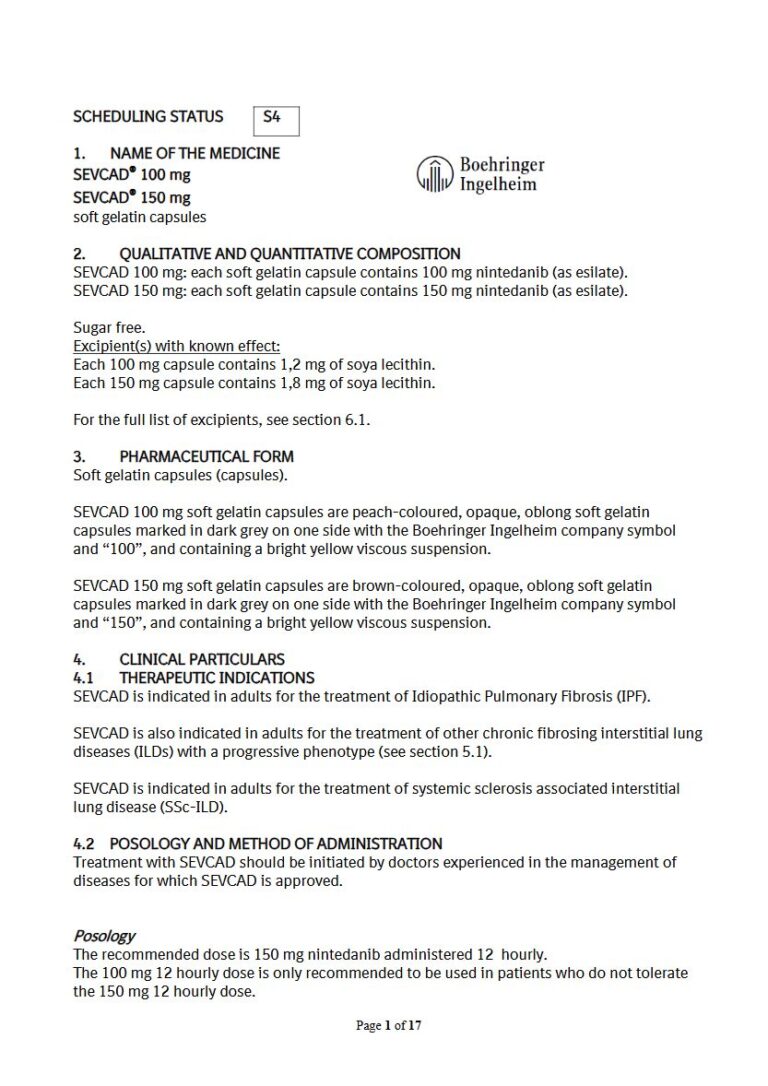
SEVCAD is indicated in adults for the treatment of Idiopathic Pulmonary Fibrosis (IPF). SEVCAD is also indicated in adults for the treatment of other chronic fibrosing interstitial lung diseases (ILDs) with a progressive phenotype (see section 5.1). SEVCAD is indicated in adults for the treatment of systemic sclerosis associated interstitial lung disease (SSc-ILD).
4.2 POSOLOGY AND METHOD OF ADMINISTRATION
Treatment with SEVCAD should be initiated by doctors experienced in the management of diseases for which SEVCAD is approved.
Posology
The recommended dose is 150 mg nintedanib administered 12 hourly. The 100 mg 12 hourly dose is only recommended to be used in patients who do not tolerate the 150 mg 12 hourly dose.
If a dose is missed, administration should resume at the next scheduled time at the recommended dose. If a dose is missed the patient should not take an additional dose. The recommended maximum daily dose of 300 mg should not be exceeded.
Dose adjustments
In addition to symptomatic treatment if applicable, the management of adverse reactions to SEVCAD (see sections 4.4 and 4.8) could include dose reduction and temporary interruption until the specific adverse reaction has resolved to levels that allow continuation of therapy. SEVCAD treatment may be resumed at the full dose (150 mg 12 hourly) or a reduced dose (100 mg 12 hourly). If a patient does not tolerate 100 mg 12 hourly, treatment with SEVCAD should be discontinued.
If diarrhoea, nausea and/or vomiting persist despite appropriate supportive care (including anti-emetic therapy), dose reduction or treatment interruption may be required. The treatment may be resumed at a reduced dose (100 mg 12 hourly) or at the full dose (150 mg 12 hourly). In case of persisting severe diarrhoea, nausea and/or vomiting despite symptomatic treatment, therapy with SEVCAD should be discontinued (see section 4.4).
In case of interruptions due to aspartate aminotransferase (AST) or alanine aminotransferase (ALT) elevations > 3x upper limit of normal (ULN), once transaminases have returned to baseline values, treatment with SEVCAD may be reintroduced at a reduced dose (100 mg 12 hourly) which subsequently may be increased to the full dose (150 mg 12 hourly) (see sections 4.4 and 4.8).
Special populations
Elderly patients (u2265 65 years)
No overall differences in safety and efficacy were observed for elderly patients. No a-priori dose adjustment is required on the basis of a patientu2019s age. Patients u2265 75 years may be more likely to require dose reduction to manage adverse effects (see section 5.2).
Renal impairment
Less than 1 % of a single dose of nintedanib is excreted via the kidney (see section 5.2). Adjustment of the starting dose in patients with mild to moderate renal impairment is not required. The safety, efficacy, and pharmacokinetics of nintedanib have not been studied in patients with severe renal impairment (<30 mL/min creatinine clearance).
Hepatic impairment
Nintedanib is predominantly eliminated via biliary/faecal excretion (> 90 %). Exposure increased in patients with hepatic impairment (Child Pugh A, Child Pugh B; see section 5.2). In patients with mild hepatic impairment (Child Pugh A), the recommended dose of SEVCAD is 100 mg 12 hourly. In patients with mild hepatic impairment (Child Pugh A), treatment interruption or discontinuation for management of adverse reactions should be considered. The safety and efficacy of nintedanib have not been investigated in patients with hepatic impairment classified as Child Pugh B and C. Treatment of patients with moderate (Child Pugh B) and severe (Child Pugh C) hepatic impairment with SEVCAD is not recommended (see section 5.2).
Paediatric population
The safety and efficacy of SEVCAD in children aged 0 - 18 years have not been established. No data are available.
Method of administration
SEVCAD is for oral use. The capsules should be taken with food, swallowed whole with water, and should not be chewed. The capsule should not be opened or crushed (see section 6.6).
4.3 CONTRAINDICATIONS
Hypersensitivity to nintedanib, to peanuts or soya, or to any of the excipients listed in section 6.1.
Pregnancy (see section 4.6).
4.4 SPECIAL WARNINGS AND PRECAUTIONS FOR USE
Gastrointestinal disorders
Diarrhoea
In the clinical trials, diarrhoea was the most frequent gastro-intestinal adverse reaction reported (see section 4.8). In most patients the adverse reaction was of mild to moderate intensity and occurred within the first 3 months of treatment. Diarrhoea led to dose reduction in 10,7 % of the patients and to discontinuation of nintedanib in 4,4 % of the patients in clinical trials.
Serious cases of diarrhoea leading to dehydration and electrolyte disturbances have been reported in the post-marketing period. Patients should be treated at first signs with adequate hydration and anti-diarrhoeal medicines, e.g. loperamide. Treatment interruption should be considered if diarrhoea and dehydration do not improve. SEVCAD treatment may be resumed at a reduced dose (100 mg 12 hourly) or at the full dose (150 mg 12 hourly). In case of persisting severe diarrhoea despite symptomatic treatment, therapy with SEVCAD should be discontinued.
Nausea and vomiting
Nausea and vomiting were frequently reported gastrointestinal adverse reactions (see section 4.8). In most patients with nausea and vomiting, the event was of mild to moderate intensity. In clinical trials nausea led to discontinuation of SEVCAD in up to 2,1 % of patients and vomiting led to discontinuation in up to 1,4 % of the patients.
If symptoms persist despite appropriate supportive care (including anti-emetic therapy), dose reduction or treatment interruption may be required. The treatment may be resumed at a reduced dose (100 mg 12 hourly) or at the full dose (150 mg 12 hourly). In case of persisting severe symptoms therapy with SEVCAD should be discontinued.
Hepatic function
The safety and efficacy of SEVCAD has not been studied in patients with moderate (Child Pugh B) or severe (Child Pugh C) hepatic impairment. Therefore, treatment with SEVCAD is not recommended in such patients (see section 4.2). Based on increased exposure, the risk for adverse events may be increased in patients with mild hepatic impairment (Child Pugh A). Patients with mild hepatic impairment (Child Pugh A) should be treated with a reduced dose of SEVCAD (see sections 4.2 and 5.2).
Cases of drug-induced liver injury have been observed with SEVCAD treatment, including severe liver injury with fatal outcome. The majority of hepatic events occur within the first three months of treatment. Therefore, hepatic transaminase and bilirubin levels should be investigated before treatment initiation and during the first month of treatment with SEVCAD. Patients should then be monitored at regular intervals during the subsequent two months of treatment and periodically thereafter, e.g. at each patient visit or as clinically indicated.
Elevations of liver enzymes (ALT, AST, ALP, gamma-glutamyl-transferase (GGT), see section 4.8) and bilirubin were reversible upon dose reduction or interruption in the majority of cases. If transaminase (AST or ALT) elevations > 3x ULN are measured, dose reduction or interruption of the therapy with SEVCAD is recommended and the patient should be monitored closely. Once transaminases have returned to baseline values, treatment with SEVCAD may be resumed at the full dose (150 mg 12 hourly) or reintroduced at a reduced dose (100 mg 12 hourly) which subsequently may be increased to the full dose (see section 4.2). If any liver test elevations are associated with clinical signs or symptoms of liver injury, e.g. jaundice, treatment with SEVCAD should be permanently discontinued. Alternative causes of the liver enzyme elevations should be investigated.
Patients with low body weight (< 65 kg), Asian and female patients have a higher risk of elevations of liver enzymes. Nintedanib exposure increased linearly with patient age, which may also result in a higher risk of developing liver enzyme elevations (see section 5.2). Close monitoring is recommended in patients with these risk factors.
Renal Function
Cases of renal impairment/failure, in some cases with fatal outcome, have been reported with SEVCAD use (see section 4.8). Patients should be monitored during SEVCAD therapy, with particular attention to those patients exhibiting risk factors for renal impairment/failure. In case of renal impairment/failure, therapy adjustment should be considered (see section 4.2 Dose adjustments).
Haemorrhage
Vascular endothelial growth factor receptor (VEGFR) inhibition might be associated with an increased risk of bleeding. Patients at known risk for bleeding including patients with inherited predisposition to bleeding or patients receiving a full dose of anticoagulant medicines were not included in the clinical trials. Non-serious and serious bleeding events, some of which were fatal, have been reported in the post-marketing period (including patients with or without anticoagulant therapy or other medicines that could cause bleeding). Therefore, these patients should only be treated with SEVCAD if the anticipated benefit outweighs the potential risk.
Arterial thromboembolic events
Patients with a recent history of myocardial infarction or stroke were excluded from the clinical trials. In the clinical trials, arterial thromboembolic events were infrequently reported (SEVCAD 2,5 % versus placebo 0,7 % for INPULSIS; SEVCAD 0,9 % versus placebo 0,9 % for INBUILD; SEVCAD 0,7 % versus placebo 0,7 % for SENSCIS). In the INPULSIS trials, a higher percentage of patients experienced myocardial infarctions in the SEVCAD group (1,6 %) compared to the placebo group (0,5 %), while adverse events reflecting ischaemic heart disease were balanced between the SEVCAD and placebo groups. In the INBUILD trial, myocardial infarction was observed with low frequency: SEVCAD 0,9 % versus placebo 0,9 %.
In the SENSCIS trial, myocardial infarction was observed with low frequency in the placebo group (0,7 %) and not observed in the SEVCAD group.
Regular cardiac monitoring (e.g. ECG, echocardiography) should be used when treating patients at higher cardiovascular risk including known coronary artery disease. Treatment interruption should be considered in patients who develop signs or symptoms of acute myocardial ischaemia.
Aneurysms and artery dissections
The use of VEGF pathway inhibitors in patients with or without hypertension may promote the formation of aneurysms and/or artery dissections. Before initiating SEVCAD, this risk should be carefully considered in patients with risk factors such as hypertension or history of aneurysm.
Venous thromboembolism
In the clinical trials no increased risk of venous thromboembolism was observed in SEVCAD treated patients. Due to the mechanism of action of SEVCAD patients might have an increased risk of thromboembolic events.
Gastrointestinal perforations and ischaemic colitis
In the clinical trials, the frequency of patients with gastrointestinal perforation was up to 0,3 % in both treatment groups. Due to the mechanism of action of SEVCAD patients might have an increased risk of gastrointestinal perforations. Cases of gastrointestinal perforations and cases of ischaemic colitis, some of which were fatal, have been reported in the post-marketing period. Particular caution should be exercised when treating patients with previous abdominal surgery, previous history of peptic ulceration, diverticular disease or receiving concomitant corticosteroids or NSAIDs. SEVCAD should only be initiated at least 4 weeks after abdominal surgery. Therapy with SEVCAD should be permanently discontinued in patients who develop gastrointestinal perforation or ischaemic colitis. Exceptionally, SEVCAD can be reintroduced after complete resolution of ischaemic colitis and careful assessment of the patientu2019s condition and other risk factors.
Nephrotic range proteinuria and thrombotic microangiopathy
Very few cases of nephrotic range proteinuria with or without renal function impairment have been reported post-marketing. Histological findings in individual cases were consistent with glomerular microangiopathy with or without renal thrombi. Reversal of the symptoms has been observed after SEVCAD was discontinued, with residual proteinuria in some cases. Treatment interruption should be considered in patients who develop signs or symptoms of nephrotic syndrome.
VEGF pathway inhibitors have been associated with thrombotic microangiopathy (TMA), including very few case reports for nintedanib. If laboratory or clinical findings associated with TMA occur in a patient receiving nintedanib, treatment with nintedanib should be discontinued and thorough evaluation for TMA should be completed.
Hypertension
Administration of SEVCAD may increase blood pressure. Systemic blood pressure should be measured periodically and as clinically indicated.
Pulmonary hypertension
Data on the use of SEVCAD in patients with pulmonary hypertension is limited. Patients with significant pulmonary hypertension (cardiac index u2264 2 L/min/mu00b2, or parenteral epoprostenol/treprostinil, or significant right heart failure) were excluded from the INBUILD and SENSCIS trials. SEVCAD should not be used in patients with severe pulmonary hypertension. Close monitoring is recommended in patients with mild to moderate pulmonary hypertension.
Wound healing complication
No increased frequency of impaired wound healing was observed in the clinical trials. Based on the mechanism of action SEVCAD may impair wound healing. No dedicated studies investigating the effect of SEVCAD on wound healing were performed. Treatment with SEVCAD should therefore only be initiated or - in case of perioperative interruption - resumed based on clinical judgement of adequate wound healing.
Co-administration with pirfenidone
In a dedicated pharmacokinetic study, concomitant treatment of SEVCAD with pirfenidone was investigated in patients with IPF. Based on these results, there is no evidence of a relevant pharmacokinetic drug-drug interaction between SEVCAD and pirfenidone when administered in combination (see section 5.2). Given the similarity in safety profiles for both medicinal products, additive adverse events, including gastrointestinal and hepatic adverse events, may be expected. The benefit-risk balance of concomitant treatment with pirfenidone has not been established.
Effect on QT interval
No evidence of QT prolongation was observed for nintedanib in the clinical trial programme (Section 5.1). As some other tyrosine kinase inhibitors are known to exert an effect on QT, caution should be exercised when administering SEVCAD in patients who may develop QTc prolongation.
Allergic reaction
Dietary soya products are known to cause allergic reactions including severe anaphylaxis in persons with soya allergy. Patients with known allergy to peanut protein carry an enhanced risk for severe reactions to soya preparations.
4.5 INTERACTIONS WITH OTHER MEDICINES AND OTHER FORMS OF INTERACTION
P-glycoprotein (P-gp)
Nintedanib is a substrate of P-gp (see section 5.2). Co-administration with the potent P-gp inhibitor ketoconazole increased exposure to nintedanib 1,61-fold based on AUC and 1,83-fold based on C max in a dedicated drug-drug interaction study. In a drug-drug interaction study with the potent P-gp inducer rifampicin, exposure to nintedanib decreased to 50,3 % based on AUC and to 60,3 % based on C max upon co-administration with rifampicin compared to administration of nintedanib alone. If co-administered with SEVCAD, potent P-gp inhibitors (e.g. ketoconazole, erythromycin or ciclosporin) may increase exposure to nintedanib. In such cases, patients should be monitored closely for tolerability of nintedanib. Management of side effects may require interruption, dose reduction, or discontinuation of therapy with SEVCAD (see section 4.2).
Potent P-gp inducers (e.g. rifampicin, carbamazepine, phenytoin, and St. Johnu2019s wort) may decrease exposure to nintedanib. Selection of an alternate concomitant medicinal product with no or minimal P-gp induction potential should be considered.
Cytochrome (CYP)-enzymes
Only a minor extent of the biotransformation of nintedanib consisted of CYP pathways. Nintedanib and its metabolites, the free acid moiety BIBF 1202 and its glucuronide BIBF 1202 glucuronide, did not inhibit or induce CYP enzymes in preclinical studies (see section 5.2). The likelihood of drug-drug interactions with SEVCAD based on CYP metabolism is therefore considered to be low.
Co-administration with other medicinal products
Co-administration of SEVCAD with oral hormonal contraceptives did not alter the pharmacokinetics of oral hormonal contraceptives to a relevant extent (see section 5.2). Co-administration of SEVCAD with bosentan did not alter the pharmacokinetics of nintedanib (see section 5.2).
4.6 FERTILITY, PREGNANCY AND LACTATION
Women of childbearing potential / Contraception
Nintedanib may cause foetal harm in humans (see section 5.3). Women of childbearing potential should be advised to avoid becoming pregnant while receiving treatment with SEVCAD and to use highly effective contraceptive methods at initiation of, during and at least 3 months after the last dose of SEVCAD. Nintedanib does not relevantly affect the plasma exposure of ethinylestradiol and levonorgestrel (see section 5.2). The efficacy of oral hormonal contraceptives may be compromised by vomiting and/or diarrhoea or other conditions where the absorption may be affected. Women taking oral hormonal contraceptives experiencing these conditions should be advised to use an alternative highly effective contraceptive measure.
Pregnancy
There is no information on the use of SEVCAD in pregnant women, but pre-clinical studies in animals have shown reproductive toxicity of this medicine (see section 5.3). As nintedanib may cause foetal harm also in humans, it must not be used during pregnancy (see section 4.3) and pregnancy testing must be conducted prior to treatment with SEVCAD and during treatment as appropriate. Female patients should be advised to notify their doctor or pharmacist if they become pregnant during therapy with SEVCAD. If the patient becomes pregnant while receiving SEVCAD, treatment must be discontinued and she should be apprised of the potential hazard to the foetus.
Breast-feeding
There is no information on the excretion of nintedanib and its metabolites in human milk. Pre-clinical studies showed that small amounts of nintedanib and its metabolites (u2264 0,5 % of the administered dose) were secreted into milk of lactating rats. A risk to the newborns/infants cannot be excluded. Breast-feeding should be discontinued during treatment with SEVCAD.
Fertility
Based on preclinical investigations there is no evidence for impairment of male fertility (see section 5.3). From subchronic and chronic toxicity studies, there is no evidence that female fertility in rats is impaired at a systemic exposure level comparable with that at the maximum recommended human dose (MRHD) of 150 mg twice daily (see section 5.3).
4.7 EFFECTS ON ABILITY TO DRIVE AND USE MACHINES
The undesirable effects (section 4.8) of SEVCAD may impair the ability to drive and use machines. Patients should be advised to be cautious when driving or using machines during treatment with SEVCAD.
4.8 UNDESIRABLE EFFECTS
Summary of the safety profile
In clinical trials and during the post-marketing experience, the most frequently reported adverse reactions associated with the use of SEVCAD included diarrhoea, nausea and vomiting, abdominal pain, decreased appetite, decreased weight and increased hepatic enzymes. For the management of selected adverse reactions please also refer to section 4.4.
Tabulated list of adverse reactions
Table 1 provides a summary of the adverse drug reactions (ADRs) by MedDRA System Organ Class (SOC) and frequency category using the following convention: very common (u2265 1/10), common (u2265 1/100 to < 1/10), uncommon (u2265 1/1 000 to < 1/100), rare (u2265 1/10 000 to < 1/1 000), very rare (< 1/10 000), not known (cannot be estimated from the available data).
Table 1: Summary of ADRs per frequency category
Frequency System Organ Class preferred term Idiopathic pulmonary fibrosis Other chronic fibrosing ILDs with a progressive phenotype Systemic sclerosis associated interstitial lung disease Blood and lymphatic system disorders Thrombocytopenia Uncommon Uncommon Uncommon Metabolism and nutrition disorders Decreased weight Common Common Common Decreased appetite Common Very common Common Dehydration Uncommon Uncommon Not known Cardiac disorders Myocardial infarction Uncommon Uncommon Not known Vascular disorders Bleeding (see section 4.4) Common Common Common Hypertension Uncommon Common Common Aneurysms and artery dissections Not known Not known Not known Gastrointestinal disorder Diarrhoea Very common Very common Very common Nausea Very common Very common Very common Abdominal pain Very common Very common Very common Vomiting Common Very common Very common Pancreatitis Uncommon Uncommon Not known Colitis Uncommon Uncommon Uncommon Hepatobiliary disorders Drug induced liver injury Uncommon Common Uncommon Increased hepatic enzyme Very common Very common Very common Increased alanine aminotransferase (ALT) Common Very common Common Increased aspartate aminotransferase (AST) Common Common Common Increased gamma glutamyl transferase (GGT) Common Common Common Hyperbilirubinaemia Uncommon Uncommon Not known Increased blood alkaline phosphatase (ALP) Uncommon Common Common Skin and subcutaneous tissue disorders Rash Common Common Uncommon Pruritus Uncommon Uncommon Uncommon Alopecia Uncommon Uncommon Not known Renal and urinary disorders Renal failure (see section 4.4) Not known Uncommon Uncommon Proteinuria Uncommon Uncommon Not known Nervous system disorders Headache Common Common Common
Description of selected adverse reactions
Diarrhoea
In clinical trials, diarrhoea was the most frequent gastrointestinal event reported. In most patients, the event was of mild to moderate intensity. More than two thirds of patients experiencing diarrhoea reported its first onset already during the first three months of treatment. In most patients, the events were managed by anti-diarrhoeal therapy, dose reduction or treatment interruption (see section 4.4). An overview of the reported diarrhoea events in the clinical trials as listed in Table 2 were managed by anti-diarrhoeal therapy, dose reduction or treatment interruption (see section 4.4).
Table 2: Diarrhoea in clinical trials over 52 weeks
INPULSIS INBUILD SENSCIS Placebo SEVCAD Placebo SEVCAD Placebo SEVCAD Diarrhoea 18,4 % 62,4 % 23,9 % 66,9 % 31,6 % 75,7 % Severe diarrhoea 0,5 % 3,3 % 0,9 % 2,4 % 1,0 % 4,2 % Diarrhoea leading to SEVCAD dose reduction 0 % 10,7 % 0,9 % 16,0 % 1,0 % 22,2 % Diarrhoea leading to SEVCAD discontinuation 0,2 % 4,4 % 0,3 % 5,7 % 0,3 % 6,9 %
Increased hepatic enzyme
In the INPULSIS trials, liver enzyme elevations (see section 4.4) were reported in 13,6 % versus 2,6 % of patients treated with SEVCAD and placebo, respectively. In the INBUILD trial, liver enzyme elevations were reported in 22,6 % versus 5,7 % of patients treated with SEVCAD and placebo, respectively. In the SENSCIS trial, liver enzyme elevations were reported in 13,2 % versus 3,1 % of patients treated with SEVCAD and placebo, respectively. Elevations of liver enzymes were reversible and not associated with clinically manifest liver disease. For further information about special populations, recommended measures and dosing adjustments in case of diarrhoea and hepatic enzyme increases, refer additionally to sections 4.4 and 4.2, respectively.
Bleeding
In clinical trials, the frequency of patients who experienced bleeding was slightly higher in patients treated with SEVCAD or comparable between the treatment arms (SEVCAD 10,3 % versus placebo 7,8 % for INPULSIS; SEVCAD 11,1 % versus placebo 12,7 % for INBUILD; SEVCAD 11,1 % versus placebo 8,3 % for SENSCIS). Non-serious epistaxis was the most frequent bleeding event reported. Serious bleeding events occurred with low frequencies in the 2 treatment groups (SEVCAD 1,3 % versus placebo 1,4 % for INPULSIS; SEVCAD 0,9 % versus placebo 1,5 % for INBUILD; SEVCAD 1,4 % versus placebo 0,7 % for SENSCIS). Post-marketing bleeding events include but are not limited to gastrointestinal, respiratory and central nervous organ systems, with the most frequent being gastrointestinal (see section 4.4).
4.9 OVERDOSE
There is no specific antidote or treatment for SEVCAD overdose. Two patients in the oncology programme had an overdose of maximum 600 mg twice daily up to eight days. Observed adverse reactions were consistent with the known safety profile of nintedanib, i.e. increased liver enzymes and gastrointestinal symptoms. Both patients recovered from these adverse reactions. In the INPULSIS trials, one patient was inadvertently exposed to a dose of 600 mg daily for a total of 21 days. A non-serious adverse event (nasopharyngitis) occurred and resolved during the period of incorrect dosing, with no onset of other reported events. In case of overdose, treatment should be interrupted, and general supportive measures initiated as appropriate.
