
Sodium Chloride 5 % Fresenius 200 ml Solution for infusion
PDF Leaflet Revision Date: 20 May 2022
Clinical Summary
Quick overview from the medicine insert
Indication
Used to correct severe sodium deficits.
Dosage (summary)
Administered via intravenous infusion; dosage depends on patient factors.
Special Populations
- Elderly
- Paediatric population
- Renal impairment
Pregnancy & Breastfeeding
Safety in pregnancy and lactation not established.
Key Drug Interactions
- Corticosteroids
- Lithium
Contraindications
- Neonates
- Young children
- Elderly
Common side effects
- Hypernatraemia
- Dehydration of the brain
- Somnolence
- Confusion
- Convulsions
Counselling Points
- Monitor fluid and electrolyte balance
- Report any signs of hypersensitivity
- Use caution in patients with renal impairment
Serious warnings
- Risk of fluid overload
- Hypersensitivity reactions
- Rapid correction of sodium levels can be dangerous
Important Disclaimer
The Sodium Chloride 5 % Fresenius 200 ml Solution for infusion professional information leaflet below is the property of Fresenius Kabi Manufacturing Sa and is provided on Medinsert exactly as issued, with no.. alterations or editorial changes. We make every effort to keep content current by updating documents as soon as new versions become available. Medinsert serves as a trusted access point for healthcare professionals, but does not replace official sources or clinical judgement. For more details, please read our full disclaimer. read more>>
 Healthcare Professionals Only
This content is for registered healthcare professionals
Sign in or create a free account to read the full package insert.
Free for HPCSA-registered professionals. Powered by Medinsert.
Clinical Particulars
Section 4 of the official insert — extracted exactly as issued, no alterations
4.1 Therapeutic indications
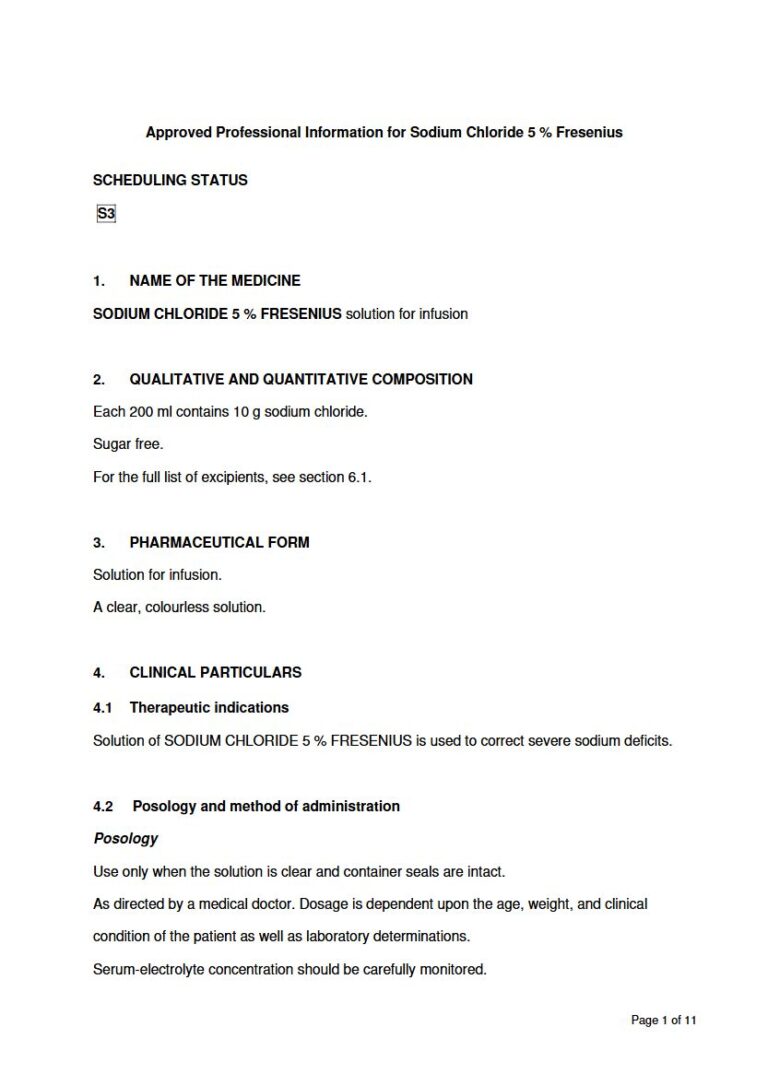
Solution of SODIUM CHLORIDE 5 % FRESENIUS is used to correct severe sodium deficits.
4.2 Posology and method of administration
Posology
Use only when the solution is clear and container seals are intact. As directed by a medical doctor. Dosage is dependent upon the age, weight, and clinical condition of the patient as well as laboratory determinations. Serum-electrolyte concentration should be carefully monitored.
When physiological conditions are re-established, dosage must be reduced.
Method of administration
Intravenous infusion.
4.3 Contraindications
Undiluted SODIUM CHLORIDE 5 % FRESENIUS should not be administered intravenously to neonates, young children and the elderly (see section 4.4).
4.4 Special warnings and precautions for use
Hypersensitivity/infusion reactions, including hypotension, pyrexia, tremor, chills, urticaria, rash, and pruritus may occur with SODIUM CHLORIDE 5 % FRESENIUS. Stop the infusion immediately if signs or symptoms of a hypersensitivity reaction develop, such as tachycardia, chest pain, dyspnoea and flushing. Appropriate therapeutic countermeasures must be instituted as clinically indicated.
Depending on the volume and rate of infusion, the intravenous administration of SODIUM CHLORIDE 5 % FRESENIUS can cause fluid and/or solute overloading resulting in dilution of serum electrolyte concentrations, overhydration/hypervolaemia, congested states, pulmonary oedema, or acid-base imbalance. The risk of dilutive states is inversely proportional to the electrolyte concentration of the injection. The risk of solute overload causing congested states with peripheral and pulmonary oedema is directly proportional to the electrolyte concentrations of the injection. Monitor changes in fluid balance, electrolyte concentrations, and acid-base balance during prolonged parenteral therapy or whenever the condition of the patient or the rate of administration warrants such evaluation.
SODIUM CHLORIDE 5 % FRESENIUS should be used with great care in patients with or at risk for hypernatraemia, hyperchloraemia, hypervolaemia or with conditions that may cause sodium retention, fluid overload and oedema, such as patients with primary or secondary hyperaldosteronism, hypertension, peripheral or pulmonary oedema, congestive heart failure, liver disease including cirrhosis, severe renal insufficiency including renal artery stenosis and nephrosclerosis, pre-eclampsia and in clinical states in which there exists oedema with sodium retention. Certain medicines may increase the risk of sodium and fluid retention (see section 4.5). In patients with diminished renal function, administration of SODIUM CHLORIDE 5 % FRESENIUS may result in sodium retention. SODIUM CHLORIDE 5 % FRESENIUS is hypertonic with an osmolarity of 1 710 mOsm/l (approx.) and may cause vein damage and thus should be administered through a large vein, for rapid dilution. Do not mix or administer SODIUM CHLORIDE 5 % FRESENIUS solutions through the same administration set with whole blood or cellular blood components. Rapid correction of hypo- and hypernatraemia is potentially dangerous (risk of serious neurologic complications). Dosage, rate, and duration of administration should be determined by a doctor experienced in intravenous fluid therapy.
Paediatric population
Plasma electrolyte concentrations should be closely monitored in the paediatric population as this population may have impaired ability to regulate fluids and electrolytes.
Geriatric population
Dose selection for an elderly patient should be cautious, usually starting at the low end of the dosing range, reflecting the greater frequency of decreased hepatic, renal, or cardiac function, and of concomitant disease or other medicine therapy. SODIUM CHLORIDE 5 % FRESENIUS is substantially excreted by the kidney, and the risk of toxic reactions to this medicine may be greater in patients with impaired renal function. Because elderly patients are more likely to have decreased renal function, care should be taken in dose selection, and it may be useful to monitor renal function.
4.5 Interaction with other medicines and other forms of interaction
Caution must be exercised in the administration of SODIUM CHLORIDE 5 % FRESENIUS to patients receiving medicines that may increase the risk of sodium and fluid retention, such as corticosteroids or corticotrophin. Caution is advised in patients treated with lithium. Renal sodium and lithium clearance may be increased during the administration of SODIUM CHLORIDE 5 % FRESENIUS. Administration of SODIUM CHLORIDE 5 % FRESENIUS may, therefore, result in decreased lithium levels.
4.6 Fertility, pregnancy and lactation
Safety in pregnancy and lactation has not been established.
4.7 Effects on ability to drive and use machines
Since adverse reactions related to dehydration, such as dizziness, somnolence, confusion, convulsions and coma have been reported in patients receiving SODIUM CHLORIDE 5 % FRESENIUS, patients should not drive, use machinery or perform any tasks that require concentration, until they are certain that SODIUM CHLORIDE 5 % FRESENIUS does not adversely affect their ability to do so (see sections 4.4, 4.8).
4.8 Undesirable effects
a) Summary of the safety profile
Convulsions can result from iatrogenically induced hypernatraemia. Hypernatraemia may also occur after inappropriate intravenous use of SODIUM CHLORIDE 5 % FRESENIUS. The most serious effect of hypernatraemia is dehydration of the brain which causes somnolence and confusion progressing to convulsions, coma, respiratory failure, and death.
b) Tabulated summary of adverse reactions
System organ class Adverse reaction Frequency unknown (cannot be estimated from the available data) Metabolism and nutrition disorders Overhydration/hypervolaemia* Hyperchloraemia Hyperchloraemic metabolic acidosis Acid-base imbalance Thirst Reduced salivation Nervous system disorders Dehydration of the brain Somnolence Confusion Convulsions Coma Headache Dizziness
Restlessness Irritability Eye disorders Reduced lachrymation Cardiac disorders Tachycardia Hypertension Hypotension Vascular disorders Peripheral oedema Venous thrombosis extending from the site of injection* Phlebitis extending from the site of injection* Respiratory, thoracic and mediastinal disorders Respiratory failure Pulmonary oedema Skin and subcutaneous tissue disorders Urticaria Rash Pruritis Musculoskeletal and connective tissue disorders Muscular twitching Rigidity General disorders and administrative site conditions Fever Tremor Chills Sweating Weakness Febrile response* Injection site infection* Injection site irritation* Injection site erythema*
Injection site streaking* Injection site urticaria* Burning sensation* Extravasation* *Adverse reactions which may occur because of SODIUM CHLORIDE 5 % FRESENIUS or the technique of administration.
c) Description of selected adverse reactions
Hypersensitivity/infusion reactions, including hypotension, pyrexia, tremor, chills, urticaria, rash, and pruritus may occur with SODIUM CHLORIDE 5 % FRESENIUS. Stop the infusion immediately if signs or symptoms of a hypersensitivity reaction develop, such as tachycardia, chest pain, dyspnoea and flushing. Appropriate therapeutic countermeasures must be instituted as clinically indicated (see section 4.4).
d) Paediatric population
Plasma electrolyte concentrations should be closely monitored in the paediatric population as this population may have impaired ability to regulate fluids and electrolytes (see section 4.4).
e) Other special populations
SODIUM CHLORIDE 5 % FRESENIUS is substantially excreted by the kidney, and the risk of toxic reactions to this medicine may be greater in patients with impaired renal function. Because elderly patients are more likely to have decreased renal function, care should be taken in dose selection, and it may be useful to monitor renal function (see section 4.4).
4.9 Overdose
Excessive administration of SODIUM CHLORIDE 5 % FRESENIUS may lead to hypernatraemia (which can lead to CNS manifestations, including seizures, coma, cerebral oedema and death) and sodium overload (which can lead to central and/or peripheral oedema). When assessing an overdose, any additives in the solution must also be considered. The effects of an overdose may require immediate medical attention and treatment. In cases of patients unable to retain the sodium selectively the treatment must be discontinued.
