
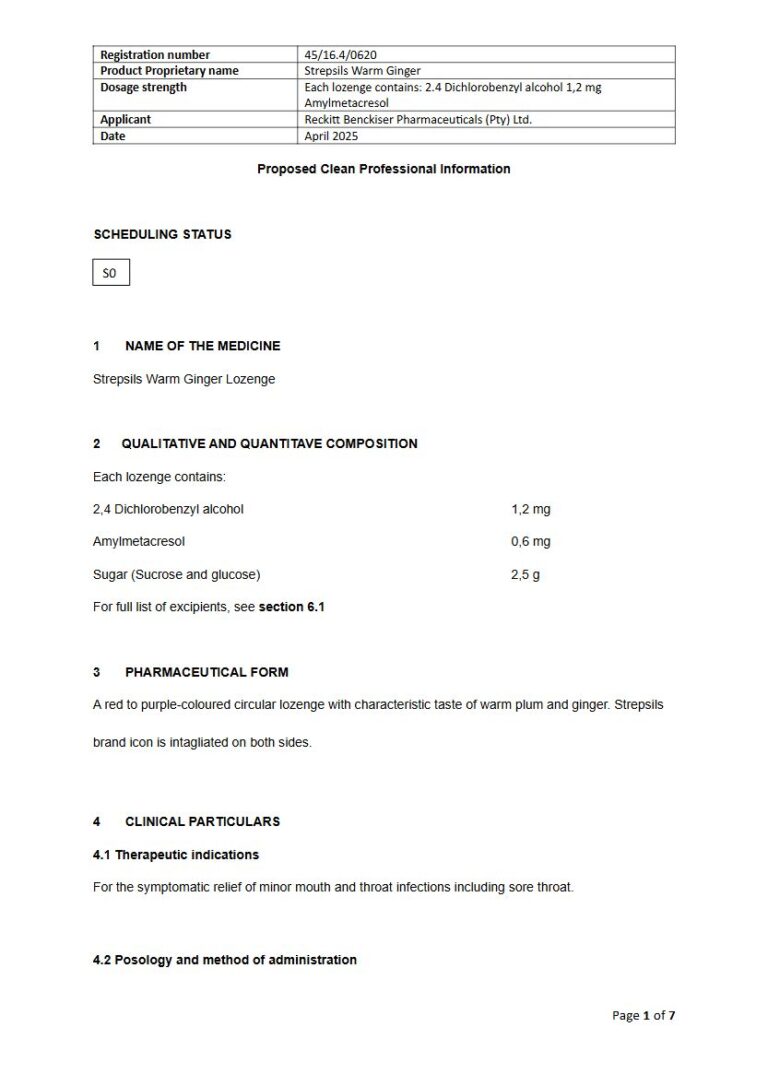
Strepsils Warm Ginger 1,2 mg Lozenge
PDF Leaflet Revision Date: 28 October 2025
Clinical Summary
Quick overview from the medicine insert
Indication
Symptomatic relief of minor mouth and throat infections including sore throat.
Dosage (summary)
One lozenge every 2-3 hours, max 12 lozenges in 24 hours. No dosage reduction for elderly.
Special Populations
- Diabetic patients
- Children under 6 years
Pregnancy & Breastfeeding
Safety in pregnancy and lactation not established; seek medical advice.
Contraindications
- Hypersensitivity to ingredients
- Children under 6 years
Common side effects
- Hypersensitivity
- Glossodynia
- Oral discomfort
Counselling Points
- Dissolve lozenge slowly in mouth
- Keep out of reach of children
- Store below 25u00b0C
Serious warnings
- Caution in patients with fructose intolerance
- Consult doctor if symptoms persist for more than two days
Important Disclaimer
The Strepsils Warm Ginger 1,2 mg Lozenge professional information leaflet below is the property of Reckitt Benckiser Pharmaceuticals and is provided on Medinsert exactly as issued, with no.. alterations or editorial changes. We make every effort to keep content current by updating documents as soon as new versions become available. Medinsert serves as a trusted access point for healthcare professionals, but does not replace official sources or clinical judgement. For more details, please read our full disclaimer. read more>>
 Healthcare Professionals Only
This content is for registered healthcare professionals
Sign in or create a free account to read the full package insert.
Free for HPCSA-registered professionals. Powered by Medinsert.
Clinical Particulars
Section 4 of the official insert — extracted exactly as issued, no alterations
4.1 Therapeutic indications
For the symptomatic relief of minor mouth and throat infections including sore throat.
4.2 Posology and method of administration
Posology
Adults and children (over 6 years old): (see section 4.4) One lozenge to be dissolved slowly in the mouth every 2-3 hours up to a maximum of 12 lozenges in 24 hours.
Elderly: There is no need for dosage reduction in elderly
Method of administration
For oral administration
4.3 Contraindications
Hypersensitivity to any of the ingredients of Strepsils Warm Ginger
Children under 6 years of age
4.4 Special warnings and precautions for use
Patients with rare hereditary problems of fructose intolerance, glucose-galactose malabsorption or sucrase-isomaltose insufficiency should not take this medicine.
As young children may choke on lozenges, Strepsils Warm Ginger is not indicated for children under the age of 6 years.
Caution should be taken when using Strepsils Warm Ginger in diabetic patients as Strepsils Warm Ginger contains Sugar Sucrose and glucose.
If symptoms persist for more than two days, consult a doctor.
4.5 Interaction with other medicines and other forms of interaction
No clinically significant interactions are known.
4.6 Fertility, pregnancy, and lactation
The safety in pregnancy and lactation has not been established.
Pregnancy
There are no or limited amount of data from the use of amylmetacresol and 2,4-dichlorbenzyl alcohol. As with all medicines care should be taken when using this product in pregnancy and medical advice sought if necessary.
Breast-feeding
It is unknown whether 2,4-dichlorobenzyl alcohol, amylmetacresol or metabolites are excreted in human milk. A risk to the newborns / infants cannot be excluded.
Fertility
No data are available regarding the effects on fertility.
4.7 Effects on ability to drive and use machines
Effects on ability to drive and use machines are not known.
4.8 Undesirable effects
The list of the following adverse effects relates to those experienced with 2,4-dichlorobenzyl alcohol and amylmetacresol at OTC doses, in short term use.
Adverse events which have been associated with 2,4-dichlorobenzyl alcohol and amylmetacresol are given below, tabulated by system organ class and frequency. Frequencies are defined as: Very common (u22651/10); Common (u22651/100 and <1/10); Uncommon (u22651/1000 and <1/100); Rare (u22651/10,000 and <1/1000); Very rare (<1/10,000); Not known (cannot be estimated from the available data). Within each frequency grouping, adverse events are presented in order of decreasing seriousness.
System Organ Class
Frequency
Adverse Events
Immune System disorders
Less Frequent
Hypersensitivity
Gastrointestinal Disorders
Not known
Glossodynia, oral discomfort
Hypersensitivity reactions may include rash, urticaria and angioedema, which may include swelling of the face, neck, throat or tongue that could affect breathing
Reporting of suspected adverse reactions
Reporting suspected adverse reactions after authorisation of the medicine is important. It allows continued monitoring of the benefit/risk balance of the medicine. Health care providers are asked to report any suspected adverse reactions to SAHPRA via the Med Safety APP (Medsafety X SAHPRA) and eReporting platform (who-umc.org) found on SAHPRA website.
4.9 Overdosage
Overdosage may cause hypersensitivity reaction and gastrointestinal discomfort, see section 4.8 . Treatment should be symptomatic and supportive.
