
Telinod 5 mg/10 mg Tablets
PDF Leaflet Revision Date: 24 June 2025
Clinical Summary
Quick overview from the medicine insert
Indication
Treatment of essential hypertension.
Dosage (summary)
Adults: 40/5 mg once daily, may titrate to 80/10 mg if needed.
Onset of Action / Duration
Onset: 3 hours, Duration: 24 hours
Special Populations
- Renal impairment
- Hepatic impairment
- Elderly
Pregnancy & Breastfeeding
Contraindicated in pregnancy and lactation.
Key Drug Interactions
- Potassium-sparing diuretics
- Lithium
- NSAIDs
- CYP3A4 inhibitors
Contraindications
- Hypersensitivity
- Severe renal impairment
- Bilateral renal artery stenosis
- Severe hepatic impairment
- Pregnancy and lactation
Common side effects
- Dizziness
- Peripheral oedema
- Hypotension
Counselling Points
- Take once daily, with or without food.
- Monitor blood pressure regularly.
- Avoid potassium supplements.
Serious warnings
- Risk of hypotension with dual RAAS blockade
- Monitor renal function in renal impairment
Important Disclaimer
The Telinod 5 mg/10 mg Tablets professional information leaflet below is the property of Adcock Ingram and is provided on Medinsert exactly as issued, with no.. alterations or editorial changes. We make every effort to keep content current by updating documents as soon as new versions become available. Medinsert serves as a trusted access point for healthcare professionals, but does not replace official sources or clinical judgement. For more details, please read our full disclaimer. read more>>
 Healthcare Professionals Only
This content is for registered healthcare professionals
Sign in or create a free account to read the full package insert.
Free for HPCSA-registered professionals. Powered by Medinsert.
Clinical Particulars
Section 4 of the official insert — extracted exactly as issued, no alterations
4. Clinical Particulars
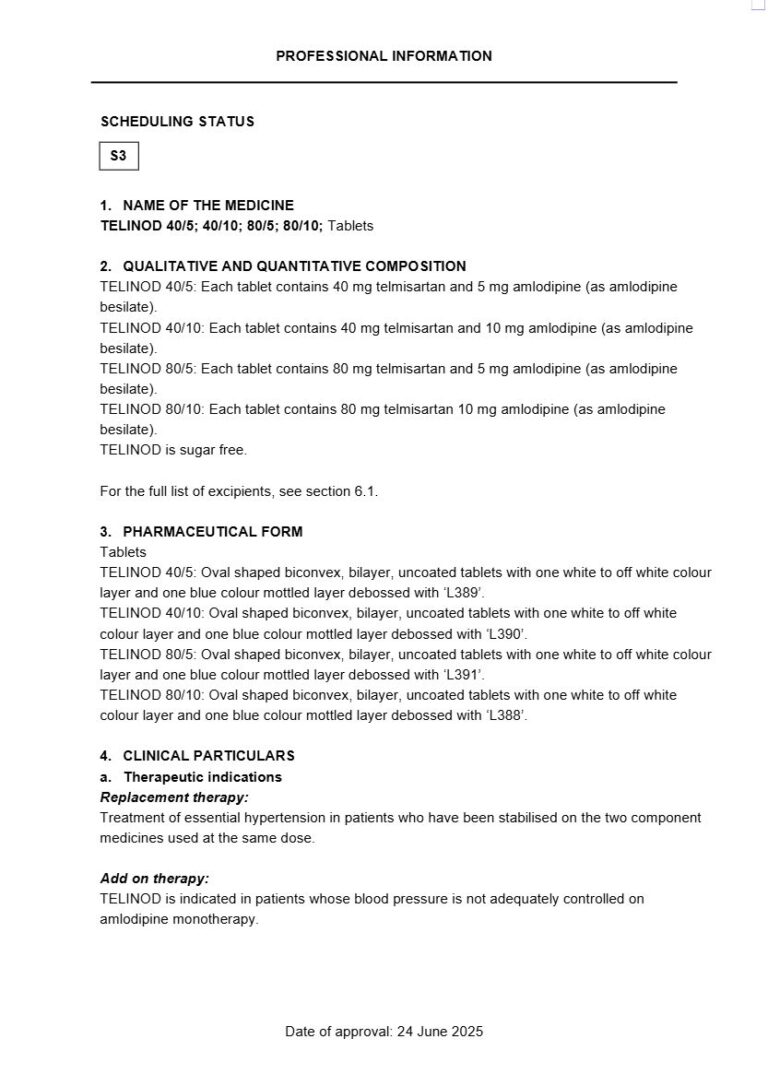
a. Therapeutic indications
Replacement therapy: Treatment of essential hypertension in patients who have been stabilised on the two component medicines used at the same dose. Add on therapy: TELINOD is indicated in patients whose blood pressure is not adequately controlled on amlodipine monotherapy.
b. Posology and method of administration
Posology: Adults TELINOD should be taken once daily. Replacement Therapy: Patients taking telmisartan and amlodipine as separate tablets can instead take TELINOD containing the same component doses in one tablet once daily. Add on therapy: TELINOD may be administered in patients whose blood pressure is not adequately controlled with amlodipine alone. The usual starting dose of TELINOD is 40/5 mg once daily. If additional blood pressure lowering is needed after at least 2 weeks of therapy, the dose may be titrated up to a maximum of 80 /10 mg once daily. Special populations Renal impairment No dosage adjustment is required for patients with mild to moderate renal impairment (see section 4.4). Amlodipine and telmisartan are not dialysable. Hepatic impairment In patients with mild to moderate hepatic impairment TELINOD should be administered with caution. For telmisartan the dose should not exceed 40 mg once daily (i.e TELINOD 40/5 mg or 40/10 mg). Elderly No dose adjustment is necessary for elderly patients. Normal amlodipine dosage regimens are recommended in the elderly but increase of dosage should take place with care (see section 4.4 and section 5.2). Paediatric population Children and adolescents TELINOD is not recommended for use in patients aged below 18 years due to a lack of data on safety and efficacy. Method of administration Tablet for oral administration. TELINOD may be taken with or without food.
4.3 Contraindications
u2022 Hypersensitivity to telmisartan, amlodipine, dihydropyridine derivatives, or to any of the ingredients of TELINOD listed in section 6.1.
u2022 A history of angioedema related to previous therapy with ACE inhibitors or angiotensin receptor blockers (ARBs): These patients must never again be given these medicines
u2022 Hereditary or idiopathic angioedema
u2022 Hypertrophic obstructive cardiomyopathy (HOCM)
u2022 Severe renal function impairment (creatinine clearance less than 30 mL/min)
u2022 Bilateral renal artery stenosis
u2022 Renal artery stenosis in patients with a single kidney
u2022 Aortic stenosis
u2022 Concomitant therapy with potassium sparing diuretics such as spironolactone, triamterene, amiloride (see section 4.5)
u2022 Porphyria
u2022 Lithium therapy: Concomitant administration with TELINOD may lead to toxic blood concentrations of lithium (see section 4.5)
u2022 Pregnancy and lactation (see section 4.6)
u2022 The concomitant use of TELINOD with aliskiren-containing products is contraindicated (see sections 4.4 and 4.5)
u2022 Biliary obstructive disorders
u2022 Severe hepatic impairment
u2022 Severe hypotension
u2022 Shock (including cardiogenic shock)
u2022 Obstruction of the outflow tract of the left ventricle (e.g. high grade aortic stenosis)
u2022 Haemodynamically unstable heart failure after acute myocardial infarction
u2022 Concomitant use of fluoroquinolones with ACE inhibitors/renin-angiotensin blockers such as TELINOD is contraindicated in patients with moderate to severe renal impairment (Creatinine Clearance u2264 30 mL/min) and in elderly patients.
4.4 Special warnings and precautions for use
Dual blockade of the renin-angiotensin-aldosterone system (RAAS) There is evidence that the concomitant use of ACE-inhibitors, angiotensin II receptor blockers (ARBs) or aliskiren may increase the risk of hypotension, hyperkalaemia and decreases renal function (including acute renal failure). Dual blockade of RAAS through the combined use of TELINOD and aliskiren is therefore contraindicated (see section 4.3). TELINOD should not be used concomitantly with aliskiren (see section 4.3). Pregnancy TELINOD should not be initiated during pregnancy (see section 4.3). Should a woman become pregnant while receiving Telinod, the treatment should be stopped promptly and switched to a different class of antihypertensive medicine (see sections 4.3 and 4.6). Patients planning pregnancy should be changed to alternative antihypertensive treatments which have an established safety profile for use in pregnancy. When pregnancy is diagnosed, treatment with TELINOD should be stopped immediately, and if appropriate, alternative therapy should be started (see section 4.6). Hepatic impairment Telmisartan as contained in TELINOD is mostly eliminated in the bile. Patients with biliary obstructive disorders or hepatic insufficiency can be expected to have reduced clearance. The half-life of amlodipine as contained in TELINOD is prolonged in patients with impaired liver function and dosage recommendations have not been established. Amlodipine should therefore be initiated at the lower end of the dosing range (i.e. TELINOD 40/5 or 80/5) and caution should be used, both on initial treatment and when increasing the dose. TELINOD should therefore be used with caution in patients with mild to moderate impairment of liver function and should not be used in patients with severe liver impairment (see section 4.3). Renovascular hypertension There is an increased risk of severe hypotension and renal insufficiency when patients with bilateral renal artery stenosis or stenosis of the artery to a single functioning kidney are treated with medicines that affect the renin-angiotensin-aldosterone system (see section 4.3). Renal impairment and kidney transplant When TELINOD is used in patients with impaired renal function, a periodic monitoring of potassium and creatinine serum levels is recommended. There is no experience regarding the administration of TELINOD in patients with a recent kidney transplant. Telmisartan and amlodipine are not dialysable. Intravascular hypovolaemia Symptomatic hypotension, especially after the first dose, may occur in patients who are volume and/or sodium depleted, by e.g., vigorous diuretic therapy, dietary salt restriction, diarrhoea or vomiting. Such conditions should be corrected before the administration of TELINOD. Other conditions with stimulation of the renin-angiotensin-aldosterone system In patients whose vascular tone and renal function depend predominantly on the activity of the renin-angiotensin-aldosterone system (e.g., patients with severe congestive heart failure or underlying renal disease, including renal artery stenosis), treatment with TELINOD, that affects this system, has been associated with acute hypotension, hyperazotaemia, oliguria, or rarely acute renal failure. Concomitant use of fluoroquinolones Concomitant use of fluoroquinolones and ACE inhibitors/Angiotensin receptor blockers such as TELINOD may precipitate acute kidney injury in patients, especially those with moderate to severe renal impairment and elderly patients. (See section 4.3). Renal function should be assessed before initiating treatment, and monitored during treatment, with fluoroquinolones or ACE inhibitors/angiotensin receptor blockers (i.e., TELINOD) whether used separately and/or concomitantly. Primary aldosteronism Patients with primary aldosteronism generally will not respond to antihypertensive medicines acting through inhibition of the renin-angiotensin-system. Therefore, the use of TELINOD is not recommended. Aortic and mitral valve stenosis, hypertrophic obstructive cardiomyopathy TELINOD is contraindicated in patients suffering from aortic or mitral stenosis, or hypertrophic obstructive cardiomyopathy. Unstable angina pectoris; acute myocardial infarction There are no data to support the use of TELINOD in unstable angina pectoris and during or within one month of a myocardial infarction. Patients with cardiac failure In an amlodipine long-term, placebo controlled study in patients with severe heart failure (NYHA class III and IV) the reported incidence of pulmonary oedema was higher in the amlodipine treated group than in the placebo group. Therefore, patients with heart failure should be treated with caution. Calcium channel blockers, including amlodipine as contained in TELINOD, should be used with caution in patients with congestive heart failure, as they may increase the risk of future cardiovascular events and mortality. Hyperkalaemia During treatment with TELINOD hyperkalaemia may occur, especially in the presence of renal impairment and/ or heart failure. Monitoring of serum potassium in patients at risk is recommended. Based on experience with the use of medicines that affect the renin-angiotensin-system, concomitant use with potassium-sparing diuretics, potassium supplements, salt substitutes containing potassium or other medicines that may increase the potassium level (heparin, etc.) may lead to an increase in serum potassium and should therefore be co-administered cautiously with TELINOD. Diabetes mellitus In diabetic patients with an additional cardiovascular risk, i.e., patients with diabetes mellitus and coexistent coronary artery disease (CAD), the risk of fatal myocardial infarction and unexpected cardiovascular death may be increased when treated with blood pressure lowering medicines such as ARBs or ACE-inhibitors such as TELINOD. In patients with diabetes mellitus CAD may be asymptomatic and therefore undiagnosed. Patients with diabetes mellitus should undergo appropriate diagnostic evaluation, e.g., exercise stress testing, to detect and to treat CAD accordingly before initiating treatment with TELINOD. Elderly patients The increase of the amlodipine dose as contained in TELINOD should take place with care in the elderly patients (see section 4.2 and section 5.2). Other Excessive reduction of blood pressure in patients with ischaemic cardiopathy or ischaemic cardiovascular disease may result in a myocardial infarction or stroke. Sodium Each tablet contains less than 1 mmol sodium (23 mg) per tablet, essentially u2018sodium-freeu2019.
4.5 Interaction with other medicines and other forms of interaction
No interactions between the two components of the fixed dose combinations have been observed in clinical studies. Interactions linked to the combination No interaction studies have been performed with TELINOD and other medicines. Other antihypertensive medicines The blood pressure lowering effect of TELINOD can be increased by concomitant use of other antihypertensive medicines. Medicines with blood pressure lowering potential Based on their pharmacological properties it can be expected that the following medicines may potentiate the hypotensive effects of TELINOD: e.g., baclofen, amifostine. Furthermore, orthostatic hypotension may be aggravated by alcohol, barbiturates, narcotics, or antidepressants. Corticosteroids (systemic route) Reduction of the antihypertensive effect. Interactions linked to the telmisartan component of TELINOD Potassium sparing diuretics or potassium supplements Angiotensin II receptor antagonists such as telmisartan, attenuate diuretic induced potassium loss. Potassium sparing diuretics e.g. spironolactone, eplerenone, triamterene, or amiloride, potassium supplements, or potassium-containing salt substitutes may lead to a significant increase in serum potassium. If concomitant use is indicated because of documented hypokalaemia, they should be used with caution and with frequent monitoring of serum potassium. Lithium Reversible increases in serum lithium concentrations and toxicity have been reported during concomitant administration of lithium with angiotensin converting enzyme inhibitors, and with angiotensin II receptor antagonists, including telmisartan. If use of the combination proves necessary, careful monitoring of serum lithium levels is recommended.
4.6 Fertility, pregnancy and lactation
TELINOD should not be used during pregnancy and lactation (see section 4.3). Effects related to the mono components are described below. Women of Childbearing Potential Women of childbearing age should ensure effective contraception. Pregnancy Telmisartan Safety in pregnancy and lactation has not been established (see section 4.3). When pregnancy is planned or confirmed TELINOD should be discontinued. Medicines affecting the renin-angiotensin system, such as TELINOD, can cause embryonal toxicity, foetal and neonatal morbidity and mortality when administered to pregnant women. Patients planning pregnancy should be changed to alternative antihypertensive treatments which have an established safety profile for use in pregnancy. Should exposure to TELINOD have occurred from the second trimester of pregnancy, ultrasound check of renal function and skull is recommended. Infants whose mothers have taken TELINOD should be closely observed for hypotension. Amlodipine The safety of amlodipine in human pregnancy has not been established. In animal studies, reproductive toxicity was observed at high doses. Breastfeeding TELINOD is contraindicated during lactation since it is not known whether telmisartan is excreted in human milk. Animal studies have shown excretion of telmisartan in breastmilk. Amlodipine is excreted in human milk. The proportion of the maternal dose received by the infant has been estimated with an interquartile range of 3 - 7 %, with a maximum of 15 %. The effect of amlodipine on infants is unknown. Because of the potential adverse reactions in breastfed infants, TELINOD should not be used by breastfeeding mothers (see section 4.3). Fertility No data from controlled clinical studies with the fixed dose combination or with the individual components are available.
4.7 Effects on ability to drive and use machines
No studies on the effects on the ability to drive and use machines have been performed. However, patients should be advised that they may experience undesirable effects such as syncope (fainting), somnolence, dizziness, or vertigo during treatment (see section 4.8). Therefore, caution should be recommended when driving a vehicle or operating machinery. If patients experience these adverse effects, they should avoid potentially hazardous tasks such as driving or operating machinery.
4.8 Undesirable effects
Summary of the safety profile The most frequent adverse reactions include dizziness and peripheral oedema. Serious syncope may occur less frequently. Tabulated summary of adverse reactions The following side effects derived from the use of the TELINOD (telmisartan and amlodipine combination) or the use of the monocomponents (telmisartan or amlodipine) in clinical trials or from post-marketing experience are shown in the table below classified by MedDRA System organ class and MedDRA Preferred terms.
4.9 Overdose
Symptoms There is no experience of overdose with TELINOD. Signs and symptoms of overdose are expected to be in line with exaggerated pharmacological effects. The most prominent manifestations of telmisartan overdosage were hypotension, tachycardia; bradycardia might also occur. Overdose with amlodipine may result in excessive peripheral vasodilatation and possibly reflex tachycardia. Marked and probably prolonged systemic hypotension up to and including shock with fatal outcome may occur. Therapy Supportive treatment should be instituted. If ingestion is recent, induction of vomiting may be considered. In healthy volunteers the use of charcoal up to 2 hours after rate administration of amlodipine 10 mg has been shown to reduce the absorption of amlodipine. Intravenous calcium gluconate may be beneficial in reversing the effects of calcium channel blockade. Serum electrolytes and creatinine should be monitored frequently. If hypotension occurs, the patient should be placed in a supine position with elevation of extremities, with salt and volume replacement given quickly. Supportive treatment should be instituted. Telmisartan and amlodipine are not removed by haemodialysis.
