
Teritemso 14 mg Tablet
PDF Leaflet Revision Date: 13 June 2023
Clinical Summary
Quick overview from the medicine insert
Indication
Treatment of relapsing forms of multiple sclerosis in adults.
Dosage (summary)
14 mg orally once daily.
Special Populations
- Elderly population
- Renal impairment
- Hepatic impairment
Pregnancy & Breastfeeding
Contraindicated in pregnancy and breastfeeding; effective contraception required during treatment.
Key Drug Interactions
- Rifampicin
- Warfarin
- CYP2C8 substrates
Contraindications
- Severe hepatic impairment
- Pregnancy
- Breastfeeding
- Severe immunodeficiency
- Hypersensitivity
Common side effects
- Influenza
- Headache
- Diarrhoea
- Increased ALT
- Alopecia
Counselling Points
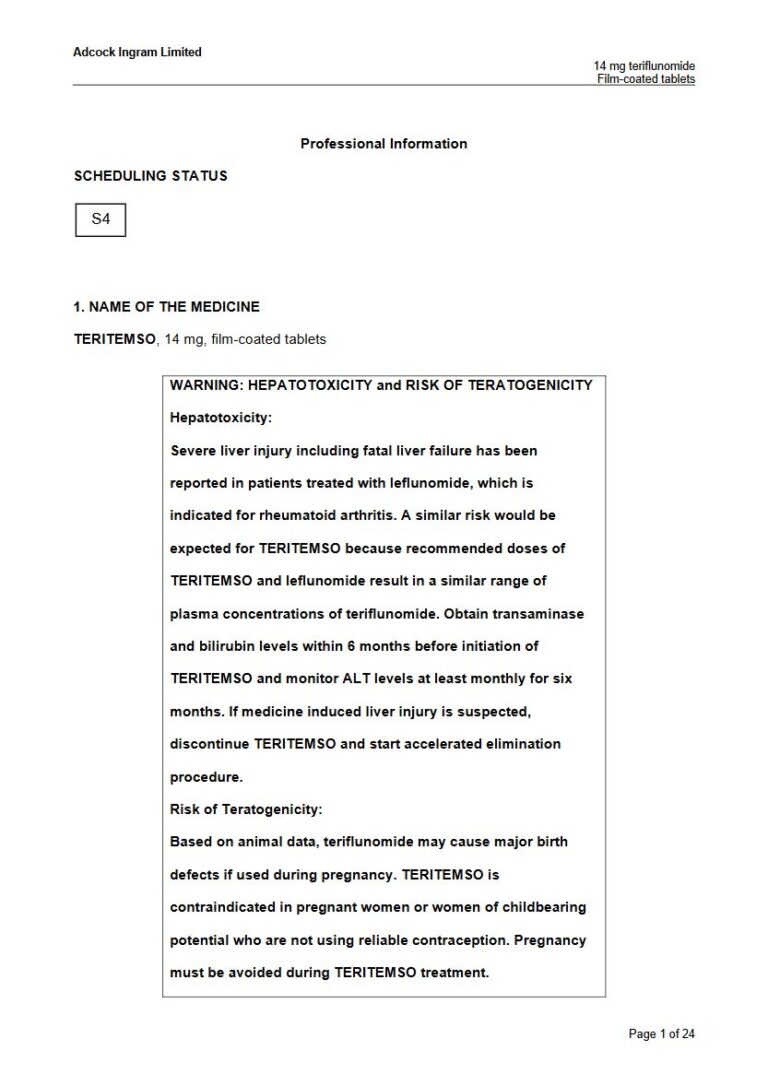
- Monitor liver enzymes monthly for 6 months
- Report signs of infection
- Avoid live vaccines
Serious warnings
- Hepatotoxicity
- Risk of teratogenicity
- Serious infections
Important Disclaimer
The Teritemso 14 mg Tablet professional information leaflet below is the property of Adcock Ingram and is provided on Medinsert exactly as issued, with no.. alterations or editorial changes. We make every effort to keep content current by updating documents as soon as new versions become available. Medinsert serves as a trusted access point for healthcare professionals, but does not replace official sources or clinical judgement. For more details, please read our full disclaimer. read more>>
 Healthcare Professionals Only
This content is for registered healthcare professionals
Sign in or create a free account to read the full package insert.
Free for HPCSA-registered professionals. Powered by Medinsert.
Clinical Particulars
Section 4 of the official insert — extracted exactly as issued, no alterations
4.1 Therapeutic indications
TERITEMSO is indicated for the treatment of adult patients with relapsing forms of multiple sclerosis (MS) to reduce the frequency of relapses and to delay the accumulation of physical disability.
4.2 Posology and method of administration
Posology
The treatment should be initiated and supervised by a medical practitioner experienced in multiple sclerosis.
The recommended dose of TERITEMSO is 14 mg orally once daily.
Special populations
Elderly population
TERITEMSO has not been specifically studied in the elderly.
Renal impairment
No dosage adjustment is necessary for patients with mild, moderate or severe renal impairment.
Hepatic impairment
No dosage adjustment is necessary for patients with mild and moderate hepatic impairment. TERITEMSO is contraindicated in patients with severe hepatic impairment (see section 4.3).
Paediatric population:
The safety and efficacy of TERITEMSO in children aged 0 to 18 years has not yet been established. Use in this age group is not recommended.
Method of administration
The film-coated tablets are for oral use. The film-coated tablet should be swallowed whole with some water. TERITEMSO can be taken with or without food.
4.3 Contraindications
- Hypersensitivity to teriflunomide or to any of the excipients of TERITEMSO listed in section 6.1.
- Patients with severe hepatic impairment (Child-Pugh class C).
- As leflunomide is the parent compound of teriflunomide, co-administration of TERITEMSO with leflunomide is not recommended (see section 4.4).
- TERITEMSO is contraindicated for women during pregnancy or women of childbearing potential who are not on reliable contraception (see section 4.6).
- Breastfeeding women (see section 4.6).
- Patients with severe immunodeficiency states, e.g. acquired immunodeficiency syndrome (AIDS).
- Patients with significantly impaired bone marrow function or significant anaemia, leukopenia, neutropenia or thrombocytopenia.
- Patients with severe active infection until resolution (see section 4.4).
- Patients with severe renal impairment undergoing dialysis, because insufficient clinical experience is available in this patient group.
- Patients with severe hypoproteinaemia, e.g. in nephrotic syndrome.
4.4 Special warnings and precautions for use
Monitoring
Before treatment
Before starting treatment with TERITEMSO the following should be assessed:
u2022 Blood pressure
u2022 Alanine aminotransferase/serum glutamic pyruvic transaminase (ALT/SGPT)
u2022 Complete blood cell count including differential white blood cell and platelet count.
During treatment
During treatment with TERITEMSO the following should be monitored:
u2022 Blood pressure
o Check periodically
u2022 Alanine aminotransferase/serum glutamic pyruvic transaminase (ALT/SGPT)
o Liver enzymes should be assessed every two weeks during the first 6 months of treatment, and every 8 weeks thereafter or as indicated by clinical signs and symptoms such as unexplained nausea, vomiting, abdominal pain, fatigue, anorexia, or jaundice and/or dark urine. For ALT (SGPT) elevations between 2- and 3-fold the upper limit of normal, monitoring must be performed weekly.
u2022 Complete blood cell counts should be performed based on clinical signs and symptoms (e.g. infections) during treatment.
Accelerated elimination procedure
Teriflunomide is eliminated slowly from the plasma. Without an accelerated elimination procedure, it takes an average of 8 months to reach plasma concentrations less than 0,02 mg/l, although due to individual variation in substance clearance it may take up to 2 years. An accelerated elimination procedure can be used at any time after discontinuation of TERITEMSO (see sections 4.6 and 5.2).
Hepatic effects
Elevations of liver enzymes have been observed in patients receiving teriflunomide (see section 4.8). These elevations occurred mostly within the first 6 months of treatment. TERITEMSO should be discontinued if liver injury is suspected; consider discontinuing TERITEMSO therapy if the ALT exceeds 3-times ULN and this is confirmed within 48 hours. Patients with pre-existing liver disease and/or who consume substantial quantities of alcohol may be at increased risk of developing elevated liver enzymes when taking teriflunomide and should be closely monitored for signals of liver disease.
Hypoproteinaemia
Since teriflunomide as contained in TERITEMSO, is highly protein bound and as the binding is dependent upon the concentrations of albumin, unbound plasma teriflunomide concentrations are expected to be increased in patients with hypoproteinaemia, e.g. in nephrotic syndrome. TERITEMSO should not be used in patients with conditions of severe hypoproteinaemia.
Blood pressure
Elevation of blood pressure may occur during treatment with TERITEMSO (see section 4.8). Check blood pressure before start of TERITEMSO and periodically thereafter. Blood pressure elevation should be appropriately managed during treatment with TERITEMSO.
Infections
Based on the immunomodulatory effect of TERITEMSO, if a patient develops a serious infection, consider suspending treatment with TERITEMSO and reassess the benefits and risks prior to re-initiation of therapy. Due to the prolonged half-life, accelerated elimination with cholestyramine or charcoal may be considered. Instruct patients receiving TERITEMSO to report symptoms of infections to a medical practitioner. Patients with active acute or chronic infections should not start treatment with TERITEMSO until the infection(s) is resolved. The safety of TERITEMSO in individuals with latent tuberculosis infection is unknown, as tuberculosis screening was not systematically performed in clinical studies. For patients testing positive in tuberculosis screening, treat by standard medical practice prior to therapy with TERITEMSO.
Respiratory reactions
Interstitial lung disease (ILD) has been reported with teriflunomide in the post marketing setting. ILD and worsening of pre-existing ILD have been reported during treatment with leflunomide, the parent compound of teriflunomide. The risk is increased in patients who had a history of ILD when treated with leflunomide. ILD may occur acutely at any time during therapy with a variable clinical presentation. ILD may be fatal. New onset or worsening pulmonary symptoms, such as persistent cough and dyspnoea, may be a reason for discontinuation of the therapy and for further investigation, as appropriate. If discontinuation of the medicine is necessary, initiation of an accelerated elimination procedure should be considered.
Haematological effects
A mean decrease of less than 15 % from baseline affecting white blood cell count has been observed (see section 4.8). As a precaution, a recent complete blood cell count, including differential white blood cell count and platelets, should be available before the initiation of treatment with TERITEMSO and the complete blood cell count should be assessed during TERITEMSO therapy as indicated by clinical signs and symptoms (e.g., infections). In patients with pre-existing anaemia, leukopenia, and/or thrombocytopenia as well as in patients with impaired bone marrow function or those at risk of bone marrow suppression, the risk of haematological disorders is increased. If such effects occur, the accelerated elimination procedure (see above) to reduce plasma levels of teriflunomide should be considered. In cases of severe haematological reactions, including pancytopenia, TERITEMSO and any concomitant myelosuppressive treatment must be discontinued and a teriflunomide accelerated elimination procedure should be considered.
Skin reactions
Cases of severe skin reactions have been reported post marketing (including Stevens-Johnson syndrome and toxic epidermal necrolysis). In patients treated with leflunomide, the parent compound, cases of Drug Reaction with Eosinophilia and Systemic Symptoms (DRESS) have also been reported. In case of ulcerative stomatitis, TERITEMSO administration should be discontinued. If skin and/or mucosal reactions are observed which raise the suspicion of severe generalised major skin reactions (Stevens-Johnson syndrome, or toxic epidermal necrolysis-Lyell's syndrome), TERITEMSO and any other possibly associated treatment must be discontinued, and an accelerated procedure initiated immediately. In such cases patients should not be re-exposed to TERITEMSO (see section 4.3). New onset of psoriasis (including pustular psoriasis) and worsening of pre-existing psoriasis have been reported during the use of TERITEMSO. Treatment withdrawal and initiation of an accelerated elimination procedure may be considered taking into account patient's disease and medical history.
Peripheral neuropathy
Cases of peripheral neuropathy have been reported in patients receiving TERITEMSO (see section 4.8). Most patients improved after discontinuation of TERITEMSO. However, there was a wide variability in final outcome, i.e. in some patients the neuropathy resolved, and some patients had persistent symptoms. If a patient taking TERITEMSO develops a confirmed peripheral neuropathy, consider discontinuing TERITEMSO therapy and performing the accelerated elimination procedure.
Vaccination
Reports from two clinical studies have shown that vaccinations to inactivated neoantigen (first vaccination) or recall antigen (re-exposure) were safe and effective during teriflunomide treatment. The use of live attenuated vaccines may carry a risk of infections and should therefore be avoided.
Immunosuppressive and immunomodulating therapies
As leflunomide is the parent compound of teriflunomide, co-administration of TERITEMSO with leflunomide is contraindicated (see section 4.3). Co-administration with antineoplastic or immunosuppressive therapies used for treatment of MS has not been evaluated. Safety studies, in which teriflunomide was concomitantly administered with other immune modulating therapies for up to one year (interferon beta, glatiramer acetate) did not reveal any specific safety concerns but a higher adverse reaction rate as compared to teriflunomide monotherapy was observed. The long-term safety of these combinations in the treatment of multiple sclerosis has not been established.
Switching to or from TERITEMSO
Based on the clinical data related to concomitant administration of teriflunomide with interferon beta or with glatiramer acetate, no waiting period is required when initiating teriflunomide after interferon beta or glatiramer acetate or when starting interferon beta or glatiramer acetate, after teriflunomide. Due to the long half-life of natalizumab, concomitant exposure, and thus concomitant immune effects, could occur for up to 2-3 months following discontinuation of natalizumab if TERITEMSO was immediately started. Therefore, caution is required when switching patients from natalizumab to TERITEMSO. Based on the half-life of fingolimod, a 6-week interval without therapy is needed for clearance from the circulation and a 1 to 2-month period is needed for lymphocytes to return to normal range following discontinuation of fingolimod. Starting TERITEMSO during this interval will result in concomitant exposure to fingolimod. This may lead to an additive effect on the immune system and caution is, therefore, indicated. In MS patients, the median t 1/2z was approximately 19 days after repeated doses of 14 mg. If a decision is made to stop treatment with TERITEMSO, during the interval of 5 half-lives (approximately 3,5 months although may be longer in some patients), starting other therapies will result in concomitant exposure to TERITEMSO. This may lead to an additive effect on the immune system and caution is, therefore, indicated.
Interference with determination of ionised calcium levels
The measurement of ionised calcium levels might show falsely decreased values under treatment with leflunomide and/or teriflunomide (the active metabolite of leflunomide) depending on the type of ionised calcium analyser used (e.g. blood gas analyser). Therefore, the plausibility of observed decreased ionised calcium levels needs to be questioned in patients under treatment with leflunomide or teriflunomide. In case of doubtful measurements, it is recommended to determine the total albumin adjusted serum calcium concentration.
Excipients with known effect
Patients with rare hereditary problems of galactose intolerance, total lactase deficiency or glucose-galactose malabsorption should not take TERITEMSO.
4.5 Interaction with other medicines and other forms of interaction
Pharmacokinetic interactions of other medicines on TERITEMSO
The primary biotransformation pathway for teriflunomide is hydrolysis, with oxidation being a minor pathway. Potent cytochrome P450 (CYP) and transporter inducers
Co-administration of repeated doses (600 mg once daily for 22 days) of rifampicin (a CYP2B6, 2C8, 2C9, 2C19, 3A inducer), as well as an inducer of the efflux transporters P-glycoprotein [P-gp] and breast cancer resistant protein [BCRP] with teriflunomide (70 mg single dose) resulted in an approximately 40 % decrease in teriflunomide exposure. Rifampicin and other known potent CYP and transporter inducers such as carbamazepine, phenobarbital (phenobarbitone), phenytoin and St John's Wort should be used with caution during the treatment with TERITEMSO.
Cholestyramine or activated charcoal
It is recommended that patients receiving TERITEMSO are not treated with cholestyramine or activated charcoal because this leads to a rapid and significant decrease in plasma concentration unless an accelerated elimination is desired. The mechanism is thought to be by interruption of enterohepatic recycling and/or gastrointestinal dialysis of teriflunomide.
Pharmacokinetic interactions of TERITEMSO on other medicine
Effect of TERITEMSO on CYP2C8 substrate: repaglinide
There was an increase in mean repaglinide C max and AUC (1,7- and 2,4-fold, respectively), following repeated doses of TERITEMSO, suggesting that TERITEMSO is an inhibitor of CYP2C8 in vivo. Therefore, medicines metabolised by CYP2C8, such as repaglinide, paclitaxel, pioglitazone or rosiglitazone, should be used with caution during treatment with TERITEMSO.
Effect of TERITEMSO on oral contraceptives: 0,03 mg ethinylestradiol and 0,15 mg levonorgestrel
There was an increase in mean ethinylestradiol C max and AUC 0-24 (1,58- and 1,54-fold, respectively) and levonorgestrel C max and AUC 0-24 (1,33- and 1,41-fold, respectively) following repeated doses of teriflunomide. While this interaction of TERITEMSO is not expected to adversely impact the efficacy of oral contraceptives, it should be considered when selecting or adjusting oral contraceptive treatment used in combination with TERITEMSO.
Effect of TERITEMSO on CYP1A2 substrate: caffeine
Repeated doses of teriflunomide decreased mean C max and AUC of caffeine (CYP1A2 substrate) by 18 % and 55 %, respectively, suggesting that teriflunomide may be a weak inducer of CYP1A2 in vivo. Therefore, medicines metabolised by CYP1A2 (such as duloxetine, alosetron, theophylline and tizanidine) should be used with caution during treatment with TERITEMSO, as it could lead to the reduction of the efficacy of these medicines.
Effect of TERITEMSO on warfarin
Repeated doses of teriflunomide had no effect on the pharmacokinetics of S-warfarin, indicating that teriflunomide is not an inhibitor or an inducer of CYP2C9. However, a 25 % decrease in peak international normalised ratio (INR) was observed when teriflunomide was co-administered with warfarin as compared with warfarin alone. Therefore, when warfarin is co-administered with TERITEMSO, close INR follow-up and monitoring is recommended.
Effect of TERITEMSO on organic anion transporter 3 (OAT3) substrates
There was an increase in mean cefaclor C max and AUC (1,43- and 1,54-fold, respectively), following repeated doses of teriflunomide, suggesting that teriflunomide is an inhibitor of OAT3 in vivo. Therefore, when TERITEMSO is co-administered with substrates of OAT3, such as cefaclor, benzylpenicillin, ciprofloxacin, indomethacin, ketoprofen, furosemide, cimetidine, methotrexate, and zidovudine, caution is recommended.
Effect of TERITEMSO on BCRP and /or organic anion transporting polypeptide B1 and B3 (OATP1B1/B3) substrates
There was an increase in mean rosuvastatin C max and AUC (2,65- and 2,51-fold, respectively), following repeated doses of TERITEMSO. However, there was no apparent impact of this increase in plasma rosuvastatin exposure on the HMG-CoA reductase activity. For rosuvastatin, a dose reduction by 50 % is recommended for co-administration with TERITEMSO. For other substrates of BCRP (e.g., methotrexate, topotecan, sulfasalazine, daunorubicin, doxorubicin) and the OATP family especially HMG-Co reductase inhibitors (e.g., simvastatin, atorvastatin, pravastatin, methotrexate, nateglinide, repaglinide, rifampicin) concomitant administration of TERITEMSO should also be undertaken with caution. Patients should be closely monitored for signs and symptoms of excessive exposure to the medicines and reduction of the dose of these medicines should be considered.
4.6 Fertility, pregnancy and lactation
Women of childbearing potential / Contraception in males and females
Use in males
The risk of male-mediated embryo-foetal toxicity through TERITEMSO treatment is considered low; however, patients should be advised to use barrier contraception (see section 5.3).
Use in females
TERITEMSO is contraindicated in women of childbearing potential not using reliable contraceptives (see section 4.3). Women of childbearing potential must use effective contraception during treatment and after treatment as long as TERITEMSO plasma concentration is above 0,02 mg/l. During this period women should discuss any plans to stop or change contraception with the treating medical practitioner.
Pregnancy
TERITEMSO is contraindicated during pregnancy (see section 4.3). There are no adequate and well-controlled studies of TERITEMSO in pregnant women. However, based on animal studies, teriflunomide may increase the risk of fetal death or teratogenic effects when administered to pregnant women. Human teriflunomide plasma concentration less than 0,02 u03bcg/mL is expected to have minimal risk based on available animal data. If TERITEMSO is to be discontinued, an accelerated elimination procedure is recommended (see sections 4.4 and 5.2). Without the accelerated elimination procedure, on average it takes 6 months to reach plasma concentrations less than 0,02 u03bcg/mL. Due to individual variation in medicines clearance, teriflunomide plasma concentrations may need to be checked for up to 2 years after discontinuation. The accelerated elimination could be used at any time after discontinuation of TERITEMSO.
Breastfeeding
Animal studies have shown excretion of teriflunomide in milk. TERITEMSO is contraindicated during breastfeeding (see section 4.3).
Fertility
Results of studies in animals have not shown an effect on fertility (see section 5.3). Although human data are lacking, no effect on male and female fertility is anticipated.
4.7 Effects on ability to drive and use machines
TERITEMSO has no or negligible influence on the ability to drive and use machines. In the case of adverse reactions such as dizziness, which has been reported with leflunomide, the parent compound, the patient's ability to concentrate and to react properly may be impaired. In such cases, patients should refrain from driving and using machines.
4.8 Undesirable effects
a. Summary of the safety profile
The most frequent reported adverse reactions in treated patients were influenza, upper respiratory tract infection, urinary tract infection, paraesthesia, headache, diarrhoea, increased ALT, nausea, and alopecia. These side effects are usually mild to moderate, transient and infrequently leads to treatment discontinuation.
b. Tabulated list of adverse reactions
Infections and infestations
Frequent: Influenza, upper respiratory tract infection, urinary tract infection, bronchitis, sinusitis, pharyngitis, cystitis, viral gastroenteritis, oral herpes, tooth infection, laryngitis, tinea pedis
Frequency not known: Severe infections including sepsis
Blood and lymphatic system disorders
Frequent: Neutropenia, anaemia
Less frequent: Mild thrombocytopenia (platelets < 100 G/l)
Immune system disorders
Frequent: Mild allergic reactions, seasonal allergy
Frequency not known: Hypersensitivity reactions (immediate or delayed) including anaphylaxis and angioedema
Metabolism and nutrition disorders
Frequency not known: Dyslipidaemia
Psychiatric disorders
Frequent: Anxiety
Nervous system disorders
Frequent: Headache, paraesthesia, sciatica, carpal tunnel syndrome, hyperaesthesia, neuralgia
Less frequent: Peripheral neuropathy
Cardiac disorders
Frequent: Palpitations
Vascular disorders
Frequent: Hypertension
Respiratory, thoracic and mediastinal disorders
Frequency not known: Interstitial lung disease
Gastrointestinal disorders
Frequent: Diarrhoea, nausea, upper abdominal pain, vomiting, toothache
Frequency not known: Pancreatitis, stomatitis
Hepato-biliary disorders
Frequent: Alanine aminotransferase (ALT) increase, gamma glutamyl transferase (GGT) increase, aspartate aminotransferase increase
Frequency not known: Acute hepatitis
Skin and subcutaneous tissue disorders
Frequent: Alopecia, rash, acne
Less frequent: Nail disorders
Frequency not known: Severe skin reactions, psoriasis (including pustular)
Musculoskeletal and connective tissue disorders
Frequent: Musculoskeletal pain, myalgia, arthralgia
Renal and urinary disorders
Frequent: Pollakiuria
Reproductive system and breast disorders
Frequent: Menorrhagia
General disorders and administration site conditions
Frequent: Pain, asthenia
Investigations
Frequent: Weight decrease, neutrophil count decrease, white blood cell count decrease, blood creatine phosphokinase increased
Injury, poisoning and procedural complications
Less frequent: Post-traumatic pain
c. Description of selected adverse reactions
Alopecia
Alopecia is reported as hair thinning, decreased hair density, hair loss, associated or not with hair texture change. It may occur more frequently as diffuse or generalised over the scalp (no complete hair loss) and more often during the first 6 months of treatment.
Hepatic effects
Mild increases in transaminase, alanine aminotransferase (ALT), may occur in patients taking teriflunomide. These elevations in transaminase occurs mostly within the first 6 months of treatment and are reversible after treatment cessation. The recovery time varies between months and years.
Blood pressure effects
Patients taking teriflunomide may have a slight increase in blood pressure.
Infections
The occurrence of serious opportunistic infections after taking teriflunomide are not frequent, but severe infections including sepsis, sometimes fatal, have been reported post-marketing.
Haematological effects
Patients may have a slight decrease in white blood cell (WBC) count after taking teriflunomide which may occur during the first 6 weeks and then stabilise over time while on treatment, but at decreased levels. The effect on red blood cell (RBC) and platelet counts are less pronounced.
Peripheral neuropathy
Peripheral neuropathy, including both polyneuropathy and mononeuropathy (e.g., carpal tunnel syndrome), may occur in patients taking teriflunomide. Recovery is likely after treatment is stopped.
Neoplasms benign, malignant and unspecified (incl. cysts and polyps)
The risk of malignancy, particularly lymphoproliferative disorders, is increased with concomitant use of teriflunomide with other medicines that affect the immune system (class effect).
Severe skin reactions
Cases of severe skin reactions have been reported with teriflunomide (see section 4.4).
Asthenia
Asthenia may occur in patients taking teriflunomide.
4.9 Overdose
Symptoms
There is no experience regarding TERITEMSO overdose or intoxication in humans.
Management:
In the event of relevant overdose or toxicity, cholestyramine or activated charcoal is recommended to accelerate elimination. Teriflunomide concentrations measured during an 11-day procedure to accelerate teriflunomide elimination with either 4 g cholestyramine three times a day, 8 g cholestyramine three times a day or 50 g activated charcoal twice a day following cessation of teriflunomide treatment have shown that these regimens were effective in accelerating teriflunomide elimination, leading to more than 98 % decrease in teriflunomide plasma concentrations, with cholestyramine being faster than charcoal. The choice between the 3 elimination procedures should depend on the patientu2019s tolerability. If cholestyramine 8 g three times a day is not well-tolerated, cholestyramine 4 g three times a day can be used. Alternatively, activated charcoal may also be used (the 11 days do not need to be consecutive unless there is a need to lower teriflunomide plasma concentration rapidly).
