
Teva Carbi-Levo 25 mg/100 mg/250 mg Tablets
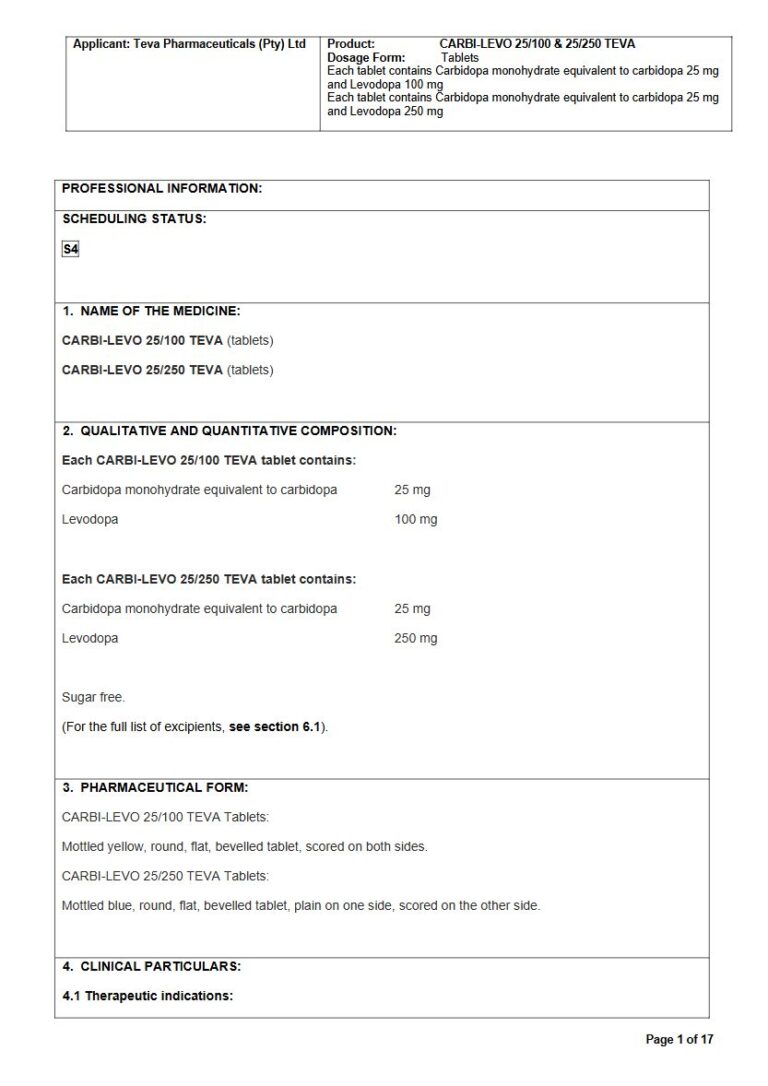
PDF Leaflet Revision Date: 9 December 2024
Clinical Summary
Quick overview from the medicine insert
Indication
Treatment of Parkinson's disease and syndrome.
Dosage (summary)
Initial: 1 tablet of CARBI-LEVO 25/100 three times daily; max: 8 tablets/day.
Onset of Action / Duration
Onset: 1 day, Duration: up to 8 hours.
Special Populations
- Elderly
- Renal impairment
- Hepatic impairment
Pregnancy & Breastfeeding
Not recommended in pregnancy or breastfeeding.
Key Drug Interactions
- MAO inhibitors
- Antihypertensives
- Tricyclic antidepressants
- Iron supplements
Contraindications
- Hypersensitivity to components
- Narrow-angle glaucoma
- Severe heart failure
- Severe psychosis
Common side effects
- Dyskinesia
- Nausea
- Confusion
- Depression
- Orthostatic hypotension
Counselling Points
- Monitor for dyskinesias
- Avoid abrupt discontinuation
- Caution with driving or operating machinery
Serious warnings
- Risk of sudden sleep onset
- Dopamine Dysregulation Syndrome
- Impulse control disorders
Important Disclaimer
The Teva Carbi-Levo 25 mg/100 mg/250 mg Tablets professional information leaflet below is the property of Teva Pharmaceuticals and is provided on Medinsert exactly as issued, with no.. alterations or editorial changes. We make every effort to keep content current by updating documents as soon as new versions become available. Medinsert serves as a trusted access point for healthcare professionals, but does not replace official sources or clinical judgement. For more details, please read our full disclaimer. read more>>
 Healthcare Professionals Only
This content is for registered healthcare professionals
Sign in or create a free account to read the full package insert.
Free for HPCSA-registered professionals. Powered by Medinsert.
Clinical Particulars
Section 4 of the official insert — extracted exactly as issued, no alterations
4.1 Therapeutic indications
CARBI - LEVO TEVA is indicated for the treatment of Parkinson's disease and syndrome. CARBI - LEVO TEVA may relieve many of the symptoms of Parkinsonism, particularly rigidity and bradykinesia, and aid in the management of tremor, dysphagia, sialorrhoea and postural instability associated with Parkinson's disease and syndrome. When response to levodopa alone is irregular, the substitution of CARBI-LEVO TEVA reduces fluctuations in response. CARBI-LEVO TEVA may be given to patients with Parkinson's disease and syndrome, who are taking vitamin preparations that contain pyridoxine hydrochloride (Vitamin B 6).
4.2 Posology and method of administration
General considerations: The optimum daily dose must be determined by careful titration in each patient. This may require the adjusting of both the individual dose and the frequency of administration. CARBI - LEVO TEVA tablets are available in a ratio of 1:4 (25 mg/100 mg) or 1:10 (25 mg/250 mg) of carbidopa and levodopa, thus permitting fine adjustment of the dose of either medicine in individual patients. Tablets of the two ratios may be given separately or combined as needed to provide the optimum dosage. Studies have shown that the peripheral enzyme dopa-decarboxylase is fully saturated by doses of 70 mg to 100 mg of carbidopa per day. Patients receiving less than this amount of carbidopa are more likely to experience nausea and vomiting. Other anti-parkinsonism preparations, with the exception of levodopa alone, may be continued while CARBI-LEVO TEVA is being administered. Such a dosage regimen may necessitate adjustment of the dosage of these medicines. If general anaesthesia is required, therapy with CARBI-LEVO TEVA may be continued as long as the patient is permitted to take fluid and medicines by mouth, and should be restarted at the same daily dosage as before, as soon as oral intake is resumed.
Patients not presently receiving levodopa: Dosage is best initiated with one tablet of CARBI-LEVO 25/100 TEVA, three times daily. This dosage schedule provides 75 mg of carbidopa per day. Dosage may be increased by one CARBI-LEVO 25/100 TEVA tablet every day or every other day, as necessary, until a dosage equivalent to 8 tablets of CARBI-LEVO 25/100 TEVA (i.e. 200 mg carbidopa) per day is reached. For patients starting with CARBI-LEVO TEVA the initial dose is half a tablet taken once or twice daily. However, this may not provide the optimal daily dose of carbidopa required by many patients. If necessary, add half a tablet every day or every other day until optimal response is reached. Response has been observed in one day, and sometimes even after one dose. Fully effective doses are usually attained within seven days, as compared to weeks or months with levodopa alone.
Patients presently receiving levodopa therapy: Both therapeutic and adverse effects are seen more rapidly with CARBI-LEVO TEVA than with levodopa alone. Patients should therefore be carefully monitored during the dosage adjustment period. Involuntary movements, particularly blepharospasm, are a useful early indication of excess dosage in some patients. The occurrence of involuntary movements may require dosage reduction. Levodopa monotherapy must be discontinued at least 12 hours (24 hours for slow-release preparations) before starting therapy with CARBI-LEVO TEVA. It is advisable to administer CARBI-LEVO TEVA as the first morning dose after a night without any levodopa. The dose of CARBI-LEVO TEVA should be approximately 20 % of the previous daily dosage of levodopa. Patients who are taking less than 1500 mg of levodopa per day should be started on one tablet of CARBI-LEVO 25/100 TEVA three to four times a day, depending on patient requirements. Patients taking more than 1500 mg of levodopa per day may be initiated on one tablet of CARBI-LEVO 25/250 TEVA, three or four times a day.
Maintenance therapy: At least 70 to 100 mg of carbidopa per day should be provided for optimal inhibition of extra-cerebral decarboxylation of levodopa. CARBI - LEVO TEVA therapy should be individualised and adjusted gradually according to response. Where more levodopa is required, CARBI-LEVO 25/250 TEVA should be substituted for CARBI-LEVO 25/100 TEVA at a dosage of one tablet three or four times a day. The dosage may be increased by half to one tablet every day or every other day, to a maximum of eight tablets a day.
Maximum recommended dose: The daily intake of carbidopa should not exceed 200 mg per day as experience with a dosage of more than 200 mg carbidopa per day is limited. Calculated for a patient weighing 70 kg, eight tablets of CARBI-LEVO 25/250 TEVA per day (200 mg carbidopa and 2 g levodopa) are equivalent to approximately 3 mg/kg carbidopa and 30 mg/kg levodopa. Patients receiving other anti-parkinsonism medicines: The combination of CARBI-LEVO TEVA with monoamine-oxidase B inhibitors such as selegiline has been reported to improve the efficacy of CARBI-LEVO TEVA in controlling episodes of akinesia and/or dyskinesia. Use in the elderly: There is extensive experience in the use of this product in elderly patients. The recommendations set out above reflect the clinical data from this experience. Treatment with CARBI-LEVO TEVA should not be stopped abruptly.
4.3 Contraindications
- CARBI-LEVO TEVA is contraindicated in patients with known hypersensitivity to carbidopa, levodopa or any of the excipients of CARBI-LEVO TEVA.
- Nonselective monoamine oxidase inhibitors (MAO) (except for low doses of selective MAO-B inhibitors, such as selegiline) should not be given concomitantly with CARBI-LEVO TEVA (see section 4.5). These MAO inhibitors must be discontinued at least 2 weeks prior to initiating therapy with CARBI-LEVO TEVA.
- CARBI-LEVO TEVA should not be administered to patients with narrow-angle glaucoma.
- Levodopa may activate a malignant melanoma, therefore CARBI-LEVO TEVA should not be used in patients with suspicious, undiagnosed skin lesions, or a history of melanoma.
- CARBI-LEVO TEVA is contraindicated in patients with severe heart failure or severe cardiac dysrhythmia.
- CARBI-LEVO TEVA is contraindicated in patients with severe psychosis.
- Children: The safety and efficacy in children under the age of 18 have not been established.
- CARBI-LEVO TEVA is contraindicated in pregnancy and lactation (see section 4.6).
4.4 Special warnings and precautions for use
CARBI-LEVO TEVA is not recommended for the treatment of medicine-induced extrapyramidal reactions. CARBI-LEVO TEVA may be given to patients already receiving levodopa alone; however, the levodopa alone must be discontinued at least 12 hours before CARBI-LEVO TEVA is started. CARBI-LEVO TEVA should be substituted at a dosage that will provide approximately 20 % of the previous levodopa dosage (see section 4.2).
Levodopa has been associated with somnolence and episodes of sudden sleep onset. Sudden onset of sleep during daily activities, in some cases without awareness or warning signs, has been reported very rarely. Patients must be informed of this and advised to exercise caution while driving or operating machines during treatment with levodopa. Patients who have experienced somnolence and/or an episode of sudden sleep onset must refrain from driving or operating machines. Furthermore, a reduction of dosage or termination of therapy may be considered.
Dyskinesias may occur in patients previously treated with levodopa alone, because carbidopa permits more levodopa to reach the brain, thereby increasing dopamine formation. The occurrences of dyskinesias may require dosage reduction. As with levodopa, CARBI-LEVO TEVA may cause involuntary movements and mental disturbances. Patients with a history of severe involuntary movements or psychotic episodes during treatment with levodopa alone should be closely monitored when treatment with CARBI-LEVO TEVA is initiated in place of levodopa. These reactions are believed to be due to increased levels of dopamine in the brain following the administration of levodopa and the use of CARBI-LEVO TEVA may cause a recurrence. Dosage reduction may be required.
Dyskinesias are the most serious dose-limiting adverse effect of CARBI-LEVO TEVA, and the frequency increases with duration of treatment. Involuntary movements of the face, tongue, lips and jaw appear first, and those of the trunk and extremities later. Severe generalised choreoathetoid and dystonic movements may occur after prolonged administration. Muscle twitching and blepharospasm may be early signs of excessive dosage.
Exaggerated respiratory movements and exacerbated oculogyric cases have been reported in patients with post-encephalitic Parkinsonism. All patients should be monitored carefully for the development of mental changes, depression with suicidal tendencies and other serious anti-social behaviour. Patients who have psychiatric disturbances or psychoses should be treated with caution and dose reduction of CARBI-LEVO TEVA is required. If an existing psychosis worsens, CARBI-LEVO TEVA should be reduced or discontinued. Caution should be exercised with concomitant administration of psychoactive medicines and CARBI-LEVO TEVA (see section 4.5). Psychotic reactions are more likely in patients with post-encephalitic parkinsonism or a history of mental disorders. Psychiatric symptoms occur in a high proportion of patients; particularly the elderly.
CARBI-LEVO TEVA should be administered cautiously in patients with open-angle glaucoma; severe cardiovascular or pulmonary disease; bronchial asthma; renal, hepatic or endocrine disease; Cushingu2019s syndrome or a history of gastric or duodenal ulceration and haematemesis (due to the possibility of upper gastro-intestinal haemorrhage). Care should be taken when CARBI-LEVO TEVA is administered to patients with a history of myocardial infarction who have atrial, nodal or ventricular dysrhythmias. Cardiac function should be monitored with particular care in such patients during the period of initial dosage administration and titration.
Concomitant administration of psycho-active medicines such as phenothiazines or butyrophenones should be carried out with caution, and the patient carefully observed for loss of antiparkinsonian effect. Patients with a history of convulsions should be treated with caution. Patients with chronic wide-angle glaucoma may be treated cautiously with CARBI-LEVO TEVA, provided that the intra-ocular pressure is well controlled, and the patient closely monitored for changes in intra-ocular pressure during therapy.
The control of the diabetic patient with hypoglycaemic medicines may be adversely affected by treatment with levodopa. The blood sugar should be monitored and the treatment regimen adjusted where necessary. Periodic evaluations of hepatic, haematopoietic, cardiovascular and renal functions are recommended during extended therapy.
CARBI-LEVO TEVA may cause a syndrome resembling the neuroleptic malignant syndrome. Symptoms including muscular rigidity; elevated body temperature; mental changes; and increased serum creatinine phosphokinase have been reported with the abrupt withdrawal of anti-parkinsonian medicines. Any abrupt dosage withdrawal or reduction of CARBI-LEVO TEVA should be closely monitored, particularly in patients who are also receiving neuroleptic medicines.
Melanoma: Studies have shown that patients with Parkinsonu2019s disease have a higher risk (2- to approximately 6-fold higher) of developing melanoma than the general population. Therefore patients and caregivers are advised to monitor for melanomas frequently and on a regular basis when using CARBI-LEVO TEVA for any indication. Periodic skin examinations should be performed by appropriately qualified physicians (e.g. dermatologists).
Close monitoring is necessary in patients with a history of orthostatic hypotension, especially at the beginning of CARBI-LEVO TEVA treatment. Symptomatic orthostatic hypotension may require treatment.
Dopamine Dysregulation Syndrome (DDS) is an addictive disorder resulting in excessive use of CARBI-LEVO TEVA seen in some patients treated with carbidopa/levodopa. Before initiation of CARBI-LEVO TEVA treatment, patients and caregivers should be warned of the potential risk of developing DDS (see section 4.8). Affected patients show a compulsive pattern of dopaminergic medicine misuse above doses adequate to control motor symptoms, which may in some cases result in severe dyskinesias.
Impulse control disorders: Patients should be regularly monitored for the development of impulse control disorders. Patients and care givers should be made aware that behavioural symptoms of impulse control disorders including pathological gambling, increased libido, hypersexuality, compulsive spending or buying, binge eating or compulsive eating can occur in patients treated with dopamine agonists and/or other dopaminergic treatments containing levodopa, including CARBI-LEVO TEVA. Review of treatment is recommended if such symptoms develop.
Care should be taken with concurrent administration of reserpine (see section 4.5).
Use in children: The safety and effectiveness of CARBI-LEVO TEVA in infants and children have not been established, and its use in patients below the age of 18 is not recommended.
4.5 Interaction with other medicines and other forms of interaction
Caution should be exercised when the following medicines are administered with CARBI-LEVO TEVA.
Monoamine Oxidase Inhibitors: The monoamine oxidase (MAO) inhibitor should be discontinued at least 2 weeks prior to initiating therapy with CARBI-LEVO TEVA. Concomitant therapy with selegiline (MAO-B inhibitor) and CARBI-LEVO TEVA may be associated with severe orthostatic hypotension, not attributable to carbidopa-levodopa alone (see section 4.3).
Antihypertensives: Postural hypotension may be induced when CARBI-LEVO TEVA are administered to patients who are already receiving antihypertensive medicines. An adjustment in the dosage of the antihypertensive preparation may be required.
Tricyclic antidepressants: Less frequently, reactions including hypertension and dyskinesia have been reported with the concomitant use of tricyclic antidepressants.
Iron: Studies demonstrate a decrease in the bioavailability of carbidopa and/or levodopa when it is ingested with ferrous sulphate or ferrous gluconate.
Dopamine D2 receptor agonists (Phenothiazines, butyrophenones and risperidone): Phenothiazines, butyrophenones and risperidone may reduce the therapeutic effect of levodopa. Patients receiving these medicines with CARBI-LEVO TEVA should be closely monitored.
Phenytoin, isoniazid and papaverine: Phenytoin, papaverine and isoniazid are known to reverse the therapeutic effect of levodopa. Patients taking these medicines in combination with CARBI-LEVO TEVA should be closely monitored for loss of therapeutic response.
Dopamine depleting medicines: The use of CARBI-LEVO TEVA with dopamine-depleting medicines (e.g. reserpine and tetrabenazine) or other medicines known to deplete monoamine stores is not recommended.
Amino acids: Due to competition of levodopa with certain amino acids for absorption, a high protein diet may impair the uptake of carbidopa and levodopa in some patients.
Anticholinergic medicines: Anticholinergic medicines can work synergistically with levodopa, in order to improve tremor. Concurrent use can, however, cause a worsening of involuntary motor disorders. Anticholinergic medicines may impair the effect of levodopa, due to a delayed absorption. A dose adjustment of levodopa may be required.
Other medicines: Neuroleptics may attenuate the therapeutic effect of levodopa. This combination is not recommended (see section 4.4). If necessary the lowest dose of both medicines should be used. Benzodiazepines may attenuate the therapeutic effect of levodopa. Sympathomimetic medicines may potentiate the adverse cardiovascular effects of levodopa.
Laboratory tests: Transient, abnormally elevated blood urea, AST (SGOT), ALT (SGPT), lactic dehydrogenase, bilirubin, alkaline phosphatase, and protein-bound iodine levels may be observed. Commonly, the levels of blood urea, creatinine and uric acid tend to be lower following the administration of CARBI-LEVO TEVA, than with levodopa alone. Decreased haemoglobin and haematocrit levels; as well as elevated serum glucose and white blood cells, bacteria and blood in the urine have been reported. A positive response to the direct Coombs test may occur, usually without evidence of haemolysis, although rare cases of auto-immune haemolytic anaemia have been reported.
CARBI-LEVO TEVA may result in a false-positive urine dipstick test for ketone bodies in the determination of ketonuria, which is not altered by boiling the urine. The use of glucose oxidase methods may yield false-negative results when testing for glycosuria.
4.6 Fertility, pregnancy and lactation
The safety of CARBI-LEVO TEVA in pregnancy has not been established. As teratogenicity has been demonstrated in experimental animals, the use of CARBI-LEVO TEVA in women of childbearing potential requires that the anticipated benefit of CARBI-LEVO TEVA be weighed against possible hazards should pregnancy occur. It is preferable to delay the administration of CARBI-LEVO TEVA after the first trimester; in case of no possibility to delay the beginning of treatment or no alternative, prenatal monitoring is necessary.
The safety of CARBI-LEVO TEVA in breastfeeding mothers has not been established. Breastfeeding during treatment with CARBI-LEVO TEVA is not recommended.
4.7 Effects on ability to drive and use machines
Levodopa has been associated with somnolence and episodes of sleep onset. Sudden onset of sleep during daily activities, in some cases without awareness or warning signs has been reported rarely. Patients must be informed of this and advised to exercise caution while driving or operating machines during CARBI-LEVO TEVA treatment. Patients who have experienced somnolence and/or an episode of sudden sleep onset must refrain from driving or operating machines, until these recurrent episodes or the somnolence have subsided. In addition, a dose reduction or discontinuation of CARBI-LEVO TEVA treatment should be considered.
4.8 Undesirable effects
The side effects which occur most frequently with CARBI-LEVO TEVA are those resulting from the central neuropharmacological activity of dopamine. A reduction in dosage usually diminishes these reactions. Most frequently, dyskinesia including choreiform, dystonic and other involuntary movements are observed. Muscle twitching and blepharospasm may be early signs of excessive dosage, necessitating dosage reduction. Other serious side effects are mental changes, including paranoid ideation and psychotic episodes; depression with or without suicidal behaviour; and dementia. Nausea is a frequent, although less serious side effect. Less frequent side effects include cardiac dysrhythmias; palpitations; orthostatic hypotension (usually asymptomatic, but sometimes associated with faintness and dizziness); bradykinesia in the form of u2018end of doseu2019 deterioration and the u2018on-offu2019 phenomenon; anorexia; vomiting and somnolence.
Possible side effects with CARBI-LEVO TEVA include:
- Infections and infestations: Frequent: Urinary tract infections.
- Neoplasms benign and malignant (including cysts and polyps): Less frequent: Malignant melanoma.
- Blood and the lymphatic system disorders: Less frequent: Phlebitis, transient leucopenia, haemolytic and non-haemolytic anaemia, thrombocytopenia and agranulocytosis.
- Immune system disorders: Less frequent: Angioedema.
- Metabolism and nutrition disorders: Frequent: Anorexia. Less frequent: Weight gain or loss.
- Psychiatric disorders: Frequent: Confusion, nightmares, delusions, hallucinations, depression with or without suicidal behaviour, insomnia, euphoria, exhaustion. Less frequent: Agitation, anxiety, fear, thought disorders, disorientation, drowsiness, aggression, paranoid, delirium, dementia, increased libido, psychotic episodes including delusions and paranoid ideation, torpor, pathological (compulsive) gambling, hypersexuality, compulsive spending/buying and binge/compulsive eating. Frequency unknown: Dopamine dysregulation syndrome (see section 4.4).
- Nervous system disorders: Frequent: Dyskinesias, bradykinetic episodes (the u2018on-offu2019 phenomenon), dizziness, dystonia, headache, paraesthesia. Less frequent: Chorea, decreased mental acuity, extrapyramidal and movement disorders, falling, gait abnormalities, somnolence including less frequently excessive daytime somnolence and sudden onset of sleep episodes, activation of latent Horner's syndrome, ataxia, convulsions, faintness, numbness, increased hand tremor, sense of stimulation, trismus, neuroleptic malignant syndrome.
- Eye disorders: Less frequent: Diplopia, blepharospasm, blurred vision, dilated pupils, oculogyric crisis, gaze spasms.
- Cardiovascular disorders: Less frequent: Cardiac dysrhythmias, palpitations, cardiac irregularities.
- Vascular disorders: Frequent: Orthostatic effects including hypotensive episodes, fainting, syncope. Less frequent: Flushing, hot flashes, hypertension, phlebitis.
- Respiratory, thoracic and mediastinal disorders: Frequent: Dyspnoea. Less frequent: Chest pain, exaggerated respiratory movements, hoarseness.
- Gastrointestinal disorders: Frequent: Nausea, vomiting, bruxism, abdominal pain, constipation, diarrhoea, dry mouth, dyspepsia. Less frequent: Gastrointestinal bleeding, duodenal ulceration, bitter taste, hiccups, burning sensation of the tongue, gastrointestinal pain, dark saliva, dysphagia, flatulence, sialorrhoea.
- Skin and subcutaneous tissue disorders: Less frequent: Increased perspiration, urticaria, pruritus, rash, hair loss, discoloration of body fluids (dark sweat), Henoch-Schoenlein purpura, oedema, exanthema.
- Musculoskeletal, connective tissue and bone disorders: Frequent: Muscle cramps. Less frequent: Muscle twitching.
- Renal and urinary disorders: Less frequent: Urinary retention, urinary incontinence, red-coloured urine which darkens on standing.
- Reproductive system and breast disorders: Less frequent: Priaprism.
- General disorders and administrative site conditions: Frequent: Weakness, fatigue, faintness, malaise. Less frequent: Asthenia.
- Investigations: Less frequent: Increased alkaline phosphatase, increased AST & ALT, increased lactic dehydrogenase, increased bilirubin, increased blood urea, increased creatinine, increased uric acid, decreased haemoglobin, decreased haematocrit, elevated serum glucose, increased white blood cells.
4.9 Overdose
Initial hypertension followed by hypotension, sinus tachycardia, symptomatic prolonged postural hypotension lasting up to a week, marked confusion, agitation, insomnia, and restlessness which lasted for more than a week have been reported with overdosage. Severe anorexia and insomnia persisted for 2 to 3 weeks. Treatment is symptomatic and supportive. Management of acute overdosage with CARBI-LEVO TEVA is the same as management of acute overdosage with levodopa. Immediate gastric lavage is advisable. Intravenous fluid should be administered judiciously and an adequate airway maintained. Pyridoxine is not effective in reversing the actions of CARBI-LEVO TEVA. Electrocardiographic (ECG) monitoring should be instituted, and the patient observed for the possible development of dysrhythmias. If necessary, appropriate anti-dysrhythmic therapy should be given. To date, no experience is available on the use of dialysis, and its value in the treatment of overdosage with CARBI-LEVO TEVA is not known.
