
Thalidomide 50 Mg Capsules
PDF Leaflet Revision Date: 2 December 2024
Clinical Summary
Quick overview from the medicine insert
Indication
Treatment of multiple myeloma and erythema nodosum leprosum.
Dosage (summary)
200 mg daily for multiple myeloma; 400 mg daily for erythema nodosum leprosum.
Special Populations
- Elderly
- Renal impairment
- Hepatic impairment
Pregnancy & Breastfeeding
Contraindicated in pregnancy; use effective contraception.
Key Drug Interactions
- Increased sedation with CNS depressants
- Caution with drugs causing bradycardia
- Increased risk of peripheral neuropathy with certain drugs
Contraindications
- Pregnancy
- Breastfeeding
- Hypersensitivity
- Women of childbearing potential without contraception
- Males not complying with contraceptive measures
Common side effects
- Neutropenia
- Somnolence
- Peripheral neuropathy
- Constipation
- Fatigue
Counselling Points
- Use two reliable forms of contraception
- Avoid driving if drowsy
- Report any signs of severe skin reactions
- Monitor for signs of thromboembolism
Serious warnings
- Teratogenic effects
- Risk of thromboembolic events
- Severe skin reactions
- Progressive multifocal leukoencephalopathy
Important Disclaimer
The Thalidomide 50 Mg Capsules professional information leaflet below is the property of Key Oncologics and is provided on Medinsert exactly as issued, with no.. alterations or editorial changes. We make every effort to keep content current by updating documents as soon as new versions become available. Medinsert serves as a trusted access point for healthcare professionals, but does not replace official sources or clinical judgement. For more details, please read our full disclaimer. read more>>
 Healthcare Professionals Only
This content is for registered healthcare professionals
Sign in or create a free account to read the full package insert.
Free for HPCSA-registered professionals. Powered by Medinsert.
Clinical Particulars
Section 4 of the official insert — extracted exactly as issued, no alterations
4.1 Therapeutic indications
- THALIDOMIDE 50 mg BMS in combination with melphalan and prednisone is indicated for the treatment of patients with untreated multiple myeloma u2265 65 years or ineligible for high dose chemotherapy.
- THALIDOMIDE 50 mg BMS in combination with dexamethasone is indicated for the treatment of patients with untreated multiple myeloma.
- THALIDOMIDE 50 mg BMS is indicated for the treatment of relapsing or refractory multiple myeloma.
- THALIDOMIDE 50 mg BMS is indicated for the acute treatment of the cutaneous manifestations of moderate to severe erythema nodosum leprosum (ENL).
- THALIDOMIDE 50 mg BMS is also indicated for the treatment of ENL relapses in patients who have been treated with thalidomide before.
4.2 Posology and method of administration
Prescription of THALIDOMIDE 50 mg BMS is restricted to patients who are registered in the THALIDOMIDE RISK MANAGEMENT PROGRAMME (TRMP). Medical doctors and pharmacists must also be registered in the THALIDOMIDE RISK MANAGEMENT PROGRAMME (TRMP) u2013 refer to details at the end of this heading.
Dosage in adults: To reduce central nervous system effects (e.g. drowsiness, somnolence, sedation) during the day, this dose is normally taken as a single dose in the evening.
The required total duration of treatment should be individually determined for each patient depending on tolerability and disease progression.
Patients with Untreated Multiple Myeloma
- In combination with melphalan and prednisone: The THALIDOMIDE 50 mg BMS recommended oral dose is 200 mg per day. A maximum number of 12 cycles of 6 weeks should be used.
- In combination with dexamethasone: The THALIDOMIDE 50 mg BMS recommended oral dose is 200 mg per day.
After Failure of Standard Therapies
- Dosing should be initiated at 200 mg daily orally and increased by 100 mg at weekly intervals to a maximum dose of 400 mg daily according to tolerance and toxicity. Depending on tolerance and observed toxicity, lower maintenance doses can be used.
Erythema nodosum leprosum (ENL): Dosing should be initiated at 400 mg daily orally as a single dose taken at night, this should be continued for one to four weeks depending on clinical response and then decreased by up to 100 mg every 2 weeks to establish a maintenance dose of 50 mg daily according to efficacy, tolerance and toxicity. The required total duration of treatment should be individually determined in each patient, depending on disease history, ENL severity and frequency of ENL recurrences. A minimal total duration of treatment of 7 weeks is recommended. In patients weighing less than 50 kg, the initial dose should be 300 mg daily.
Special populations
- Elderly population: No specific dose adjustments are recommended for the elderly.
- Renal impairment: Specific dose recommendations in patients with renal disease have not been established. Since renal insufficiency is common among patients with multiple myeloma as a complication of their disease, the recommended dosage in adults has been established in populations of patients including patients with reduced renal function. In general, doses in patients with renal disease should be titrated against observed tolerance and toxicity and the highest tolerated dose should be selected. Patients with severe renal impairment should be carefully monitored for adverse effects.
- Hepatic impairment: Specific dose recommendations in patients with hepatic disease have not been established. In general, doses in patients with hepatic disease should be titrated against observed tolerance and toxicity and the highest tolerated dose should be selected. Patients with severe hepatic impairment should be carefully monitored for adverse effects.
- Thromboembolic events: Thromboprophylaxis should be administered for at least the first 5 months of treatment especially in patients with additional thrombotic risk factors.
4.3 Contraindications
THALIDOMIDE 50 mg BMS is contraindicated in the following patients:
- patients with known hypersensitivity to the active ingredient or to any of the excipients,
- pregnant women (see Pregnancy and lactation in boxed WARNING as well as under section 4.4 and 4.6),
- those who are breastfeeding,
- women of childbearing potential who are not using, or not able to use adequate contraceptive measures to prevent pregnancy as outlined in the THALIDOMIDE RISK MANAGEMENT PROGRAMME (TRMP),
- sexually mature males who are not able or willing to comply with the contraceptive measures outlined in the THALIDOMIDE RISK MANAGEMENT PROGRAMME (TRMP),
- patients who, for whatever reasons, are unable to understand or comply with the instructions given in the THALIDOMIDE RISK MANAGEMENT PROGRAMME (TRMP).
4.4 Special warnings and precautions for use
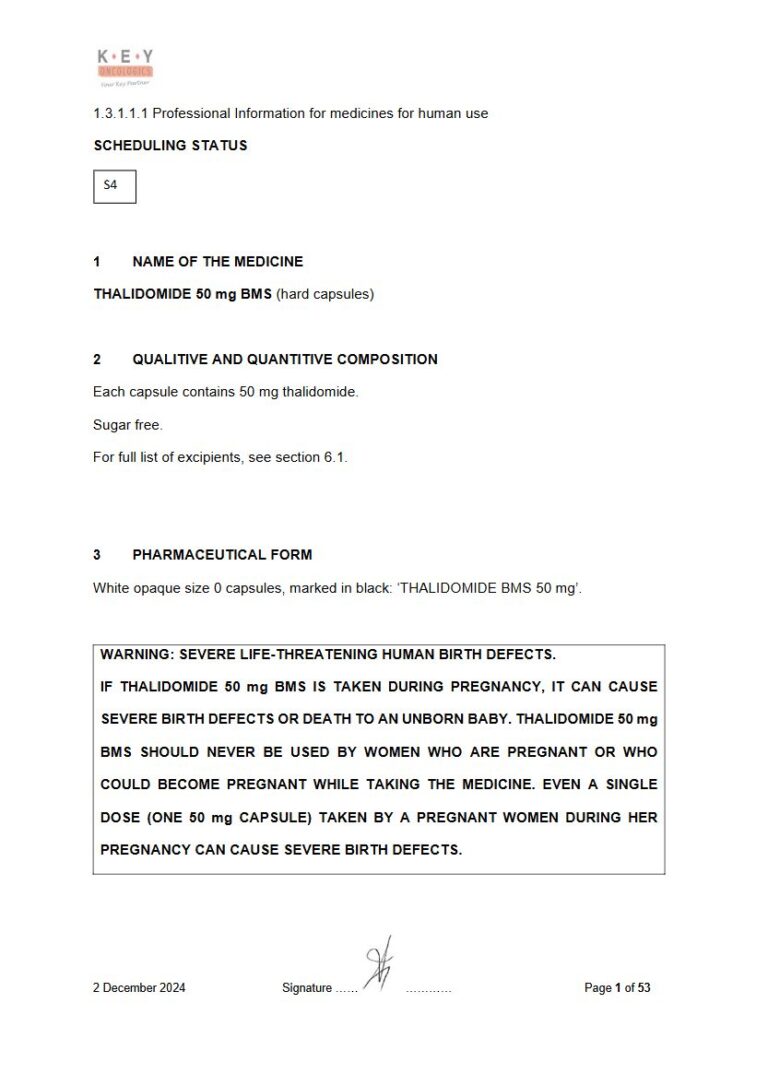
WARNINGS: Teratogenic effects u2013 (see sections 4.3 and 4.6 and use in pregnancy and lactation under boxed WARNINGS): If THALIDOMIDE 50 mg BMS is taken during pregnancy, it can cause severe birth defects or death to an unborn baby. A single dose (one capsule) taken by a pregnant woman during her pregnancy can cause severe birth defects. THALIDOMIDE 50 mg BMS should never be used by women who are pregnant, or in whom the risk to become pregnant while taking the medicine, or within 4 weeks after stopping it, cannot be excluded.
Because of this toxicity and in an effort to reduce the chance of foetal exposure to thalidomide, THALIDOMIDE 50 mg BMS is approved for marketing only under a special risk management programme. This programme is called the THALIDOMIDE RISK MANAGEMENT PROGRAMME (TRMP). Under this risk management programme, only physicians and pharmacists registered with the Thalidomide Risk Management Programme are allowed to prescribe and dispense THALIDOMIDE 50 mg BMS. In addition, patients must be advised of, agree to, register with and comply with the requirements of the programme in order to receive THALIDOMIDE 50 mg BMS.
Requirements and monitoring procedures applicable in all patients: THALIDOMIDE 50 mg BMS may be prescribed by any licensed prescriber who is registered in the risk management programme and understands the risk of teratogenicity if THALIDOMIDE 50 mg BMS is used during pregnancy. The use of THALIDOMIDE 50 mg BMS is restricted to those patients who have given their individual written agreement (or legal guardian as appropriate) to use the medicine as specified, by signing an informed consent form. The patientu2019s signature is only obtained after the patient has been fully informed of the potential side effects and risks with the medicine, its risk for foetal death and severe birth defects, its potential toxicity in children being breast-fed and the precautions that need to be taken before starting, during and after termination of THALIDOMIDE 50 mg BMS therapy.
THALIDOMIDE 50 mg BMS should be prescribed to a patient only after the prescribing medical practitioner has found the patient to be eligible to receive this treatment. The medical practitioner must perform all necessary investigations and inquiries as outlined in the THALIDOMIDE RISK MANAGEMENT PROGRAMME and determine that the potential benefits to the patient outweigh the potential risks of its use. In any patient, the actual prescription for THALIDOMIDE 50 mg BMS must not cover a treatment period of more than 28 days. Repeat prescriptions where a patient has not visited their medical practitioner are prohibited in the THALIDOMIDE RISK MANAGEMENT PROGRAMME (TRMP).
Before starting THALIDOMIDE 50 mg BMS in a patient and at each of the monthly visits of the patient, the medical practitioner should perform any tests required, and adequately counsel the patient with respect to the potential risks associated with THALIDOMIDE 50 mg BMS and the necessary precautions and warnings that must be taken into account including advice on contraceptive measures which must be used.
Any suspected adverse event that is observed in the patient during treatment with THALIDOMIDE 50 mg BMS or within 8 weeks after stopping the treatment must be reported immediately to SAHPRA via Med Safety APP (Medsafety X SAHPRA) and eReporting platform (who-umc.org) found on SAHPRA website and also to KEY ONCOLOGICS at telephone (011) 483 0060. Patients should be informed not to donate blood or semen during or within 8 weeks of stopping THALIDOMIDE 50 mg BMS treatment, and not to share THALIDOMIDE 50 mg BMS.
4.5 Interactions with other medicines
Thalidomide is a poor substrate for cytochrome P450 isoenzymes and therefore clinically important interactions with medicines that are inhibitors and/or inducers of this enzyme system are unlikely. Non-enzymatic hydrolysis of thalidomide, being the primary clearance mechanism, suggests that the potential for drug-drug interactions with thalidomide is low.
Increase of sedative effects of other medicines: Thalidomide has sedative properties, THALIDOMIDE 50 mg BMS may thus enhance the sedation induced by anxiolytics, hypnotics, antipsychotics, H1 antihistamines, opiate derivatives, barbiturates and alcohol. Caution should be used when THALIDOMIDE 50 mg BMS is given in combination with medicines that cause drowsiness.
Bradycardic effect: Due to thalidomideu2019s potential to induce bradycardia, caution should be exercised with medicines having the same pharmacodynamic effect such as active substances known to induce torsade de pointes, beta blockers or anticholinesterase agents.
Medicines known to cause peripheral neuropathy: Medicines known to be associated with peripheral neuropathy (e.g. vincristine and bortezomib) should be used with caution in patients receiving THALIDOMIDE 50 mg BMS. Increased risk of peripheral neuropathy has been reported in combination with zalcitabine, didanosine and stavudine.
Hormonal contraceptives: Thalidomide does not interact with hormonal contraceptives. In 10 healthy women, the pharmacokinetic profiles of norethindrone and ethinyl estradiol following administration of a single dose containing 1.0 mg of norethindrone acetate and 0.75 mg of ethinyl estradiol were studied. The results were similar with and without co-administration of THALIDOMIDE BMS 200 mg/day to steady-state levels. However, combined hormonal contraceptives are not recommended due to the increased risk of venous thromboembolic disease.
Warfarin: Multiple dose administration of 200 mg THALIDOMIDE BMS q.d. for 4 days had no effect on the international normalized ratio (INR) in healthy volunteers. However, due to the increased risk of thrombosis in cancer patients, and a potentially accelerated metabolism of warfarin with corticosteroids, close monitoring of INR values is advised during thalidomide-prednisone combination treatment as well as during the first weeks after ending these treatments.
Digoxin: Thalidomide does not interact with digoxin. In 18 healthy male volunteers, multiple dose administration of 200 mg thalidomide had no apparent effect on the single dose pharmacokinetics of digoxin. In addition, single dose administration of 0.5 mg digoxin had no apparent effect on thalidomide pharmacokinetics. It is not known whether the effect will be different in multiple myeloma patients.
Important non-THALIDOMIDE 50 mg BMS medicine interactions - medicines that interfere with hormonal contraceptives: Concomitant use of cytochrome P450 inducing agents such as lopinavir, nevirapine, efavirenz, griseofulvin, rifampin, rifabutin, phenytoin, or carbamazepine with hormonal contraceptive agents, may reduce the effectiveness of the contraception. Therefore, women of childbearing potential requiring treatment with one or more of these medicines must use two other effective methods of contraception.
4.6 Fertility, pregnancy and lactation
Women of childbearing potential must use one effective method of contraception for at least 4 weeks before start of treatment, during treatment including during dose interruptions, and until at least 4 weeks after THALIDOMIDE 50 mg BMS treatment (see section 4.4). If pregnancy occurs in a woman treated with THALIDOMIDE 50 mg BMS, treatment must be stopped immediately and the patient should be referred to a doctor specialised or experienced in teratology for evaluation and advice.
As thalidomide is found in semen, as a precaution all male patients must use condoms during treatment, during dose interruption and for at least 7 days following discontinuation of treatment when having sexual intercourse with a pregnant woman or with a woman of childbearing potential who is not using effective contraception. This applies even if the man has had a vasectomy. If pregnancy occurs in a partner of a male patient taking thalidomide, the female partner should be referred to a doctor specialised or experienced in teratology for evaluation and advice.
Pregnancy: THALIDOMIDE 50 mg BMS is contraindicated during pregnancy and in women of childbearing potential unless all the conditions of the Pregnancy Prevention Programme are met (see section 4.3). Thalidomide is a powerful human teratogen, inducing a high frequency (about 30 %) of severe and live-threatening birth defects such as: ectromelia (amelia, phocomelia, hemimelia) of the upper and/or lower extremities, microtia with abnormality of the external acoustic meatus (blind or absent), middle and internal ear lesions (less frequent), ocular lesions (anophthalmia, microphthalmia), congenital heart disease, renal abnormalities. Other less frequent abnormalities have also been described.
Breastfeeding: It is unknown whether THALIDOMIDE 50 mg BMS is excreted in human breast milk. Animal studies have shown excretion of thalidomide in breast milk. Therefore, breastfeeding should be discontinued during treatment with thalidomide.
Fertility: A study in rabbits demonstrated no effect on fertility indices in males or females although testicular degeneration was observed in males.
4.7 Effects on ability to drive and use machines
THALIDOMIDE 50 mg BMS as per the recommended posology has minor or moderate influence on the ability to drive and use machines. THALIDOMIDE 50 mg BMS may cause fatigue (very common), dizziness (very common), somnolence (very common) and blurred vision (common) (see section 4.8). Patients should be instructed not to drive cars, use machines or perform hazardous tasks while being treated with thalidomide if they feel tired, dizzy, sleepy or have blurred vision.
4.8 Undesirable effects
Summary of the safety profile: Most patients taking THALIDOMIDE 50 mg BMS can be expected to experience adverse reactions. The most commonly observed adverse reactions associated with the use of THALIDOMIDE 50 mg BMS in combination with melphalan and prednisone are: neutropenia, leukopenia, constipation, somnolence, paraesthesia, peripheral neuropathy, anaemia, lymphopenia, thrombocytopenia, dizziness, dysaesthesia, tremor and peripheral oedema. In addition to the adverse reactions outlined above, THALIDOMIDE 50 mg BMS in combination with dexamethasone in other clinical studies led to the very common adverse reaction of fatigue; common adverse reactions of transient ischaemic event, syncope, vertigo, hypotension, mood altered, anxiety, blurred vision, nausea and dyspepsia; and uncommon adverse reactions of cerebrovascular accident, diverticular perforation, peritonitis, orthostatic hypotension and bronchitis.
The most clinically important adverse reactions associated with the use of thalidomide in combination with melphalan and prednisone or dexamethasone include deep vein thrombosis and pulmonary embolism, peripheral neuropathy, severe skin reactions including Stevens-Johnson syndrome, toxic epidermal necrolysis and drug reaction with eosinophilia and systemic symptoms, syncope, bradycardia, and dizziness (see sections 4.2, 4.4 and 4.5).
4.9 Overdose
Eighteen cases of overdose have been reported in the literature concerning doses up to 14.4 grams. In thirteen of these cases, patients took thalidomide alone; amounts ranged from 350 mg to 4000 mg. These patients either exhibited no symptoms or exhibited symptoms of drowsiness, irritability, u201csickness,u201d and/or headache. In one 2-year-old child who took 700 mg, there was an abnormal plantar response in addition to drowsiness and irritability. No fatalities have been reported and all overdose patients recovered without sequelae. There is no specific antidote for a thalidomide overdose. In the event of an overdose, the patientu2019s vital signs should be monitored and appropriate supportive care given to maintain blood pressure and respiratory status.
