
Tobradex 1mg Eye Drops
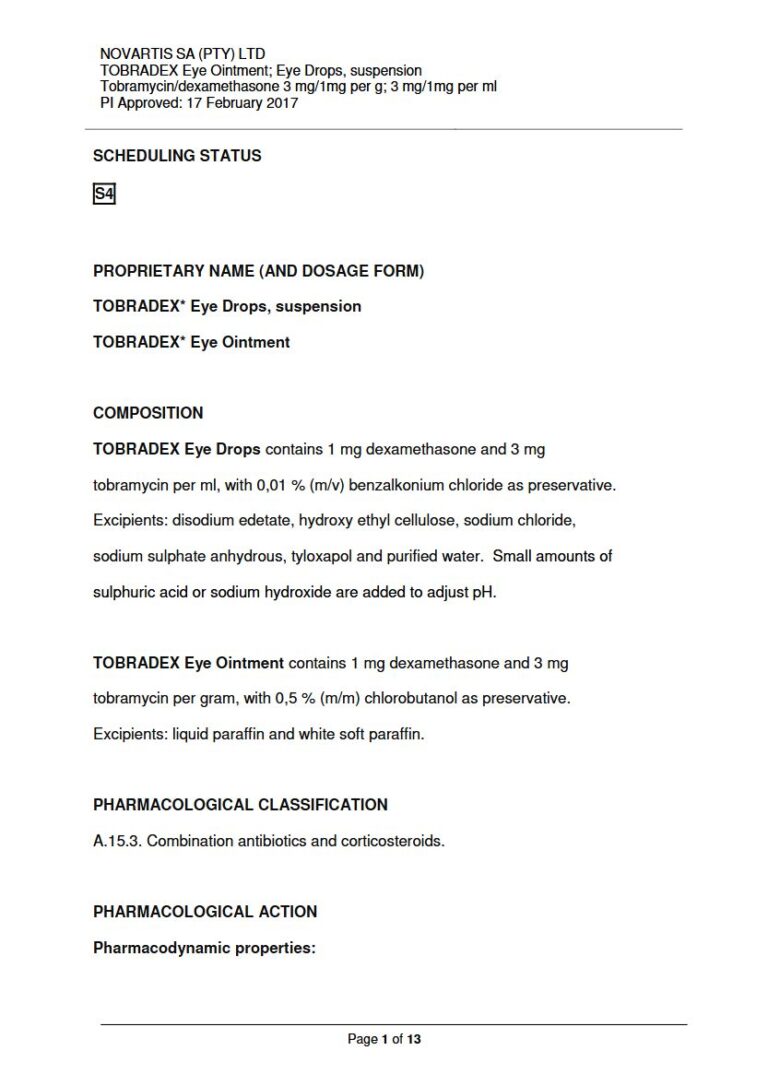
PDF Leaflet Revision Date: 17 February 2017
Clinical Summary
Quick overview from the medicine insert
Indication
Reduction of ocular inflammation and prophylaxis of infection post-surgery.
Dosage (summary)
Eye Drops: 1 drop every 4 hours pre-surgery, 2 drops every 2 hours post-surgery for 2 days, then 1 drop 4 times daily for 1 week. Eye Ointment: 1.5 cm ribbon 3 times daily pre-surgery, then 3 times daily post-surgery for 9 days.
Special Populations
- Children
- Glaucoma patients
Pregnancy & Breastfeeding
Safety during pregnancy not established; caution advised during breastfeeding.
Key Drug Interactions
- Topical NSAIDs may delay corneal healing
Contraindications
- Hypersensitivity to components
- Herpes simplex keratitis
- Fungal ocular diseases
- Mechanical lacerations
Common side effects
- Increased intraocular pressure
- Eye pain
- Eye irritation
- Blurred vision
Counselling Points
- Avoid contact lenses during treatment
- Wait 15 minutes before reinserting contact lenses after application
- Report any signs of infection immediately
Serious warnings
- Prolonged use may cause glaucoma
- Monitor intraocular pressure if used for 10 days or longer
Important Disclaimer
The Tobradex 1mg Eye Drops professional information leaflet below is the property of Alcon Laboratories (Sa) and is provided on Medinsert exactly as issued, with no.. alterations or editorial changes. We make every effort to keep content current by updating documents as soon as new versions become available. Medinsert serves as a trusted access point for healthcare professionals, but does not replace official sources or clinical judgement. For more details, please read our full disclaimer. read more>>
 Healthcare Professionals Only
This content is for registered healthcare professionals
Sign in or create a free account to read the full package insert.
Free for HPCSA-registered professionals. Powered by Medinsert.
Clinical Particulars
Section 4 of the official insert — extracted exactly as issued, no alterations
4.1 Therapeutic indications
TOBRADEX Eye Drops and TOBRADEX Eye Ointment are indicated for the reduction of ocular inflammation and prophylaxis of infection due to susceptible organisms, following intraocular surgery.
4.2 Posology and method of administration
TOBRADEX Eye Drops: Instil one drop into the operative eye every four hours whilst awake for three days prior to surgery and one drop immediately upon conclusion of surgery. Beginning at the first dressing change one day following surgery, instil two drops every two hours whilst awake for two days. From post-operative day three, instil one drop into the eye four times a day for one week. Thereafter, instil one drop per day for ten days as maintenance therapy. Not more than 20 ml should be prescribed initially and the prescription should not be repeated without further evaluation as outlined under SPECIAL PRECAUTIONS. SHAKE WELL BEFORE USE. STORE UPRIGHT. When removing the cap for the first time, remove and discard the snap collar, in order to prevent the snap collar from falling into the patientu2019s eye.
TOBRADEX Eye Ointment: Apply approximately a 1,5 cm ribbon ointment strip into the operative eye three times a day, three days prior to surgery. Apply a 1,5 cm ribbon ointment strip into the eye immediately upon completing surgery. Beginning at the first dressing change on day one following surgery, apply a 1,5 cm ribbon ointment strip three times daily for the first nine days following surgery. For maintenance therapy apply a 1,5 cm ribbon ointment strip per day from day ten and continue till day twenty. Not more than 7 g should be prescribed initially and the prescription should not be refilled without further evaluation as outlined in WARNINGS & SPECIAL PRECAUTIONS. If more than one topical ophthalmic medicine is being used, the medicines must be administered at least 5 minutes apart. Eye ointments should be administered last.
4.3 Contraindications
Hypersensitivity to dexamethasone, tobramycin or any component of TOBRADEX. Epithelial herpes simplex keratitis (dendritic keratitis), vaccinia, varicella and many other viral diseases of the cornea and conjunctiva. Mycobacterial infection of the eye. Fungal diseases of ocular structures. The use of TOBRADEX is always contra-indicated after uncomplicated removal of a corneal foreign body. TOBRADEX should not be used in the treatment of mechanical lacerations and abrasions of the eye. TOBRADEX will delay healing and promote the development and spread of infection.
4.4 Special warnings and precautions for use
Prolonged use of TOBRADEX may result in ocular hypertension and/or glaucoma, with damage to the optic nerve, defects in visual acuity and fields of vision and posterior subcapsular cataract formation. Family or personal history of glaucoma has a higher risk of corticosteroid induced rise in intraocular pressure. A steroid glaucoma may be produced after a week or more of treatment in patients predisposed to chronic simple glaucoma. Topical corticosteroid therapy such as TOBRADEX frequently induces intraocular hypertension in normal eyes and increases pressure in eyes with initially elevated pressure. Glaucoma is not always reversible on cessation of corticosteroid treatment such as TOBRADEX. IF TOBRADEX IS USED FOR 10 DAYS OR LONGER, INTRAOCULAR PRESSURE SHOULD BE ROUTINELY MONITORED (WEEKLY FOR GLAUCOMA PATIENTS) EVEN THOUGH IT MAY BE DIFFICULT IN CHILDREN AND UNCOOPERATIVE PATIENTS. This is especially important in paediatric patients, as the risk of corticosteroid-induced ocular hypertension may be greater in children and may occur earlier than in adults. The local administration of corticosteroids such as TOBRADEX to the eyes of patients with bacterial, viral and fungal conjunctivitis may mask evidence of progression of infection until sight is lost. In those diseases causing thinning of the cornea or sclera, perforations have been known to occur with the use of the topical steroids such as TOBRADEX. Corneal ulceration may be aggravated when TOBRADEX is applied. It is important that corneal ulcers are correctly diagnosed before treatment with TOBRADEX is initiated. Concomitant use of topical steroids such as TOBRADEX and topical NSAIDs may delay corneal healing. TOBRADEX may reduce resistance to and aid in the development of bacterial, viral or fungal infections and mask the clinical signs of infection. Secondary infection: Prolonged use of corticosteroids such as TOBRADEX may suppress the host response and thus increase the hazard of secondary ocular infection. Corticosteroids such as TOBRADEX may cause progression of the dendritic keratitis (herpes simplex infection), resulting in irreversible clouding of the cornea. In acute purulent conditions of the eye, corticosteroids such as TOBRADEX may mask progression of infection until sight is lost or enhance existing infection. Fungal infections of the cornea are particularly prone to develop coincidentally with long-term applications of corticosteroids such as TOBRADEX. The possibility of fungal invasion must be considered in any persistent corneal ulceration where TOBRADEX treatment has been used. If fungal infection occurs, corticosteroid therapy should be discontinued. TOBRADEX should not be used for injection into the eye. Hyper-sensitivity to topically applied aminoglycosides may occur in some patients. If a hyper-sensitivity reaction does occur, discontinue use of TOBRADEX. Cross-hypersensitivity to other aminoglycosides can occur and the possibility that patients who become sensitised to topical tobramycin may also be sensitive to other topical and/or systemic aminoglycosides should be considered. Serious adverse reactions including neurotoxicity, ototoxicity and nephrotoxicity have occurred in patients receiving systemic aminoglycoside therapy. Caution is advised when used concomitantly. Contact lens wear is not recommended during treatment of an ocular inflammation or infection.
4.5 Interactions with other medicines
No specific interaction studies were performed. Concomitant use of topical steroids and topical NSAIDs may delay corneal healing.
4.6 Fertility, pregnancy and lactation
Pregnancy: The safety of TOBRADEX during pregnancy has not yet been established.
Lactation: It is not known whether TOBRADEX Eye Drops or TOBRADEX Eye Ointment is excreted in human milk; therefore caution should be observed when it is administered to mothers breast-feeding their infants.
4.7 Effects on ability to drive and use machines
Temporarily blurred vision or other visual disturbances with use of TOBRADEX may affect the ability to drive or use machines. If blurred vision occurs with application, the patient must wait until the vision clears before driving or using machinery. TOBRADEX Eye Drops contains benzalkonium chloride which may cause eye irritation and is known to discolour soft contact lenses. Avoid contact with soft contact lenses. In case patients are allowed to wear contact lenses, they must be instructed to remove contact lenses prior to application of TOBRADEX Eye Drops and wait at least 15 minutes before reinsertion. As the possibility of adverse effects on the corneal permeability and the danger of disruption of the corneal epithelium with prolonged or repeated usage of benzalkonium chloride preserved ophthalmological preparations such as TOBRADEX Eye Drops cannot be excluded, regular ophthalmological examination is required. Caution should be exercised in the use of benzalkonium chloride preserved topical medication such as TOBRADEX over an extended period in patients with extensive ocular surface disease.
4.8 Undesirable effects
The following adverse reactions have been reported during clinical trials with TOBRADEX and are classified according to the subsequent convention: very common (u2265 1/10), common (u2265 1/100 to <1/10), uncommon (u22651/1,000 to <1/100), rare (u22651/10,000 to <1/1,000) and very rare (<1/10,000). Within each frequency-grouping, adverse reactions are presented in order of decreasing seriousness.
System Organ Classification
Adverse reactions
Eye disorders
Uncommon: intraocular pressure increased, eye pain, eye pruritus, ocular discomfort, eye irritation
Rare: keratitis, eye allergy, vision blurred, dry eye, ocular hyperaemia
Gastro-intestinal disorders
Rare: dysgeusia
Adverse reactions identified from post-marketing surveillance include the following. Frequencies cannot be estimated from the available data.
System organ classification
Adverse reactions
Immune system disorders hypersensitivity
Nervous system disorders dizziness, headache
Eye disorders eyelid oedema, erythema of eyelid, mydriasis, lacrimation increased
Gastrointestinal disorders nausea, abdominal discomfort
Skin and subcutaneous tissue disorders rash, swelling face, pruritus
Side-effects have occurred with steroid/antibiotic combination medicines which can usually be attributed to either the steroid component or to the antibiotic component. The following adverse effects may occur following use of topical ophthalmic dexamethasone: Infections and Infestations Less frequent: eye infection (exacerbation or secondary). Endocrine Disorders Less frequent: adrenal suppression. Eye Disorders Less frequent: reduced visual acuity, glaucoma, visual field defects, subcapsular cataract, increased ocular pressure. General Disorders and Administration Site Conditions Less frequent: impaired healing. Injury, Poisoning and Procedural Complications Less frequent: optic nerve injury, corneal perforation.
The following adverse effects have been reported following use of topical ophthalmic tobramycin: Infections and Infestations Less frequent: eye infection (secondary) Immune System Disorders Less frequent: hypersensitivity (local) Eye Disorders Less frequent: eye irritation (burning and stinging upon instillation), ocular hyperaemia, blurred vision, eyelid oedema, eyelid pruritus, eye pain (periorbital). Skin and Subcutaneous Tissue Disorders Less frequent: erythema (periorbital). Doses recommended for ocular administration are significantly lower than those used systemically, and systemic effects are unlikely with TOBRADEX.
4.9 Overdose
See the Side-effects above. Discontinue use immediately. Treatment is symptomatic and supportive.
