
Travatan 40 _g eye drops. solution
PDF Leaflet Revision Date: 06 June 2014
Clinical Summary
Quick overview from the medicine insert
Indication
Reduction of elevated intraocular pressure in open-angle glaucoma or ocular hypertension.
Dosage (summary)
One drop in the affected eye(s) once daily in the evening.
Onset of Action / Duration
Onset: 30 mins, Duration: Not specified
Special Populations
- Hepatic impairment
- Renal impairment
Pregnancy & Breastfeeding
Contraindicated in pregnancy and breastfeeding; teratogenic effects observed.
Key Drug Interactions
- Additive effect with timolol
- Additive effect with brimonidine
Contraindications
- Hypersensitivity to travoprost
- Pregnancy
- Breastfeeding
- Children under 18
Common side effects
- Ocular hyperaemia
- Iris hyperpigmentation
- Eyelash changes
Counselling Points
- Inform about possible iris color change
- Avoid contact with eyes and surfaces
- Remove contact lenses before use
Serious warnings
- Potential permanent iris color change
- Skin irritation from excipients
Important Disclaimer
The Travatan 40 _g eye drops. solution professional information leaflet below is the property of Alcon Laboratories (Sa) and is provided on Medinsert exactly as issued, with no.. alterations or editorial changes. We make every effort to keep content current by updating documents as soon as new versions become available. Medinsert serves as a trusted access point for healthcare professionals, but does not replace official sources or clinical judgement. For more details, please read our full disclaimer. read more>>
 Healthcare Professionals Only
This content is for registered healthcare professionals
Sign in or create a free account to read the full package insert.
Free for HPCSA-registered professionals. Powered by Medinsert.
Clinical Particulars
Section 4 of the official insert — extracted exactly as issued, no alterations
4.1 Therapeutic indications
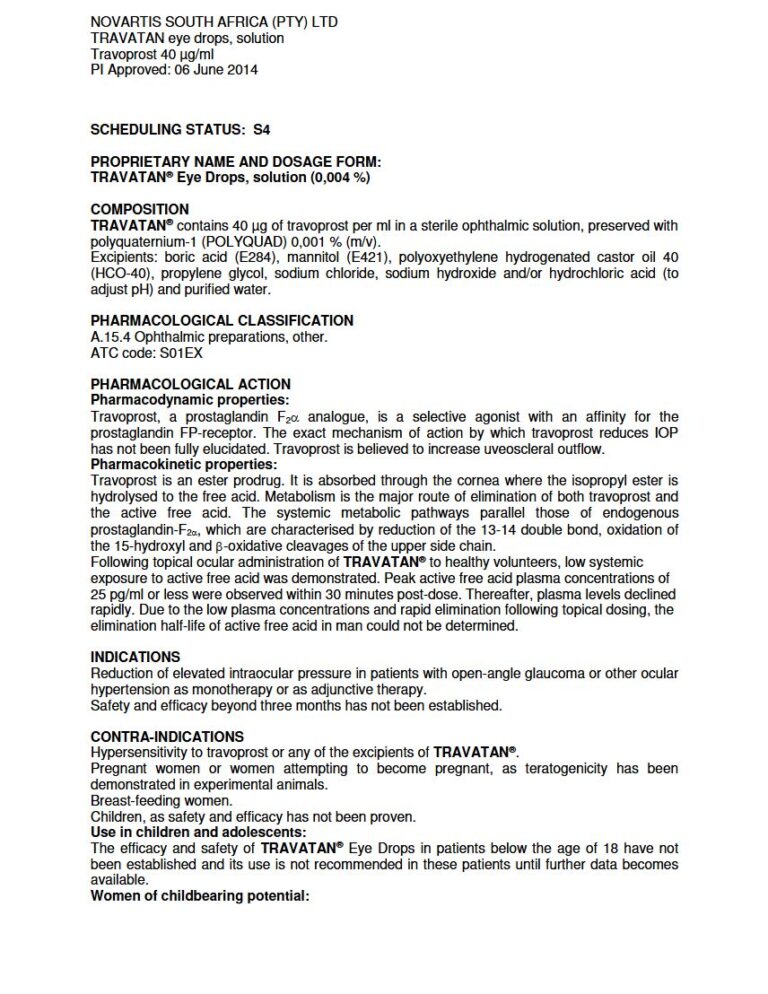
Reduction of elevated intraocular pressure in patients with open-angle glaucoma or other ocular hypertension as monotherapy or as adjunctive therapy. Safety and efficacy beyond three months has not been established.
4.2 Posology and method of administration
For ocular use: The recommended dose in adults and the elderly: one drop of TRAVATAN u00ae in the conjunctival sac of the affected eye(s) once daily in the evening. Nasolacrimal occlusion or gently closing the eyelid after administration is recommended. This may reduce the systemic absorption of medicinal products administered via the ocular route and result in a decrease in systemic adverse reactions. If more than one topical ophthalmic medicinal product is being used, the medicines must be administered at least 5 minutes apart.
If a dose is missed, treatment should be continued with the next dose as planned. The dose should not exceed one drop in the affected eye(s) daily. When substituting another ophthalmic antiglaucoma agent with TRAVATAN u00ae, discontinue the other agent and start the following day with TRAVATAN u00ae.
Hepatic and renal impairment: TRAVATAN u00ae has been studied in patients with mild to severe hepatic impairment and in patients with mild to severe renal impairment (creatinine clearance as low as 14 ml/min). No dosage adjustment is necessary in these patients.
Method of administration: To prevent contamination of the dropper tip and solution, care must be taken not to touch the eyelids, surrounding areas or other surfaces with the dropper tip of the bottle.
Instructions for use and handling: The patient should remove the protective over-wrap immediately prior to initial use. Since TRAVATAN u00ae is a biologically active material and since it may be absorbed through the skin, women who are pregnant or attempting to become pregnant should exercise appropriate precautions to avoid direct exposure to the contents of the bottle. In case of accidental contact with the contents of the bottle, thoroughly cleanse the exposed area immediately.
4.3 Contraindications
Hypersensitivity to travoprost or any of the excipients of TRAVATAN u00ae. Pregnant women or women attempting to become pregnant, as teratogenicity has been demonstrated in experimental animals. Breast-feeding women. Children, as safety and efficacy has not been proven.
Use in children and adolescents: The efficacy and safety of TRAVATAN u00ae Eye Drops in patients below the age of 18 have not been established and its use is not recommended in these patients until further data becomes available.
Women of childbearing potential: TRAVATAN u00ae must not be used in women who may become pregnant unless adequate contraceptive measures are in place.
Nursing women: Animal studies indicate that travoprost and its metabolites may pass into breast milk and TRAVATAN u00ae must therefore not be used in breast-feeding women.
4.4 Special warnings and precautions for use
TRAVATAN u00ae has been reported to cause changes to pigmented tissues. The most frequently reported changes have been increased pigmentation of the iris and periorbital tissue (eyelid) and increased pigmentation and growth of eyelashes. These changes may be permanent.
TRAVATAN u00ae may gradually change eye colour, increasing the amount of brown pigmentation in the iris by increasing the number of melanosomes (pigment granules) in melanocytes. The long-term effect on the melanocytes and the consequences of potential injury to the melanocytes and/or deposition of pigment granules to other areas of the eye are currently unknown. The change in iris colour occurs slowly and may not be noticeable for months to years. Patients should be informed of the possibility of iris colour change. Eyelid skin darkening has been reported in association with the use of TRAVATAN u00ae.
TRAVATAN u00ae may gradually change eyelashes in the treated eye; these changes include increased length, thickness, pigmentation and/or number of eyelashes. Patients who are expected to receive treatment in only one eye should be informed about the potential for increased brown pigmentation of the iris, periorbital and/or eyelid tissue and eyelashes of the treated eye, and thus heterochromia between the eyes. They should also be advised of the potential for a disparity between the eyes in length, thickness and/or number of eyelashes.
TRAVATAN u00ae contains propylene glycol which may cause skin irritation.
TRAVATAN u00ae contains polyoxyethylene hydrogenated castor oil 40 (HCO-40) which may cause skin irritation. In patients with known predisposing risk factors for iritis/uveitis, TRAVATAN u00ae can be used with caution.
4.5 Interactions with other medicines
Data on adjunctive administration of TRAVATAN u00ae with timolol and with brimonidine eye drops confirmed the additive effect of TRAVATAN u00ae with these glaucoma medications. No data are available on adjunctive use with other ocular hypotensive medications. Data on concomitant administration with brimonidine are limited. Interactions of TRAVATAN u00ae with other medications have not been specifically evaluated.
4.6 Fertility, pregnancy and lactation
Please refer to the CONTRA-INDICATIONS section.
4.7 Effects on ability to drive and use machines
Temporary blurred vision or other visual disturbances may affect the ability to drive or use machines. If blurred vision occurs at instillation, the patient must wait until the vision clears before driving or using machinery.
4.8 Undesirable effects
In 2 clinical trials involved in the development of TRAVATAN u00ae (polyquaternium-1-preserved), 201 patients were exposed for up to 3 months. The most frequently reported treatment-related undesirable effect with TRAVATAN u00ae (polyquaternium-1 preserved) was hyperaemia of the eye (18,9 %), which included ocular or conjunctival hyperaemia. One patient (0,5 %) discontinued study. The following undesirable effects were assessed to be treatment-related with TRAVATAN u00ae monotherapy and are classified according to the following convention: very common (u2265 1/10); common (u2265 1/100, < 1/10); uncommon (u2265 1/1 000, < 1/100); rare (u2265 1/10 000, < 1/1 000); very rare (u2264 1/10 000). Within each frequency grouping, undesirable effects are presented in decreasing order of seriousness.
Infections and infestations: Uncommon: herpes simplex, keratitis herpetic.
Immune system disorders: Uncommon: hypersensitivity, drug hypersensitivity, seasonal allergy.
Nervous system disorders: Uncommon: dysgeusia, dizziness, visual field defect, headache.
Eye disorders: Very common: ocular hyperaemia, conjunctival hyperaemia, iris hyperpigmentation. Common: punctate keratitis, anterior chamber cell, anterior chamber flare, eye pain, photophobia, eye discharge, ocular discomfort, eye irritation, abnormal sensation in eye, foreign body sensation in eyes, vision blurred, dry eye, eye pruritus, erythema of eyelid, eyelid oedema, growth of eyelashes, eyelash discolouration. Uncommon: visual acuity reduced, macular degeneration, corneal erosion, iridocyclitis, iritis, uveitis, keratitis, anterior chamber inflammation, eye inflammation, eye swelling, corneal staining, photopia, blepharitis, conjunctival oedema, corneal epithelium defect, halo vision, corneal pigmentation, conjunctivitis allergic, conjunctival disorder, conjunctivitis, conjunctival follicles, hypoaesthesia eye, meibomianitis, lacrimation increased, ectropion, keratoconjunctivitis sicca, sicca syndrome, pigment dispersion syndrome, anterior chamber pigmentation, mydriasis, cataract, eye allergy, eyelid pain, dark circles under eyes, eyelid disorder, eyelid margin crusting, scleral hyperaemia, asthenopia, eyelids pruritus.
Cardiac disorders: Uncommon: heart rate irregular, palpitations, heart rate decreased.
Vascular disorders: Uncommon: blood pressure decreased, blood pressure increased, hypotension, hypertension.
Respiratory, thoracic and mediastinal disorders: Uncommon: dyspnoea, asthma, respiratory disorder, oropharyngeal pain, cough, dysphonia, nasal congestion, throat irritation.
Gastrointestinal disorders: Uncommon: peptic ulcer reactivated, gastrointestinal disorder, constipation dry mouth.
Skin and subcutaneous tissue disorders: Common: skin hyperpigmentation (periocular). Uncommon: dermatitis allergic, periorbital oedema, dermatitis contact, erythema, rash, hair colour changes, hair texture abnormal, hypertrichosis, madarosis.
Musculoskeletal, connective tissue and bone disorders: Uncommon: musculoskeletal pain.
General disorders and administrative site conditions: Uncommon: asthenia, malaise.
4.9 Overdose
No cases of overdose have been reported. A topical overdose is not likely to occur or to be associated with toxicity. A topical overdose of TRAVATAN u00ae may be flushed from the eye(s) with lukewarm water. Treatment of suspected oral ingestion is symptomatic and supportive. If overdosage with TRAVATAN u00ae occurs, treatment should be symptomatic.
