
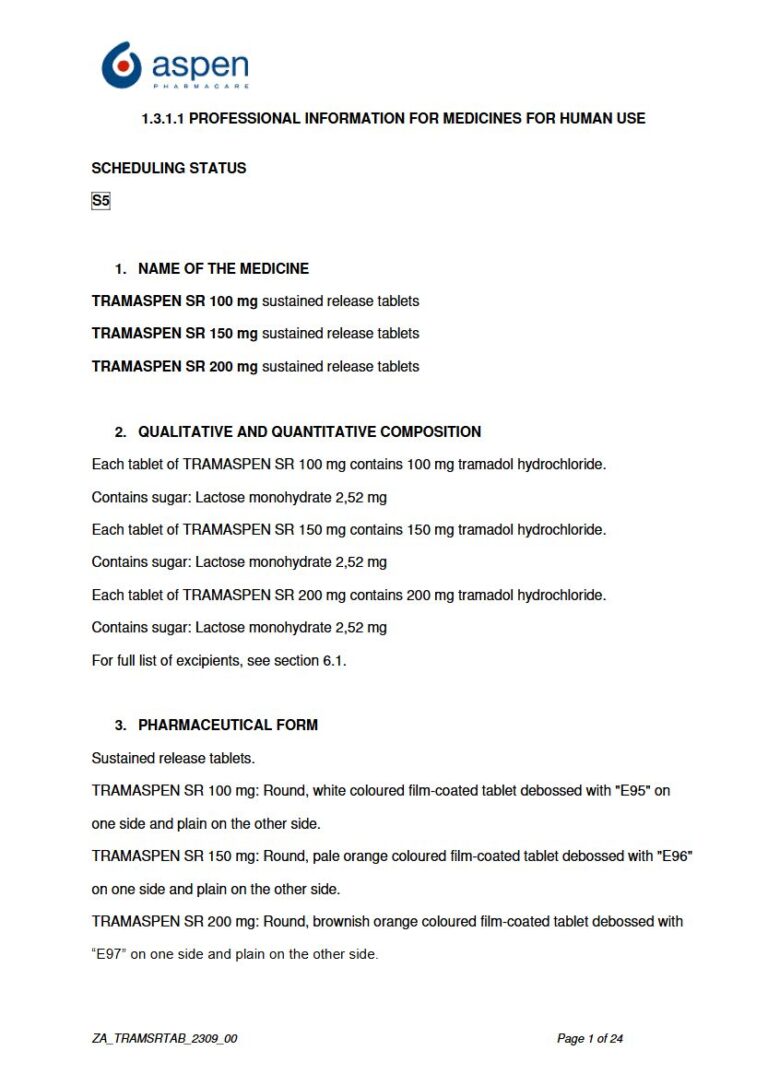
Tramaspen Sr 100 mg, 150 mg, 200 mg Sustained release tablets.
PDF Leaflet Revision Date: 27 September 2023
Clinical Summary
Quick overview from the medicine insert
Indication
Management of moderate to severe pain in adults and children aged 12 years and older.
Dosage (summary)
Initial dose: 100 mg twice daily; max: 400 mg/day.
Special Populations
- Elderly
- Renal impairment
- Hepatic impairment
Pregnancy & Breastfeeding
Not recommended in pregnancy or breastfeeding due to risks of adverse reactions.
Key Drug Interactions
- MAOIs
- CNS depressants
- Carbamazepine
Contraindications
- Hypersensitivity to tramadol or opioids
- Acute intoxication with CNS depressants
- Uncontrolled epilepsy
- Respiratory depression
Common side effects
- Nausea
- Dizziness
- Constipation
Counselling Points
- Avoid alcohol while taking this medication.
- Monitor for signs of respiratory depression.
- Do not abruptly discontinue if dependent.
Serious warnings
- Risk of respiratory depression
- Potential for abuse and dependence
- Seizure risk
Important Disclaimer
The Tramaspen Sr 100 mg, 150 mg, 200 mg Sustained release tablets. professional information leaflet below is the property of Pharmacare and is provided on Medinsert exactly as issued, with no.. alterations or editorial changes. We make every effort to keep content current by updating documents as soon as new versions become available. Medinsert serves as a trusted access point for healthcare professionals, but does not replace official sources or clinical judgement. For more details, please read our full disclaimer. read more>>
 Healthcare Professionals Only
This content is for registered healthcare professionals
Sign in or create a free account to read the full package insert.
Free for HPCSA-registered professionals. Powered by Medinsert.
Clinical Particulars
Section 4 of the official insert — extracted exactly as issued, no alterations
4.1. Therapeutic indications
TRAMASPEN SR is indicated in adults and children aged 12 years and older for the management of moderate to severe pain.
4.2. Posology and method of administration
Posology
The dosage should be adjusted to the intensity of pain and the sensitivity of the individual patient.
Adults and children over 12 years
The usual initial dose is 100 mg twice daily, to be taken whole, not divided or chewed, with sufficient liquid, with or without meals, preferably mornings and evenings. If pain relief is not adequate, the dose may be increased to 150 mg or 200 mg twice daily. A total daily dose of 400 mg TRAMASPEN SR should not be exceeded. Dosage intervals can be adjusted to individual requirements but should be at least 8 hours. The lowest analgesically effective dose should generally be selected.
Duration of treatment
Under no circumstances should TRAMASPEN SR be given for longer than absolutely necessary. If the nature and severity of the disease require long-term pain treatment with TRAMASPEN SR, careful checks should be carried out initially and at regular intervals to assess efficacy and adverse events, and to what extent further treatment is necessary.
Special populations
Elderly population
A downward adjustment of the dose and/or prolongation of the interval between doses are recommended in the elderly (over 75 years).
Renal insufficiency/dialysis/hepatic insufficiency
In patients with renal and/or hepatic insufficiency the elimination of tramadol hydrochloride is delayed. In these patients, prolongation of the dosage intervals should be carefully considered according to the patientu2019s requirements. In cases of severe renal and/or severe hepatic insufficiency, TRAMASPEN SR is not recommended.
Paediatric population
On account of the dosage strength, TRAMASPEN SR is not recommended for children below the age of 12 years.
Method of administration
For oral administration.
4.3. Contraindications
TRAMASPEN SR is contraindicated in:
u2022 Patients with hypersensitivity to tramadol hydrochloride or opioids or to any excipients in TRAMASPEN SR (see section 6.1).
u2022 In acute intoxication with alcohol, hypnotics, analgesics, opioids or psychotropic medicines.
u2022 Patients who are receiving monoamine oxidase inhibitors (MAOIs) or within two weeks of their withdrawal (see section 4.5).
u2022 Patients with epilepsy not adequately controlled by treatment.
u2022 Patients with respiratory depression, especially in the presence of cyanosis and excessive bronchial secretions (see section 4.4).
u2022 Patients with increased intracranial pressure or central nervous depression due to head injury or cerebral disease.
TRAMASPEN SR must not be used for narcotic withdrawal treatment. The safety of TRAMASPEN SR in pregnancy and lactation has not been established (see section 4.6).
4.4. Special warnings and precautions for use
WARNINGS
Limitations of use
Because of the risks associated with the use of opioids, TRAMASPEN SR should only be used in patients for whom other treatment options, including non-opioid analgesics, are ineffective, not tolerated or otherwise inadequate to provide appropriate management of pain.
Hazardous and harmful use
TRAMASPEN SR poses risks of hazardous and harmful use which can lead to overdose and death. Assess the patient's risk of hazardous and harmful use before prescribing and monitor the patient regularly during treatment (see section 4.9).
Life threatening respiratory depression
Serious, life-threatening or fatal respiratory depression may occur with the use of TRAMASPEN SR. Be aware of situations which increase the risk of respiratory depression, modify dosing in patients at risk and monitor patients closely, especially on initiation or following a dose increase (see sections 4.3 and 4.9).
Concomitant use of benzodiazepines and other central nervous system (CNS) depressants, including alcohol
Concomitant use of opioids with benzodiazepines, gabapentinoids, antihistamines, tricyclic antidepressants, antipsychotics, cannabis or other central nervous system (CNS) depressants, including alcohol, may result in profound sedation, respiratory depression, coma, and death. Limit dosages and durations to the minimum required; and monitor patients for signs and symptoms of respiratory depression and sedation. Caution patients not to drink alcohol while taking TRAMASPEN SR.
TRAMASPEN SR is not suitable for children under the age of 12 years.
TRAMASPEN SR should be used with care in patients with increased reactivity to opioids.
Seizures
Seizures have been reported in patients receiving TRAMASPEN SR at dosages within the recommended dosage range. The risk of seizures may be enhanced in patients exceeding the recommended dose, or in patients taking tricyclic anti-depressants or other tricyclic compounds e.g. promethazine, selective serotonin re-uptake inhibitors, MAOIs and neuroleptics. The risk of seizures may also be increased in patients with epilepsy; with a history of seizures or in patients with a recognized risk for seizures e.g. medicine and alcohol withdrawal, intracranial infections, head trauma, metabolic disorders and naloxone administration with TRAMASPEN SR overdose. Patients with epilepsy or those susceptible to seizures should only be treated if there are compelling circumstances. Patients known to suffer from cerebral convulsions should be carefully monitored during treatment with TRAMASPEN SR (see section 4.3).
Drug abuse and dependence
Tolerance, psychic and physical dependence of the morphine-type (u03bc opioid) may develop. Tramadol, as contained in TRAMASPEN SR, has been associated with craving drug-seeking behaviour and tolerance development and is a potential drug of abuse, misuse and addiction. Addiction can occur in patients appropriately prescribed TRAMASPEN SR at recommended doses. Cases of abuse and dependence on TRAMASPEN SR have been reported.
TRAMASPEN SR should not be used in opioid-dependent patients. TRAMASPEN SR can reinstate physical dependence in patients that have tendency to drug abuse, a history of drug dependence or who are chronically using opioids. For such patients, treatment with TRAMASPEN SR is not recommended.
Minor pain
TRAMASPEN SR should not be used in the treatment of minor pain (see section 4.1).
Hepatic and renal function impairment
TRAMASPEN SR should be used with caution in patients with impairment of hepatic and renal function and in patients with convulsive disorders or in shock (see section 4.2).
Impaired consciousness of unclear aetiology, shock
TRAMASPEN SR should only be used following a strict benefit-risk evaluation and appropriate precautionary measures in impaired consciousness of unclear aetiology or shock.
Risk from concomitant use of sedative medicines such as benzodiazepines or related active substances (see section 4.5)
Concomitant use of opioids, such as tramadol, and sedative medicines such as benzodiazepines, related active substances, or other CNS depressant, including alcohol, may result in sedation, respiratory depression, coma and death. Because of these risks, concomitant prescribing of TRAMASPEN SR with CNS depressant medicines, such as other opioid analgesics, benzodiazepines, gabapentinoids, cannabis, sedatives, hypnotics, tricyclic antidepressants, antipsychotics, antihistamines, centrally-acting antiemetics and other CNS depressants, should be reserved for patients for whom alternative treatment options are not possible. If a decision is made to prescribe TRAMASPEN SR concomitantly with sedative medicines, the lowest effective dose should be used, and the duration of treatment should be as short as possible.
The patients should be monitored closely for signs and symptoms of respiratory depression and sedation. In this respect, it is strongly recommended to inform patients and their caregivers to be aware of these symptoms. Patients and their caregivers should also be informed of the potential harms of consuming alcohol while taking TRAMASPEN SR (see section 4.5).
Use of opioids in chronic (long-term) non-cancer pain (CNCP)
Current evidence does not generally support opioid analgesics in improving pain and function for most patients with chronic non-cancer pain. The development of tolerance and physical dependence and risks of adverse effects, including hazardous and harmful use, increase with the length of time a patient takes an opioid. The use of opioids for long-term treatment of CNCP is not recommended. The use of an opioid to treat CNCP should only be considered after maximised non-pharmacological and non-opioid treatments have been tried and found ineffective, not tolerated or otherwise inadequate to provide sufficient management of pain. Opioids should only be prescribed as a component of comprehensive multidisciplinary and multimodal pain management. Opioid therapy for CNCP should be initiated as a trial in accordance with clinical guidelines and after a comprehensive biopsychosocial assessment has established a cause for the pain and the appropriateness of opioid therapy for the patient (see Hazardous and harmful use, above). The expected outcome of therapy (pain reduction rather than complete abolition of pain, improved function and quality of life) should be discussed with the patient before commencing opioid treatment, with agreement to discontinue treatment if these objectives are not met. Owing to the varied response to opioids between individuals, it is recommended that all patients be started at the lowest appropriate dose and titrated to achieve an adequate level of analgesia and functional improvement with minimum adverse reactions. Immediate-release products should not be used to treat chronic pain, but may be used for a short period in opioid-nau00efve patients to develop a level of tolerance before switching to a modified-release formulation. Careful and regular assessment and monitoring is required to establish the clinical need for ongoing treatment. Discontinue opioid therapy if there is no improvement of pain and/or function during the trial period or if there is any evidence of misuse or abuse. Treatment should only continue if the trial has demonstrated that the pain is opioid responsive and there has been functional improvement. The patient's condition should be reviewed regularly and the dose tapered off slowly if opioid treatment is no longer appropriate (see Ceasing Opioids below).
Tolerance, dependence and withdrawal
Neuroadaptation of the opioid receptors to repeated administration of opioids can produce tolerance and physical dependence. Tolerance is the need for increasing doses to maintain analgesia. Tolerance may occur to both the desired and undesired effects of the opioid. Physical dependence, which can occur after several days to weeks of continued opioid usage, results in withdrawal symptoms if the opioid is ceased abruptly or the dose is significantly reduced. Withdrawal symptoms can also occur following the administration of an opioid antagonist (e.g. naloxone) or partial agonist (e.g. buprenorphine). Withdrawal can result in some or all of the following symptoms: dysphoria, restlessness/agitation, lacrimation, rhinorrhoea, yawning, sweating, chills, myalgia, mydriasis, irritability, anxiety, increasing pain, backache, joint pain, weakness, abdominal cramps, insomnia, nausea, anorexia, vomiting, diarrhoea, increased blood pressure, increased respiratory rate and increased heart rate (see section 4.8). When discontinuing TRAMASPEN SR in a person who may be physically-dependent, the medicine should not be ceased abruptly but withdrawn by tapering the dose gradually (see Ceasing opioids below).
4.5. Interaction with other medicines and other forms of interaction
TRAMASPEN SR should not be combined with MAOIs (see section 4.3). In patients treated with MAOIs in the 14 days prior to the use of the opioid pethidine, life-threatening interactions on the central nervous system, respiratory and cardiovascular function have been observed. The same interactions with MAOIs cannot be ruled out during treatment with TRAMASPEN SR (see section 4.3). Concomitant administration of TRAMASPEN SR with other centrally depressant medicines including alcohol may potentiate the CNS effects (see section 4.4). Simultaneous or previous administration of carbamazepine (enzyme inducer) may reduce the analgesic effect and shorten the duration of action. The combination with mixed agonist/antagonists (e.g. buprenorphine, nalbuphine, pentazocine) and TRAMASPEN SR is not advisable, because the analgesic effect of a pure agonist like TRAMASPEN SR may be reduced in such circumstances. TRAMASPEN SR can induce convulsions and increase the potential for selective serotonin re-uptake inhibitors, tricyclic antidepressants, anti-psychotics and other seizure threshold-lowering medicines (such as bupropion, mirtazapine, tetrahydrocannabinol) to cause convulsions (see sections 4.3 and 4.4). There have been reports of serotonin syndrome in a temporal connection with the therapeutic use of tramadol, as contained in TRAMASPEN SR, in combination with other serotoninergic medicines such as selective serotonin re-uptake inhibitors (SSRIs) or with MAOIs and migraine medicines. Signs of serotonin syndrome may be for example confusion, agitation, fever, sweating, ataxia, hyperreflexia, myoclonus and diarrhoea. Withdrawal of the serotoninergic medicines usually brings about a rapid improvement. Treatment depends on the nature and severity of the symptoms. Caution should be exercised during concomitant treatment with TRAMASPEN SR and coumarin derivatives (e.g. warfarin) due to reports of increased INR with major bleeding and ecchymoses in some patients. Other active substances known to inhibit CYP3A4, such as ketoconazole and erythromycin, might inhibit the metabolism of tramadol (N-demethylation) probably also the metabolism of the active O-demethylated metabolite. The clinical importance of such an interaction has not been studied. In a limited number of studies, the pre- or postoperative application of the antiemetic 5-HT 3 antagonist ondansetron increased the requirement of TRAMASPEN SR in patients with postoperative pain. The concomitant use of opioids with sedative medicines such as benzodiazepines or related medicines increases the risk of sedation, respiratory depression, coma and death because of additive CNS depressant effect. The dose and duration of concomitant use should be limited (see section 4.4). Based on available pharmacokinetic results, no clinically relevant interactions are expected with the co-administration or previous administration of tramadol, as contained in TRAMASPEN SR, with cimetidine (enzyme inhibitor).
4.6. Fertility, pregnancy and lactation
The safety of TRAMASPEN SR in pregnancy and lactation has not been established (see section 4.3).
Pregnancy
TRAMASPEN SR should not be used in pregnant women. TRAMASPEN SR crosses the placenta. Animal studies with TRAMASPEN SR revealed at very high doses effects on organ development, ossification and neonatal mortality. The repeated administration of TRAMASPEN SR during pregnancy may lead to habituation in the unborn child. The child may experience withdrawal symptoms after birth.
Breastfeeding
TRAMASPEN SR is not recommended during breastfeeding. Tramadol and its active form are also present in breast milk. There is risk of serious adverse reactions in breastfed infants. These adverse reactions include excess sleepiness, difficulty breastfeeding or serious breathing problems that could result in death.
Fertility
Post marketing surveillance does not suggest an effect of tramadol, as in TRAMASPEN SR, on fertility. Animal studies did not show an effect of tramadol on fertility. Patients should be advised to inform their healthcare providers if they experience symptoms of low libido, impotence, erectile dysfunction, lack of menstruation, or infertility. Healthcare providers should conduct laboratory evaluation in patients presenting with such signs or symptoms.
4.7. Effects on ability to drive and use machines
TRAMASPEN SR has major influence. TRAMASPEN SR may cause drowsiness and blurred vision altering one's capacity to react, so that the ability to drive and use machines or work without a steady foothold is reduced. This applies especially at the start of treatment, when changing over to another treatment, in combination with other centrally active medicines, and particularly if combined with alcohol. TRAMASPEN SR can impair cognitive function and can affect a patient's ability to drive safely.
4.8. Undesirable effects
a) Summary of the safety profile
The common side-effects during treatment with TRAMASPEN SR are nausea and dizziness.
b) Tabulated list of adverse reactions
System organ class
Frequent Less frequent Frequency unknown (cannot be estimated from the available data)
Immune system disorders Allergic reactions (e.g. dyspnoea, bronchospasm, wheezing, angioneurotic oedema), anaphylaxis
Metabolism and nutrition disorders Changes in appetite Hypoglycaemia
Psychiatric disorders Hallucinations, confusion, sleep disorders, anxiety and nightmares, psychic adverse reactions. Their intensity and nature may vary (according to the patientu2019s personality and length of therapy). These may appear as a change in mood (usually elation, occasionally dysphoria), changes in activity (usually suppression, occasionally increase) and changes in cognitive and sensory perception (decision behaviour, perception disorders), dependence, delirium
Nervous system disorders Dizziness, headaches, somnolence Paraesthesia, tremor, epileptiform convulsions, involuntary muscle contractions, abnormal coordination, syncope, speech disorders
Eye disorders Blurred vision, miosis, mydriasis
Cardiac disorders Cardiovascular regulation (palpitation, tachycardia), bradycardia, increase in blood pressure
Vascular disorders Cardiovascular regulation (postural hypotension or cardiovascular collapse)
Respiratory, thoracic and mediastinal disorders Respiratory depression dyspnoea, worsening of asthma Respiratory depression in children
Gastrointestinal disorders Nausea, vomiting, constipation, dry mouth Retching, gastrointestinal irritation (e.g. feeling of pressure in stomach, bloating), diarrhoea, hiccups
Hepato- biliary disorders Increase in liver enzyme values
Skin and subcutaneous tissue disorders Sweating Dermal reactions (e.g. itching, rash, urticaria)
Musculoskeletal and connective tissue disorders Motor weakness
Renal and urinary disorders Micturition disorders (difficulties in passing urine, dysuria and urinary retention)
General disorders and administrative site conditions Fatigue
c) Description of selected adverse reactions
Cardiovascular regulation (palpitation, tachycardia, postural hypotension or cardiovascular collapse) may appear in patients who are physically stressed. Epileptic convulsions occurred mainly after taking high doses of tramadol or after concomitant treatment with medicines which can lower the seizure threshold (see sections 4.3 and 4.4). Dependence may occur (see section 4.4). After discontinuation of TRAMASPEN SR, signs of withdrawal may appear. Symptoms of withdrawal reactions may occur as follows: agitation, anxiety, nervousness, insomnia, hyperkinesia, tremor and gastrointestinal symptoms. Other symptoms that have very rarely been seen with tramadol discontinuation include: panic attacks; severe anxiety, hallucinations, paraesthesia, tinnitus and unusual CNS symptoms (i.e. confusion, delusions, depersonalisation, derealisation, paranoia).
4.9. Overdose
Symptoms
In principle, on intoxication with TRAMASPEN SR, symptoms similar to those of other centrally acting analgesics (opioids) are to be expected. These include in particular constriction of the pupil of the eye, vomiting, cardiovascular collapse, consciousness disorders up to coma, convulsions and respiratory depression up to respiratory arrest (see section 4.4).
Treatment
The general emergency measures apply. Keep the airway open, prevent aspiration and maintain respiration and circulation. Respiratory depression can be antagonised with a pure opiate antagonist (naloxone). In animal experiments naloxone had no effect on convulsions. In such cases diazepam should be given intravenously. In cases of overdosage with oral formulation, gastrointestinal decontamination with activated charcoal is only recommended within 2 hours after TRAMASPEN SR intake. Gastrointestinal decontamination at a later time point may be useful in case of overdosage with exceptionally large quantities or prolonged-release formulations.
Tramadol is minimally eliminated from the serum by haemodialysis or haemofiltration. Treatment of acute intoxication with TRAMASPEN SR with haemodialysis or haemofiltration alone is therefore not suitable for detoxification.
