
Ultomiris 1100 Mg/300 mg Solution
PDF Leaflet Revision Date: Not applicable
Clinical Summary
Quick overview from the medicine insert
Indication
Treatment of PNH, aHUS, gMG, and NMOSD.
Dosage (summary)
Weight-based dosing every 4 or 8 weeks after loading dose.
Special Populations
- Elderly
- Renal impairment
- Hepatic impairment
Pregnancy & Breastfeeding
Use contraception during treatment; unknown if excreted in milk.
Key Drug Interactions
- Neonatal Fc receptor blockers
Contraindications
- Hypersensitivity to ravulizumab
- Unresolved Neisseria meningitidis infection
Common side effects
- Headache
- Nasopharyngitis
- Upper respiratory tract infection
- Diarrhoea
- Fatigue
Counselling Points
- Vaccination against meningococcal infection required
- Monitor for signs of infection
- Inform about potential infusion reactions
Serious warnings
- Increased susceptibility to meningococcal infections
- Serious infections with Neisseria species
Important Disclaimer
The Ultomiris 1100 Mg/300 mg Solution professional information leaflet below is the property of Astrazeneca Pharmaceuticals and is provided on Medinsert exactly as issued, with no.. alterations or editorial changes. We make every effort to keep content current by updating documents as soon as new versions become available. Medinsert serves as a trusted access point for healthcare professionals, but does not replace official sources or clinical judgement. For more details, please read our full disclaimer. read more>>
 Healthcare Professionals Only
This content is for registered healthcare professionals
Sign in or create a free account to read the full package insert.
Free for HPCSA-registered professionals. Powered by Medinsert.
Clinical Particulars
Section 4 of the official insert — extracted exactly as issued, no alterations
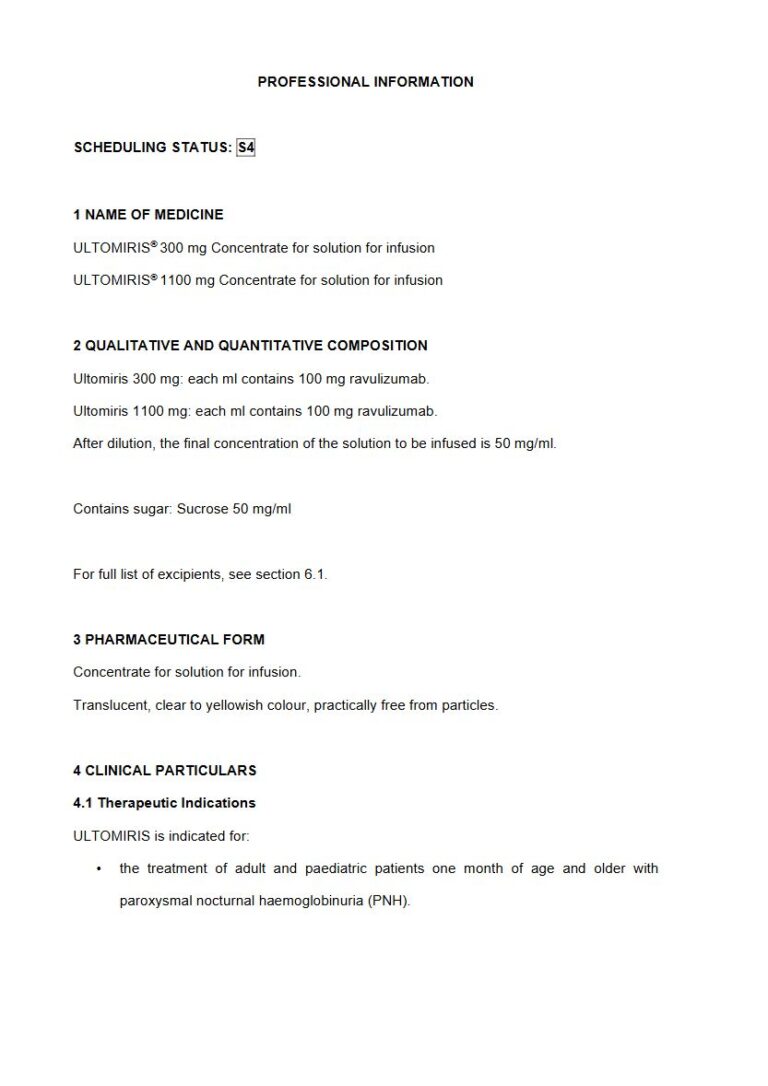
4.1 Therapeutic Indications
ULTOMIRIS is indicated for:
- the treatment of adult and paediatric patients one month of age and older with paroxysmal nocturnal haemoglobinuria (PNH).
- the treatment of adults and paediatric patients one month of age and older with atypical haemolytic uremic syndrome (aHUS) to inhibit complement-mediated thrombotic microangiopathy (TMA).
- the treatment of adult patients with generalized myasthenia gravis (gMG) who are anti-acetylcholine receptor (AChR) antibody-positive.
- the treatment of adult patients with anti-aquaporin 4 (AQP4) antibody-positive neuromyelitis optica spectrum disorder (NMOSD).
4.2 Posology and method of administration
Posology
Adult and paediatric patients with PNH or aHUS with body weight greater than or equal to 5 kg
The recommended ULTOMIRIS maintenance dosing in adult and paediatric patients with PNH or aHUS with a body weight greater than or equal to 5 kg is based on the patientu2019s body weight, as shown in Table 1, with maintenance doses administered every 4 or 8 weeks, starting 2 weeks after loading dose. Refer to Table 2 or treatment initiation instructions in patients who are complement inhibitor treatment-nau00efve or switching treatment from eculizumab. Dosing schedule is allowed to occasionally vary by u00b1 7 days of the scheduled infusion day (except for the first maintenance dose of ULTOMIRIS), but the subsequent dose should be administered according to the original schedule.
Adult patients with gMG or NMOSD with body weight greater than or equal to 40 kg
The recommended ULTOMIRIS maintenance dosing in adult patients with gMG or NMOSD with a body weight greater than or equal to 40 kg is based on the patientu2019s body weight, as shown in Table 1, with maintenance doses administered every 8 weeks, starting 2 weeks after loading dose. Refer to Table 2 for treatment initiation instructions in patients who are complement inhibitor treatment-nau00efve or switching treatment from eculizumab. Dosing schedule is allowed to occasionally vary by u00b1 7 days of the scheduled infusion day (except for the first maintenance dose of ULTOMIRIS) but the subsequent dose should be administered according to the original schedule.
Table 1: ULTOMIRIS weight-based dosing regimen
| Body Weight Range (kg) | Loading Dose (mg)* | Maintenance Dose (mg) | Dosing Interval |
|---|---|---|---|
| u2265 5 to < 10 ** | 600 | 300 | Every 4 weeks |
| u2265 10 to < 20 ** | 600 | 600 | Every 4 weeks |
| u2265 20 to < 30 ** | 900 | 2100 | Every 8 weeks |
| u2265 30 to < 40 ** | 1200 | 2700 | Every 8 weeks |
| u2265 40 to < 60 | 2400 | 3000 | Every 8 weeks |
| u2265 60 to < 100 | 2700 | 3300 | Every 8 weeks |
| u2265 100 | 3000 | 3600 | Every 8 weeks |
*See Table 2 for ULTOMIRIS loading dose instructions prior to maintenance dosing.
**For PNH and aHUS indications only.
Table 2: ULTOMIRIS treatment initiation instructions
| Population | Weight-based ULTOMIRIS Loading Dose | Time of First ULTOMIRIS Weight-based Maintenance Dose |
|---|---|---|
| Not currently on ULTOMIRIS or eculizumab treatment | At treatment start | 2 weeks after ULTOMIRIS loading dose |
| Currently treated with eculizumab | At time of next scheduled eculizumab dose | 2 weeks after ULTOMIRIS loading dose |
Supplemental dosing following treatment with plasma exchange (PE), plasmapheresis (PP), or intravenous immunoglobulin (IVIg)
Plasma exchange (PE), plasmapheresis (PP), and intravenous immunoglobulin (IVIg) have been shown to reduce ULTOMIRIS serum levels. A supplemental dose of ULTOMIRIS is required in the setting of PE, PP, or IVIg (Table 3).
Table 3: Supplemental dose of ULTOMIRIS dose after PE, PP, or IVIg
| Body Weight Group (kg) | Most Recent ULTOMIRIS Dose (mg) | Supplemental Dose (mg) following Each PP or PE Session | Supplemental Dose (mg) following Complete IVIg Cycle |
|---|---|---|---|
| u2265 40 to < 60 | 2400 | 1200 | 600 |
| 3000 | 1500 | ||
| u2265 60 to < 100 | 2700 | 1500 | 600 |
| 3300 | 1800 | ||
| u2265 100 | 3000 | 1500 | 600 |
| 3600 | 1800 |
Timing of ULTOMIRIS Supplemental Dose
Within 4 hours following each PE or PP intervention
Within 4 hours following completion of an IVIg cycle
Method of Administration
This medicinal product must be administered through a 0.2 u03bcm filter and should not be administered as an intravenous push or bolus injection. For instructions on dilution of the medicinal product before administration, see section 6.6 ULTOMIRIS must be diluted to a final concentration of 50 mg/ml. Following dilution, ULTOMIRIS is to be administered by intravenous infusion based on body weight as shown in Table 4 and Table 5.
Table 4: Loading and maintenance dose administration rate for ULTOMIRIS
| Body Weight Range (kg) a | Loading Dose (mg) | Minimum Infusion Duration Minutes (hours) | Maintenance Dose (mg) | Minimum Infusion Duration Minutes (hours) |
|---|---|---|---|---|
| u2265 5 to < 10 * | 600 | 85 (1.4) | 300 | 45 (0.8) |
| u2265 10 to < 20 * | 600 | 45 (0.8) | 600 | 45 (0.8) |
| u2265 20 to < 30 * | 900 | 35 (0.6) | 2100 | 75 (1.3) |
| u2265 30 to < 40 * | 1200 | 31 (0.5) | 2700 | 65 (1.1) |
| u2265 40 to < 60 | 2400 | 45 (0.8) | 3000 | 55 (0.9) |
| u2265 60 to < 100 | 2700 | 35 (0.6) | 3300 | 40 (0.7) |
| u2265 100 | 3000 | 25 (0.4) | 3600 | 30 (0.5) |
* For PNH and aHUS indications only.
a Body weight at time of treatment.
Table 5: Supplemental dose administration rate for ULTOMIRIS
| Body Weight Range (kg) a | Supplemental Dose (mg) | Minimum Infusion Duration Minutes (h) |
|---|---|---|
| u2265 40 to < 60 | 600 | 15 (0.25) |
| 1200 | 25 (0.42) | |
| 1500 | 30 (0.5) | |
| u2265 60 to < 100 | 600 | 12 (0.20) |
| 1500 | 22 (0.36) | |
| 1800 | 25 (0.42) | |
| u2265 100 | 600 | 10 (0.17) |
| 1500 | 15 (0.25) | |
| 1800 | 17 (0.28) |
a Body weight at time of treatment.
Special populations
Use in the elderly
ULTOMIRIS may be administered to patients aged 65 years and over. There is no evidence indicating any special precautions are required for treating a geriatric population.
Patients with aplastic anaemia
ULTOMIRIS may be administered to patients with PNH treated with concomitant medications for aplastic anaemia (including immunosuppressive therapies). There is no evidence indicating any special precautions are required in patients with aplastic anaemia.
Renal and hepatic impairment
Studies have not been conducted to examine the effects of hepatic impairment; however, pharmacokinetic data suggest that no dose adjustment is required in patients with hepatic impairment. No dose adjustment is required for patients with renal impairment, see section 5.2.
The clinical trials of ULTOMIRIS in patients with aHUS included patients with other complement-mediated TMA conditions (patients with renal impairment, some of whom were receiving dialysis). No dose adjustment is required in this population, see section 5.2.
Paediatric population
Use of ULTOMIRIS in paediatric patients for treatment of PNH is supported by evidence from a paediatric clinical study (13 patients aged 9 to 17 years). The safety and efficacy of ULTOMIRIS for the treatment of paediatric and adult patients with PNH appear similar. See section 5.1.
Use of ULTOMIRIS in paediatric patients for treatment of aHUS is supported by evidence from a paediatric clinical study (14 patients aged 10 months to 17 years). The safety and efficacy of ULTOMIRIS for the treatment of aHUS is consistent in paediatric and adult patients. ULTOMIRIS has not been studied in PNH patients below 9 years of age. The posology to be used in paediatric patients with PNH is identical to the weight-based dosing recommendations provided for paediatric patients with aHUS, with maintenance dosing starting 2 weeks after loading dose administration. Based on the PK/PD data available in aHUS and PNH patients treated with ULTOMIRIS, this dosing regimen is expected to result in an efficacy and safety profile similar to that in adults, for all paediatric patients starting at 5 kg. ULTOMIRIS has not been evaluated in paediatric patients with gMG or NMOSD.
4.3 Contraindications
Hypersensitivity to ravulizumab or to any of the excipients of ULTOMIRIS. ULTOMIRIS is contraindicated in patients:
- with unresolved Neisseria meningitidis infection.
- who are not currently vaccinated against Neisseria meningitidis unless they receive prophylactic treatment with appropriate antibiotics until 2 weeks after vaccination.
4.4 Special warnings and precautions for use
Serious meningococcal infection
Due to its mechanism of action, the use of ULTOMIRIS increases the patient's susceptibility to meningococcal infection/sepsis (Neisseria meningitidis). Meningococcal disease due to any serogroup may occur. To reduce this risk of infection, all patients must be vaccinated against meningococcal infection at least 2 weeks prior to initiating ULTOMIRIS unless the risk of delaying ULTOMIRIS outweighs the risks of developing a meningococcal infection. Patients who initiate ULTOMIRIS treatment less than 2 weeks after receiving a meningococcal vaccine must receive treatment with appropriate prophylactic antibiotics until 2 weeks after vaccination. Vaccines against serogroups A, C, Y, W135 and B, where available, are recommended in preventing the commonly pathogenic meningococcal serogroups. Patients must be vaccinated or revaccinated according to current national guidelines for vaccination use. Vaccination may not be sufficient to prevent meningococcal infection. Consideration should be given to official guidance on the appropriate use of antibacterial agents. Cases of serious or fatal meningococcal infections/sepsis have been reported in patients treated with ULTOMIRIS and other terminal complement inhibitors. All patients should be monitored for early signs of meningococcal infection and sepsis, evaluated immediately if infection is suspected, and treated with appropriate antibiotics. Patients should be informed of these signs and symptoms and steps should be taken to seek medical care immediately. Health care providers should provide patients with a patient information leaflet.
Immunisation
Vaccination may further activate complement. As a result, patients with complement-mediated diseases may experience increased signs and symptoms of their underlying disease. Therefore, patients should be closely monitored for disease symptoms after recommended vaccination.
Other systemic infections
ULTOMIRIS therapy should be administered with caution to patients with active systemic infections. ULTOMIRIS blocks terminal complement activation; therefore, patients may have increased susceptibility to infections, especially infections caused by Neisseria species. Serious infections with Neisseria species (other than Neisseria meningitidis), including disseminated gonococcal infections, have been reported in patients treated with ULTOMIRIS. Patients should be provided with information from the patient information leaflet to increase their awareness of potential serious infections and their signs and symptoms. Health care providers should advise patients about gonorrhoea prevention. Patients below the age of 18 years old must be vaccinated against Haemophilus influenzae and pneumococcal infections and need to adhere strictly to the national vaccination recommendations for their age group.
Infusion related reactions
Intravenous administration of ULTOMIRIS may result in systemic infusion-related reactions that cause allergic or hypersensitivity reactions (including anaphylaxis). In case of a systemic infusion-related reaction, if signs of cardiovascular instability or respiratory compromise occur, administration of ULTOMIRIS should be interrupted and appropriate supportive measures should be instituted.
Immunogenicity
Treatment with any therapeutic protein may induce an immune response. In ULTOMIRIS studies in PNH (N = 488), aHUS (N = 89), gMG (N = 86), and NMOSD (N = 58), treatment-emergent anti-drug antibodies were reported in 2 patients (0.28%), one with PNH and one with aHUS. These anti-drug antibodies were transient in nature with low titre and did not correlate with clinical response or adverse events.
Treatment discontinuation
Treatment discontinuation in PNH Paroxysmal Nocturnal Haemoglobinuria (PNH) is a chronic disease, and treatment with ULTOMIRIS is recommended to continue for the patientu2019s lifetime. If patients with PNH discontinue treatment with ULTOMIRIS, they should be closely monitored for signs and symptoms of haemolysis, identified by elevated lactate dehydrogenase (LDH) along with sudden decrease in PNH clone size or haemoglobin, or re-appearance of symptoms such as fatigue, haemoglobinuria, abdominal pain, shortness of breath (dyspnoea), major adverse vascular event (including thrombosis), dysphagia, or erectile dysfunction. Any patient who discontinues ULTOMIRIS should be monitored for at least 16 weeks to detect haemolysis and other reactions. If signs and symptoms of haemolysis occur after discontinuation, including elevated LDH, consider restarting treatment with ULTOMIRIS.
Treatment discontinuation in aHUS ULTOMIRIS treatment to resolve aHUS should be a minimum duration of 6 months, beyond which length of treatment needs to be considered for each patient individually. Patients who are at higher risk for TMA recurrence, as determined by the treating healthcare provider (or clinically indicated), may require chronic therapy. There are no specific data on ravulizumab discontinuation. In a long-term prospective observational study, discontinuation of complement C5 inhibitor treatment (eculizumab) resulted in a 13.5-fold higher rate of TMA recurrence and showed a trend toward reduced renal function compared to patients who continued treatment. If patients must discontinue treatment with ravulizumab, they should be monitored closely for signs and symptoms of TMA on an ongoing basis. However, monitoring may be insufficient to predict or prevent severe TMA complications. TMA complications post-discontinuation can be identified if any of the following is observed: (i) At least two of the following laboratory results observed concurrently: - a decrease in platelet count of 25% or more as compared to either baseline or to peak platelet count during ravulizumab treatment; - an increase in serum creatinine of 25% or more as compared to baseline or to nadir during ravulizumab treatment; or, an increase in serum LDH of 25% or more as compared to baseline or to nadir during ravulizumab treatment; (results should be confirmed by a second measurement 28 days apart). Or (ii) any one of the following symptoms of TMA: a change in mental status or seizures or other extra renal TMA manifestations including cardiovascular abnormalities, pericarditis, gastrointestinal symptoms/diarrhoea; or thrombosis. If TMA complications occur after ravulizumab discontinuation, consider reinitiating ravulizumab treatment beginning with the loading dose and maintenance dose described in section 4.2.
Treatment discontinuation in gMG Considering that gMG is a chronic disease, patients benefiting from ULTOMIRIS treatment who discontinue treatment should be monitored for symptoms of the underlying disease. If symptoms of gMG occur after discontinuation, consider restarting treatment with ULTOMIRIS.
Treatment Discontinuation in NMOSD Considering that NMOSD is a chronic disease, patients benefiting from ULTOMIRIS treatment who discontinue treatment should be monitored for symptoms of NMOSD relapse. If symptoms of NMOSD relapse occur after discontinuation, consider restarting treatment with ULTOMIRIS.
4.5 Interaction with other medicines and other forms of interaction
No drug-drug interaction studies have been performed. Concomitant use of ULTOMIRIS with neonatal Fc receptor (FcRn) blockers may lower systemic exposures and reduce effectiveness of ULTOMIRIS. Closely monitor for reduced effectiveness of ULTOMIRIS. See section 4.2 for guidance in case of concomitant PE, PP, or IVIg treatment.
4.6 Fertility, pregnancy and lactation
Woman of childbearing potential/Contraception in males and females
Women of childbearing potential should use effective contraception methods during treatment and up to 8 months after treatment.
Pregnancy
No clinical data on exposed pregnancies are available. Nonclinical reproductive toxicology studies were not conducted with ULTOMIRIS. Reproductive toxicology studies were conducted in mice using the murine surrogate molecule BB5.1, which assessed effect of C5 blockade on the reproductive system. No specific test-article related reproductive toxicities were identified in these studies. Human IgG are known to cross the human placental barrier, and thus ULTOMIRIS may potentially cause terminal complement inhibition in foetal circulation.
Breastfeeding
It is unknown whether ULTOMIRIS is excreted into human milk. Since many medicinal products and immunoglobulins are secreted into human milk, and because of the potential for serious adverse reactions in nursing infants, breast-feeding should be discontinued during treatment and up to 8 months after treatment. Nonclinical reproductive toxicology studies conducted in mice with the murine surrogate molecule BB5.1 identified no adverse effect to pups resulting from consuming milk from treated dams.
Fertility
No specific non-clinical study on fertility has been conducted with ULTOMIRIS. Nonclinical reproductive toxicology studies conducted in mice with a murine surrogate molecule (BB5.1) identified no adverse effect on fertility of the treated females or males.
4.7 Effects on ability to drive and use machines
ULTOMIRIS has no or negligible influence on the ability to drive and use machines. ULTOMIRIS may cause dizziness.
4.8 Undesirable effects
Summary of safety profile
The most common adverse drug reactions (u2265 10%) across all clinical trials are headache, nasopharyngitis, upper respiratory tract infection, diarrhoea, pyrexia, nausea, arthralgia, fatigue, back pain, abdominal pain which occurred with administration of ULTOMIRIS. The most serious adverse reactions in patients in clinical trials are meningococcal infections.
Tabulated list of adverse reactions
Table 6 lists the adverse reactions observed from clinical trials and post-marketing experience. Adverse reactions with ULTOMIRIS are listed by System Organ Class and preferred term using MedDRA frequency convention very common (u2265 1/10), common (u2265 1/100 to < 1/10), uncommon (u2265 1/1,000 to < 1/100), rare (u2265 1/10,000 to < 1/1,000), very rare (< 1/10,000) and not known (cannot be estimated from the available data). Within each frequency grouping, adverse reactions are presented in order of decreasing seriousness.
Table 6: Adverse reactions from clinical trials & post-marketing experience
| MedDRA System Organ Class | Very Common | Common | Uncommon |
|---|---|---|---|
| Infections and infestations | Upper respiratory tract infection, Nasopharyngitis | Meningococcal infection b, Gonococcal infection c | |
| Immune system disorders | Hypersensitivity d | Anaphylactic reaction a | |
| Nervous system disorders | Headache | Dizziness | |
| Gastrointestinal disorders | Diarrhoea, Nausea, Abdominal pain | Vomiting, Dyspepsia | |
| Skin and subcutaneous tissue disorders | Urticaria, Rash | Pruritus | |
| Musculoskeletal and connective tissue disorders | Back pain, Arthralgia | Myalgia, Muscle spasms | |
| General disorders and administration site conditions | Pyrexia, Fatigue | Influenza like illness, Chills, Asthenia, Injury, poisoning and procedural complications | Infusion-related reaction a |
Estimated post-marketing experience based on 2020 - Dec - 31 cut-off from Periodic Safety Update Report (PSUR).
b Meningococcal infection is a group term that includes Preferred Terms meningococcal infection, meningococcal sepsis, and encephalitis meningococcal.
c Gonococcal infection includes disseminated gonococcal infection; data based on 2021 - Dec - 31 cut-off date from Development Safety Update Report (DSUR).
d Hypersensitivity is a group term for Preferred Term drug hypersensitivity with related causality and Preferred Term hypersensitivity.
Description of selected adverse reactions
Meningococcal infections/sepsis In clinical studies, the most serious adverse reactions from ULTOMIRIS were meningococcal infections, which were uncommon in frequency (0.5%). Meningococcal infections in patients treated with ULTOMIRIS have presented as meningococcal sepsis. Patients should be informed of the signs and symptoms of meningococcal septicaemia and advised to seek medical care immediately.
Infusion-related reactions In clinical trials, infusion-related reactions were common (1.8%). They were mild to moderate in severity and transient (e.g., lower back pain, abdominal pain, muscle spasms, drop in blood pressure, elevation in blood pressure, rigors, limb discomfort, drug hypersensitivity [allergic reaction], dysgeusia [bad taste], and drowsiness). These reactions did not require discontinuation of ULTOMIRIS.
Paediatric population Paroxysmal nocturnal haemoglobinuria (PNH) In children and adolescent PNH patients (aged 9 to 17 years old) included in the paediatric PNH Study (ALXN1210-PNH-304), the safety profile of ULTOMIRIS was consistent with that observed in adult PNH patients. The most common adverse reaction reported in paediatric PNH patient was abdominal pain and nasopharyngitis.
Atypical haemolytic uremic syndrome (aHUS) In paediatric aHUS patients (aged 10 months to 17 years old) included in Study ALXN1210-aHUS-312, the safety profile of ULTOMIRIS was consistent with that observed in adult patients with evidence of aHUS. The safety profile was also consistent for paediatric patients in the different age-group subsets. The safety data for patients below 2 years of age are limited to four patients. The most common adverse reaction reported in paediatric patients was pyrexia.
Generalized myasthenia gravis (gMG) and neuromyelitis optica spectrum disorder (NMOSD) ULTOMIRIS has not been evaluated in paediatric patients with gMG or NMOSD.
Other special populations Geriatric population No overall differences in safety were reported between elderly (u2265 65 years) and younger patients (< 65 years) with ULTOMIRIS.
Reporting suspected adverse reactions Reporting suspected adverse reactions after authorisation of the medicine is important. It allows continued monitoring of the benefit/risk balance of the medicine. Health care providers are asked to report any suspected adverse reactions to SAHPRA via the u201c6.04 Adverse Drug Reactions Reporting Formu201d, found online under SAHPRAu2019s publications: https://www.sahpra.org.za/Publications/Index/8
4.9 Overdose
No case of overdose has been reported to date. In overdose, side effects can be precipitated and/or be of increased severity (see section 4.8).
